
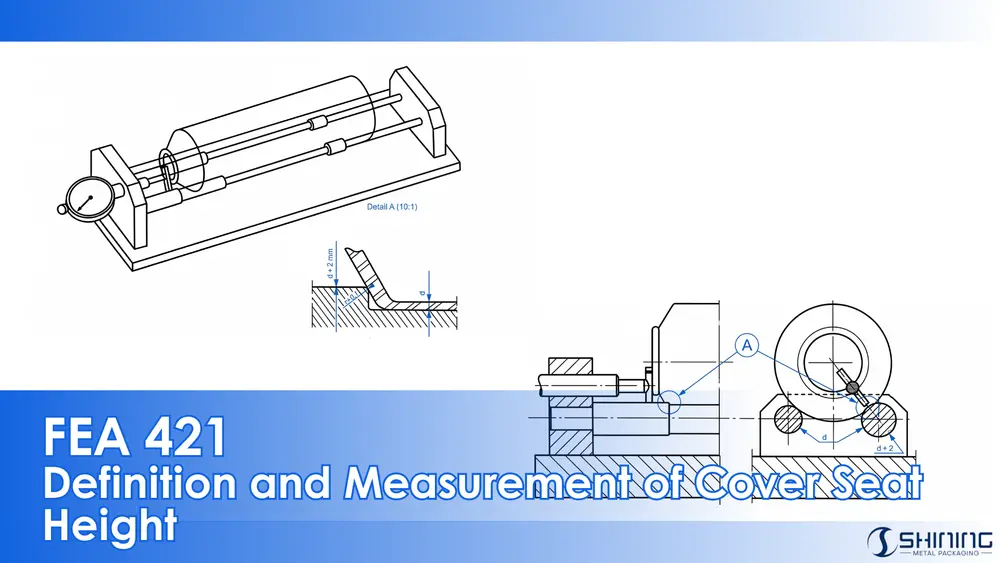
Standard Overview
FEA 421 is an industry standard issued by the European Aerosol Federation (FEA), defining the method for measuring cover seat height on aerosol containers with a 25.4 mm opening.
Cover seat height is a fundamental geometric reference used for the design and fit of plastic caps and overcaps. Unlike sealing dimensions, it primarily affects external component fit, visual alignment, and retention behavior.
Scope of Application
The method defined in FEA 421 applies to:
- Two-piece aerosol containers
- Three-piece aerosol containers
- One-piece (monobloc) containers
The standard is intended for inspection and dimensional control. It does not define target values or tolerances, which are agreed separately between container, cap, and brand owners.
Definition of Cover Seat Height
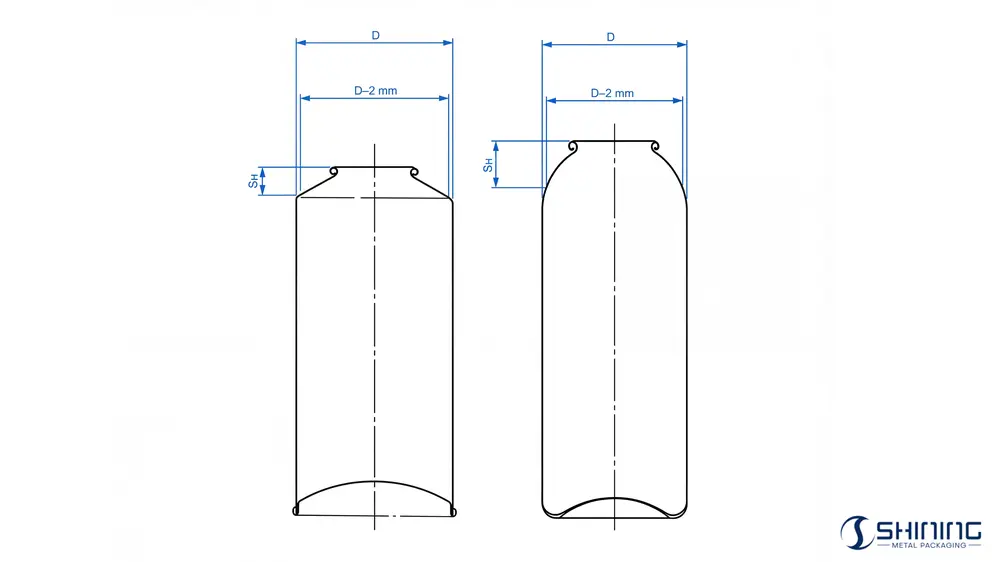
Cover seat height (HS) is defined with respect to a diametrical vertical plane passing through the container axis. The height is measured from this reference plane to the top of the rolled-over neck section.
The mean value obtained from measurements around the container is used as a key input dimension for cap design.
Measurement Methods
Optical Measurement
Optical measuring systems are commercially available and can be used to determine cover seat height, provided they respect the geometric definition given in Figures.
These systems are typically used in laboratories or during development work, rather than for routine shop-floor inspection.
Mechanical Measurement Instrument
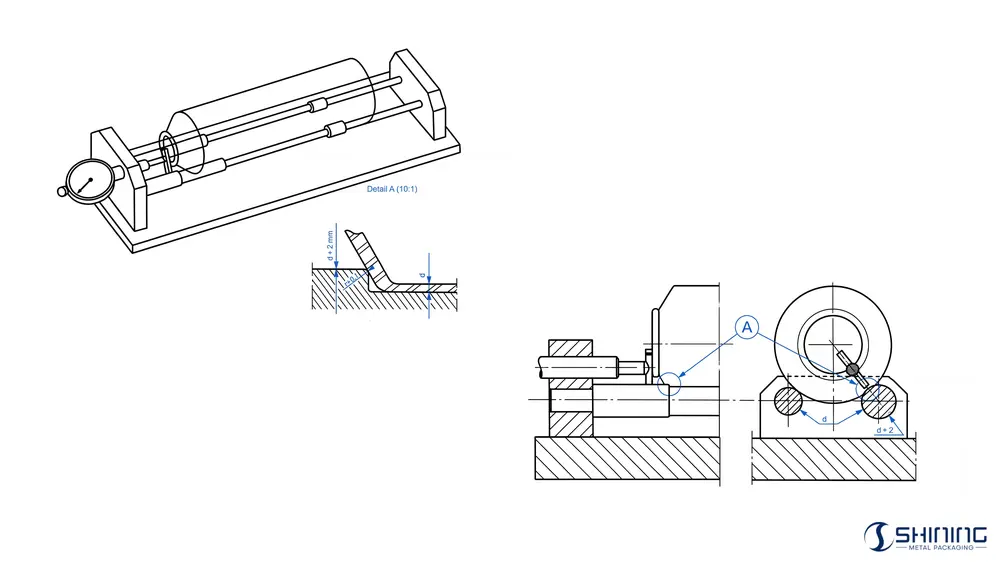
FEA 421 also describes a mechanical measuring instrument designed for production and inspection environments. This instrument allows point-by-point measurement and detection of height variation on a single container.
Principle of the Instrument
- The container rests horizontally on two parallel cutaway rods.
- One rod includes a stop of diameter d + 2 mm, defining the reference plane.
- A micrometer gauge contacts the top of the rolled-over neck section.
By rotating the container and repeating the measurement, variations in cover seat height around the circumference can be identified.
Why Cover Seat Height Matters
Cover seat height directly affects:
- Cap retention force
- Visual alignment between cap and container
- Consistency of snap-fit or friction-fit systems
Large variation in HS can result in loose caps, rocking caps, or excessive assembly force—none of which are detected by valve leak tests.
Relationship with Other 25.4 mm Standards
- EN 14850 – defines contact height for clinching (sealing interface)
- EN 15010 – defines tolerances affecting clinch performance
- FEA 405 – measurement of opening parallelism
- FEA 406 – measurement of bead planeness
Download the Standard PDF
This document provides FEA 421, defining the measurement method for cover seat height on aerosol containers with 25.4 mm openings. It specifies mechanical and optical inspection procedures to ensure accurate cap fit, dimensional consistency, and reliable packaging performance.
FAQ – Engineering & Purchasing
No. FEA 421 defines only the measurement method. Target values and tolerances depend on cap design and retention system and are usually agreed between supplier and customer.
Indirectly at most. Sealing is governed by contact height and clinch geometry, while cover seat height mainly affects cap fit and appearance.
Because a single-point measurement can hide circumferential variation. Rotation reveals asymmetry that may cause cap rocking or uneven engagement.
They can, if the geometric reference is not aligned. That is why FEA 421 clearly defines the measurement plane rather than a single point.
It is recommended when cap fit complaints occur despite correct sealing, or when switching container suppliers while keeping the same cap design.