
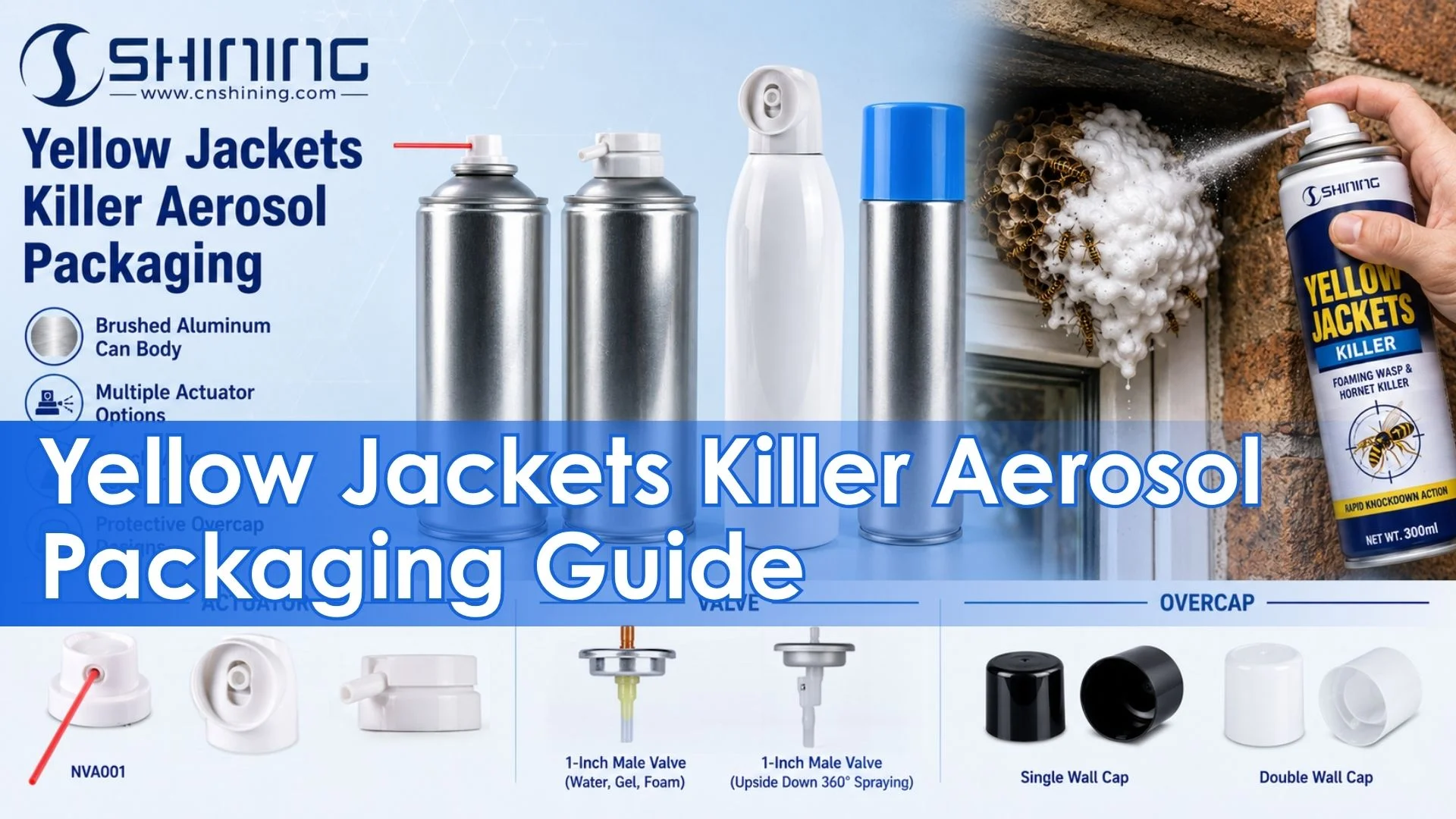
Yellow jackets killer spray is a nest-treatment aerosol, not a room spray. In retail language, the term usually covers wasp and hornet killer aerosols, hornet and wasp foams, and outdoor stinging-insect sprays used against yellowjackets, paper wasps, hornets, mud daubers, and related nest-building insects.
Biologically, yellowjackets in North America are social wasps, mainly from the Vespula and Dolichovespula groups. Commercially, the product sits inside the broader wasp and hornet killer shelf category. Its value is simple: treat a visible nest entrance or nest surface from a distance, with a fast jet or foam stream.
The hard part is also simple. A can that cannot project a stable stream, empty cleanly, seal properly, or explain its use case will be judged as ineffective even when the active ingredient is correct.
1. Definition, Target Pest, and Use Boundary
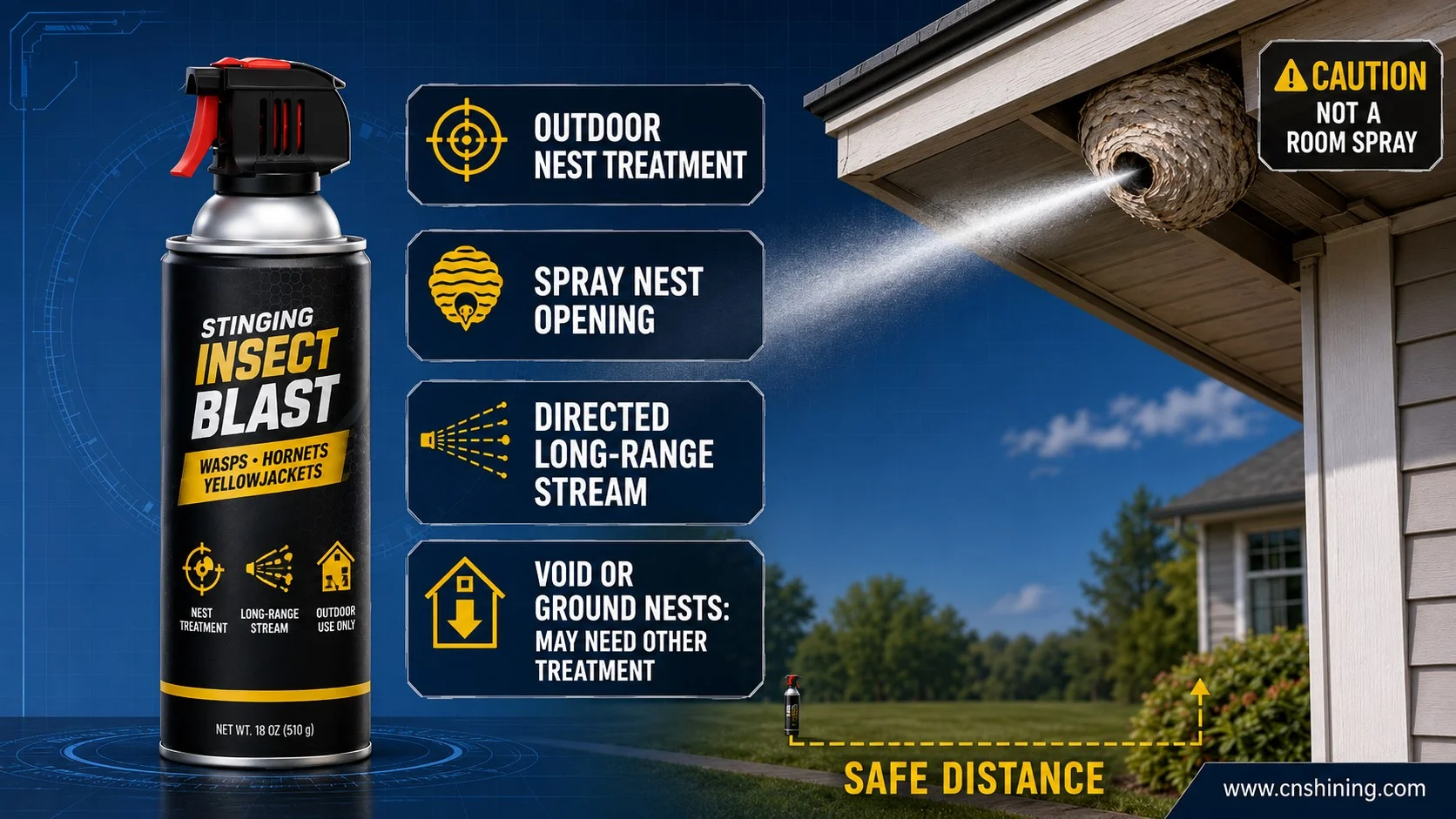
Official and university pest-control materials generally treat yellowjackets together with wasps and hornets under stinging-insect management. The spray is most useful when the user can identify a nest entrance or exposed nest surface and direct the product into that target. The University of Kentucky extension material on wasps, hornets, and yellowjackets supports this nest-focused use logic through its control guidance.
For hidden nests in walls, foundations, underground cavities, or multi-exit structures, a surface spray often gives partial results. It may kill workers at the entrance without reaching the full colony. That is why dust, bait, foam injection, or professional treatment can be more suitable for some void or ground nests.
For source context on extension-level control recommendations, see the University of Kentucky wasp, hornet, and yellowjacket control guidance.
2. Active Ingredients and Formulation Logic
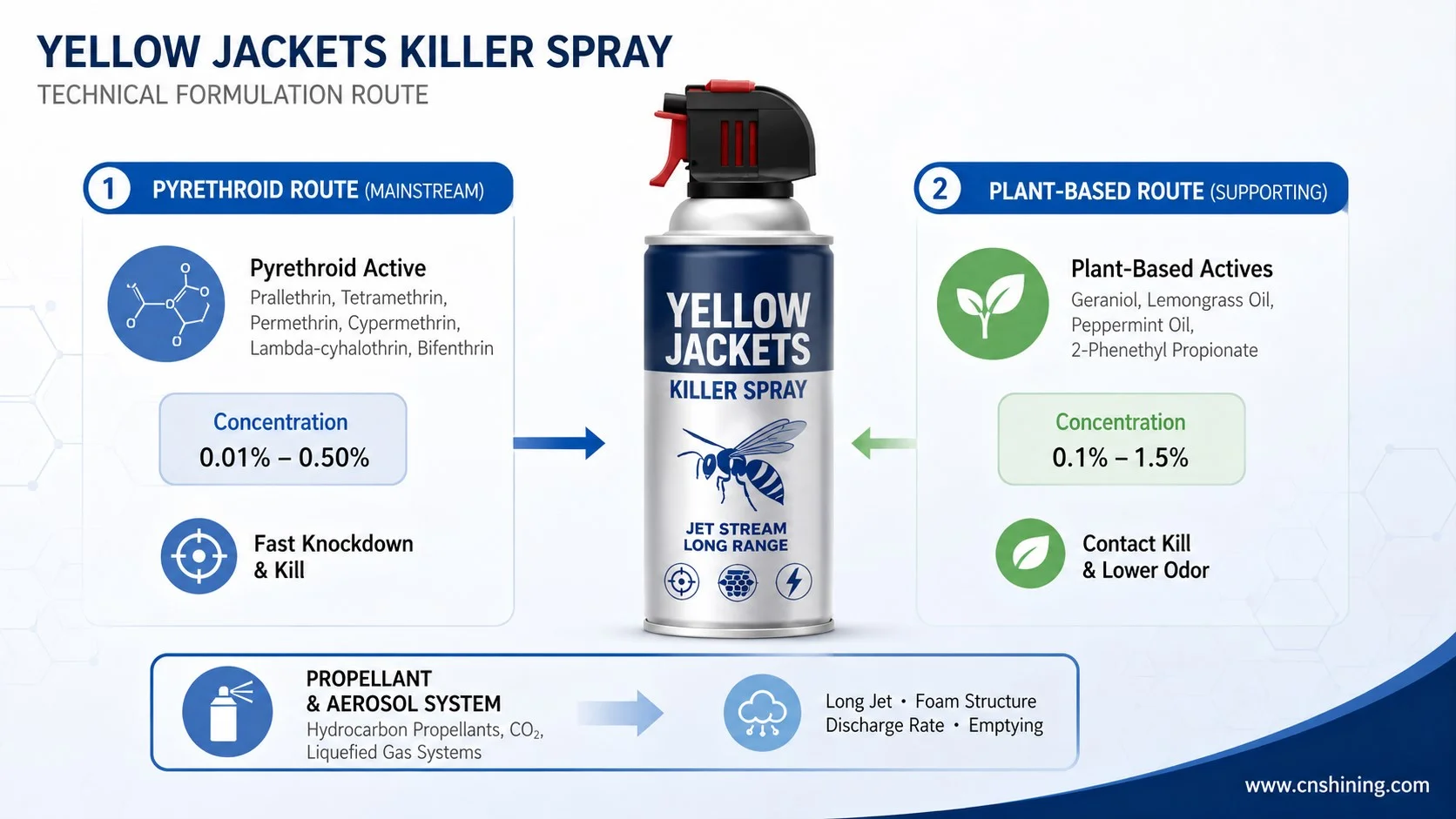
The mainstream technical route is still based on pyrethroids. Common examples include prallethrin, tetramethrin, permethrin, cypermethrin, lambda-cyhalothrin, and bifenthrin. These compounds act on insect nerve transmission by affecting voltage-gated sodium channels, leading to overexcitation, paralysis, knockdown, and death. EPA continues to review pyrethrins and pyrethroids as a class, especially for ecological risk mitigation.
Organophosphates are a different historical route. Their typical mechanism is acetylcholinesterase inhibition. They can be effective, but residential use in major consumer markets has been restricted or phased out over time. The practical conclusion is not that organophosphates never work. The conclusion is that they are no longer the preferred mainstream path for home-use yellowjacket aerosols.
Plant-based products use actives such as geraniol, lemongrass oil, peppermint oil, and 2-phenethyl propionate. They can support lower odor and lower conventional-pesticide perception. They also tend to face tougher performance questions: jet range, instant knockdown, and large-nest penetration.
EPA’s pyrethroid review can be checked through the EPA pyrethrins and pyrethroids registration review. Organophosphate toxicology background is available in the NPIC organophosphate poisoning management chapter.
| Technical Route | Typical Ingredients | Visible Concentration Range | Main Function | Technical Reading |
|---|---|---|---|---|
| Pyrethroids | Prallethrin, tetramethrin, permethrin, cypermethrin, lambda-cyhalothrin, bifenthrin | About 0.01% to 0.50% in visible retail/professional examples | Fast knockdown, contact kill, sometimes residual activity | Mainstream route. Works well with long jet delivery, but aquatic life and beneficial insects need attention. |
| Organophosphates | Diazinon, chlorpyrifos and related historical actives | Not common in current mainstream retail yellowjacket spray samples | Neurotoxic kill through cholinesterase inhibition | Mostly a historical reference for this shelf category because of residential-use restrictions. |
| Plant-based actives | Geraniol, lemongrass oil, peppermint oil, 2-phenethyl propionate | Often around 0.1% to 1.5% in public examples | Contact kill, odor-positioning, lower conventional-pesticide perception | Useful for differentiation. Performance depends heavily on delivery, wetting, and user expectations. |
| Propellant and aerosol system | Hydrocarbon propellants, CO2, liquefied gas systems | Usually not front-labeled as active ingredient | Creates stream range, foam structure, discharge rate, and emptying behavior | Often more visible to the user than the active ingredient percentage. |
| Product Type | Typical Active System | Capacity / Feature | Engineering Comment |
|---|---|---|---|
| Professional wasp and hornet aerosol | Tetramethrin + permethrin + PBO | 18 oz class; around 20 ft claimed range in public examples | Typical fast knockdown plus residual positioning. |
| Mainstream retail wasp and hornet aerosol | Prallethrin + lambda-cyhalothrin | 18 to 18.5 oz class; 20 to 27 ft claims appear in retail pages | Retail-friendly balance of range, knockdown, and price. |
| Foaming wasp and hornet aerosol | Prallethrin + cypermethrin or permethrin route | 14 to 16 oz class | Foam improves visible coverage and dwell time, but not always deep void penetration. |
| Plant-based aerosol | Peppermint oil, geraniol, lemongrass oil, 2-phenethyl propionate | 10 to 14 oz class in public examples | Good for low-odor positioning. Needs careful expectation control on large nests. |
3. Top 10 Brand Observation
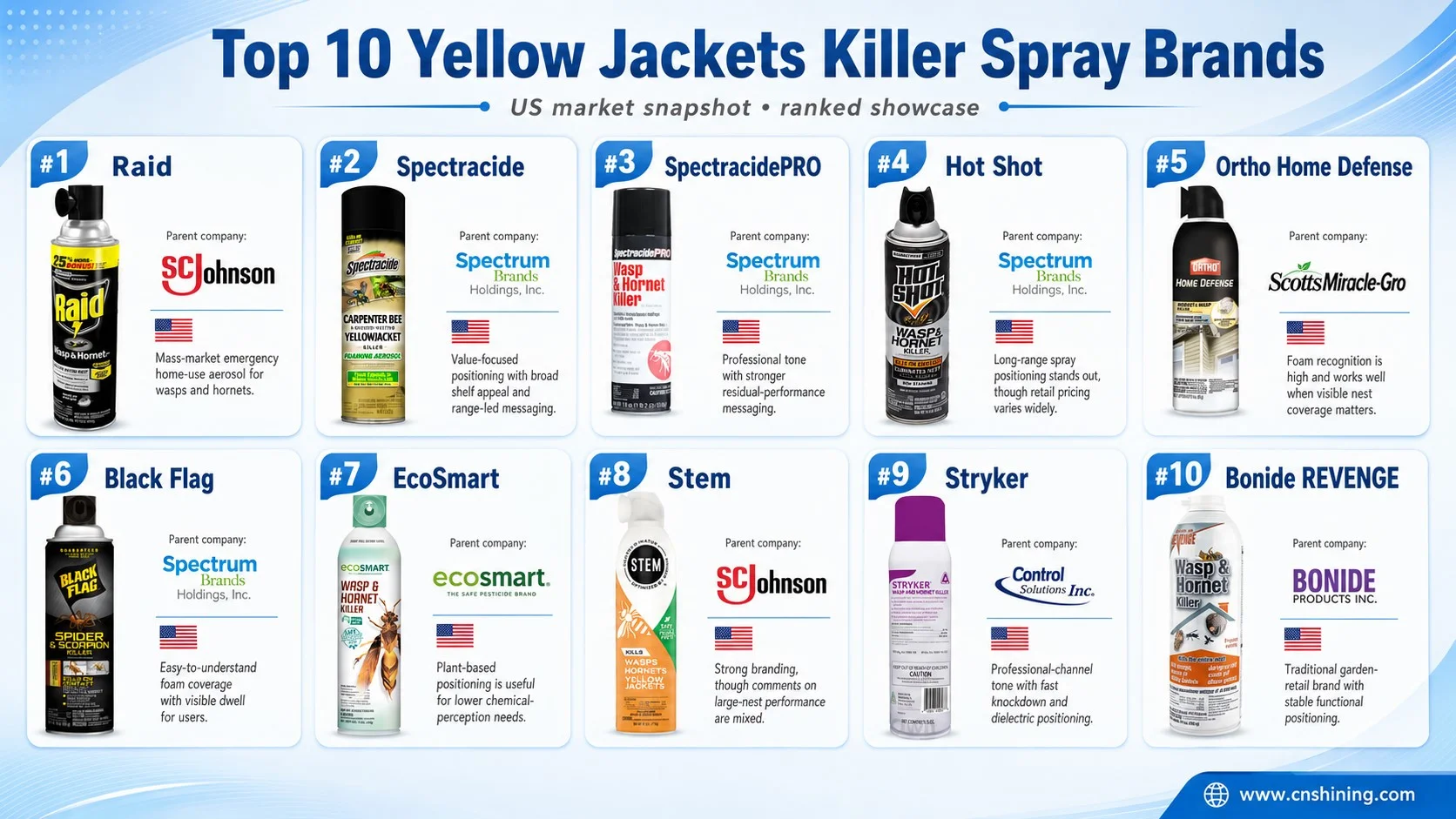
| Brand | Main Market | Owner / Holder | Common Capacity | Public Price Snapshot | Technical Comment |
|---|---|---|---|---|---|
| Raid | US | SC Johnson | 14 to 17.5 oz; 400 g | Public examples around about 6.38$; Canada examples converted to about 8.93$ | Mass distribution. Typical emergency home-use wasp and hornet aerosol. |
| Spectracide | US | Spectrum Brands Holdings, Inc. | 18 to 18.5 oz | Two-can retail examples around about 7.97$ | Strong value positioning and range-centered shelf language. |
| SpectracidePRO | US | Spectrum Brands Holdings, Inc. | 18 oz | Public examples around about 8.27$ | More professional tone, with stronger residual-performance language. |
| Hot Shot | US | Spectrum Brands Holdings, Inc. | 14 oz | Retail snapshots varied widely from about 17.90$ to about 29.99$ | Long-range claim is central, but retail price volatility is visible. |
| Ortho Home Defense | US | ScottsMiracle-Gro system | 16 oz; 400 g | Public examples around about 10$ to about 13$ | Foam recognition is high. Works well where visible nest coverage matters. |
| Black Flag | US | Spectrum Brands Holdings, Inc. | 14 oz | Public examples around about 11.36$ to about 14.45$ | Foam line is easy for users to understand: visible coverage and dwell. |
| EcoSmart | US | EcoSmart brand | 14 oz x 2; smaller plant-based packs also visible | Public examples around about 15.25$ to about 23.97$ | Plant-based route. Useful for low chemical-perception positioning. |
| Stem | US | SC Johnson plant-based brand system | 10 oz | Public examples around about 7.29$ to about 33.49$ depending on pack count | Strong branding, but large-nest performance comments are mixed. |
| Stryker | US | Control Solutions, Inc. | 15 oz | Public dealer examples around about 14.65$ | Professional channel tone, fast knockdown, and dielectric positioning. |
| Bonide REVENGE | US | Bonide Products, Inc. | 15 oz | Public examples around about 5.99$ to about 14.20$ | Traditional garden-retail brand with stable functional positioning. |
The main message from this table is not price. The message is that the category is highly North American and highly retail-channel driven. Professional and consumer products differ mainly in range, residual claims, dielectric properties, foam format, and price level, not in a completely different chemistry universe.
4. Spray, Trap, Dust, Bait, and Electronic Repellent Compared
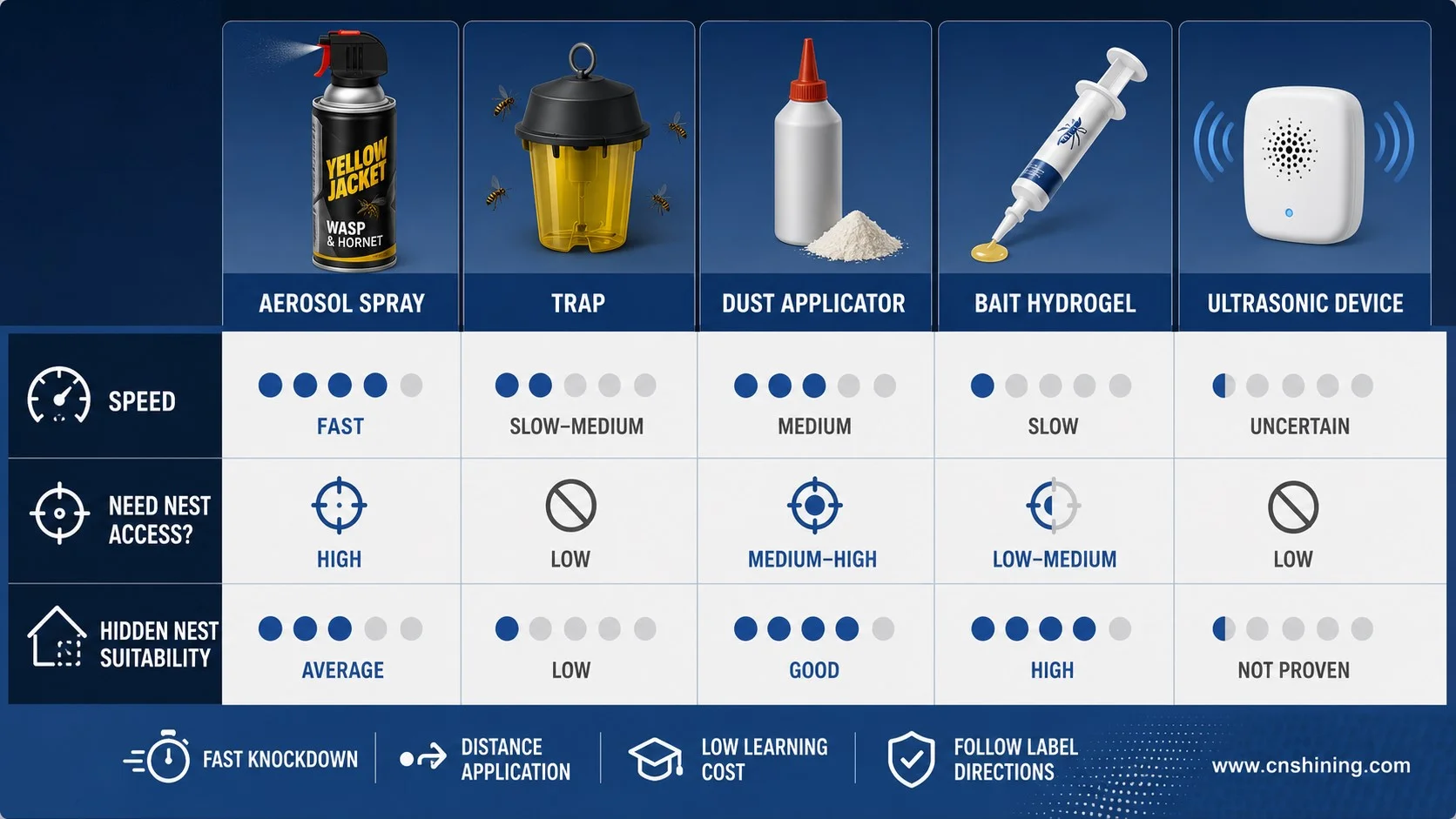
Aerosol spray wins on immediacy, distance, and low learning cost. It loses when the nest is hidden, the entry is hard to reach, or the colony has multiple routes. Dust can work better in cracks, ground holes, or void entries because insects may carry particles into the nest. Baits and hydrogels are slower but more interesting for hidden colonies and public-space management.
The FTC has warned manufacturers and retailers that ultrasonic pest-control device claims need evidence. For yellowjacket nest treatment, electronic repellents should not be treated as a first-line substitute for nest-directed chemical or IPM methods.
For bait development context, see the UC ANR yellowjacket hydrogel bait discussion. For electronic-device caution, see the FTC warning on ultrasonic pest-control devices.
| Method | Speed | Needs Nest Entrance? | Hidden Nest Fit | Main Advantage | Main Weakness |
|---|---|---|---|---|---|
| Yellowjacket spray | Fast | High | Average | Distance, instant knockdown, simple use | Unstable results on wall, underground, or multi-exit nests |
| Trap | Slow to medium | Low | Does not eliminate the nest directly | Monitoring and activity reduction | Needs bait maintenance and does not guarantee colony removal |
| Dust | Medium | Medium to high | Good | Can be carried inward by workers | Application error can disturb the colony or block entry points |
| Bait / hydrogel | Slow | Low to medium | Potentially high | Better fit for hidden colony transfer logic | Availability, palatability, and label constraints |
| Electronic / ultrasonic | Uncertain | Low | Not proven for this use | No pesticide residue | Weak evidence for yellowjacket nest control |
5. Compliance: Registration, Label, MRL, and UN1950 Transport
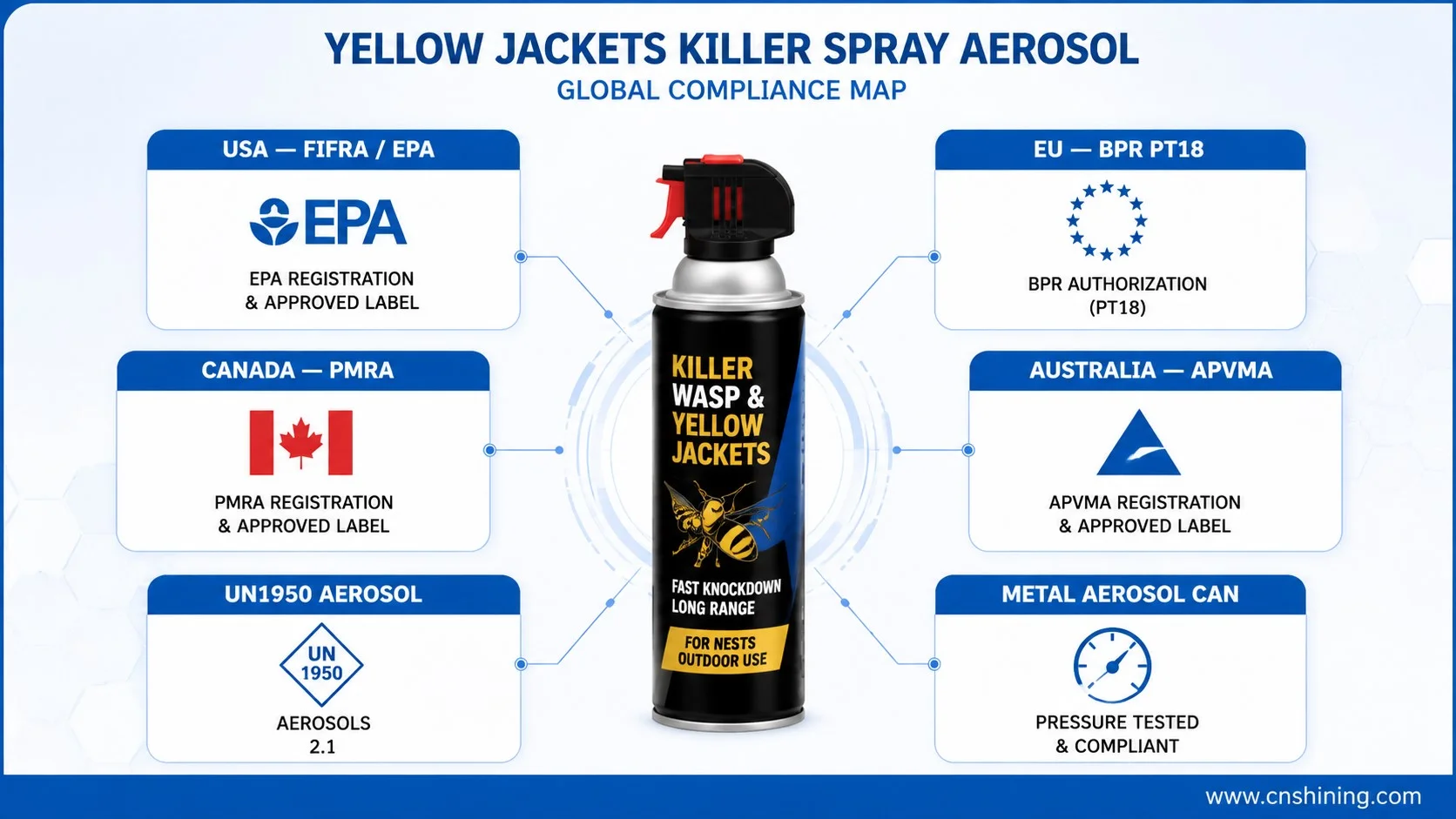
The core compliance question is not food residue. For this product type, the core question is whether the pesticide is registered or authorized, whether the label matches the approved use, and whether the aerosol package is shipped as a pressure container under dangerous-goods rules.
In the United States, FIFRA and EPA registration control the product and label. In the European Union, the BPR route applies, typically under product type PT18 for arthropod control. Canada uses PMRA registration and label databases. Australia uses APVMA registration.
Food MRL systems still matter in pesticide regulation, but they are usually not the product-level center for a structural or outdoor nest-treatment wasp aerosol. A user spraying a nest under an eave is not applying the product as a food-crop pesticide.
Reference frameworks include the EU Biocidal Products Regulation 528/2012, the EPA pesticide tolerance index, the Health Canada PMRA pesticide label search, and the Australian APVMA website.
For aerosol transport, limited-quantity and compressed-gas rules are directly relevant. The eCFR section on limited quantities of compressed gases is available at 49 CFR 173.306.
| Market | Main Framework | Label Focus | MRL Logic | Transport Concern |
|---|---|---|---|---|
| United States | EPA registration under FIFRA | Approved use site, PPE, hazards, water avoidance, directions | 40 CFR Part 180 is food/feed residue oriented | Aerosol shipment commonly follows UN1950 logic |
| European Union | BPR PT18 plus REACH/CLP | Authorization, hazard communication, approved active substance route | Reg. 396/2005 is mainly food residue logic | CLP and dangerous-goods classification |
| Canada | PMRA registration | Label is the legal use boundary | MRL is food-residue system | TDG treatment for aerosols |
| Australia | APVMA registration and Poisons Standard | Directions for use, warnings, restrictions | APVMA / FSANZ MRL applies to food residue | ADG Code for Class 2 aerosol handling |
6. User Pain Points and Aerosol Package Engineering
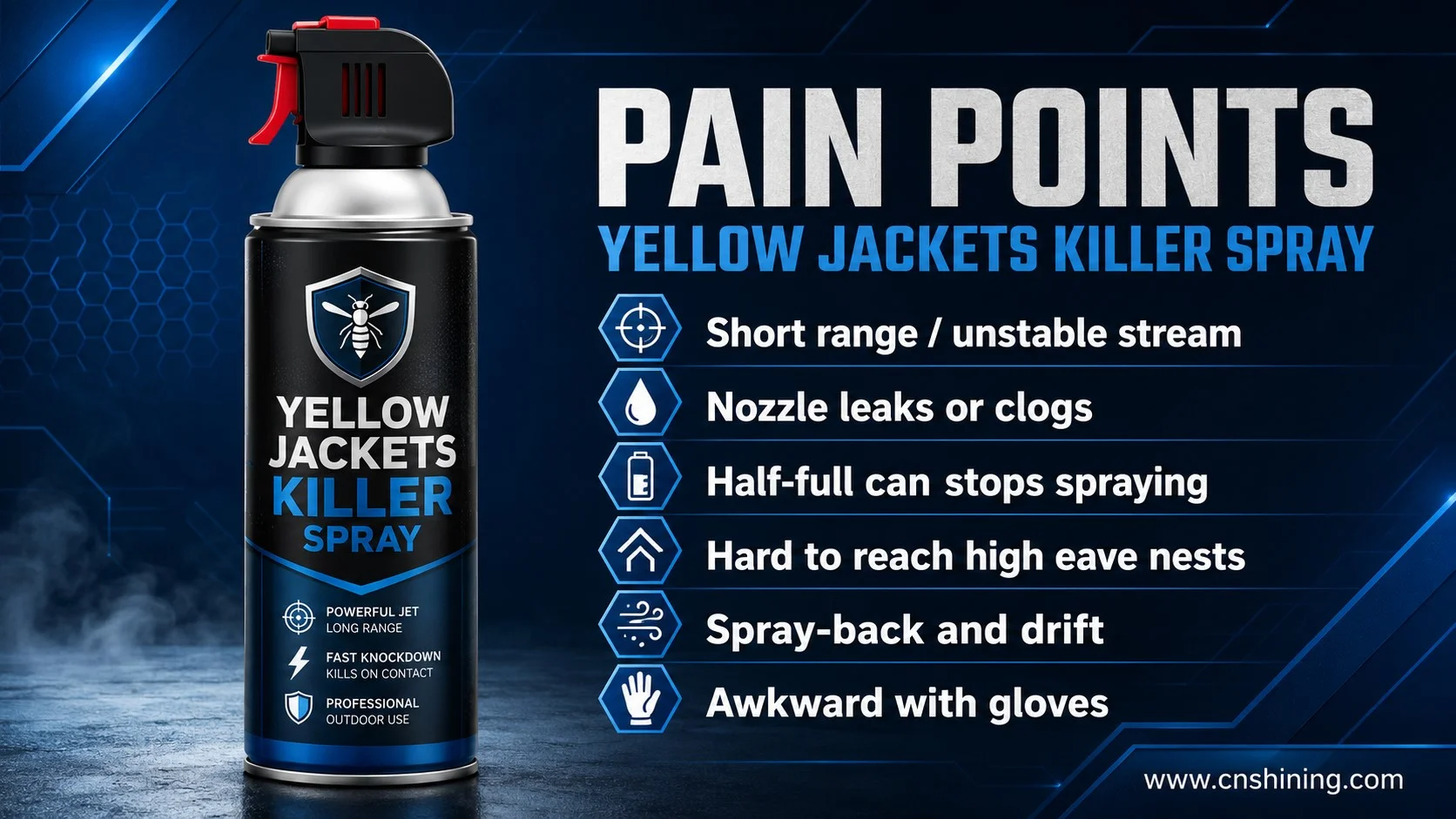
The most repeated user complaints are not hard to understand: claimed range not reached, spray pattern too weak, nozzle leaks, nozzle clogs, half the can remains unusable, large nests survive, hidden nests remain active, and plant-based products kill too slowly. Most of these complaints sit at the boundary between chemistry and packaging.
In this category, the package is part of the product performance. A strong formula that cannot be delivered as a narrow, stable, long-range stream is not perceived as strong. A valve that fails halfway through the can turns active ingredient into dead inventory.
| Pain Point | Engineering Response | Expected Effect | Feasibility | Cost Impact |
|---|---|---|---|---|
| Short jet range or unstable stream | Directional orifice overcap, higher-flow valve, tighter filling-pressure window | Better real-world range and less claim gap | High | Medium |
| Nozzle leakage or clogging | Anti-clog actuator design, seal sampling, actuation test on line | Fewer returns and fewer “product failed” reviews | High | Low to medium |
| Half can cannot discharge | Valve stem, dip tube, and posture compatibility optimization | Better emptying rate and lower residue complaint | Medium to high | Medium |
| High nest under eaves | Extension-compatible actuator or remote trigger accessory | Less ladder use and better distance control | Medium | Medium |
| Spray-back, drift, or overspray | Separate jet SKU and foam SKU; narrow-cone nozzle; wind-use warning | Less operator exposure and less off-target contamination | High | Low to medium |
| Gloved-hand operation is awkward | Larger actuator pad, finger rest, clear safety-lock graphics | Higher first-shot success and less misuse | High | Low |
| Hidden nest mistaken for visible nest | Front-panel “suitable / not suitable” diagrams | Fewer expectation mismatch complaints | Very high | Very low |
| Plant-based route feels slow | Do not imply professional fast knockdown unless performance supports it | Lower claim-risk and better user expectation fit | Very high | Very low |
7. Product Fit: Shining Packaging Actuators, Cans and Valves
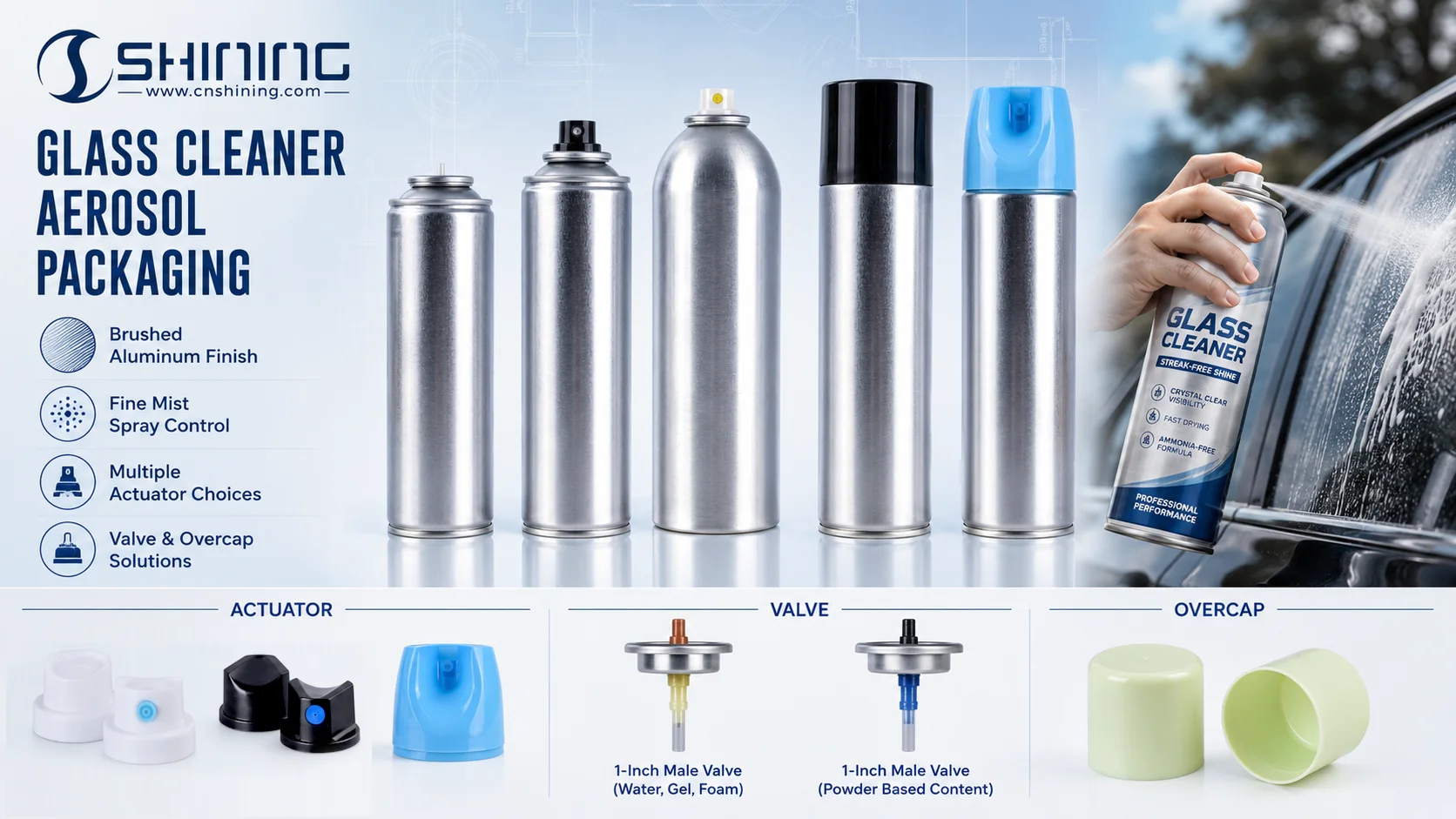
For yellow jackets killer spray, the aerosol package is not a passive container. It determines discharge rate, range, foam quality, valve reliability, leakage risk, storage stability, and user confidence at the moment of use.
Shining Packaging fits into this discussion through three hardware areas: actuators, aerosol cans, and valves. The actuator controls user force, stream direction, and pattern stability. The valve controls discharge rate, sealing, compatibility, and emptying performance. The metal aerosol can provides pressure resistance, corrosion protection, print surface, transport durability, and shelf stability.
The practical design target is not complicated: the spray must leave the can cleanly, travel in a controlled line, reach the marked distance under normal use, and stop without leaking. For foaming SKUs, the system must also support foam expansion and cling without turning the user’s hand into the test surface.
In formula development, packaging selection should start early. Pyrethroid solvent systems, plant-based essential oil systems, and foamable formulations can stress gaskets, internal coatings, and valve components differently. Compatibility testing is not paperwork. It prevents field leakage, clogging, pressure loss, and valve failure after storage.
8. Technology Direction, Source Links, and Closing Judgment
The recent technical direction is not a wave of entirely new active ingredients. The visible movement is product engineering inside known boundaries: plant-based formulas, foam formats, longer and narrower streams, remote triggering, better nest-entry delivery, essential-oil microencapsulation, and clearer label communication.
Patent literature supports this view. Long-distance aerosol spray, foamable pesticide composition, remote target spraying, and microencapsulated essential oil formulation are all established development lines. Useful references include long-range insecticidal aerosol technology, foamable pesticide composition technology, remote target spraying apparatus, and microencapsulated essential oil formulation.
Trapping and baiting also remain relevant. For research context, see the yellowjacket trapping study.
Closing judgment: Yellow Jackets Killer Spray is best understood as a regulated aerosol delivery problem. Chemistry matters, but it does not work alone. The can, valve, actuator, propellant, foam or jet geometry, label boundary, and transport classification decide whether the product performs in the user’s hand. For this category, packaging engineering is not secondary support. It is one of the main performance levers.
9. FAQ: Yellow Jackets Killer Spray
No. In most commercial and regulatory contexts, it is not a separate legal product category. It is usually sold under wasp and hornet killer aerosols or foaming sprays. The yellowjacket wording helps consumers identify the target pest, especially in North America, but registration normally follows broader insecticide, biocide, or household aerosol rules.
The main target is the nest entrance or visible nest body, not a single flying insect in open space. The spray is designed to deliver active ingredient from a distance into the traffic point where workers enter and leave. If the nest is hidden inside a wall or underground void, surface spray may not reach enough of the colony.
Pyrethroids provide fast knockdown and contact toxicity at relatively low concentrations, which fits the user’s expectation for stinging-insect sprays. They also work well with aerosol jet delivery. The constraint is environmental risk, especially around aquatic organisms and beneficial insects. Label limits, drift control, and water-body warnings should not be treated as minor text.
Not automatically, but their performance profile is different. Plant-based actives can support lower odor and lower conventional-pesticide perception. The weak points often appear in long jet range, instant knockdown, and large-nest control. A plant-based formula still needs a strong actuator, stable valve, compatible can lining, and honest label claims.
Foam makes coverage visible and helps the formulation stay on a nest surface longer than a thin liquid stream. It can also reduce some run-off and spray-back. Foam is not magic. If the colony is deep inside a cavity, the foam may cover the entrance without reaching the full nest structure behind it.
This is often a package-system issue. Possible causes include poor dip-tube positioning, valve mismatch, pressure loss, actuator clogging, incompatible formulation, or use angle outside the design window. Users usually do not separate these causes. They simply see remaining liquid and call the product ineffective, so emptying performance needs formal testing.
Usually no. Maximum residue limits mainly govern pesticide residues in food and feed commodities. A yellowjacket aerosol used around structures or outdoor nest sites is governed more directly by registration, approved label use, hazard communication, use restrictions, aerosol pressure safety, and dangerous-goods shipping rules. MRL questions can still arise, but they are not the center.
Most pressure aerosol insecticides fall into aerosol dangerous-goods handling logic, commonly associated with UN1950. This affects transport documentation, cartons, storage, temperature control, and cross-border shipping. A formula can be technically effective and still fail commercially if the aerosol can, pressure rating, flammability class, or shipping classification is not handled correctly.
Spray should not be the first assumption when the nest is hidden, deep underground, inside a wall void, or has unclear entry points. In those cases, dust, bait, foam injection, or professional inspection may fit better. Repeated surface spraying can kill workers while leaving the colony active, which creates the impression that the product failed.
The important features are actuator geometry, valve sealing, discharge rate, dip-tube emptying, spray pattern, can pressure resistance, internal coating compatibility, and clear use diagrams. Long-range claims depend on the whole aerosol system, not only propellant pressure. A reliable package turns formulation performance into field performance that users can actually observe.