
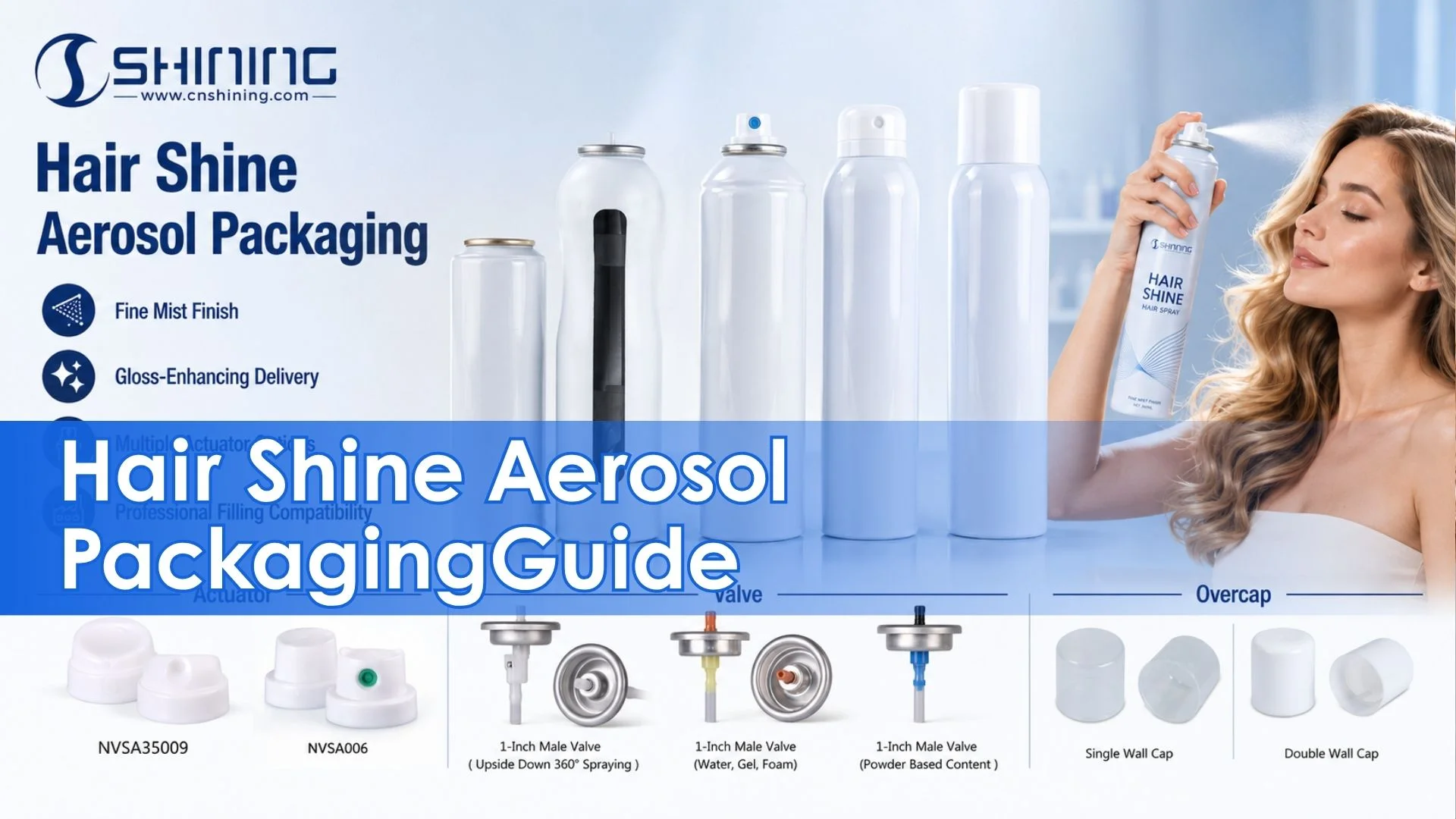
A hair shine aerosol spray is not just a weaker hairspray with more oil. It is a leave-in finishing product that uses propellant pressure to atomize a low-viscosity formula into fine droplets. The volatile carrier spreads fast, evaporates fast, and leaves a thin gloss film on the hair fiber.
The product sits closer to finishing spray, glossing spray, shine mist, and glass hair spray than to traditional high-hold hairspray. Some formulas give almost no hold. Others add light shaping, humidity resistance, heat protection, color-care claims, or fragrance positioning.
The engineering problem is simple to say and hard to solve: the spray must look shiny without looking oily, feel dry without spraying coarse, and smell pleasant without creating inhalation discomfort. Packaging is part of that formula. Valve, actuator, can coating, propellant choice, and spray rate decide whether the same liquid feels premium or fails in the first two seconds.
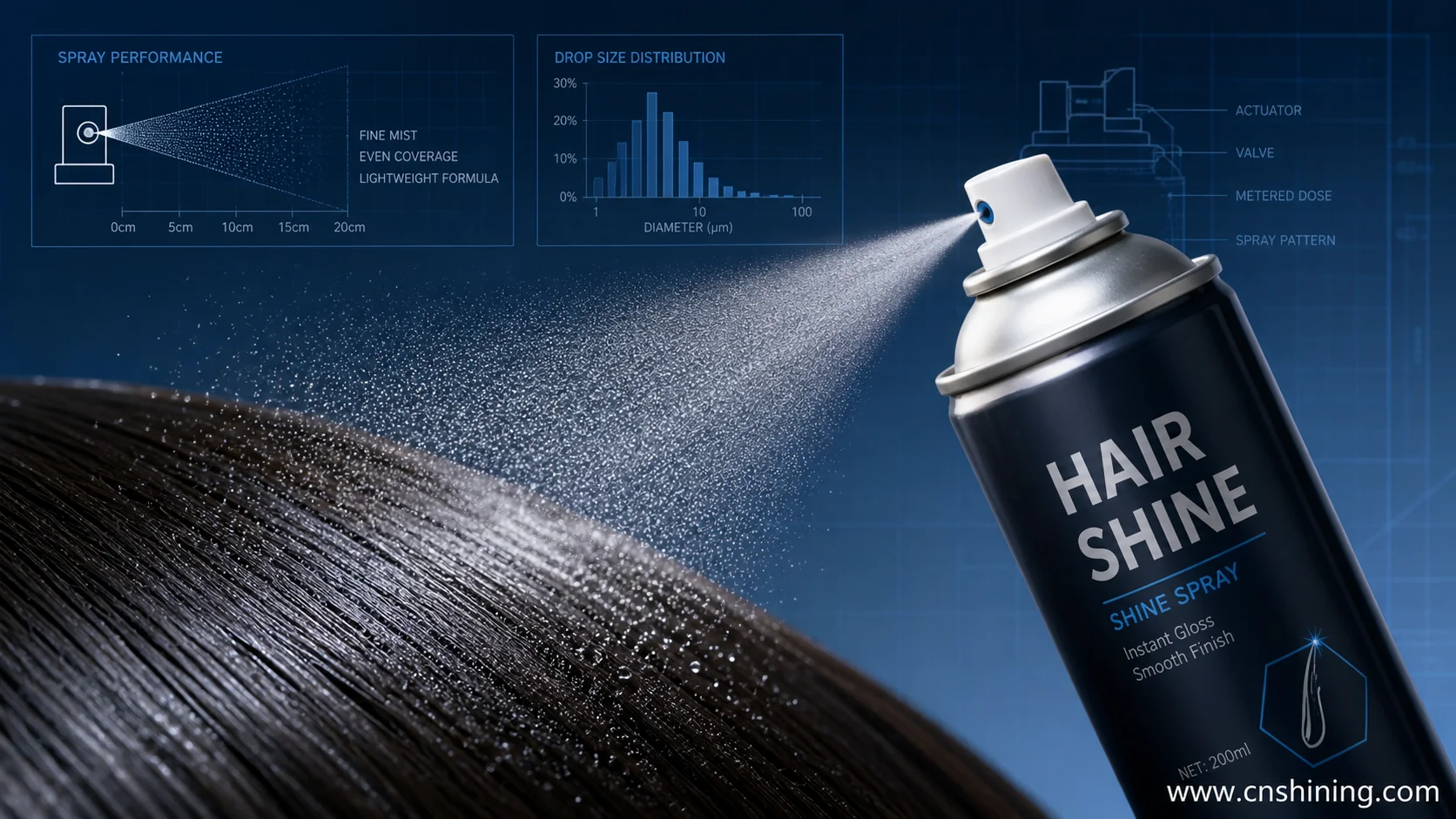
1. Executive Technical View
The core function of hair shine aerosol spray is instant optical correction. It improves mirror reflection, reduces scattered reflection from rough cuticles, calms flyaways, and leaves a smoother visual surface. The shine effect comes from four linked factors:
| Factor | Technical role | Failure mode when poorly controlled |
|---|---|---|
| Fine atomization | Creates small droplets and even surface coverage. | Large droplets wet the hair, create clumps, and slow drying. |
| Fast spreading | Alcohol or other volatile carriers reduce surface tension. | Poor spread gives local oily spots instead of uniform gloss. |
| High refractive index residue | Phenyl silicones or silicone resins raise visible gloss. | Too much gloss agent gives greasy shine and hair collapse. |
| Thin film formation | Light film formers extend gloss and reduce frizz. | Excess film former feels stiff, tacky, or like old hairspray. |
2. Definition and Working Principle
From a product-form standpoint, hair shine aerosol spray is a pressurized leave-in cosmetic or styling product. A public aerosol hairspray patent describes this type of system as a pressure-resistant container, nozzle, propellant, and hair formulation designed to form an aerosol and deposit the formulation on hair. The same patent notes that hairsprays normally contain film-forming polymers and that propellant changes can affect droplet size and product performance. See the aerosol hairspray patent discussion.
Hair shine aerosol spray shifts the main performance target from strong hold to high gloss, frizz reduction, and finishing feel. The product still uses the same aerosol physics: internal pressure, a valve, an actuator, and a liquid formulation broken into droplets during discharge.
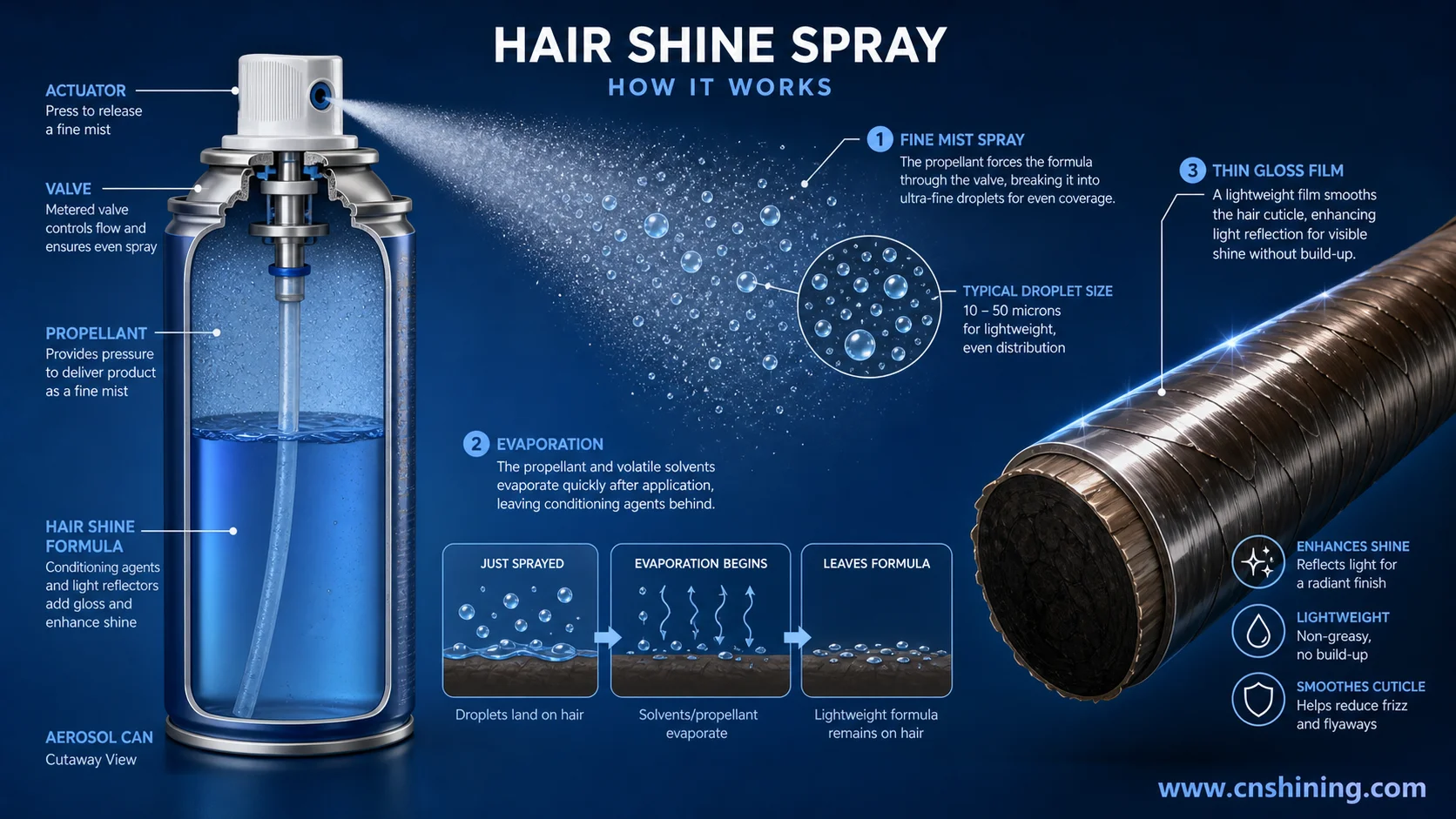
2.1 Four-step mechanism
| Step | What happens | Why it matters for shine spray |
|---|---|---|
| Atomization | Propellant pressure drives the formula through the valve and actuator, forming fine droplets. | Droplet size controls wetness, drying time, spray width, and over-application risk. |
| Spreading | Volatile solvents reduce surface tension and help the liquid spread over hair fibers. | Good spreading gives uniform gloss instead of spotted oil shine. |
| Evaporation | Propellant and volatile carrier leave the surface. | Fast evaporation creates the “dry spray” feel users expect from a finishing mist. |
| Film and optical gloss | Silicones, silicone resins, light polymers, and care ingredients remain on the hair. | A smooth, thin film reduces diffuse reflection and increases mirror-like reflection. |
2.2 Main formulation roles
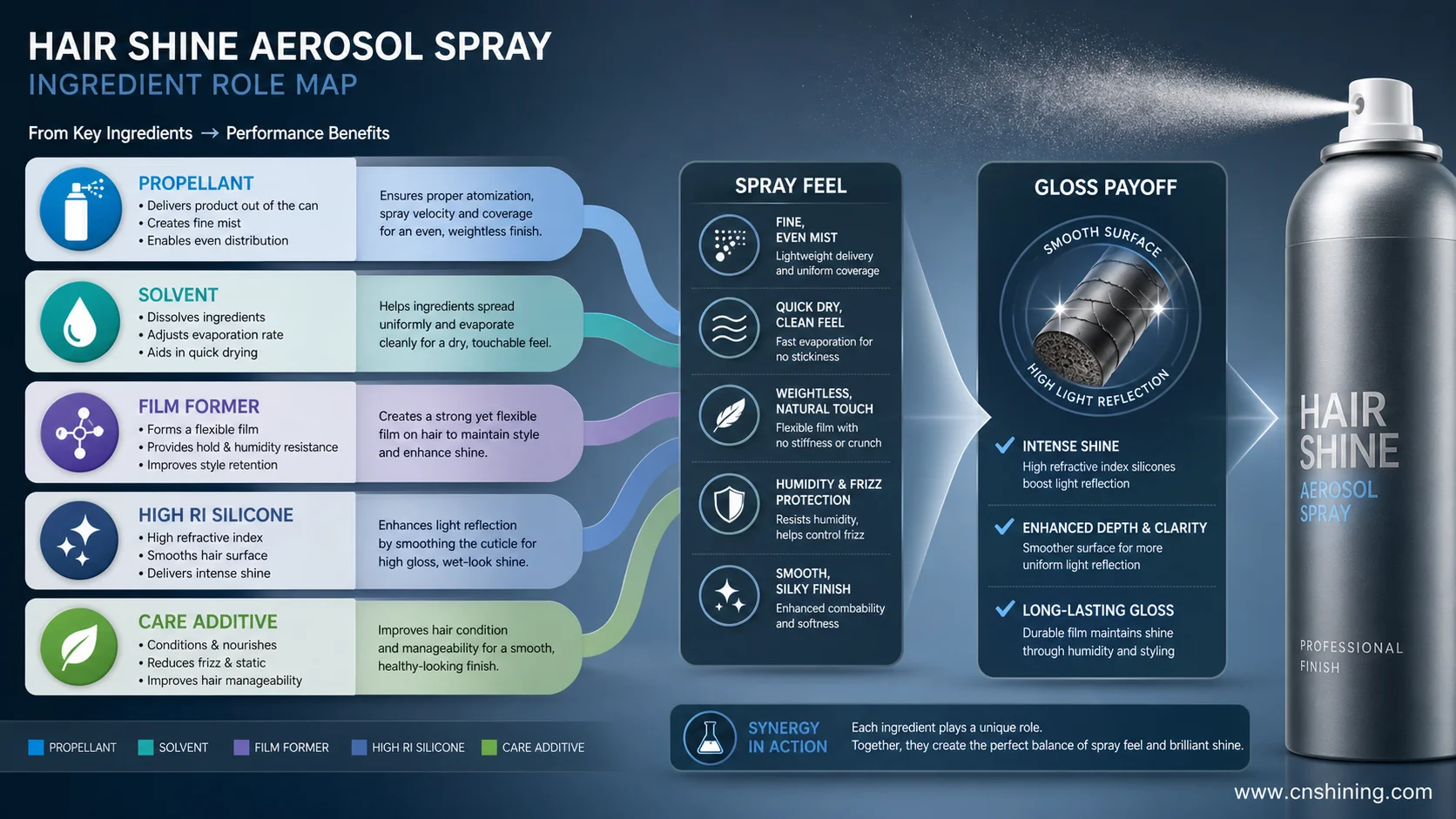
| Component role | Main task | Direct effect on product feel | Typical development difficulty |
|---|---|---|---|
| Film former | Leaves a thin film; may provide light hold or humidity resistance. | Gloss duration, frizz control, brushability. | Too much film former turns the product stiff, brittle, or hazy. |
| Solvent | Lowers surface tension and speeds drying. | Dry spray feel, less wetting, reduced strand clumping. | High alcohol levels can feel dry, brittle, or irritating. |
| Propellant | Provides pressure and breaks the liquid into droplets. | Spray rate, mist quality, flammability profile. | Low VOC targets and refined spray feel often pull against each other. |
| High RI shine agent | Raises mirror reflection on hair. | Glass hair effect and photo-visible shine. | Too much creates oiliness, stringiness, and limp hair. |
| Light care ingredient | Improves combing, smoothness, and flyaway control. | Softness and lower frizz. | Care oils can reduce lightness on fine or oily hair. |
Common propellants include propane, butane, isobutane, dimethyl ether, and HFC-152a. VOC propellants are not passive gases. They can also help solubilize, dry, and break the liquid stream into smaller particles. That is useful for spray feel, but it creates flammability and VOC compliance pressure.
3. Market Size and Trend Reading
Public free market data rarely isolate the narrow subcategory “aerosol hair shine spray.” A workable commercial view uses three layers: direct hair gloss spray, adjacent hair spray, and the upper hairstyling products category. This avoids over-reading one report number.
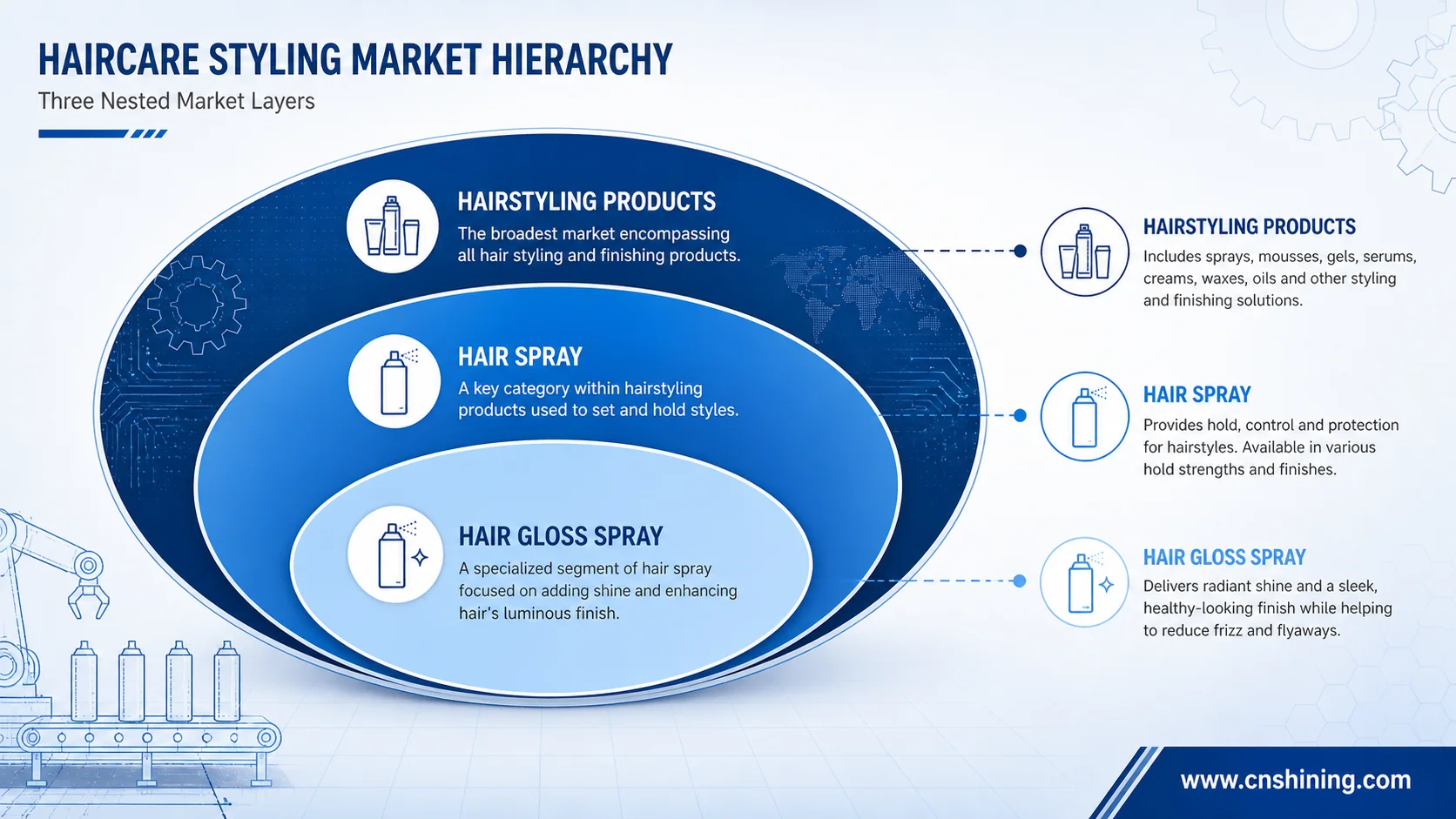
The strict shine or gloss spray segment is not as large as the whole hairspray market. It is still commercially attractive because it sits in a high-value finishing niche: gloss, light feel, frizz control, heat protection, color care, and fragrance are increasingly sold as one product experience.
| Market scope | 2023/2024 base | Future value | Use in business discussion |
|---|---|---|---|
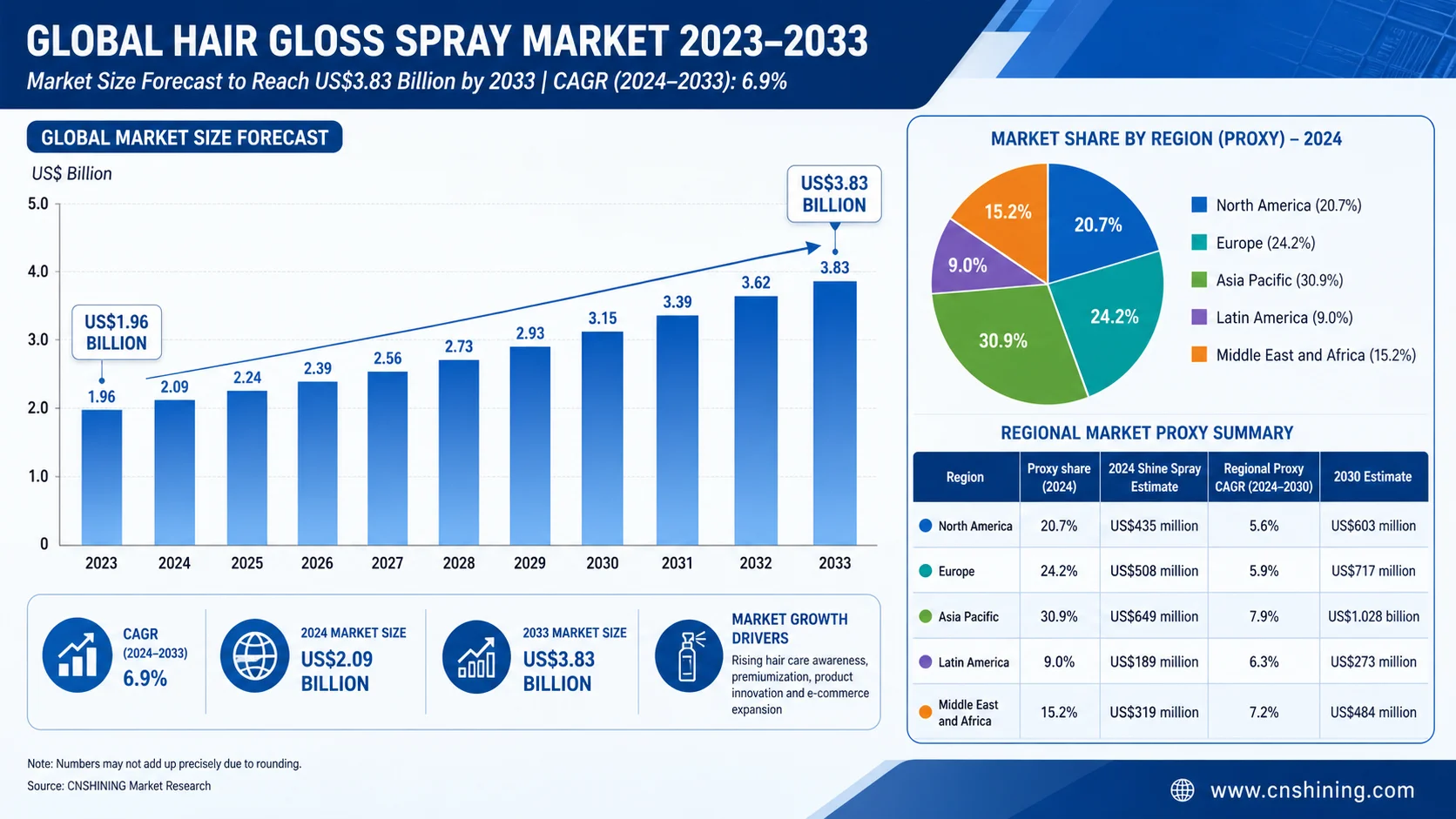
| Direct scope: Hair Gloss Spray | About US$2.1 billion in 2024 | About US$3.9 billion by 2033, CAGR about 6.9% | Closest public proxy for shine and gloss spray. Regional detail is limited. Source: hair gloss spray market data. |
| Adjacent scope: Hair Spray | About US$11.17 billion in 2024 | About US$17.82 billion by 2030, CAGR about 8.16% | Includes styling, finishing, gloss, and some anti-frizz sprays. Source: hair spray market data. |
| Upper scope: Hairstyling Products | About US$27.30 billion in 2023 | About US$43.05 billion by 2030 | Shows regional structure and broad channel direction. Hair spray was about US$8.68 billion in 2023. Source: global hairstyling products data. |
3.1 Regional proxy view
Public regional data are stronger for hairstyling products than for hair shine aerosol spray itself. Using the hairstyling products regional split as a proxy, Asia Pacific is the largest and fastest-growing region.
| Region | Proxy share | 2024 shine spray estimate | Regional proxy CAGR | 2030 estimate |
|---|---|---|---|---|
| North America | 20.7% | US$435 million | 5.6% | US$603 million |
| Europe | 24.2% | US$508 million | 5.9% | US$717 million |
| Asia Pacific | 30.9% | US$649 million | 7.9% | US$1.028 billion |
| Latin America | 9.0% | US$189 million | 6.3% | US$273 million |
| Middle East and Africa | 15.2% | US$319 million | 7.2% | US$484 million |
3.2 Main growth drivers and restraints
| Driver or restraint | Technical meaning |
|---|---|
| Photo-visible gloss and “glass hair” trends | Users expect immediate shine that shows on camera, not only a soft conditioning feel. |
| Natural, plant-based, and lower-irritation claims | These claims affect solvent, fragrance, silicone, and preservative strategy. |
| Multi-benefit finishing | Gloss is often bundled with anti-frizz, heat protection, color care, and lightweight feel. |
| E-commerce and professional channel overlap | Products must perform in salon language and also survive user-generated reviews. |
| VOC, flammability, and recycling pressure | Low VOC, BOV, recyclable aluminum, PCR, and traceable aluminum are becoming stronger design themes. |
| Experience contradiction | Users want more shine, but not more oil; more fragrance, but not headache; more durability, but not stiffness. |
4. Product Comparison, Formula Segmentation, and Gloss Terms
The main strength of hair shine aerosol spray is instant visual finish, even coverage, and lightweight application. It is not the strongest product for deep repair or precise hand-applied control. That distinction matters when building claims, packaging, and use instructions.
4.1 Adjacent product comparison
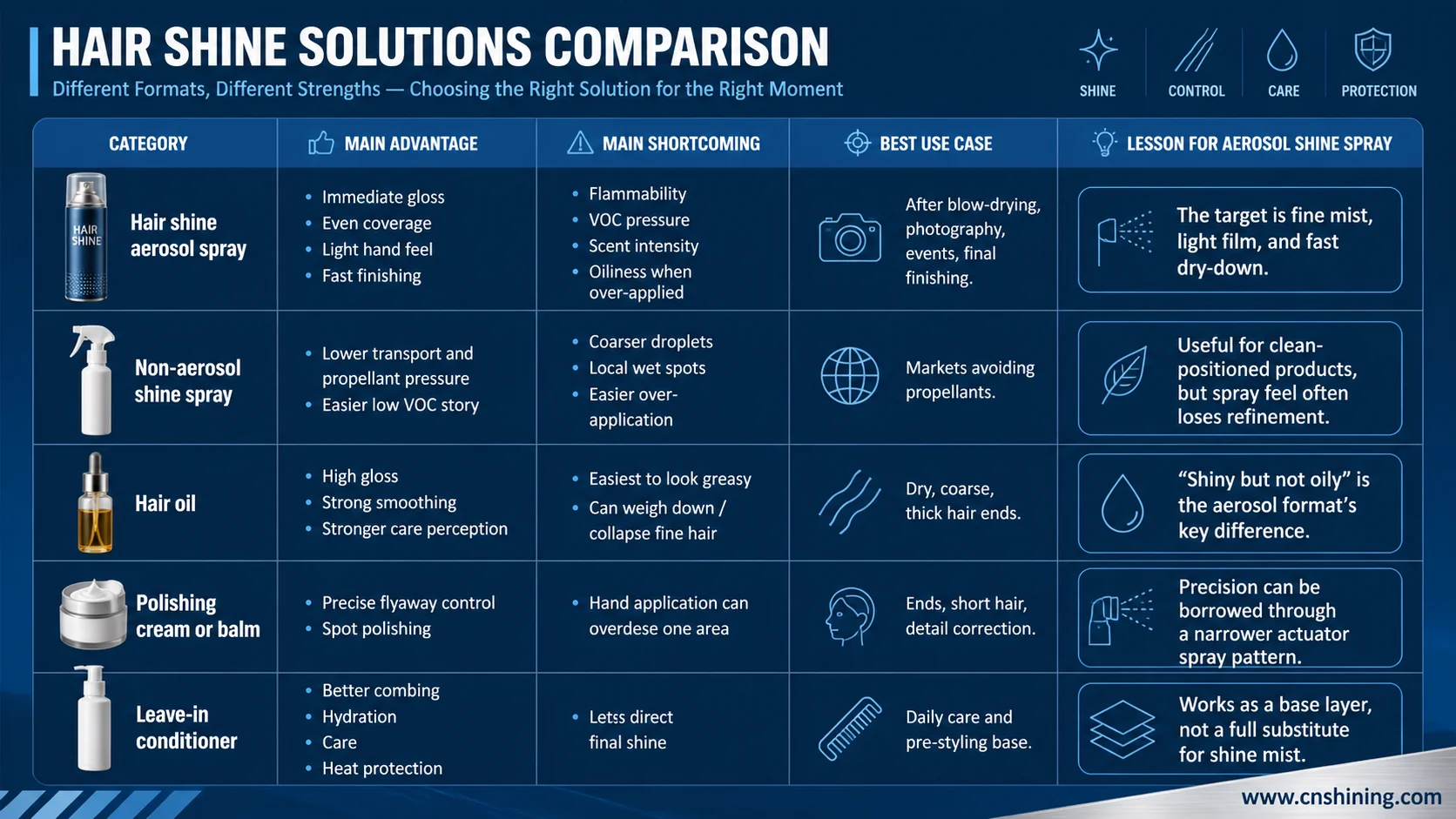
| Category | Main advantage | Main shortcoming | Best use case | Lesson for aerosol shine spray |
|---|---|---|---|---|
| Hair shine aerosol spray | Immediate gloss, even coverage, light hand feel, fast finishing. | Flammability, VOC pressure, scent intensity, oiliness when over-applied. | After blow-drying, photography, events, final finishing. | The target is fine mist, light film, and fast dry-down. |
| Non-aerosol shine spray | Lower transport and propellant pressure; easier low VOC story. | Coarser droplets, local wet spots, easier over-application. | Markets avoiding propellants. | Useful for clean-positioned products, but spray feel often loses refinement. |
| Hair oil | High gloss, strong smoothing, stronger care perception. | Easiest to look greasy or collapse fine hair. | Dry, coarse, thick hair ends. | “Shiny but not oily” is the aerosol format’s key difference. |
| Polishing cream or balm | Precise flyaway control and spot polishing. | Hand application can overdose one area. | Ends, short hair, detail correction. | Precision can be borrowed through a narrower actuator spray pattern. |
| Leave-in conditioner | Better combing, hydration, care, and heat protection. | Less direct final shine. | Daily care and pre-styling base. | Works as a base layer, not a full substitute for shine mist. |
4.2 Practical segmentation framework
| Segmentation dimension | Common subtypes | Commercial meaning |
|---|---|---|
| Core benefit | Pure shine, shine + anti-frizz, shine + heat protection, shine + light hold, shine + color care. | Clear for shelf education, e-commerce search, and short video keywords. |
| Film system | Silicone fluid, silicone resin/high RI system, light polymer, silicone-polymer hybrid. | Controls gloss intensity, gloss duration, oiliness, and brushability. |
| Solvent system | Alcohol fast-dry, water-based low VOC, mixed solvent. | Controls spray feel, regulatory route, and compatibility. |
| Propulsion system | LPG/DME aerosol, HFC aerosol, BOV compressed gas, continuous pump spray. | Controls VOC, flammability, spray stability, and manufacturing cost. |
| Value narrative | Organic, natural, silicone-free, vegan, alcohol-free, salon-grade, fragrance-forward. | Defines target users but can reduce formulation freedom. |
4.3 Ingredient roles and risks
Phenyl silicones and high refractive index silicone fluids are used because they can raise gloss without needing heavy oil loading. Dow’s technical page for DOWSIL PH-1555 HRI Cosmetic Fluid gives a useful example of the high RI shine concept. CIR material also records phenyl-substituted methicones in cosmetic use, including hair applications; see the CIR phenyl-substituted methicones safety assessment.
| Ingredient or class | Main function | Typical risk point |
|---|---|---|
| Phenyl Trimethicone / high RI phenyl silicone | High gloss, smoothness, better dry comb feel. | Excess level can look oily or artificial. |
| Phenyl siloxysilicate / high RI silicone resin | More durable high-gloss film with lower migration. | Can increase tack or residue if the system is not stable. |
| Propane / butane / isobutane / dimethyl ether | Propulsion, fast drying, atomization support. | Flammability, VOC control, and inhalation perception. |
| HFC-152a | Aerosol propellant. | Safety assessment can be favorable under current use, but environmental and regulatory review continues. |
| Alcohol solvent | Lower surface tension and speed drying. | High level may feel dry, brittle, or irritating. |
| Light film-forming polymer | Light hold, humidity resistance, longer gloss wear. | Too much makes hair stiff, crunchy, or hazy. |
| Oils and botanical extracts | Softness, color-care story, conditioning feel. | Fine hair collapses quickly if deposition is too heavy. |
4.4 Working glossary
| Term | Short explanation | Why it matters commercially |
|---|---|---|
| Aerosol | Fine liquid droplets or particles carried by gas. | Defines the refined spray feel and fast coverage. |
| Propellant | Liquefied or compressed gas that expels the formulation. | Controls spray force, VOC position, and flammability profile. |
| Atomization | Breaking liquid into fine droplets. | Key to dry spray feel and low clumping. |
| Film former | Material that leaves a film after volatile components evaporate. | Controls wear time and frizz resistance. |
| High RI silicone | High refractive index silicone gloss agent. | Supports glass-like shine without heavy oil feel. |
| VOC | Volatile organic compound. | Affects environmental compliance and market entry. |
| LVP-VOC | Low vapor pressure VOC. | Often used in lower VOC formulation strategies. |
| BOV | Bag-on-valve system separating product and propellant gas. | Supports low VOC positioning, 360° spray, and high evacuation. |
| Actuator | Button or spray head pressed by the user. | Controls spray width, output, and overdose risk. |
| Valve | Metering and sealing system between can and actuator. | Controls leakage, output consistency, and clogging behavior. |
| Compatibility | Stability among formula, propellant, valve, gasket, can, and inner coating. | Prevents corrosion, swelling, leakage, and spray failure. |
| Shine payoff | Visible gloss delivered per spray amount. | Decides whether users see an effect before they overdose. |
5. Regulatory and Compliance Requirements
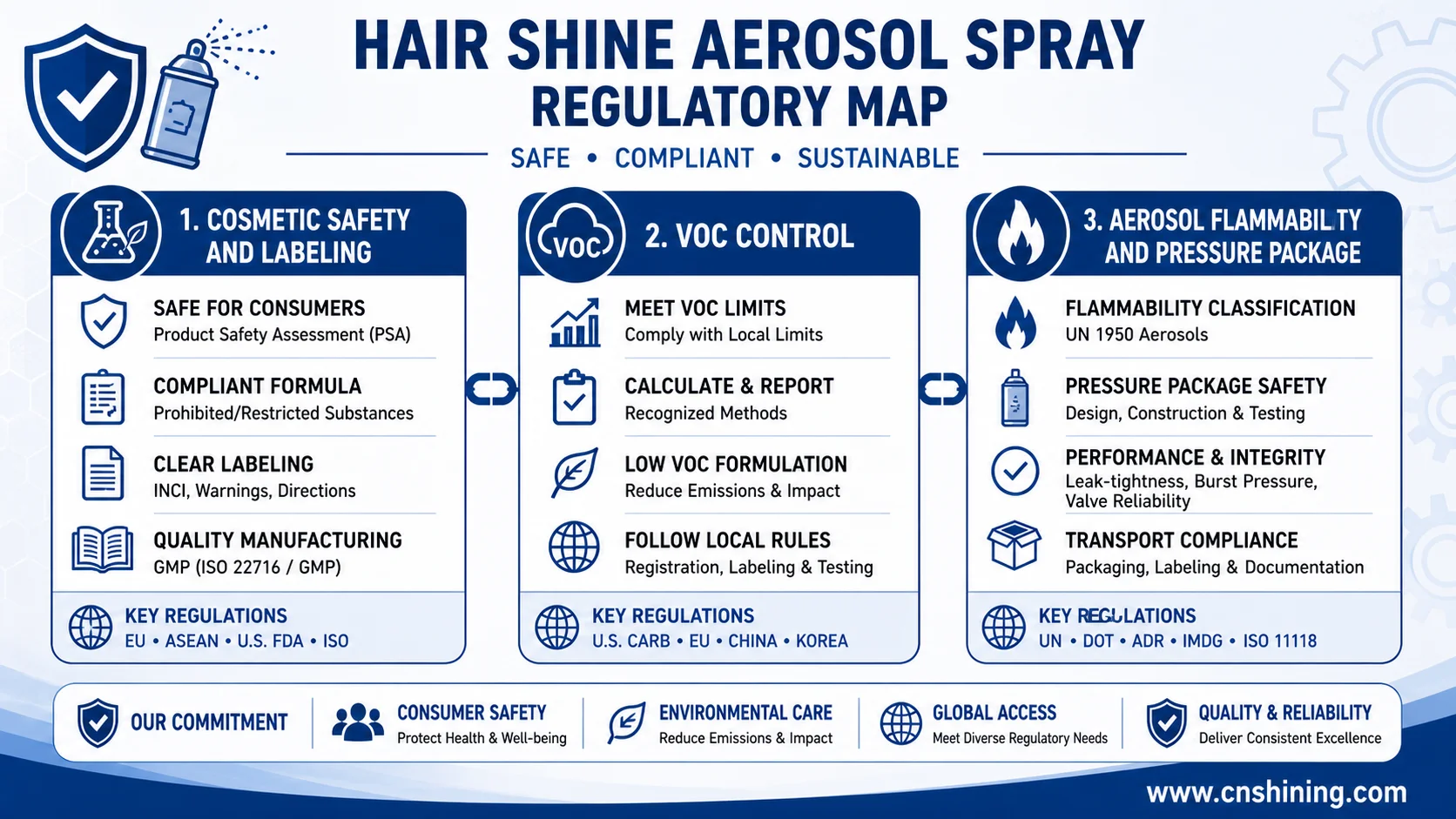
The common mistake is treating aerosol shine spray as only a cosmetic formula. It is also a VOC consumer product in some markets and an easy-to-ignite pressure package. Three layers need to be checked together: cosmetic safety and labeling, environmental VOC rules, and aerosol container or transport safety.
| Market | Main framework | Most relevant requirement for hair shine aerosol spray | Development meaning |
|---|---|---|---|
| United States | EPA consumer product VOC rules and FDA cosmetic rules. | EPA rules define regulated consumer product categories and VOC limits. The source report notes an 80 wt% federal VOC limit for hairspray and stricter California practice. FDA cosmetic products generally need safety and compliant labeling; MoCRA adds facility registration, product listing, safety substantiation, and adverse event duties. | For nationwide U.S. plans, develop against the stricter route early instead of treating VOC as a late label issue. |
| European Union | Cosmetics Regulation, REACH/CLP, Aerosol Dispensers Directive, PPWR. | Aerosol dispensers require attention to flammability, pressure hazards, and hazard analysis. Packaging rules are moving toward recyclability, minimization, and clearer information. | Formula, valve, can, coating, and recycling claim must be validated as one package system. |
For the United States, the most useful starting points are EPA 40 CFR Part 59 Subpart C and the FDA MoCRA page. For Europe, the EU Aerosol Dispenser Directive is a direct packaging safety reference.
On inhalation and propellant safety, CIR sources are useful for technical review, including the CIR inhalation exposure resource and the CIR HFC-152a safety assessment. These do not remove the need for formula-specific exposure assessment. They help frame the questions.
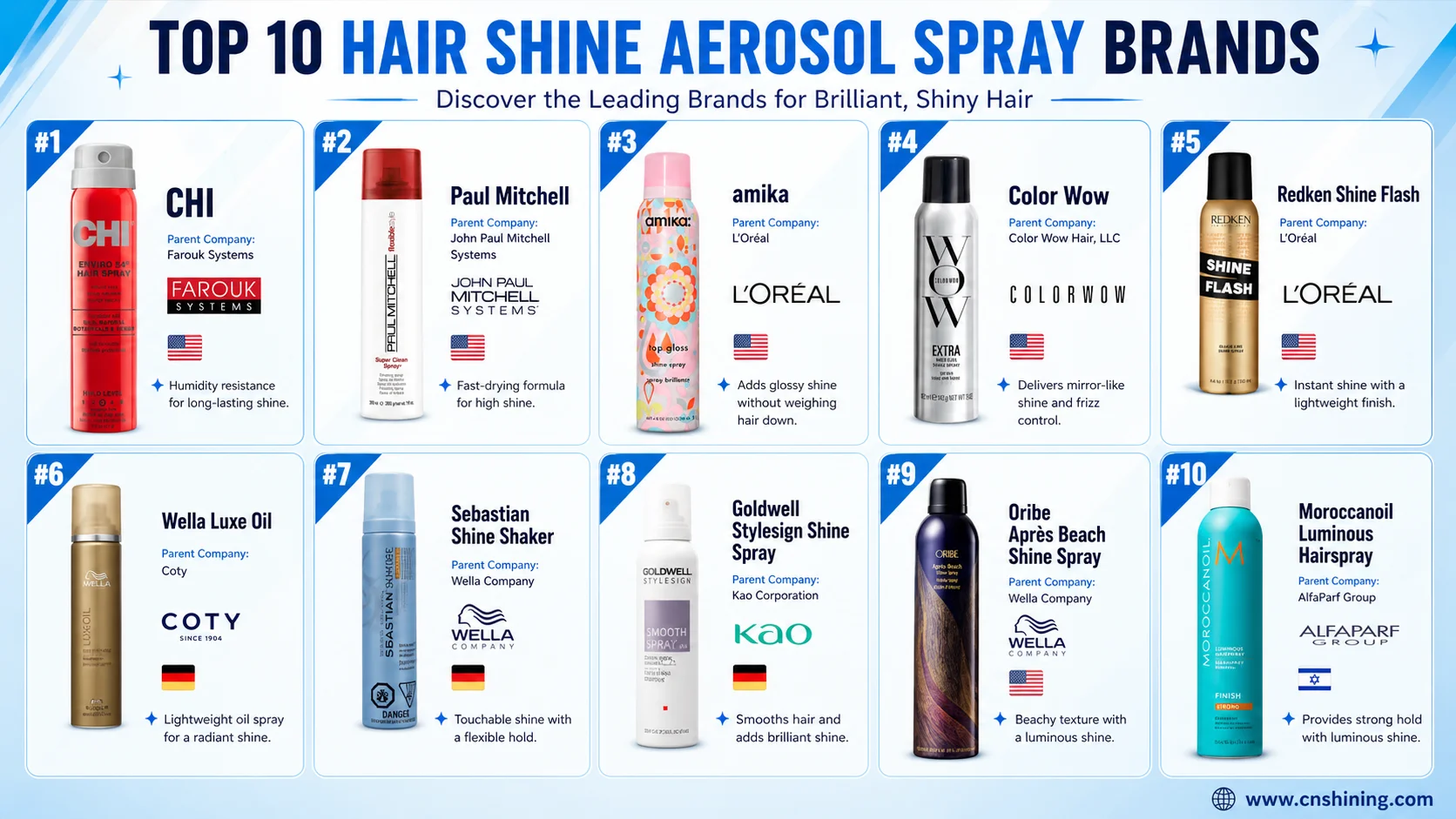
6. Top 10 Hair Shine Aerosol Spray Brands
| Brand | Country | Parent company | Common size | Price | Direct technical reading |
|---|---|---|---|---|---|
| CHI | United States | Farouk Systems | 5.3 oz | US$19.99–22 | Older professional-line logic; strong connection to heat tools; stable value perception. |
| Paul Mitchell | United States | John Paul Mitchell Systems | 3.3 oz | US$24.22–25.50 | More salon-care oriented; shine without an excessively oily reading. |
| amika | United States | Bansk Group | 4.8 oz | US$29 | Social-media-friendly positioning; gloss, frizz control, and color-care language work together. |
| Color Wow | United States | L’Oréal | 5 oz | US$27.55–29 | “All gloss, no grease” is a precise technical promise for fine-hair users. |
| Redken | United States | L’Oréal | 4.4 oz | US$19.20–24 | Professional spray identity, visible shine, anti-frizz function, and broad channel reach. |
| Wella Professionals | United States | Wella Company | 200 ml / 6.8 oz | US$15–20 | UV and humidity-protection claims are easy for users to understand. |
| Sebastian Professional | United States | Wella Company | 200 ml / 6.8 oz | US$24–34 | Classic professional profile: shine, flexible hold, and heat protection. |
| Goldwell | Japan | Kao Corporation | 3.6 oz | US$19.99–25 | Humidity resistance and light gloss are the stronger signals. |
| Oribe | Japan | Kao Corporation | 4.9 oz | US$31.9–38, | High-end sensory expectation; price and availability vary by channel. |
| Moroccanoil | United States | Moroccanoil | 100 ml / 3.4 oz | US$30 or BRL 319 in retail channels | Oil-associated shine identity; more attractive to coarse, dry, or thick hair users. |
7. User Pain Points and Packaging Response
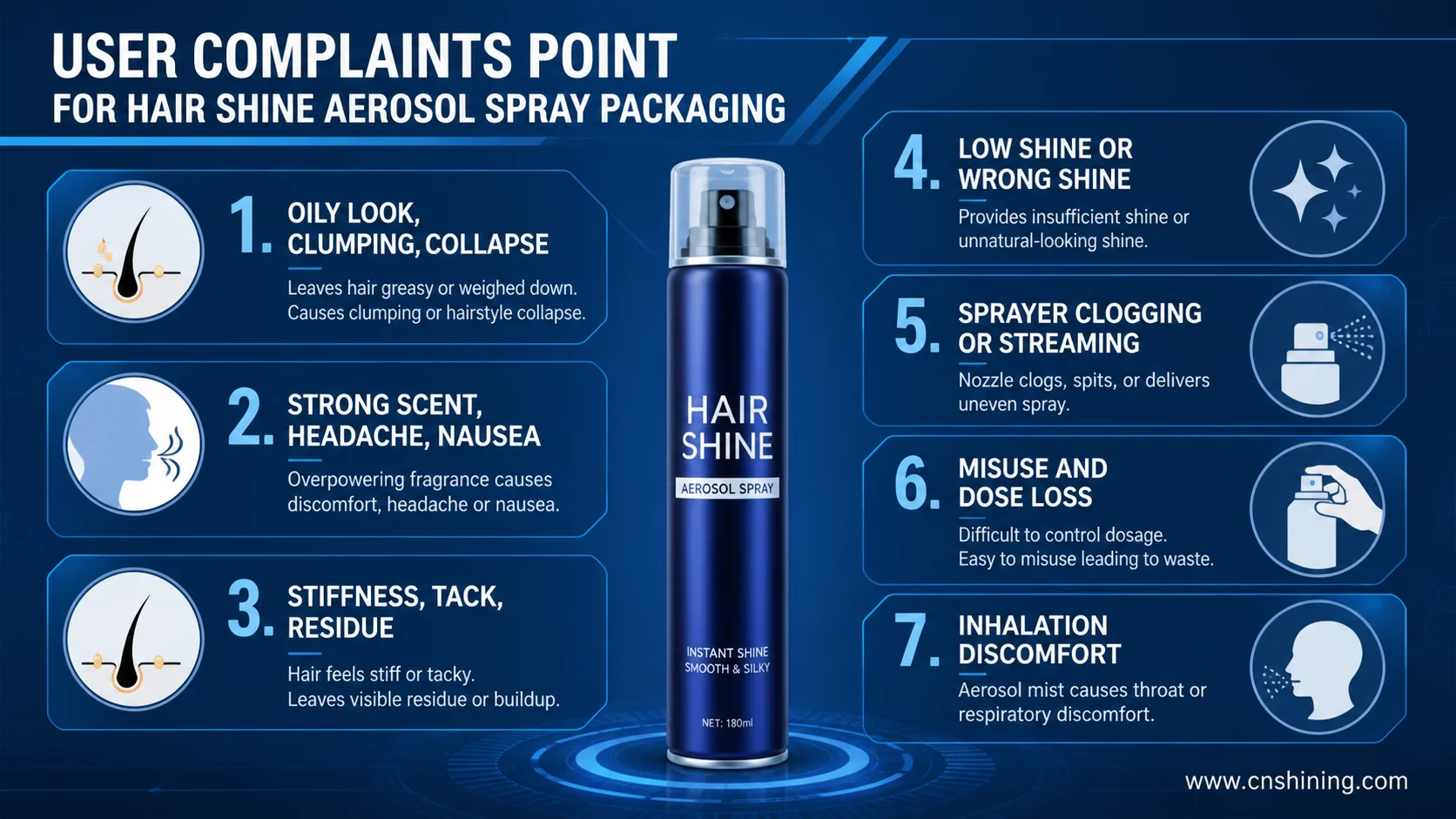
User complaints point to a packaging-formula system problem. The most repeated failures are greasy look, clumping, heavy fragrance, sticky feel, weak shine, clogging, streaming, leakage, overdose, and inhalation discomfort. These are not all formulation failures. Many start at the valve and actuator.
| Pain point | Condensed user signal | Likely technical cause |
|---|---|---|
| Oily look, clumping, collapse | Fine hair users often say one spray too much makes hair greasy or stringy. | High deposition per spray, coarse droplets, heavy gloss agent, wide uncontrolled output. |
| Strong scent, headache, nausea | Heavy fragrance complaints appear across brands, not only one product. | High fragrance load, fast aerosol dispersion, insufficient use-distance instruction. |
| Stiffness, tack, residue | Users confuse shine + light hold with sticky traditional hairspray feel. | Excess polymer, poor solvent balance, incomplete dry-down, over-application. |
| Low shine or wrong shine | Some users see no shine; others see oily shine rather than healthy gloss. | Gloss chemistry and hair type do not match; deposition is too low or too concentrated. |
| Sprayer clogging or streaming | Clog, leak, or jet spray is a clear package failure in user perception. | Actuator insert mismatch, resin build-up, poor valve selection, formula compatibility problem. |
| Misuse and dose loss | Users do not know how little product is needed. | No dose guidance, no distance icon, too high output per press. |
| Inhalation discomfort | Some users report coughing or choking after only one or two sprays. | Spray plume too aggressive, fragrance cloud too strong, poor direction control. |
7.1 Packaging routes
| Route | Key components | Pain point addressed | Advantages | Limitations |
|---|---|---|---|---|
| Standard fine mist aerosol | Standard valve, fine mist actuator, LPG/DME. | Wetness, clumping, uneven spray. | Strong dry spray feel and familiar user format. | VOC and flammability pressure are high. |
| BOV compressed gas | Bag-on-valve, compressed air or nitrogen, 360° spraying. | Low VOC needs, near-complete evacuation, multi-angle use. | Product and propellant gas are separated. | Higher cost; spray may feel wetter if not tuned well. |
| Continuous pump spray | Non-aerosol continuous sprayer. | Propellant and some transport pressure. | Easier low VOC and clean-beauty story. | Droplets are often coarser and local wetness is harder to avoid. |
| Fine mist dedicated actuator | Small orifice, swirl insert, controlled spray angle. | Over-application and local oiliness. | Directly improves first-spray perception. | More sensitive to viscosity and surface tension window. |
| Travel-size can | 50–100 ml slim can with protective cap. | Portability, leakage, actuator contamination. | Works for high-frequency touch-up and trial sets. | Higher unit packaging cost. |
| Recyclable aluminum / PCR / traceable aluminum | Aluminum aerosol can, recycled content strategy, certified sourcing where available. | Sustainability and procurement screening. | Aluminum aerosol cans have strong recycling value | Certification and material cost need review. |
7.2 Component-level recommendations
| Package area | Recommendation | Reason |
|---|---|---|
| Valve | Select for ultra-fine mist, low output, and narrow output distribution first; then tune formula. | The main user failures are wet hair, overdose, and uneven shine. |
| Actuator | Use a fine-mist, flow-limiting design with a geometry that discourages clogging. | The actuator directly controls over-application and first-use perception. |
| Can shape | Use slim tall cans for main SKUs; 50–100 ml formats for travel; consider clearer shoulder and grip geometry for premium lines. | Better handling helps users aim and apply less product. |
| Printing | Use front-panel language that answers user anxiety: non-greasy, fine mist, anti-frizz. Put safety and recycling icons on the side panel. | Hair shine spray is a fast-decision product. The package must reduce misuse quickly. |
| Inner coating and compatibility | Run corrosion, extraction, gasket swelling, valve clogging, and spray stability tests, especially for water-based low VOC routes. | Water-based aerosol systems increase metal corrosion risk without proper internal coating. |
| Use instruction | Add clear icons: shake if required, hold 20–30 cm away, do not spray near face, use small bursts. | Many “greasy” and “too strong” complaints come from wrong distance and dose. |
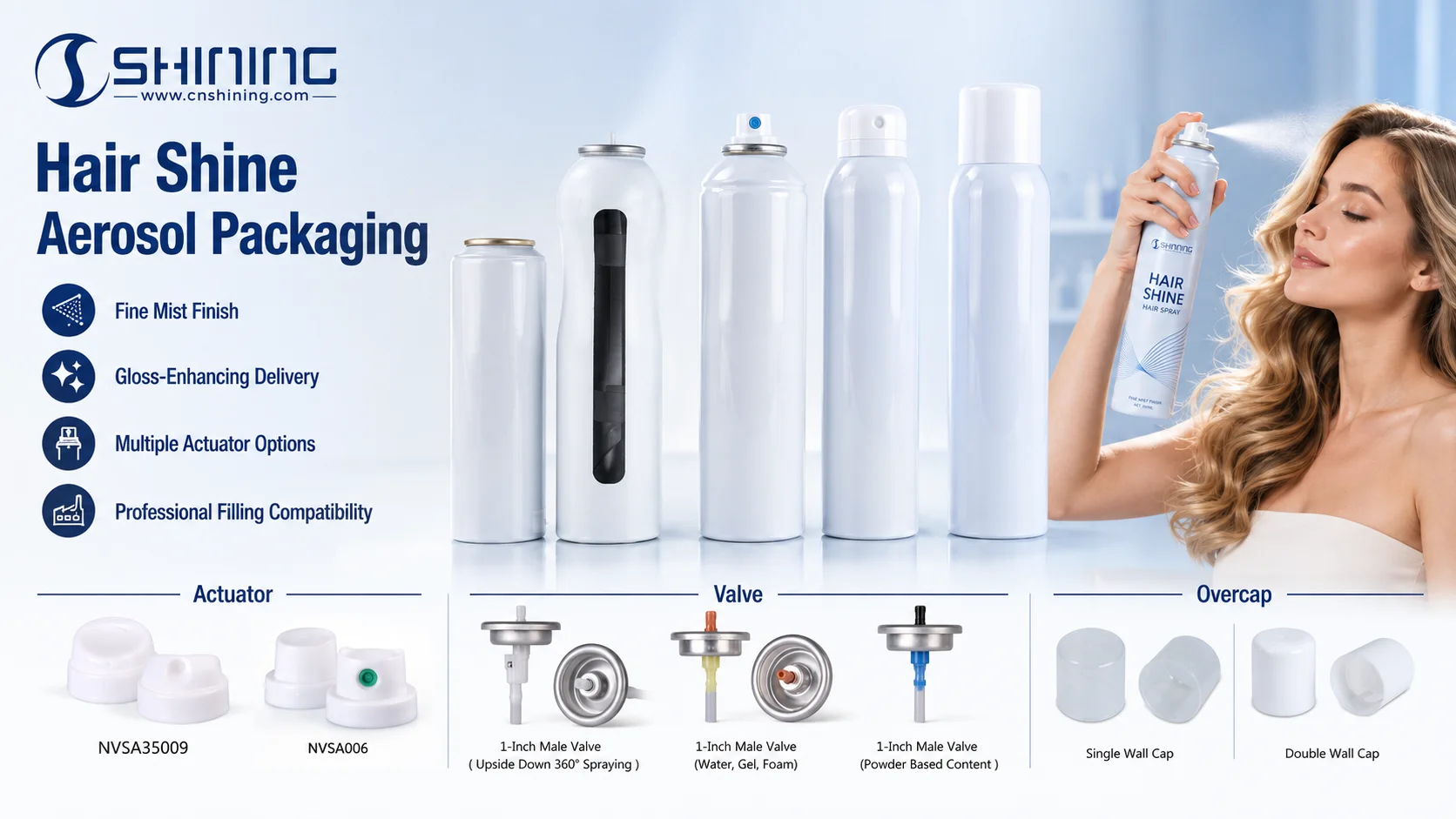
8. Packaging Components for Hair Shine Aerosol Spray by Shining Packaging
For hair shine aerosol spray, packaging should be treated as part of the formulation system. Shining Packaging can be naturally positioned around three component groups: actuators, aerosol cans, and valves. The useful question is not “which part looks better?” The useful question is “which combination gives lower wetness, finer mist, stable output, and fewer user mistakes?”
For actuators, the priority is spray control. A shine spray normally benefits from a fine-mist actuator with controlled output and a spray angle that avoids dumping too much gloss agent on one spot. For aerosol cans, aluminum can selection, internal coating, print readability, cap protection, and travel-size options should be reviewed with the formula and propellant. For valves, output consistency, sealing, gasket compatibility, and clog resistance need bench testing before commercial artwork is fixed.
Shining Packaging’s role in this context is practical: match actuator, valve, and can specification to the hair shine aerosol spray’s viscosity, solvent level, propellant route, and desired spray feel. The same package logic also applies to glossing spray, anti-frizz shine mist, salon finishing spray, and glass hair spray formats.
9. Conclusion
Hair shine aerosol spray succeeds when four things happen at the same time: fine mist, fast dry-down, controlled gloss deposition, and low user burden. More shine agent alone does not solve the product. It often creates the next complaint: greasy feel, clumping, and collapsed hair.
The better development route is to tune the full system. Formula, propellant, valve, actuator, can coating, safety artwork, and recycling claim should be tested together. If the product can deliver visible gloss with less wetness, less scent overload, lower VOC pressure, and clearer use instruction, it becomes more than a finishing accessory. It becomes a repeat-use professional finishing format.
10. FAQ: Hair Shine Aerosol Spray Technical Questions
Normal hairspray is usually designed around hold, fiber-to-fiber bonding, and style retention. Hair shine aerosol spray focuses on optical finishing. It uses fine mist deposition, volatile carrier evaporation, and a thin gloss film to increase mirror reflection on hair. Some formulas still add light hold or humidity resistance, but strong fixation is not the main target.
Greasiness usually comes from excess deposition in one area. Causes include too much shine agent, coarse droplets, high spray output, short spraying distance, or an actuator that produces a wet plume. Fine or oily hair shows this failure faster. The package should support small-dose application, not push a heavy gloss load per press.
Shine usually comes from phenyl silicones, high refractive index silicone fluids or resins, light oils, and a smooth residual film. These materials reduce surface roughness and increase mirror-like reflection. The final effect is not from one ingredient alone. Atomization, spreading, evaporation, and residue film quality decide how clean the gloss looks.
Atomization controls droplet size and distribution. Fine droplets spread evenly and dry quickly, which gives a light finishing feel. Large droplets can wet the hair, form shiny patches, and create clumps. For shine spray, poor atomization can make a good formula look oily. Valve and actuator selection therefore affect visible performance directly.
Not always, but it narrows the design window. VOC propellants and solvents often help with fast drying and particle break-up. Reducing VOC may require water-based systems, compressed gas, BOV, or different polymer choices. These routes can work, but the spray may feel wetter unless valve, actuator, surface tension, and solids level are tuned together.
The actuator shapes the spray plume. It affects spray width, droplet size, output rate, aim, and clogging behavior. In hair shine aerosol spray, a fine-mist and flow-limited actuator can reduce overdose and greasy patches. A poor actuator can turn the same formula into a wet stream, causing clumping and weak user trust.
Aerosol delivery disperses fragrance quickly into the air, so the same fragrance level can feel stronger than in a cream or oil. Alcohol, propellant expansion, and wide spray plumes also spread odor fast. Strong fragrance may be read as “salon-like” by some users, but it can trigger complaints about headache, nausea, or coughing.
Bag-on-valve can suit shine spray when low VOC, product-propellant separation, 360° spraying, or high evacuation are priorities. It is not automatically better. If the valve and actuator are not matched to the formula, the spray can feel wetter than a classic LPG/DME aerosol. BOV should be tested on hair switches, not judged by concept alone.
Useful tests include output rate, spray pattern, droplet feel, clogging, leakage, actuator recovery, can corrosion, gasket compatibility, valve swelling, hot storage, cold storage, and hair-switch deposition. For water-based or low VOC formulas, inner coating and corrosion checks are especially important. A good lab result still needs a repeatable user-distance test.
Instructions should tell users to spray from about 20–30 cm away, use short light bursts, avoid spraying toward the face, keep away from flame, and use the product in a ventilated area. Dose guidance matters. Many bad outcomes come from spraying too close or too much, not from the product concept itself.