
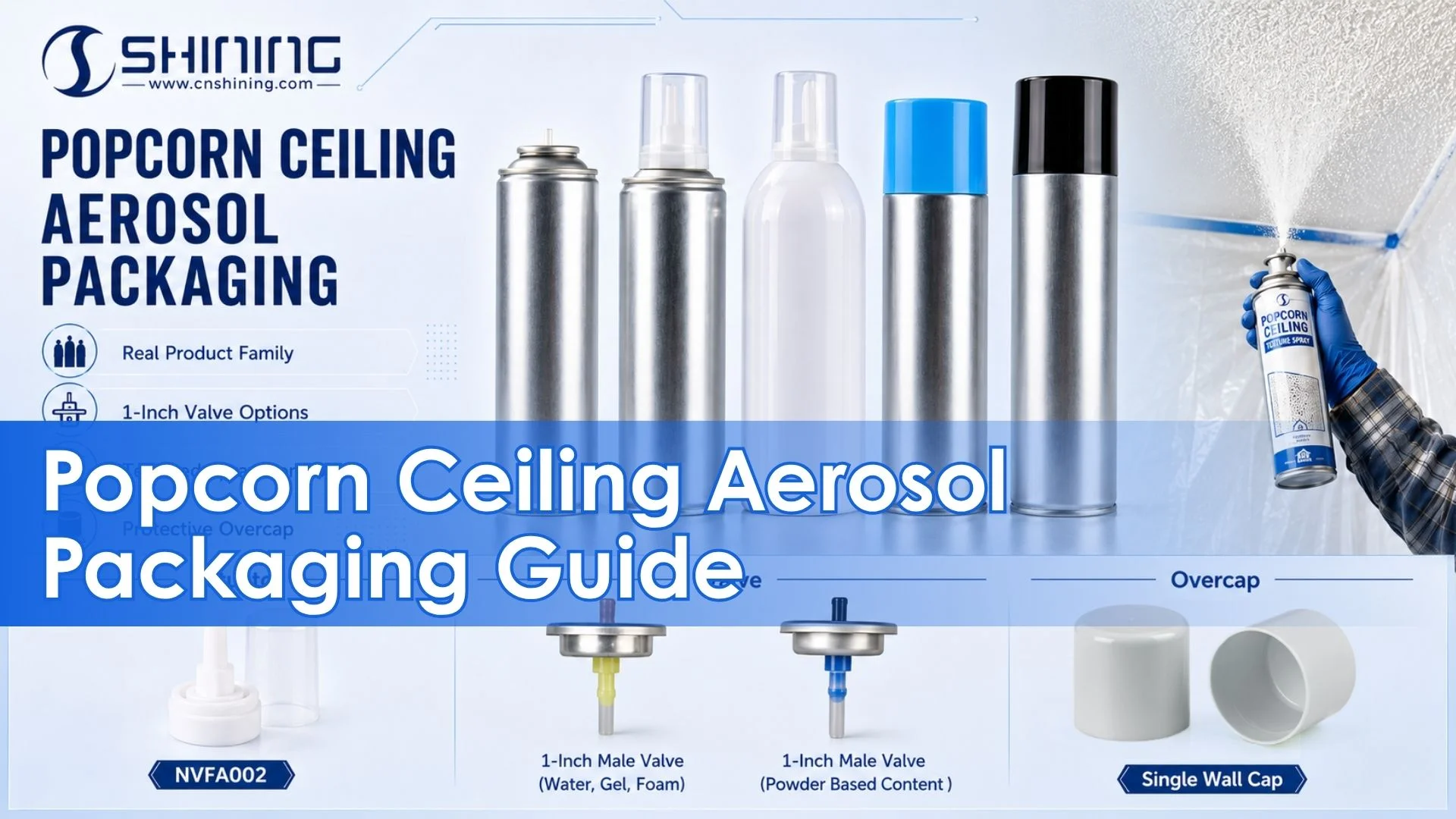
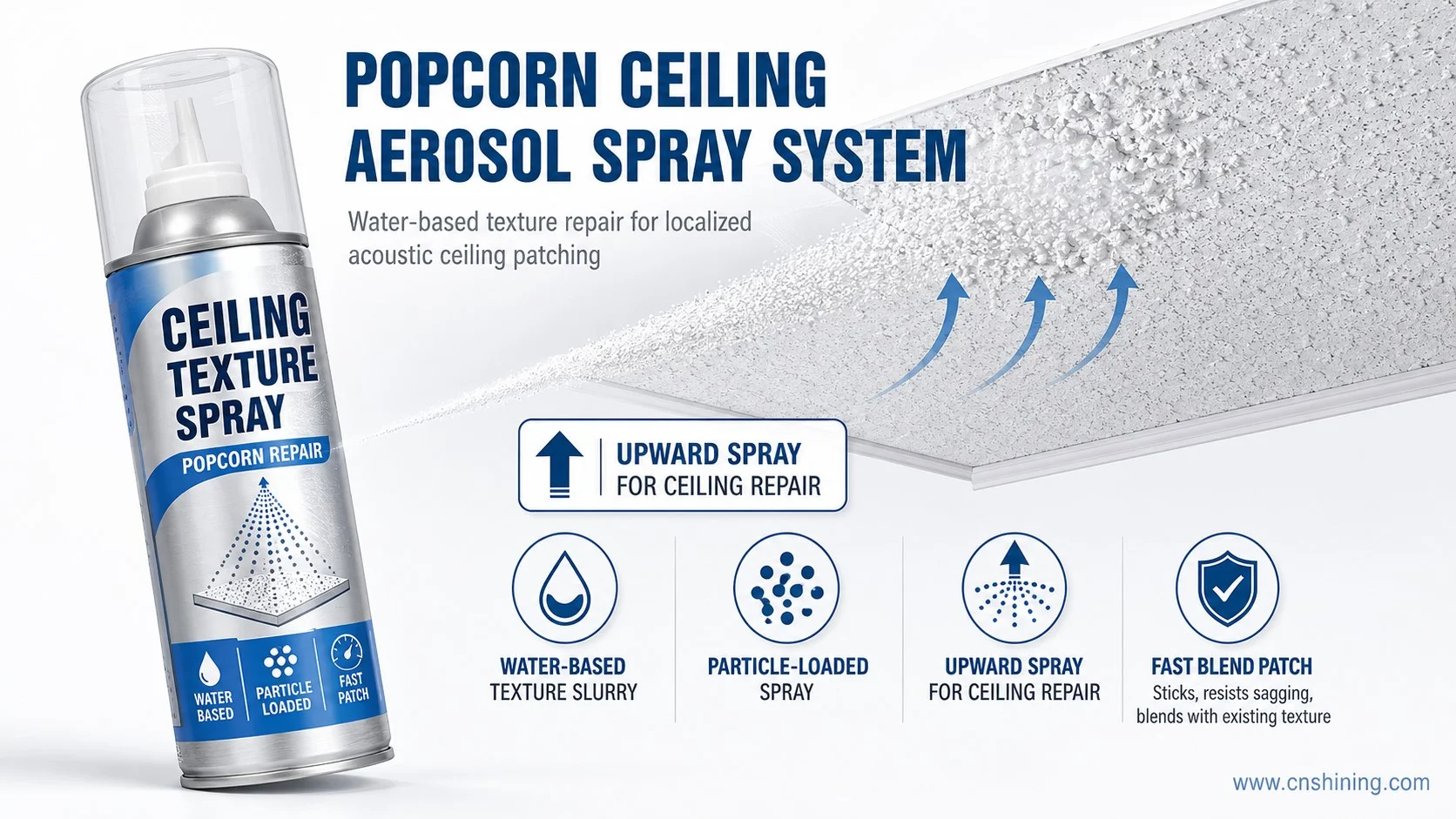
Popcorn ceiling aerosol spray is not ordinary spray paint. It is a high-solids, particle-loaded aerosol texture system used to repair or rebuild localized acoustic ceiling texture, also called popcorn texture, stipple ceiling, or acoustic ceiling texture. The can must deliver water-based texture slurry, lightweight aggregate, binder, fillers, and propellant through a valve and actuator without clogging or dumping material onto the ceiling.
That is the technical problem. A hopper gun and compressor can handle coarse slurry because the operator controls air, mix, and flow. A small aerosol can has less room for error. The texture must spray upward, stick to the ceiling, resist sagging, and blend with old commercial texture in a few square feet.
1. Product Definition and Repair Use Cases
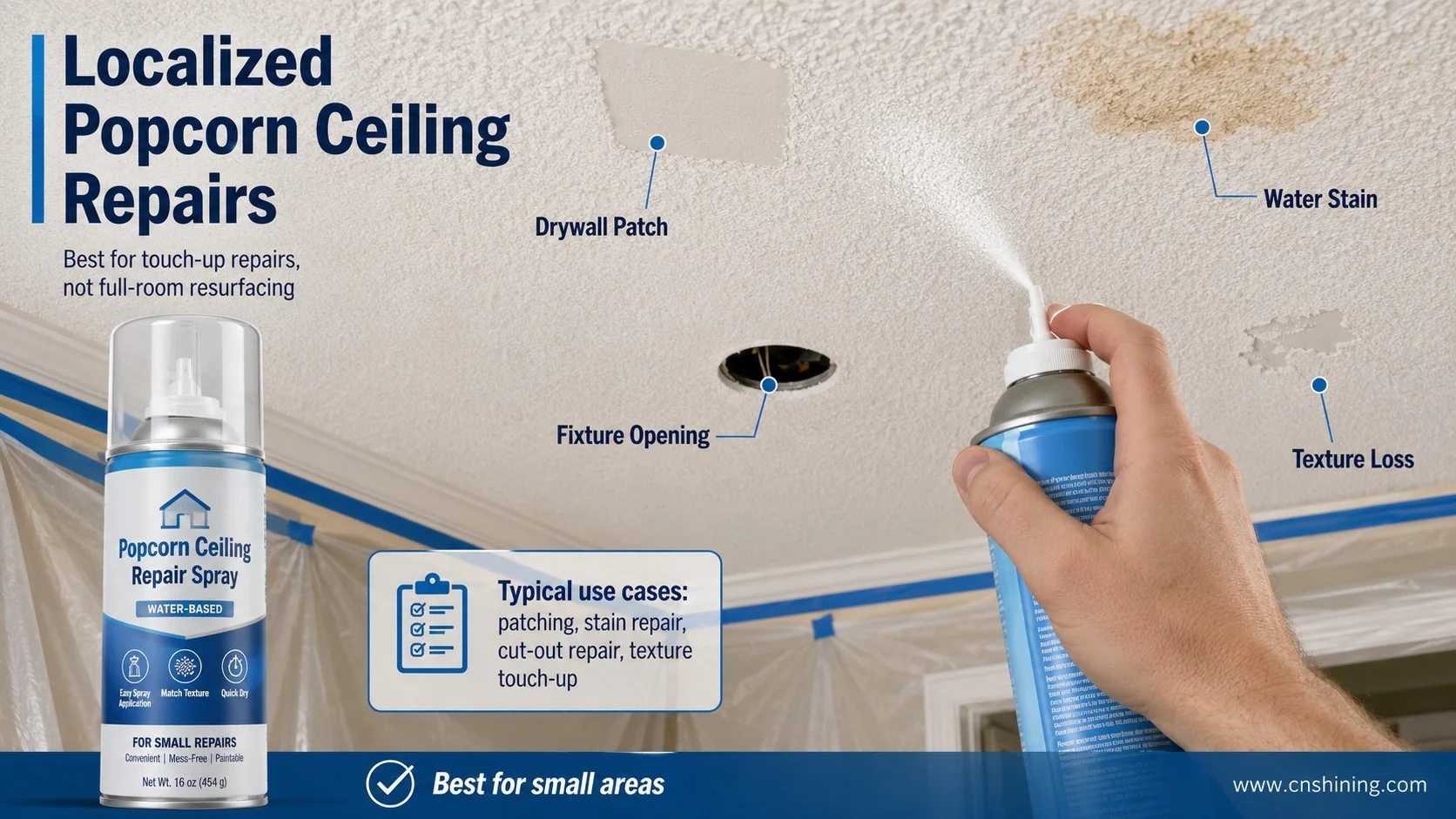
Public product documents position this category for localized repair, not full-room resurfacing. A Homax/PPG product page states that its aerosol ceiling texture is designed to match originally commercially applied popcorn texture and contains actual polystyrene chips without requiring a hopper gun; see the Homax aerosol ceiling texture product description. DAP describes its water-based popcorn ceiling aerosol as an easy-to-use ceiling repair product with strong adhesion, sag resistance, low odor, water cleanup, and 30-minute paint-ready time in its DAP popcorn water-based technical data sheet. Zinsser positions its water-based spray for repairs and patches on already textured ceilings in the Zinsser popcorn ceiling texture spray TDS.
The practical use cases are narrow and clear: water-damage repair, small drywall patch repair, cut-out repair around fixtures, localized texture loss, staining cover-up, and DIY repairs where the user wants to avoid renting a hopper gun and compressor. Typical public coverage figures sit in the 2–9 ft² per can range, depending on texture thickness and product format.
2. Spray Mechanism and Formulation Logic
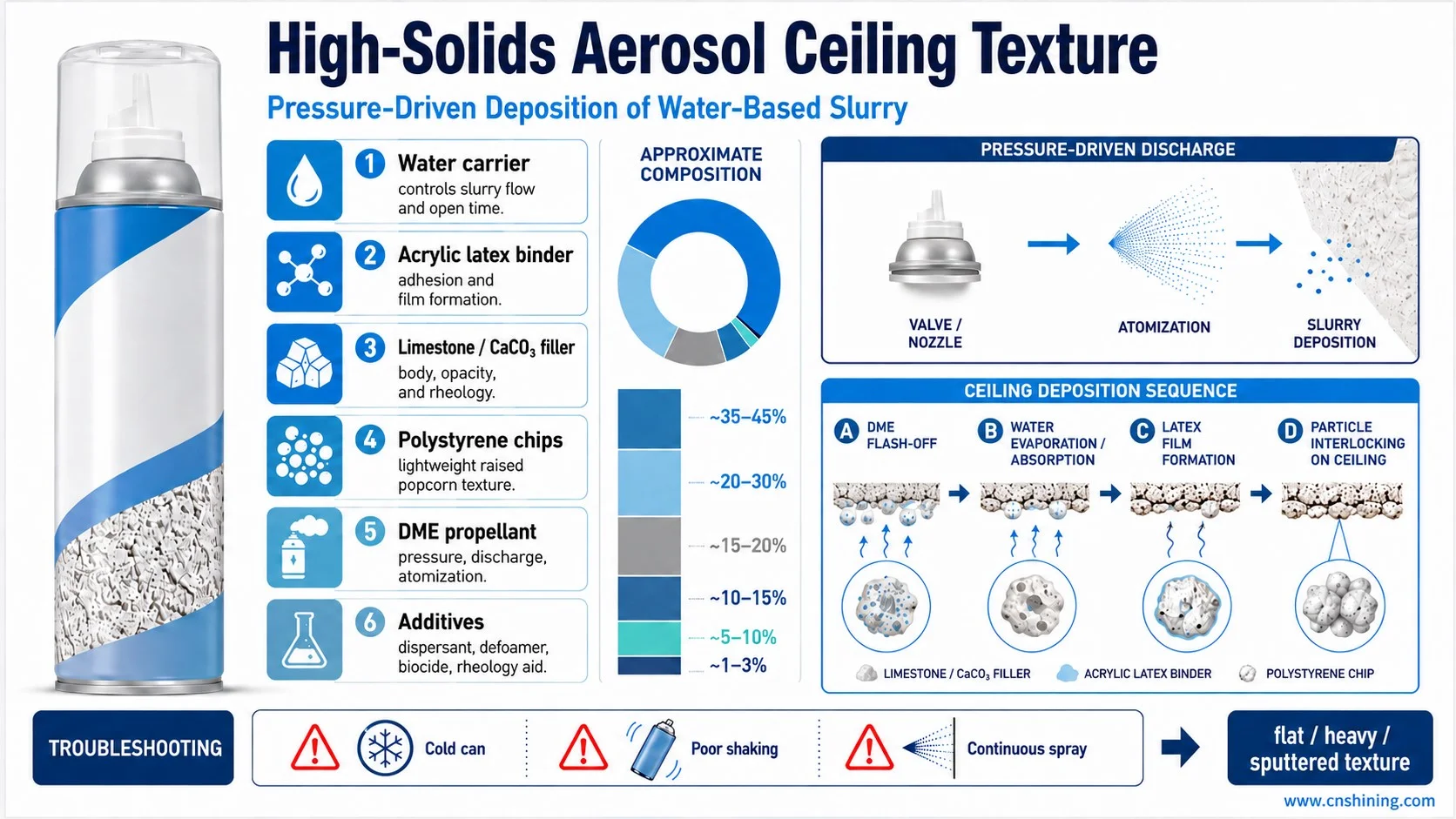
The core mechanism is a pressure-driven deposition of high-solids slurry. Related patent literature separates the system into an aerosol dispenser, concentrate, and propellant, and also discusses actuator outlet opening area as a way to influence texture pattern; see the spray texture aerosol system patent. Another patent describes an aqueous quick-dry sprayable drywall texture based on water, filler, and polymer in a pressurized container; see the aqueous quick-dry sprayable drywall texture patent.
After spraying, the process is best understood as four linked steps: propellant flash-off, water evaporation or absorption, latex or copolymer film formation, and particle interlocking. DME helps discharge and atomize the slurry. Water then leaves the deposit. The binder coalesces and fixes calcium carbonate, limestone, clay, titanium dioxide, talc, polystyrene aggregate, or similar lightweight particles to the ceiling surface.
This explains the common failures. If the can is cold, poorly shaken, sprayed too close, or sprayed continuously instead of in bursts, the texture may come out too flat, too heavy, sputtered, or cream-like. Ceiling work is unforgiving because gravity exposes every rheology weakness.
| Functional Group | Typical Ingredients | Role in the System | Public Ratio Clues |
|---|---|---|---|
| Lightweight aggregate / bulking phase | Polystyrene chips, perlite | Creates raised popcorn texture, lowers density, improves visual/acoustic roughness | USG QT Poly dry texture lists polystyrene aggregate; see the USG QT Poly submittal sheet. |
| Binder | Acrylic latex, EVA copolymer, starch/PVA in dry systems | Binds filler and particles to the ceiling; affects adhesion, paintability, and chalk resistance | DAP identifies acrylic latex as base polymer; Zinsser identifies EVA copolymer. |
| Fillers | Limestone, calcium carbonate, clay, talc, titanium dioxide, silica | Provides body, opacity, whiteness, rheology, and particle framework | DAP SDS lists limestone 10–30%, calcium carbonate 7–13%, clay 3–7%, titanium dioxide 1–5%, respirable crystalline silica 0.1–1.0%; see the DAP popcorn aerosol SDS. |
| Carrier | Water, minor coalescent or co-solvent | Controls application viscosity and film formation | Water-based systems dominate the sampled public documents; DAP lists Texanol at 1–5%. |
| Propellant | Dimethyl ether, DME | Builds can pressure and drives discharge; affects flammability and temperature sensitivity | DAP lists DME at 10–30%; sampled Homax/DAP/Zinsser public documents do not list HFC/HFO propellants. |
| Additives | Dispersant, defoamer, biocide, anti-corrosion package, rheology aid | Supports storage stability, corrosion control, microbial preservation, and spray feel | Patent documents explicitly discuss biocide, defoamer, dispersant, and anti-corrosion materials. |
3. Performance Compared with Alternative Texture Systems
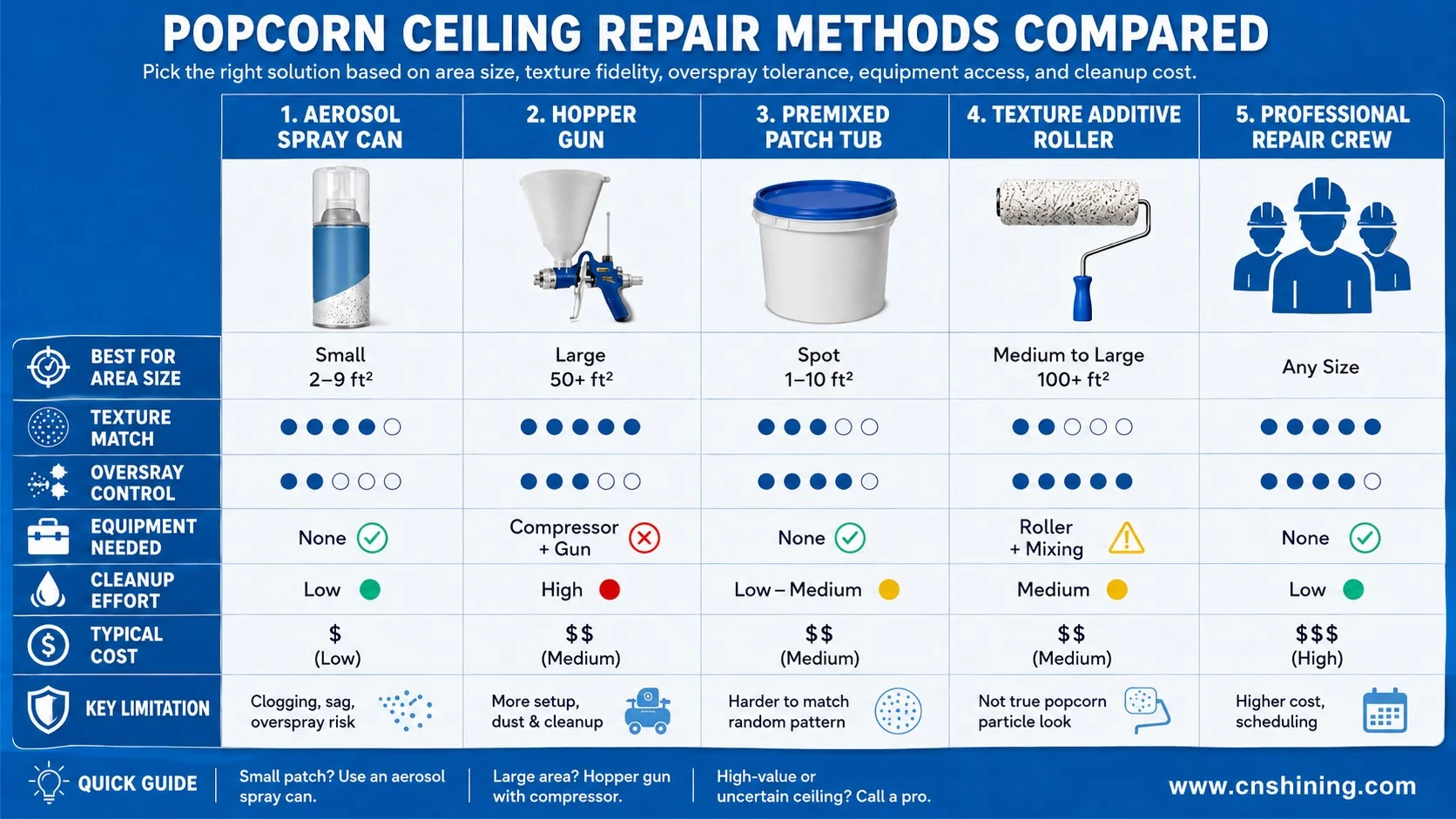
The choice is not aerosol versus nothing. Contractors and DIY users have several repair paths. The right answer depends on area size, texture fidelity, overspray tolerance, equipment access, and cleanup cost.
| System | Typical Performance | Convenience | Safety / Environmental Notes | Technical Judgment |
|---|---|---|---|---|
| Popcorn ceiling aerosol spray | Best suited for 2–9 ft² repairs; good particle texture if shaken, warmed, and sprayed correctly | Highest. No compressor or hopper gun. | Often water-based and low odor, but DME keeps flammability and pressure-container duties in place. | Good for small ceiling repairs. Poor control design causes clogging, sag, and overspray complaints. |
| Dry texture mix + hopper gun | Better for large areas and adjustable texture build | Lower. Requires mixing, masking, compressor, gun cleanup. | Dust and cleanup load are higher. | Better for re-sprays and larger repairs, not convenient for one small patch. |
| Premixed patch compound | Useful for spot repair and hand application | Medium. No pressurized can, but hand texture skill matters. | Shipping and storage are simpler than aerosol. | Low-mess option, but the random sprayed popcorn particle look is harder to reproduce. |
| Texture additive mixed into paint | Creates acoustic texture appearance, not always true popcorn repair | Medium. Requires mixing and rolling. | Avoids aerosol overspray and dangerous-goods shipment. | Useful for broader refresh work, weaker for high-fidelity patch blending. |
| Professional repair or removal | Highest possible finish quality, dependent on worker skill | Low user effort, higher scheduling and labor cost | Older ceilings may require better dust and lead/asbestos risk management. | Best for high-value or uncertain substrates. Often excessive for a small DIY patch. |
A cost point from public remodeling data is useful but should not be overread: popcorn ceiling removal is often discussed around $1–$6 per square foot, while repair quotes can vary heavily by minimum call-out charges. For a broad cost reference, see Angi’s popcorn ceiling removal cost data.
4. Regulatory and Compliance Framework
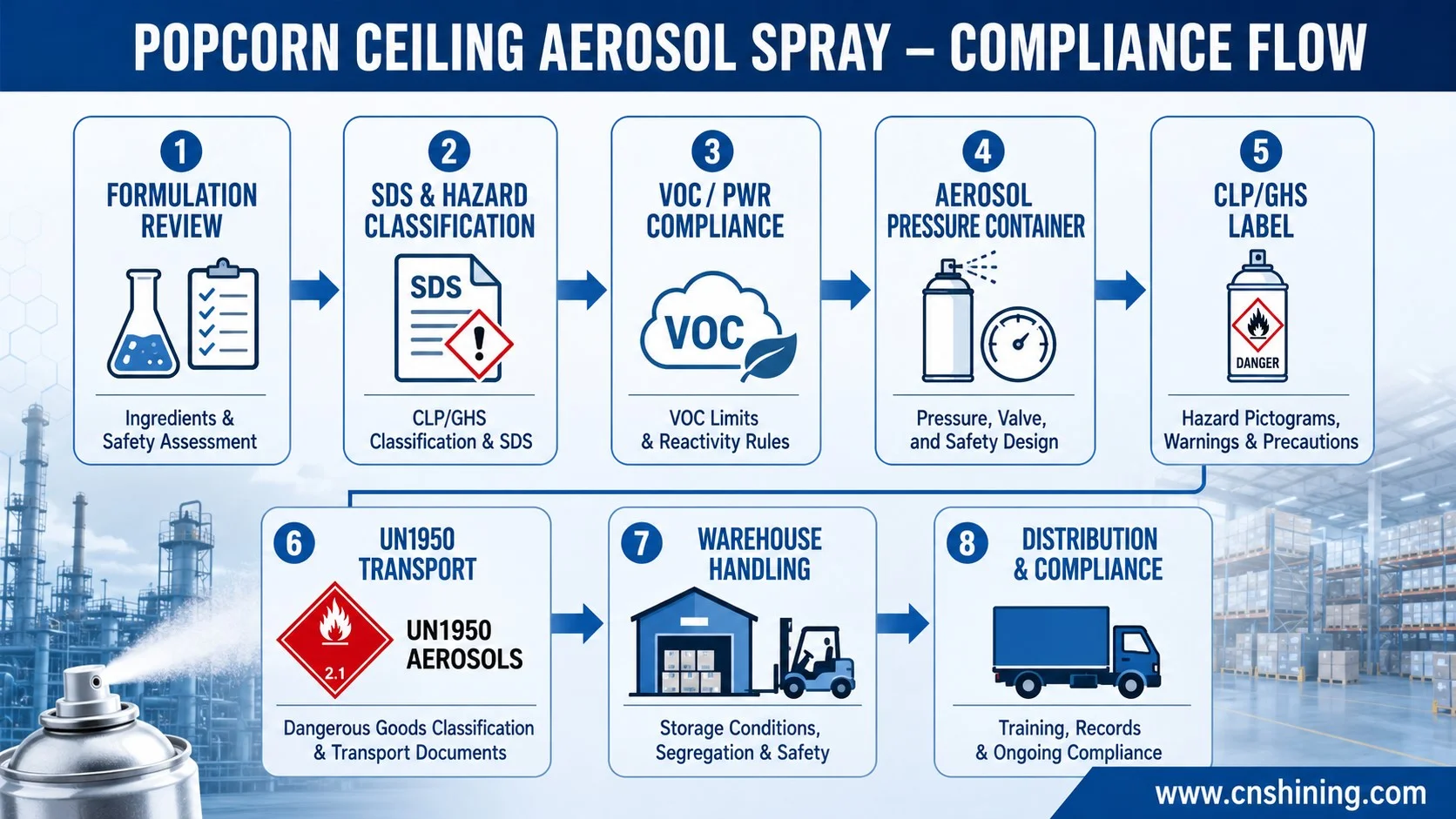
This product sits across five compliance layers: chemical substance control, hazard classification and SDS, VOC or reactivity rules, aerosol pressure-container rules, and dangerous-goods transport. The common mistake is to assume “water-based” means low regulatory burden. It does not. A water-based aerosol with DME is still a pressurized, flammable aerosol system.
| Market | Relevant Framework | Technical Meaning for Popcorn Texture Aerosols |
|---|---|---|
| United States | EPA aerosol coatings VOC rule and 40 CFR Part 59 Subpart E | Formulation must be reviewed against reactivity/VOC logic, labeling, records, and reporting. Flammable aerosol transport duties remain separate. |
| Canada | Transportation of Dangerous Goods Regulation 2.14.1 | Aerosol containers are transported under UN1950 AEROSOLS. Container design and transport classification matter early in packaging development. |
| European Union | EU Aerosol Dispensers Directive 75/324/EEC | Labeling, flammability, maximum pressure, and aerosol-specific requirements must be aligned with CLP-style hazard communication. |
| United Kingdom | HSE GB CLP guidance | Post-Brexit GB classification, labeling, SDS, and duty-holder responsibilities need separate checking rather than assuming EU transfer. |
| Brazil | ANVISA PHPC aerosol labeling context | The linked public framework is category-specific, but it illustrates how aerosol warning language differs by regulated product class. |
5. Top Brands and Main Product Lines
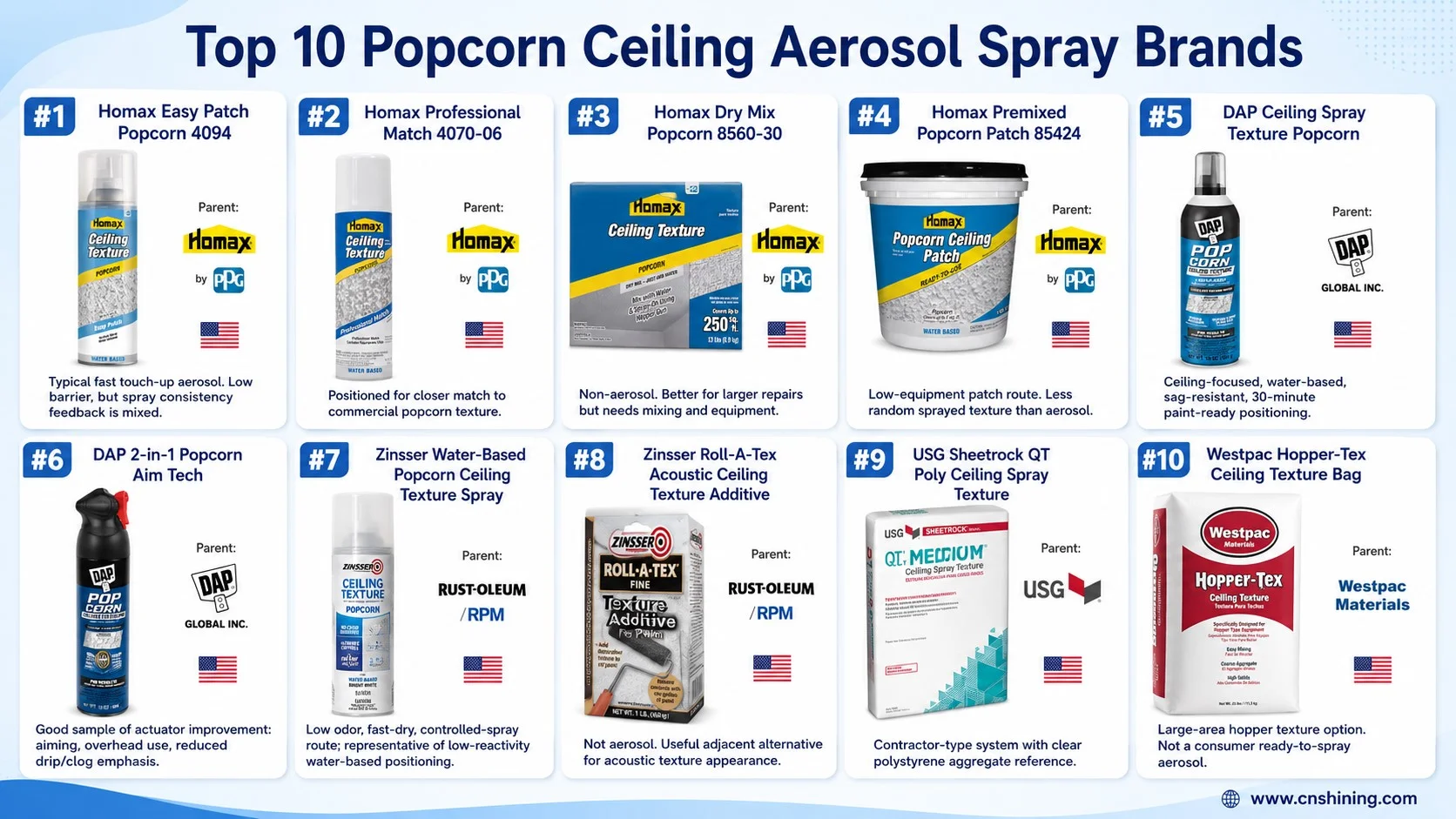
| Brand / Product Line | Country | Company | Common Size | Technical Comment |
|---|---|---|---|---|
| Homax Easy Patch Popcorn 4094 | U.S. | Homax / PPG | 14 oz | Typical fast touch-up aerosol. Low barrier, but spray consistency feedback is mixed. |
| Homax Professional Match 4070-06 | U.S. | Homax / PPG | 16 oz | Positioned for closer match to commercial popcorn texture. |
| Homax Dry Mix Popcorn 8560-30 | U.S. | Homax / PPG | 13 lb | Non-aerosol. Better for larger repairs but needs mixing and equipment. |
| Homax Premixed Popcorn Patch 85424 | U.S. | Homax / PPG | 1 qt | Low-equipment patch route. Less random sprayed texture than aerosol. |
| DAP Ceiling Spray Texture Popcorn | U.S. | DAP Global Inc. | 16 oz | Ceiling-focused, water-based, sag-resistant, 30-minute paint-ready positioning. |
| DAP 2-in-1 Popcorn Aim Tech | U.S. | DAP Global Inc. | 20 oz | Good sample of actuator improvement: aiming, overhead use, reduced drip/clog emphasis. |
| Zinsser Water-Based Popcorn Ceiling Texture Spray | U.S. | Rust-Oleum / RPM | 14 oz | Low odor, fast-dry, controlled-spray route; representative of low-reactivity water-based positioning. |
| Zinsser Roll-A-Tex Acoustic Ceiling Texture Additive | U.S. | Rust-Oleum / RPM | 1 lb | Not aerosol. Useful adjacent alternative for acoustic texture appearance. |
| USG Sheetrock QT Poly Ceiling Spray Texture | U.S. | USG | 40 lb | Contractor-type system with clear polystyrene aggregate reference. |
| Westpac Hopper-Tex Ceiling Texture Bag | U.S. | Westpac Materials | 25 lb | Large-area hopper texture option. Not a consumer ready-to-spray aerosol. |
6. Customer Pain Points and Packaging Design Improvements
The repeated complaints are not random. They point back to flow path, actuator ergonomics, temperature window, can shaking, and cleanup behavior. In this category, packaging is part of product performance.
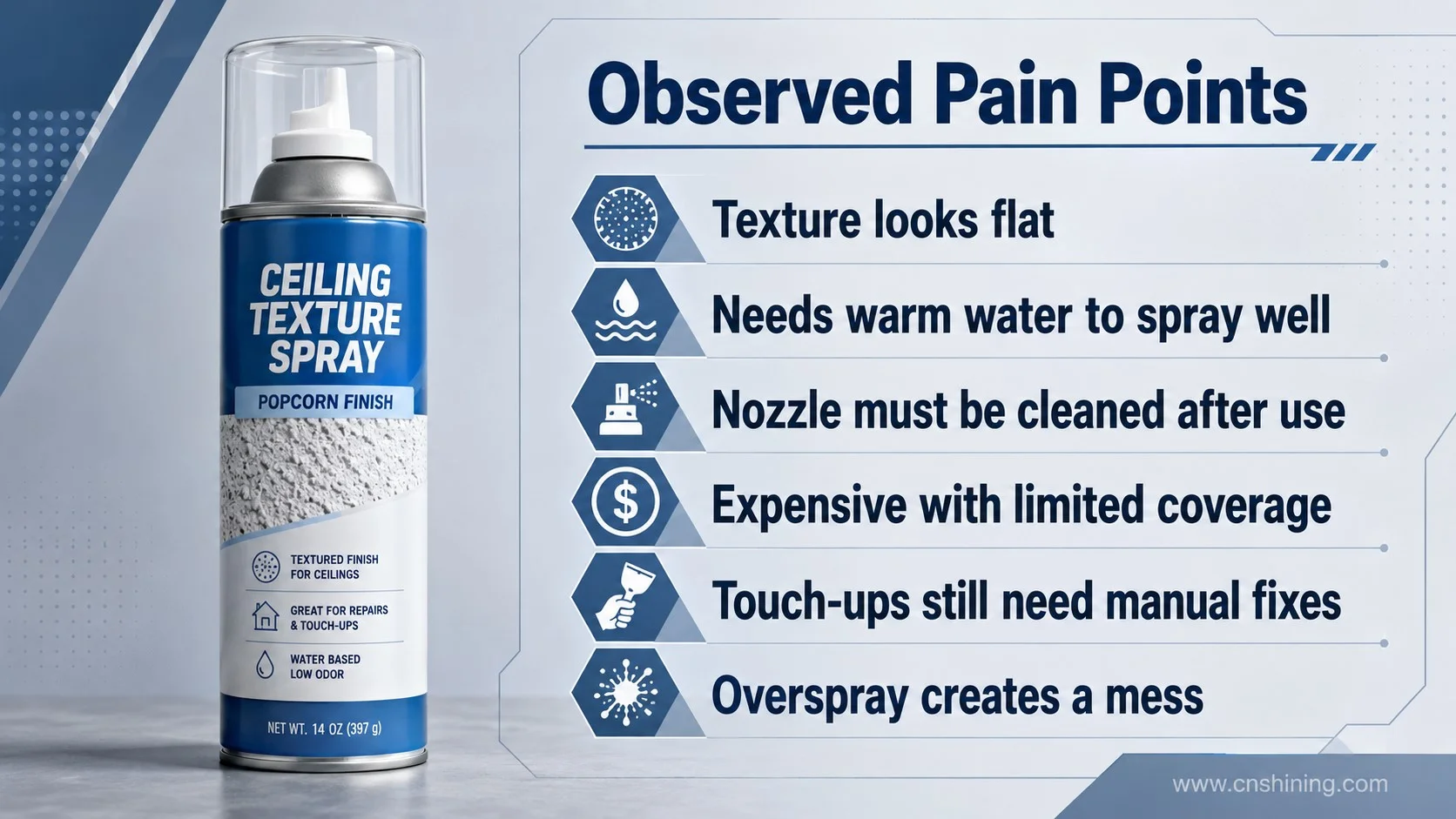
| Observed Pain Point | Likely Root Cause | Packaging / Structure Improvement | Why It Helps |
|---|---|---|---|
| Texture looks too flat; user is told to shake more or spray farther away. | Poor dispersion, short stand-off distance, low particle lift | Printed shake timer, distance scale, test card | Turns vague instructions into visible actions. |
| Can needs warm water to spray acceptably. | DME pressure and slurry viscosity are temperature-sensitive | Thermochromic temperature strip on can body | User sees when the can is within a workable temperature range. |
| Nozzle must be washed or soaked after use. | Residual slurry dries in the outlet path | Removable nozzle, rinse cap, purge channel | Keeps dried texture outside the valve stem as much as possible. |
| Canned texture is expensive and does not go far. | High build per pass, low coverage expectation, trial-and-error loss | Two-stage actuator: Spot/Blend and Heavy/Build | Lets users feather edges before building heavy popcorn texture. |
| Touch-up kits still invite user modification. | Spray direction and pattern control are not intuitive enough | Rotatable actuator with indexed angle positions | Builds the common user “modification” into the factory design. |
| Overspray and mess spread quickly. | Coarse droplets, upward spraying, rebound, poor masking | Snap-on overspray skirt or small folding shield | Reduces the cleanup burden and makes masking less optional. |
The strongest development route is practical: large-flow anti-clog valve, rotatable or upward actuator, two-flow control, visible temperature window, overspray accessory, corrosion-resistant internal coating, and graphic instructions with QR video support. None of these changes need inflated claims. They target known failure modes.
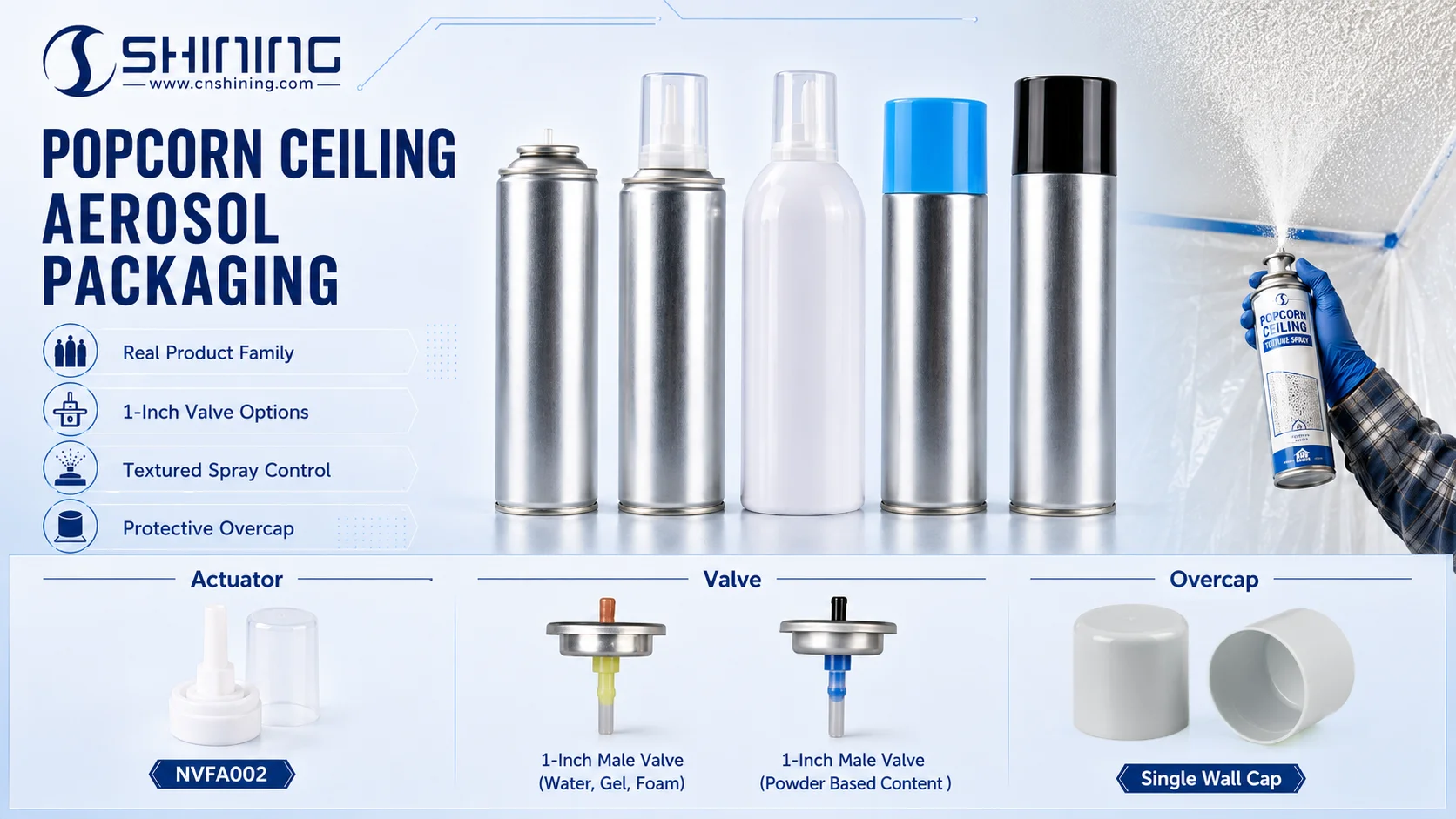
7. Product Fit: Shining Packaging Actuators, Cans and Valves
For popcorn ceiling aerosol spray, the package is a dispensing machine. The aerosol can, internal coating, valve, dip tube, actuator, overcap, and printed instructions all affect the repair result. Shining Packaging fits naturally into this discussion as a metal packaging and aerosol component supplier, especially where customers need coordinated work on actuators, aerosol cans, and valves.
For this product type, the actuator should not be treated as a cosmetic button. It needs enough outlet area for particle-loaded slurry, stable upward spraying, finger comfort during ceiling work, and a cleanup path that prevents dried texture from locking the nozzle. The can also needs compatible internal protection because water-based, mineral-filled, high-solid slurry can be more aggressive to storage stability than a simple solvent spray paint.
A practical component brief would include: tinplate or aluminum aerosol can specification, water-based slurry compatibility check, anti-corrosion internal coating review, valve flow-path sizing, actuator spray-angle testing, overcap clearance for messy nozzles, and label space for temperature, shake, distance, purge, and transport warnings.
8. Closing Technical Judgment
Popcorn ceiling aerosol spray is a small repair category with a demanding package. The product must move coarse, high-solid slurry through a compact aerosol system, then make that slurry stick overhead and blend into old texture. The competitive problem has moved from “can it spray?” to “can it spray predictably, cleanly, and close enough on the first attempt?” The most useful improvements are therefore mechanical and instructional: better valve flow, better actuator control, better temperature guidance, better cleanup design, and clearer use instructions.
9. FAQ: Popcorn Ceiling Aerosol Spray
It is a ready-to-use aerosol texture material for repairing localized popcorn or acoustic ceiling texture. Unlike normal spray paint, it contains a high-solids water-based slurry, binder, fillers, lightweight particles, and propellant. The can, valve, and actuator must discharge coarse material upward while still producing a random raised texture that can blend into an existing ceiling.
Ordinary spray paint is usually a lower-viscosity coating. Popcorn ceiling aerosol spray carries particles and mineral fillers, so it behaves more like a pressurized texture slurry. The flow path must be large enough to avoid clogging, but controlled enough to prevent dumping, sputtering, overspray, and sagging. Temperature and shaking also affect discharge much more strongly.
The typical functional groups are water carrier, acrylic latex or EVA-type binder, limestone or calcium carbonate filler, clay or talc rheology contributors, titanium dioxide for opacity, lightweight aggregate such as polystyrene chips, DME propellant, and small amounts of additives. Public SDS and TDS files do not disclose full formulas, so exact ratios are usually unavailable.
DME provides pressure and helps discharge water-based texture slurry from a compact aerosol can. Public Homax, DAP, and Zinsser documents sampled in the source report point to DME-based systems rather than HFC or HFO propellants. The tradeoff is clear: DME supports spray function, but it also keeps the product within flammable aerosol and dangerous-goods transport logic.
Clogging usually comes from particle-loaded slurry drying or settling in narrow passages. The nozzle, actuator outlet, valve stem, and dip tube are all possible restriction points. Poor shaking, oversized particles, cold cans, long pauses, and weak purge behavior make it worse. Removable nozzles, wider flow channels, and better post-use cleaning design can reduce the issue.
Public product instructions vary, but the working range is often around 12–20 inches from the surface. Too close can create heavy blobs, sagging, and flat-looking texture. Too far can increase overspray and weak deposition. The best practice is to test on scrap board first, use intermittent bursts, and blend beyond the exact patch edge.
It is usually not the best tool for full-room resurfacing. The aerosol format is built for small repairs where equipment setup would cost more time than the repair itself. For larger areas, dry texture mix with a hopper gun gives better control, lower material cost per square foot, and more adjustable texture build, but setup and cleanup are heavier.
The most important parts are the valve flow path, actuator outlet geometry, spray angle, nozzle cleanability, internal can coating, and label instructions. A better formula cannot compensate for a narrow actuator that traps slurry. For ceiling work, upward spray ergonomics, two-stage flow control, temperature indication, and a reliable purge path have direct value.
No. Water-based describes the carrier system, not the whole hazard profile. If the can uses DME or another flammable propellant, the product remains a pressurized aerosol with flammability and transport requirements. SDS, GHS/CLP labeling, storage temperature, puncture warnings, and UN1950 transport classification still need to be reviewed for each market.
Old popcorn texture varies by original equipment, aggregate size, paint layers, age, moisture history, and repair area lighting. Aerosol repair adds more variables: can temperature, shaking, spray distance, burst rhythm, actuator pattern, and film thickness. A perfect match is not guaranteed. The realistic goal is controlled feathering and a close visual blend after drying and painting.