
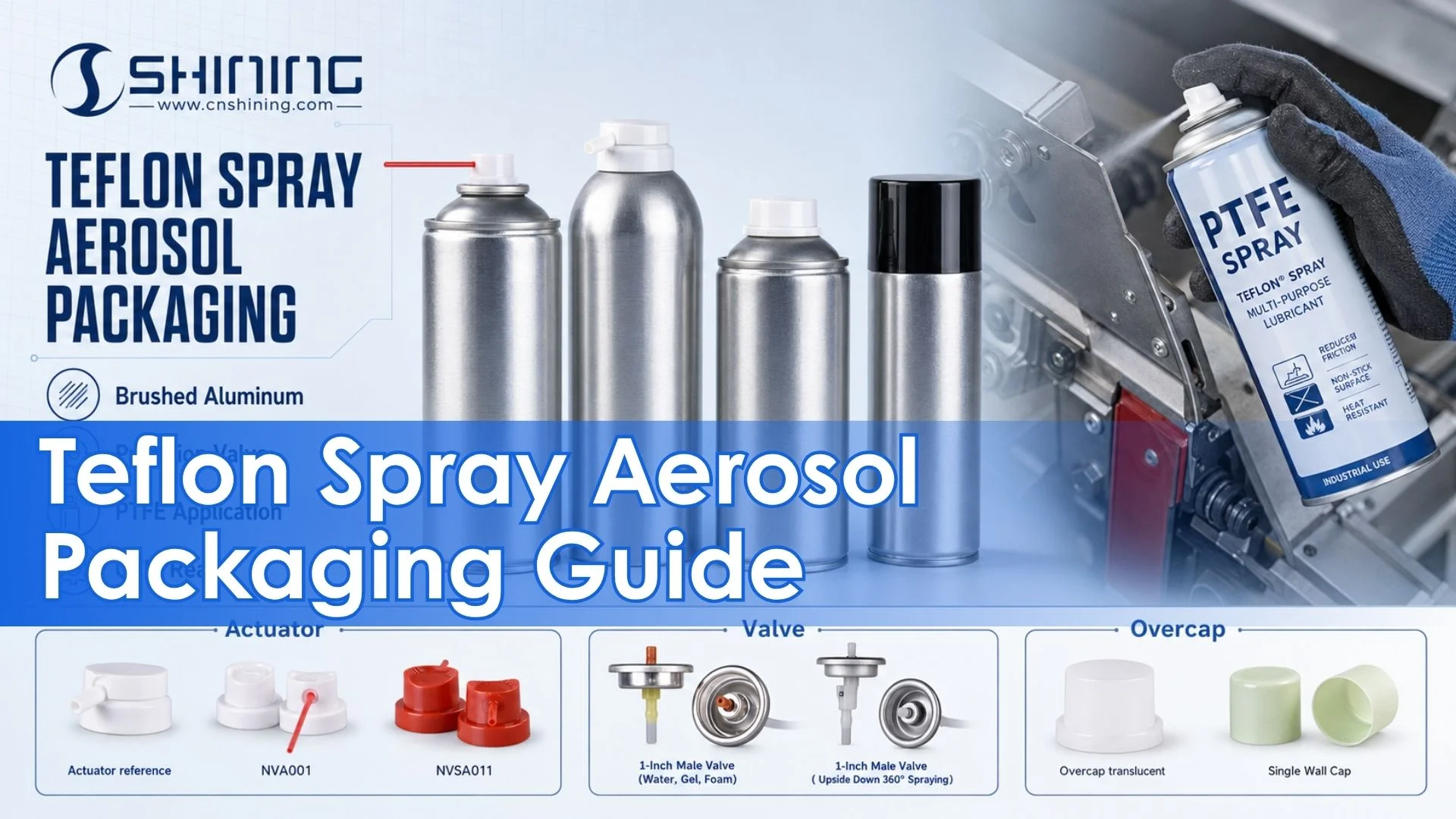
Teflon aerosol spray, also called PTFE dry-film lubricant spray or fluoropolymer aerosol lube, is not one single chemical product. In industrial use, the term normally refers to a sprayable dry-film or near-dry-film lubricant built around PTFE or related fluoropolymer friction modifiers.
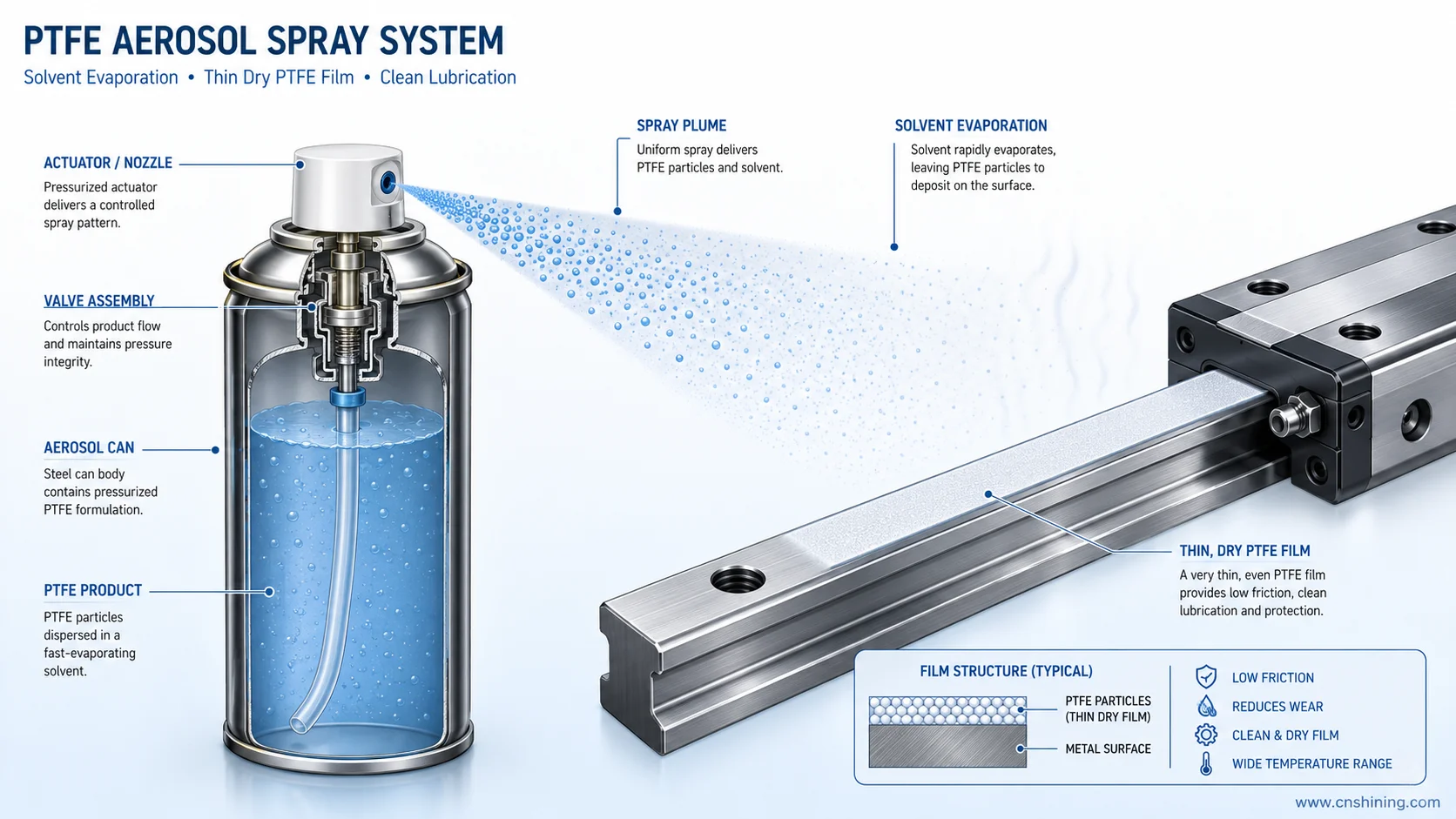
The working principle is simple enough: solvent wets the surface, propellant atomizes the formula, volatile components leave, and a thin low-friction film remains. The engineering problem is less simple. Final performance depends on particle size, resin binder, solids content, solvent system, propellant, valve geometry, actuator design, and label clarity. PTFE does the friction work, but packaging often decides whether users trust the product.
1. Executive Technical View
In the market, common references include CRC Dry PTFE Lube, WD-40 Specialist Dry Lube, Super Lube Dri-Film, and DuPont Non-Stick Dry-Film. The shared claim is not oiliness. It is low friction, reduced wear, anti-stick behavior, fast drying, and less dust attraction.
PTFE itself gives the category its technical center: very low friction, strong chemical resistance, and a high usable temperature window. The Teflon PTFE fluoropolymer properties handbook lists a continuous service temperature of 260°C / 500°F for PTFE resin. That does not mean a finished aerosol can be sprayed near flame, hot tooling, or poorly ventilated high-temperature equipment.
The source report estimated a 2025 global observable market of roughly US$128–306 million, with a base case near US$213 million. By 2030, the base case rises to about US$290 million.
2. Definition, Film Formation, and Key Performance
For this article, Teflon aerosol spray means an aerosol-packaged dry-film or anti-stick lubricant using PTFE, fluoropolymer particles, or fluoropolymer dispersion as the main friction modifier. Some product data sheets state PTFE directly. Others use terms such as fluorotelomer dispersion, Syncolon PTFE powder, or dry-film Teflon coating. In practice, they sit in the same commercial family: fluoropolymer aerosol dry-film systems.
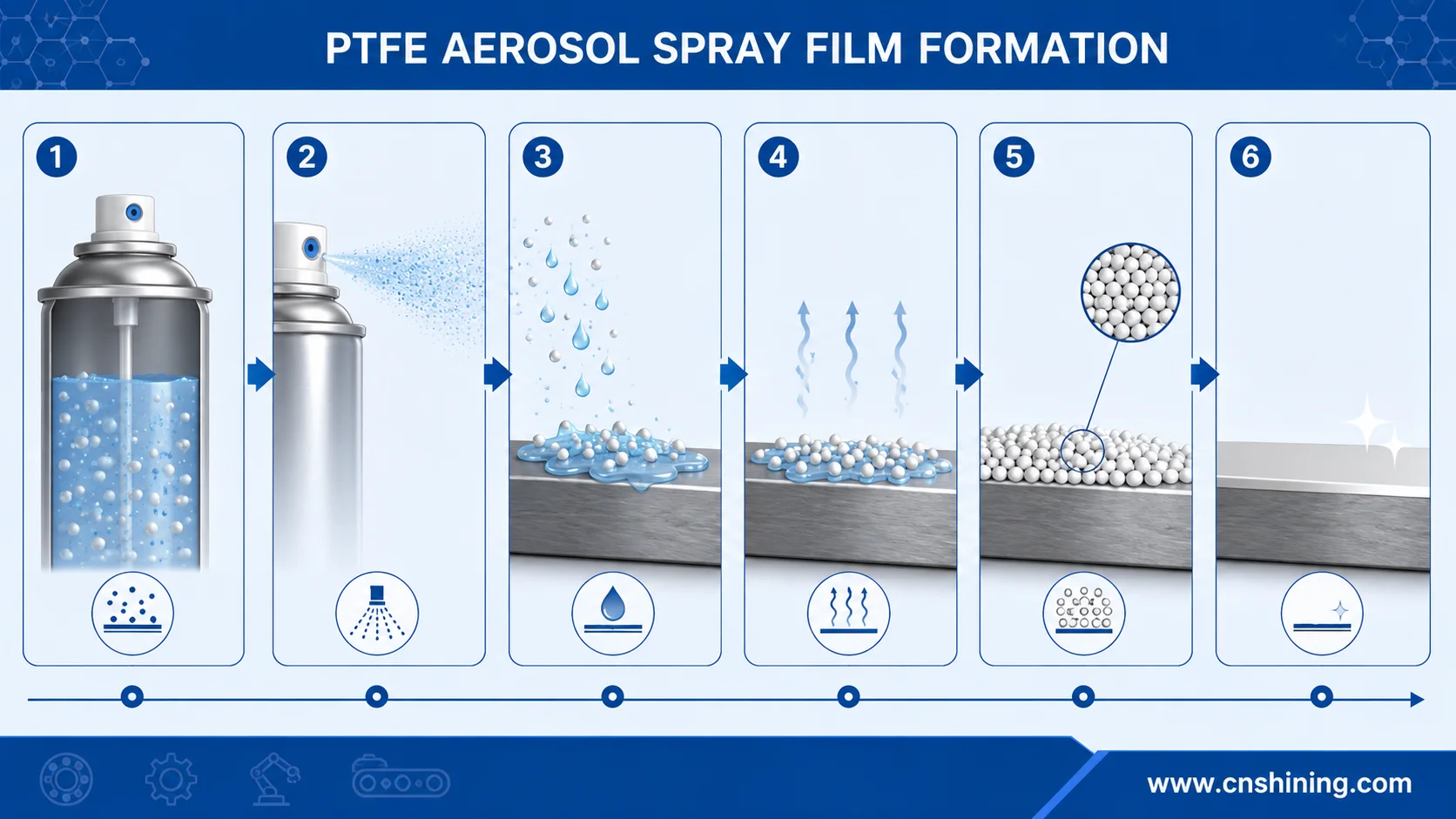
Film formation follows a repeatable path: the formula remains suspended inside the can, the propellant pushes it through the valve, the actuator breaks it into a spray pattern, the solvent wets and spreads over the surface, and evaporation leaves PTFE or PTFE-resin solids behind. Under movement, the film may compact and polish. This improves the low-shear interface.
A useful public example is the Super Lube Dri-Film lubricant technical product page, which describes sub-micron PTFE powder in a solvent base and a protective non-oily shield after evaporation.
It helps to separate raw PTFE behavior from finished aerosol behavior. Raw PTFE dispersions may be high-solids, colloidal, and water-based. Retail aerosol products normally carry much lower effective solid content so that they can spray cleanly, dry quickly, and avoid clogging. More PTFE is not automatically better. A high-solids product can lay down more film, but it also raises the risk of sedimentation, white residue, slow drying, and valve blockage.
| Indicator | Typical Public Expression | Meaning in Finished Aerosol Products |
|---|---|---|
| Coefficient of friction | “Low coefficient of friction,” “reduces friction,” or conveyor dry-film systems below COF < 0.20 | Actual COF depends on substrate roughness, load, speed, humidity, film thickness, and wear-in condition. |
| Wear protection | Four-ball wear data, field wear protection, door track, tool, and conveyor claims | Binder choice, film adhesion, and reapplication interval matter as much as PTFE itself. |
| Temperature range | PTFE resin has strong high-temperature stability; finished sprays may claim -100°F to 500°F | This is an application window, not permission to spray on hot surfaces or near ignition sources. |
| Chemical resistance | PTFE resin resists many aggressive chemicals | Finished product compatibility is often controlled by the solvent, not the PTFE. |
| Solids content | Raw dispersions can sit in high-solids ranges; retail aerosols are usually lower | Higher solids can improve film build but increases sedimentation and clogging risk. |
| Particle size | Colloidal or sub-micron PTFE is common in technical descriptions | Larger particles can settle, clog, and whiten the surface; smaller particles are harder to disperse. |
| Film type | Dry film, micro-thin film, resin-bonded film, non-oily shield | Dry feel, wash resistance, and visible haze depend heavily on resin and evaporation path. |
3. Market Size, Regional Pattern, and Competitive Logic
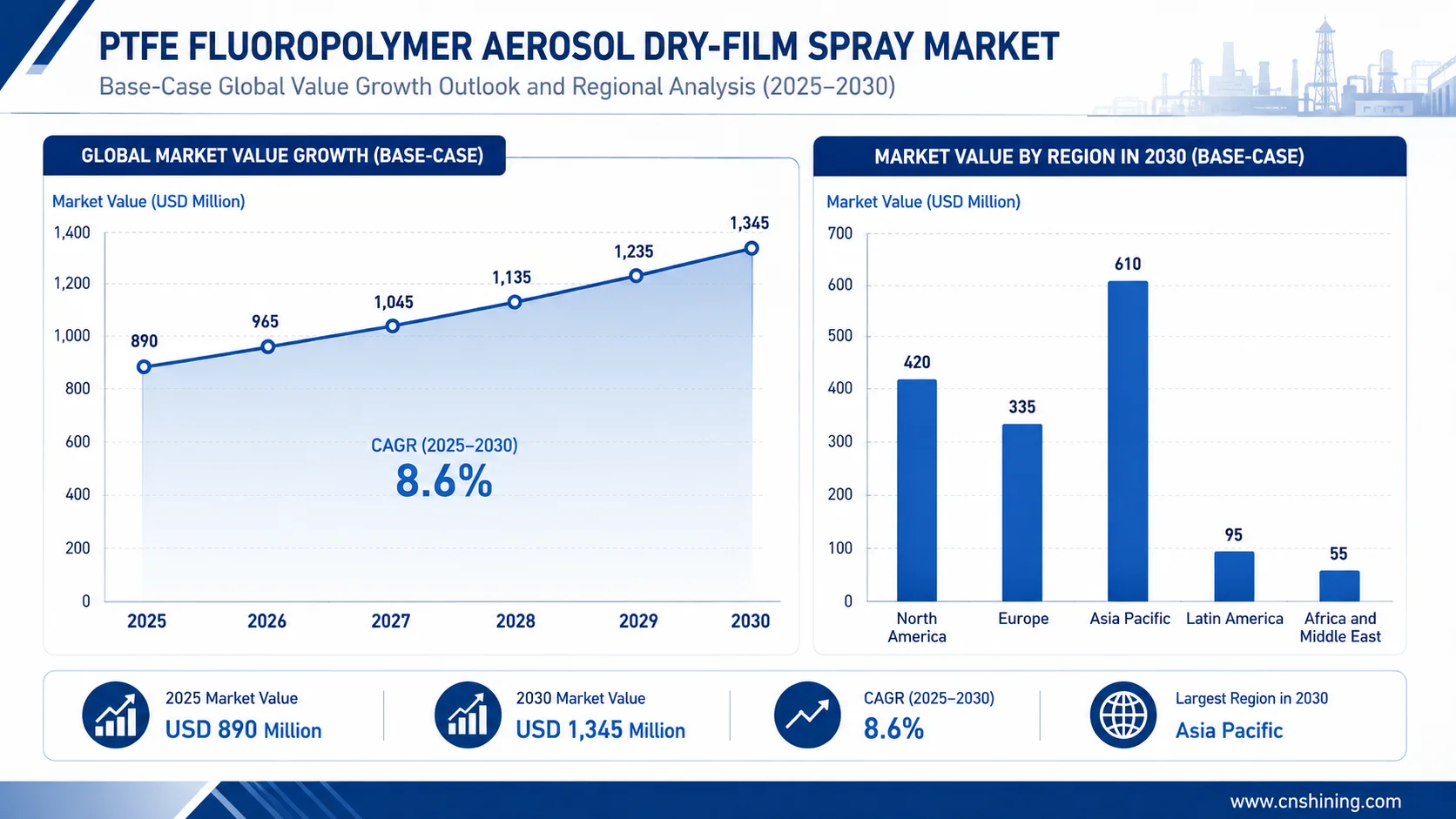
| Region | 2021 | 2023 | 2025 | 2030 | Technical Judgment |
|---|---|---|---|---|---|
| North America | 46 | 53 | 58 | 75 | Strong MRO, automotive aftermarket, DIY channel, and brand concentration. |
| Europe | 40 | 45 | 51 | 67 | High regulatory pressure, mature industrial technical aerosols, clear food-line demand. |
| Asia Pacific | 56 | 66 | 77 | 110 | Electronics, manufacturing, automotive, and PTFE upstream capacity support the lead. |
| Latin America | 12 | 13 | 15 | 20 | Price-sensitive, but repair and maintenance use remains stable. |
| Africa and Middle East | 12 | 11 | 13 | 17 | Industrial repair demand depends heavily on distribution coverage. |
| End Use | 2025 | Core Logic |
|---|---|---|
| Industrial / MRO | US$81 million | Door slides, guide rails, jigs, conveyors, tools, and general equipment maintenance. |
| Automotive aftermarket | US$49 million | Locks, windows, hinges, cables, and light-duty moving parts. |
| Home / DIY | US$36 million | Doors, drawers, locks, garden equipment, and fitness equipment. |
| Electronics / electrical | US$26 million | Precision mechanisms, low-contamination lubrication, and assembly maintenance. |
| Food contact / H1 and packaging lines | US$21 million | Packaging conveyors and food-plant audit requirements increase unit value. |
The main demand drivers are direct: MRO wants low friction without dust pickup. Automotive maintenance wants clean, quick-drying motion support. Electronics and precision mechanisms want low migration. Food packaging plants want H1 language, audit documents, and reduced contamination risk. The constraints are just as direct: PFAS review, VOC rules, odor complaints, flammability labels, and fluorine-free alternatives.
4. Product Comparison and Formulation Classes
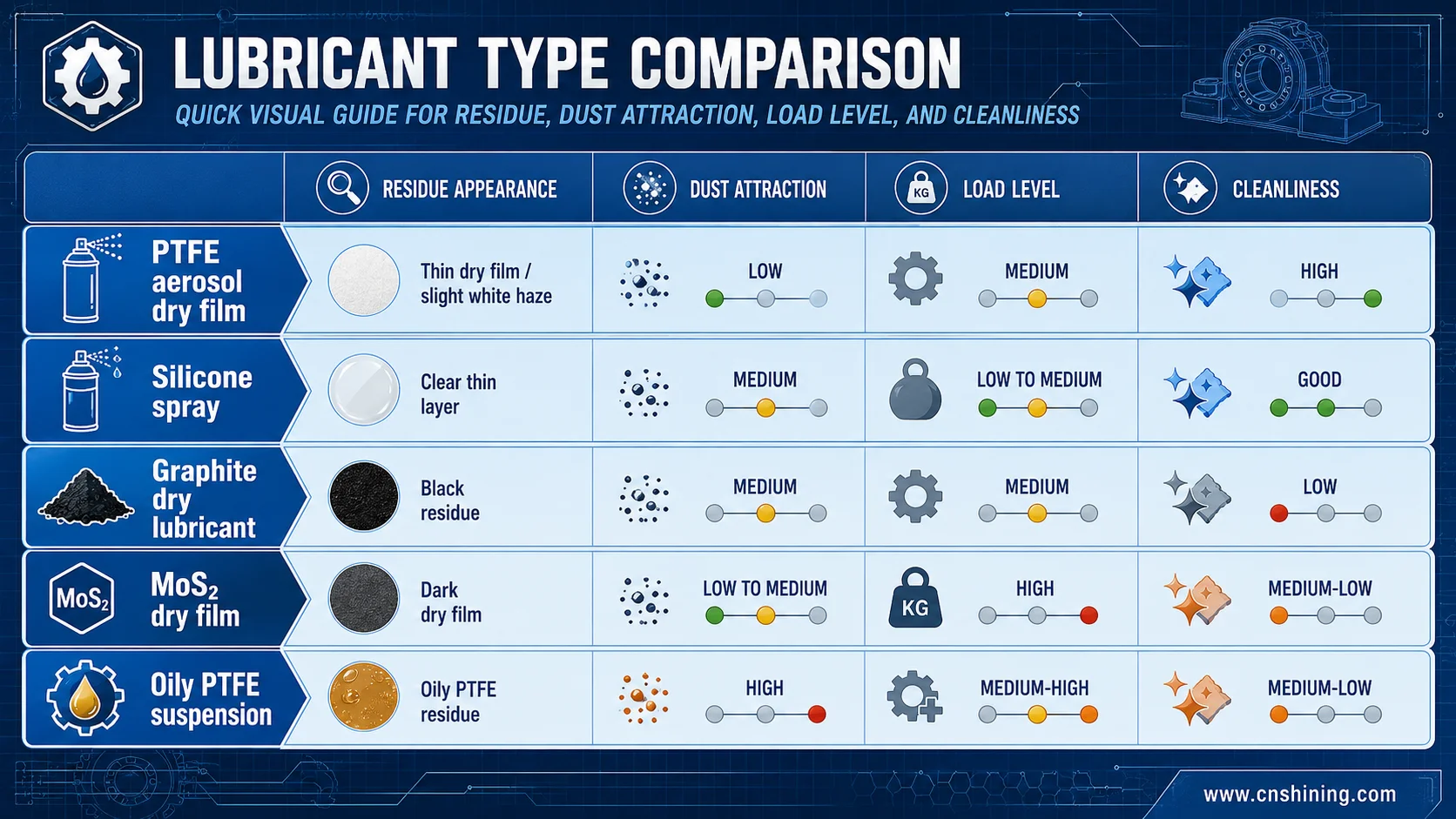
PTFE aerosol spray is not a universal lubricant. It is a good fit when the job needs a clean, dry-feeling, low-friction film under light to medium load. If the job moves toward high load, long-duration wetting, water sealing, or severe boundary lubrication, silicone oil, graphite, MoS2, lithium grease, or oily PTFE dispersions may make more sense. NASA tribology material gives useful background on solid lubrication behavior in demanding applications through this solid lubrication reference.
| Category | Typical State | Strengths | Limitations | Cost Impression | Environmental / Safety Impression |
|---|---|---|---|---|---|
| PTFE aerosol dry-film spray | Fast-drying, micro-thin dry film | Low friction, low dust pickup, clean feel, good for slides, locks, and precision parts | Not as strong as greases under high load; may leave haze or white film; PFAS pressure is high | $$ | PFAS and VOC attention; many products are flammable aerosols |
| Silicone spray | Wet or semi-dry thin layer | Water resistance, good plastic and rubber compatibility, low surface energy | Migration and paint contamination risk; some cases still attract dust | $–$$ | No direct PFAS issue, but aerosol odor and flammability remain |
| Graphite dry lubricant | Black solid powder or spray | Low cost, heat resistance, useful for locks and anti-seize threads | Dirty, black residue, conductive, poor visual cleanliness | $ | No PFAS issue, but black residue is a hard trade-off |
| MoS2 dry film | Dark solid film | Strong under high load, vacuum, and severe conditions | Dark color, less accepted in consumer settings, many formulas still use flammable solvents | $$ | No PFAS issue, but not automatically low-odor or low-risk |
| Oily PTFE suspension | PTFE in oil or solvent | More durable than pure dry film; convenient for chains and transmissions | Attracts more dust, leaves stronger residue, can look dirty over time | $$ | Non-aerosol options reduce transport risk, but do not automatically reduce VOC |
From a formulation view, the category can be split by carrier system, solids level, regulatory positioning, and film-building method.
| Classification Dimension | Typical Subtypes | Practical Meaning |
|---|---|---|
| Carrier system | Solvent-based / water-based | Solvent systems dry fast and spray well in cold start; water systems help low-VOC and H1 routes. |
| Solids content | Low / medium / high solids | Low solids favor clean spray and appearance; medium-high solids improve one-pass film but increase sediment and blockage risk. |
| Regulatory position | General industrial / automotive aftermarket / H1 food-grade | H1 products need tighter ingredient control, odor control, documentation, and label discipline. |
| Film formation | PTFE powder deposition / resin-bonded film | Bonded films last longer, but may not feel as dry or repair as easily as powder-dominant films. |
| Typical System | Public Indicative Range | Main Purpose |
|---|---|---|
| Solvent-based general PTFE dry-film aerosol | PTFE / fluoropolymer 1–8%; resin / binder 0–5%; fast solvent 40–70%; propellant 20–40%; dispersion, corrosion, and rheology additives 0.2–5% | Fast drying, dry touch, door tracks, tools, hardware, and automotive maintenance. |
| Water-based or low-VOC industrial bonded PTFE spray | PTFE dispersion 10–25% as supplied; resin 3–12%; water 35–65%; co-solvent 0–10%; additives 0.3–3%; propellant 5–20% | Lower VOC, better adhesion, and regulatory upgrade path. |
| H1 / food packaging line dry-film spray | PTFE solids typically low to medium-low; H1-acceptable carriers and additives; milder odor; strong NSF H1 and document focus | Packaging conveyors and food-processing equipment areas where incidental contact language is required. |
5. Compliance Lines That Cannot Be Ignored
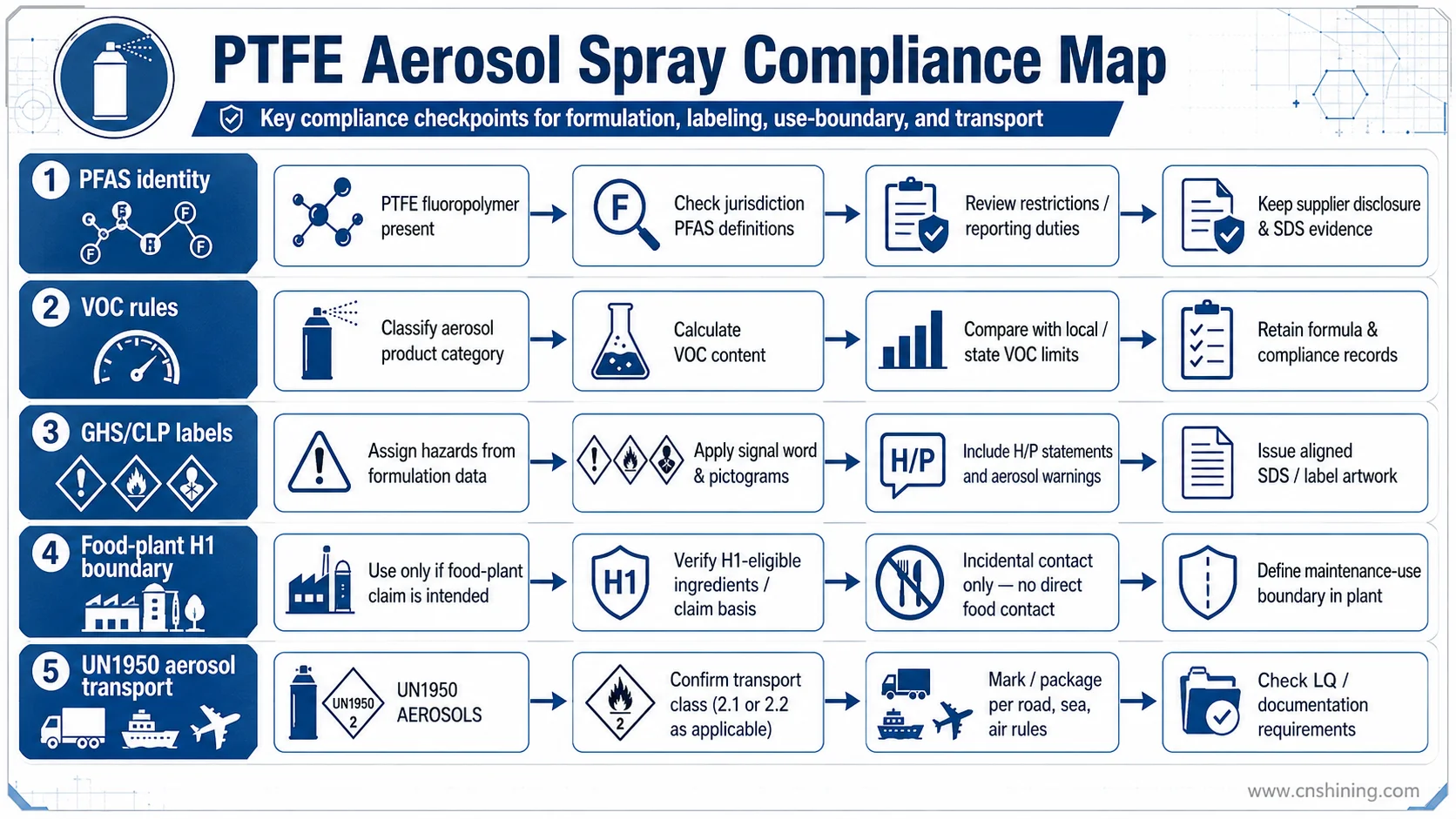
A PTFE aerosol spray is not controlled only by formula chemistry. It must be checked across five lines: PFAS identity, VOC, hazardous chemical label, food-contact boundary, and aerosol transport classification. Missing one line can block listing, warehousing, export, or customer audit approval.
5.1 United States
The U.S. market has at least three practical layers. First, VOC control under 40 CFR Part 59 Subpart C for consumer products. In practice, CARB-style consumer product rules often become the tighter benchmark. Second, PFAS reporting under TSCA Section 8(a)(7), with deadlines and scope still requiring current verification. Third, workplace SDS, label, and training requirements, normally enforced through supplier SDS and customer EHS review.
5.2 European Union
The EU route runs through REACH, CLP, the PFAS restriction process, and customer-driven RoHS statements where electronics chains are involved. The European Commission CLP information page is the starting point for classification, labeling, and packaging. RoHS does not automatically apply to every lubricant spray, but it can become a commercial requirement if the residue is used in electronic assembly or maintenance.
5.3 Food Contact and Food-Plant Use
Two concepts are often mixed up. Material-level food contact rules are not the same as lubricant registration for incidental contact. 21 CFR 177.1550 on perfluorocarbon resins describes food-contact use for certain resin articles or components under specified conditions. That does not mean every PTFE aerosol spray can be applied to food-contact surfaces. For plant maintenance, NSF H1 or ISO 21469 style documentation is normally the audit language.
5.4 Transport
Most solvent or hydrocarbon-propellant aerosols will fall into UN1950 Aerosols, often Class 2.1 flammable. The FEA transport guide for aerosols is useful for understanding limited quantity, labeling, and international transport practice. In real export work, the common failure is not PTFE chemistry. It is shipping the aerosol as if it were an ordinary parcel.
| Market / Use | Key System | Relation to PTFE Aerosol Spray |
|---|---|---|
| United States | EPA 40 CFR Part 59; CARB consumer products; TSCA PFAS | Controls VOC, PFAS reporting rhythm, formula route, and state-level saleability. |
| European Union | REACH; CLP; PFAS restriction process; RoHS boundary | Controls mixture classification, PFAS strategy, labels, and electronics customer declarations. |
| Food plant | FDA 21 CFR 177.1550; NSF H1; ISO 21469 | Separates resin-level food-contact permission from finished lubricant incidental-contact approval. |
| Transport | UN1950; IATA / ICAO / IMDG / ADR practice | Controls dangerous goods marking, quantity limits, and carrier acceptance. |
6. New Development and Innovation Directions
Recent development is not only about making a slicker PTFE spray. The practical direction is to redesign the lubrication mechanism and packaging system under regulatory, environmental, and user-experience pressure.
The first route is water-based or low-VOC bonded PTFE. An aqueous PTFE-based bonded solid lubricant study shows why waterborne dry-film systems are technically relevant. Lower odor and lower VOC are no longer only comfort issues. They affect EHS acceptance and regional saleability.
The second route is nano-filled composite lubrication. Research is moving from pure PTFE toward PTFE plus MXene, PTFE plus h-BN, and other nano-additive systems. A MXene and PTFE tribology study illustrates this direction. The target is not only low friction. It is friction reduction, wear resistance, and film stability at the same time.
The third route is fluorine-free or lower-risk substitution. PTFE remains technically strong, but PFAS pressure pushes some applications toward h-BN, graphite, silicone, wax, bio-based additives, and multi-dimensional nano-fillers. h-BN is especially interesting where a white solid lubricant is preferred and black graphite residue is unacceptable.
The fourth route is microencapsulation and controlled release. The microencapsulation of lubricant additives patent shows a long-running idea: encapsulate active additives so storage stability and wear-triggered release can both improve.
The fifth route is dry lubrication for conveyors and packaging lines. The dry lubricant for conveying containers patent points to lower-water, lower-residue conveyor lubrication. For beverage and food packaging, this is not just a lubricant decision. It affects water use, hygiene, downtime, and audit files.
The sixth route is smarter spray systems. Valves, springs, dip tubes, actuator holes, spray cone angle, and anti-clog geometry often matter more to user satisfaction than another small increase in PTFE content. Reviews tend to complain about the sprayer first.
7. Brand Landscape, User Pain Points, and Packaging Improvements
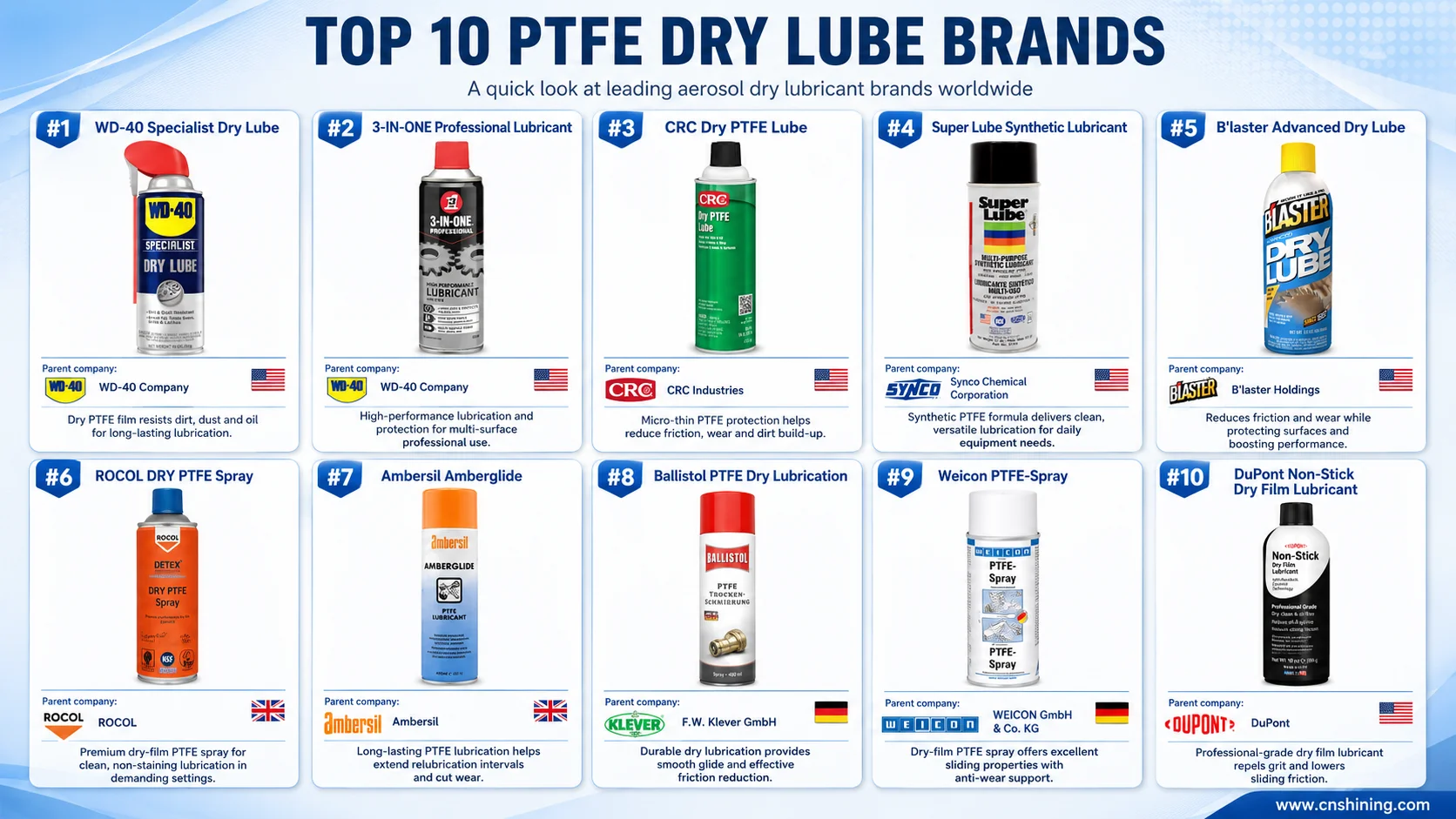
7.1 Top 10 Teflon Aerosol Spray Brands Snapshot
| Brand | Country / Region | Parent / Owner | Common Size | Public Price Observation | Practical Reading |
|---|---|---|---|---|---|
| WD-40 Specialist | United States | WD-40 Company | 10 oz / 283 g / 360 ml | about 7.98$ to 8.78$ | Strong channel reach and strong user education. It turns a technical spray into a mass-market maintenance product. |
| 3-IN-ONE | United States | WD-40 Company | 2.5 oz / 10 oz | about 8.48$ | More scenario-based, with clear lock, window track, and home maintenance positioning. |
| CRC | United States | CRC Industries; Berwind system | 10 oz / 454 g | about 16.44$ to 21.68$ | Industrial and MRO foundation is strong. Documents and registrations feel closer to B2B use. |
| Super Lube | United States | Kano Laboratories acquired Synco / Super Lube line | 11 oz / 400–500 ml | about 17.29$ to 17.49$ | Industrial and food-grade positioning sit together. Higher price, but the positioning is stable. |
| B’laster | United States | B’laster Holdings | 9.3 oz | about 7.98$ | Strong value perception in home repair and automotive repair channels. |
| ROCOL | United Kingdom | ITW | 400 ml | about 28.86$ to 33.72$ | Industrial brand with higher price. Strong in technical and food-grade lines. |
| Ambersil | United Kingdom | CRC Industries Group | 400 ml | about 15.79$ to 20.91$ | Factory-oriented European brand. Food-grade and industrial boundaries are clearer than mass retail products. |
| Ballistol | Germany | F.W. Klever / Ballistol | 200 ml / 400 ml | about 6.86$ to 14.87$ | Clean, restrained, tool-oriented German positioning. Less theatrical, but practical. |
| WEICON | Germany | WEICON GmbH | 400 ml | about 17.95$ to 30.81$ | Industrial chemical background is visible. Global B2B recognition is strong. |
| DuPont Non-Stick Dry-Film | United States | DuPont | 10–14 oz | about 16.65$ | Brand-symbol value is high. The selling image is tied to Teflon and resin-bonded dry-film language. |
The real competition is not only “who is slipperier.” It is channel access, scenario labeling, regulatory files, food-grade registration, and spray-system reliability. A mass retailer sells “easy home repair.” A factory supplier sells “documented maintenance with fewer interruptions.”
7.2 User Pain Points
| Platform Signal | Pain Point | Technical Reading |
|---|---|---|
| Amazon | Sprayer, straw, or actuator failure | PTFE particles make valve and actuator tolerance more important than in pure liquid sprays. |
| Amazon / Home Depot | “Dry” product still feels wet or oily | Dry-film wording fails when solvent evaporation, resin level, or application amount is not controlled. |
| Amazon / Home Depot / Reddit | White haze, staining, or visible film | Particle size, film thickness, resin, and substrate chemistry can all create residue complaints. |
| Home Depot / video pages | Strong odor and poor indoor comfort | Solvent and propellant selection directly affect EHS acceptance and repeat purchase. |
| Confusion between silicone, PTFE, lithium grease, and dry lube | Labels often fail to explain the correct operating window. | |
| Walmart / Home Depot | Reapplication frequency and durability mismatch | Users may expect lubrication to solve worn or misaligned mechanical parts. |
7.3 Packaging Improvements That Actually Address Complaints
For valves and nozzles, the first improvement is not can shape. It is valve orifice size, screen design, valve chamber geometry, spring material, dip-tube inner diameter, and actuator spray hole design. White-film or powder-heavy systems need a more blockage-tolerant valve and a secure integrated straw. Water-based or low-VOC routes may justify compressed gas or bag-on-valve structures.
For actuators, users often complain about failed spray but praise attached precision straws when they work. The direction is clear: a dual-mode actuator with wide spray and pinpoint stream, plus locking geometry, clear on/off indication, stronger straw retention, and better anti-clog design. For retail products, that change can return more value than adding another one percent of PTFE.
For can size, the market needs a two-level matrix. A 90–150 ml small can fits locks, home repair, tool bags, and trial purchases. A 300–500 ml workshop can fits door tracks, conveyors, tool maintenance, and MRO. Capacity is not only about price. It prevents the mismatch where household users buy too much and industrial users buy too little.
For label architecture, the most visible space should not be used only for the logo. Four items need bigger treatment: suitable surfaces, unsuitable surfaces, drying and reapplication interval, and indoor ventilation / flammability / food-contact boundary. Many negative reviews are not chemistry failures. They are instruction failures.
8. Packaging Components for PTFE Aerosol Spray: Where Shining Packaging Fits
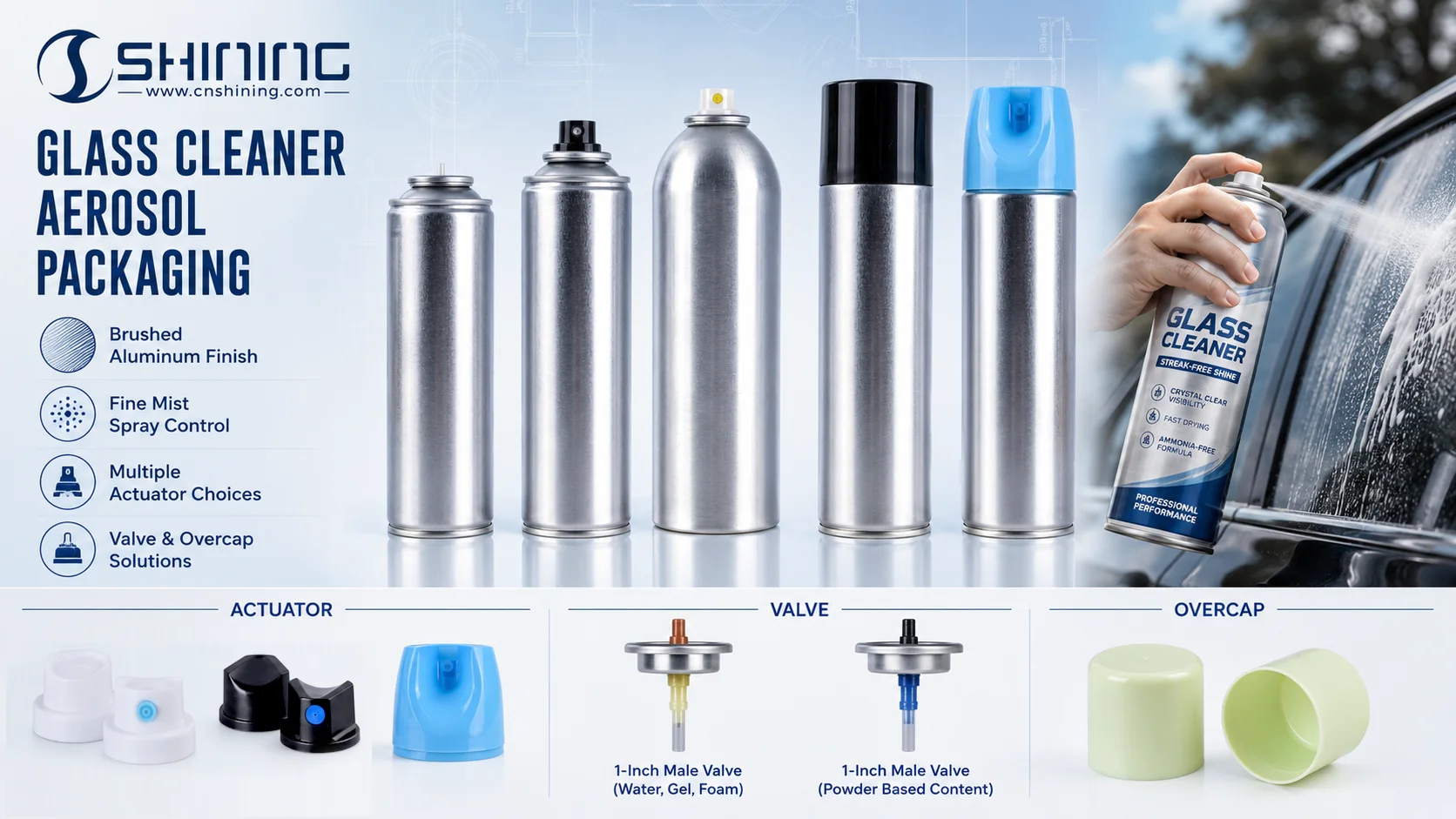
For PTFE aerosol spray, packaging is part of the formulation system. The actuator, valve, dip tube, aerosol can, inner coating, and spray pattern all affect suspension delivery. A formula that performs well in a lab cup can fail commercially if PTFE settles, the valve clogs, the actuator spits, or the straw detaches.
This is where Shining Packaging can be discussed in a practical way. For PTFE dry-film lubricant sprays, the relevant packaging work is not decorative. It is the selection and matching of aerosol cans, valves, actuators, and spray accessories so the product can deliver a stable cone or precision stream over its shelf life. For higher-solvent formulas, can inner coating and gasket compatibility need early checks. For water-based PTFE systems, corrosion resistance and long-term wet contact with valve components become more important.
A useful packaging brief for this category should define at least six items before sampling: target spray pattern, particle sedimentation behavior, intended use angle, actuator mode, valve anti-clog requirement, and expected storage condition. If those are not specified, the packaging trial becomes guesswork.
9. Glossary
| Term | Short Explanation | Commercial Meaning |
|---|---|---|
| PTFE | Polytetrafluoroethylene, a classic low-friction fluoropolymer | Core story behind dry feel, low friction, and low dirt pickup. |
| Fluoropolymer | Family including PTFE, FEP, PFA, and related materials | Determines whether the product falls into PFAS discussion. |
| Fluorotelomer dispersion | Fluorinated dispersion language used in some PTFE spray descriptions | Affects regulatory interpretation and technical positioning. |
| Dry film | Non-oily thin film left after volatile components evaporate | Supports low dust pickup and clean-use claims. |
| Bonded film | Solid film held by resin binder | Improves adhesion, but may change transparency and repair behavior. |
| Solids content | Non-volatile material left after drying | Controls film amount, coverage, blockage risk, and cost. |
| Particle size | Size of dispersed PTFE or filler particles | Controls sedimentation, nozzle blockage, film appearance, and friction behavior. |
| COF | Coefficient of friction | Core performance number, but only meaningful under defined test conditions. |
| Propellant | Gas or liquefied gas that drives aerosol discharge | Controls spray shape, flammability, VOC profile, and transport classification. |
| Actuator | Spray button or head | Often decides user experience and complaint rate. |
| Smart Straw | Integrated precision straw actuator | Useful for pinpoint spraying, but also a common mechanical failure point. |
| H1 | NSF incidental food-contact lubricant category | Allows entry into food-plant audit language when product registration supports it. |
| H2 | NSF non-food-contact lubricant category | May be acceptable in a plant, but should not be described as food-grade contact use. |
| VOC | Volatile organic compound | Affects state rules, factory EHS review, odor, and indoor use acceptance. |
| PFAS | Per- and polyfluoroalkyl substances | Affects regulation, brand risk, substitution pressure, and customer questions. |
| CLP | EU classification, labeling, and packaging regulation framework | Controls EU hazard label and warning presentation. |
| UN1950 | UN number for aerosols | Controls dangerous goods transport and warehousing requirements. |
10. Technical Notes
PTFE gives Teflon aerosol spray its technical reason to exist. It lowers friction, resists many chemicals, and leaves a dry-feeling surface when the formula is well built. But product success is usually decided outside the PTFE molecule. The valve must not clog. The actuator must spray predictably. The film must not haze on sensitive substrates. The label must say where the product should not be used.
The practical conclusion is plain: treat PTFE aerosol spray as a formulation-plus-packaging system. When formulation, valve, actuator, can, label, and compliance route are developed together, the product has a chance to solve real maintenance problems. When they are treated separately, the review page usually finds the weak point.
11. FAQ: Teflon Aerosol Spray
Teflon aerosol spray usually means a PTFE or fluoropolymer-based dry-film lubricant delivered from an aerosol can. The spray uses solvent and propellant to carry fine particles onto a surface. After evaporation, it leaves a thin, low-friction film. It is used where a cleaner, less dust-attracting lubricant is preferred over oil or grease.
In common use, the terms are often used together, but they are not exactly identical. Teflon is a trademark associated with fluoropolymer materials, while PTFE is the polymer name. Many products marketed as Teflon aerosol spray rely on PTFE, but finished performance also depends on solvent, binder, propellant, valve, and actuator design.
White film usually comes from particle loading, particle size, excess application, uneven solvent evaporation, or binder behavior. PTFE itself is white, so a thicker or poorly dispersed film can become visible. The risk increases on dark plastics, glossy surfaces, transparent polymers, and over-applied sliding parts. A small-area test is the safest first step.
No. Higher PTFE content can increase the amount of dry film left on the surface, but it can also create settling, clogging, slow drying, and visible residue. A good aerosol formula balances solids content, dispersion stability, solvent evaporation, and valve tolerance. For many products, spray reliability is more important than maximum PTFE loading.
It works best in light to medium load applications where clean movement matters: door tracks, locks, guide rails, sliding mechanisms, tools, light automotive hardware, and some precision assemblies. It is useful when oil would attract dust or leave a messy surface. It should not be treated as a replacement for grease in heavy-load bearings.
PTFE particles are solids. If the dispersion settles, agglomerates, or moves through a valve with tight tolerance, blockage can occur. Clogging is affected by particle size, formula viscosity, storage time, shaking behavior, valve orifice design, dip-tube diameter, actuator geometry, and filter structure. Anti-clog packaging is part of product engineering.
Only if the finished product has the right registration or statement for that use. PTFE resin may have food-contact relevance under specific regulations, but that does not make every aerosol spray acceptable near food equipment. Food-plant maintenance normally looks for NSF H1 or similar incidental-contact documentation, plus proper label and SDS support.
The main checks are PFAS identity, VOC limits, GHS or CLP labeling, SDS accuracy, food-contact boundary, and aerosol transport. Many solvent-based products also involve flammability and UN1950 aerosol classification. Regional rules differ, so a formula that can sell in one market may need label, VOC, or documentation changes in another.
PTFE dry-film spray is usually chosen for cleaner low-friction surfaces with less dust pickup. Silicone spray is often chosen for water resistance and rubber or plastic compatibility. Silicone can migrate and create coating or paint contamination issues. PTFE can create white residue and carries PFAS-related scrutiny. The better choice depends on the surface and load.
They should test sedimentation, shaking recovery, valve clogging, actuator spray pattern, dip-tube drawdown, can inner coating, gasket compatibility, corrosion, flammability labeling, and spray performance at different storage temperatures. PTFE aerosol products need packaging trials that reflect real use angles, repeated spraying, and shelf-life conditions, not only fresh-lab samples.