
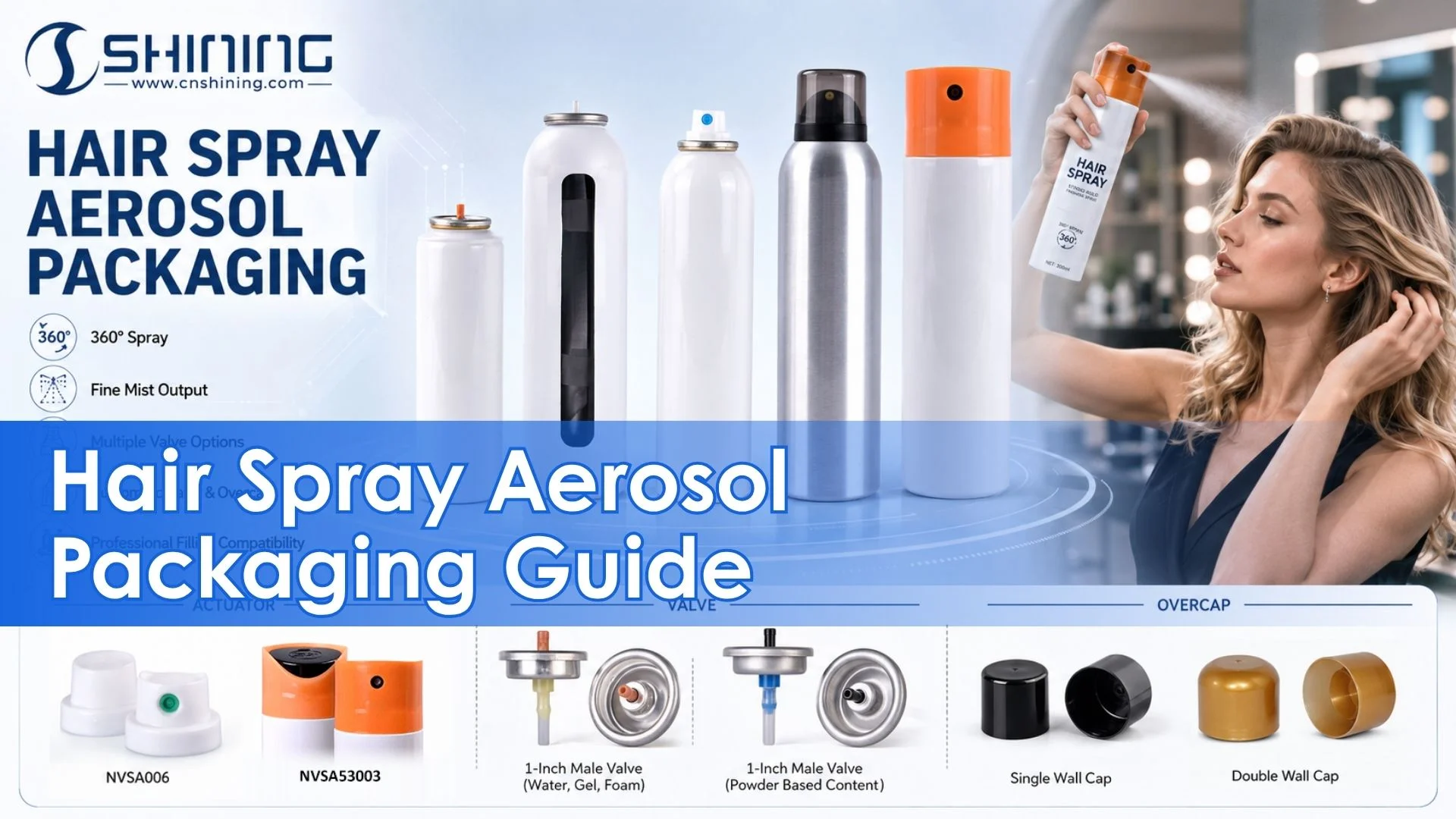
1. Executive Technical View
A hairspray aerosol works because a valve, actuator, propellant, solvent and film-forming polymer behave as one pressurized system. The product is not only a cosmetic formula. It is a controlled atomization package.
The basic structure is clear: film-forming polymer + volatile solvent + propellant + functional additives. Pressing the actuator opens the valve. The internal pressure drops. The liquid phase is broken into droplets. The solvent evaporates, and the polymer forms a thin film on the hair surface. This is how hair finishing spray delivers hold, humidity resistance, frizz control and gloss management.
The main advantage is not that aerosol hairspray uses a more mysterious ingredient. The advantage is the spray method: finer mist, more even coverage and faster drying. That is why aerosol hair spray remains strong in finishing applications, salon work, stage styling and high-humidity markets.
Current product development is moving from “strong hold” toward high humidity curl retention, light feel, low flaking, low odor and lower environmental load. That shift affects formulation, propellant selection, aerosol can coating, valve gasket compatibility and actuator geometry at the same time.
2. Product Definition and Working Mechanism
A hairspray aerosol belongs to pressurized cosmetic spray packaging. In most cases, it contains film-forming resin, alcohol and/or water as volatile carrier, and LPG, DME or another propellant system. The first event after spraying is fluid mechanics. The liquid stream is sheared, flash-vaporized and broken again inside the valve and actuator. The second event is surface chemistry. The solvent evaporates, the polymer deposits, and hair fibers are bridged by a flexible film.
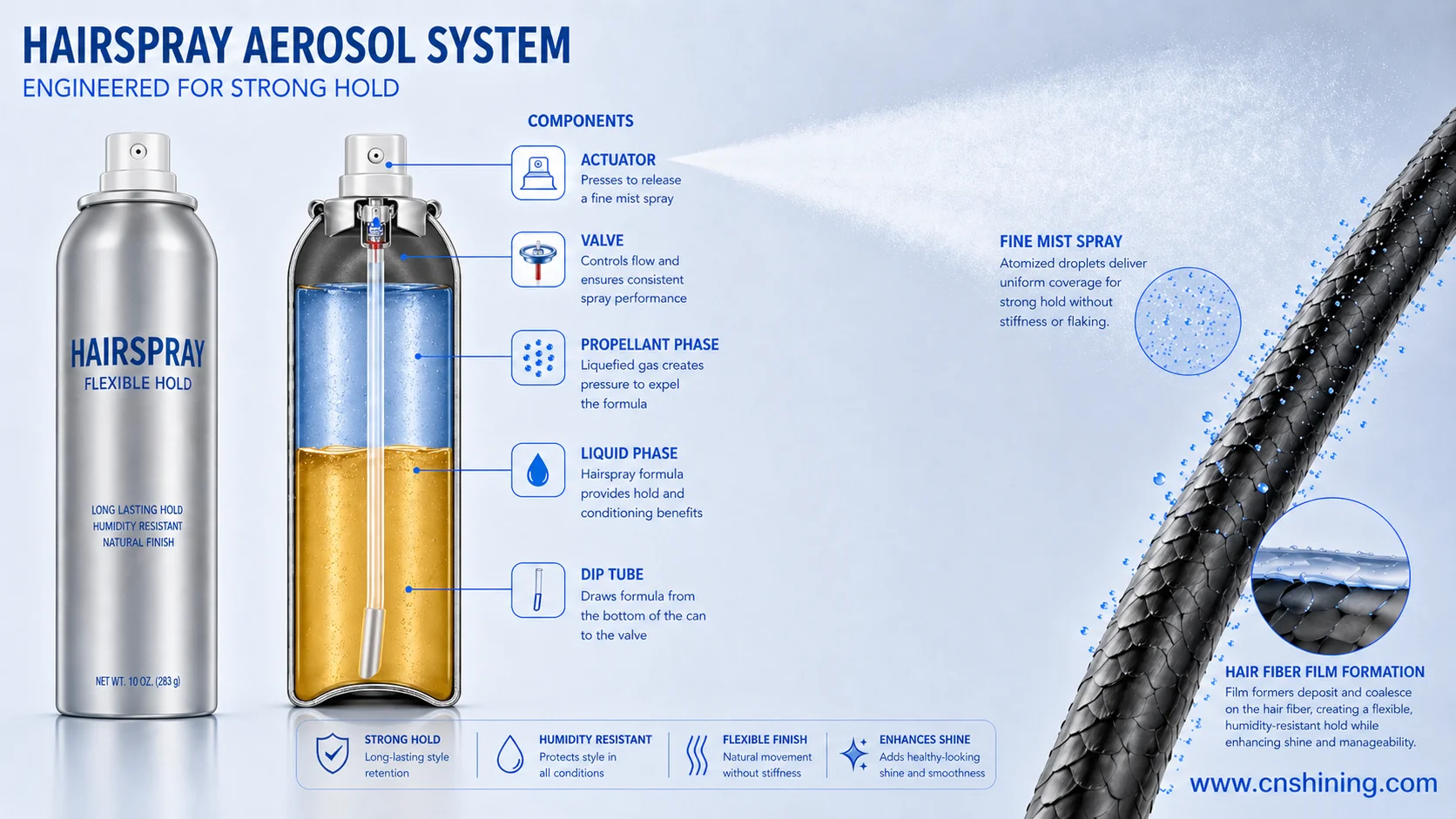
Engineering data on aerosol valve systems show that actuator orifice, insert geometry, mechanical break-up structure and vapor tap design influence spray rate, particle size, spray projection and clogging risk. A higher vapor phase contribution can reduce average droplet size, but making the mist too fine may increase overspray, inhalation exposure and hand-feel drift.
Aerosol hairspray device patents also show that spray quality depends on both formula and delivery structure. The product is not finished when the resin is selected. It is finished when the formula still sprays correctly after filling, storage, transport and repeated use.
3. Aerosol Hairspray vs Similar Styling Formats
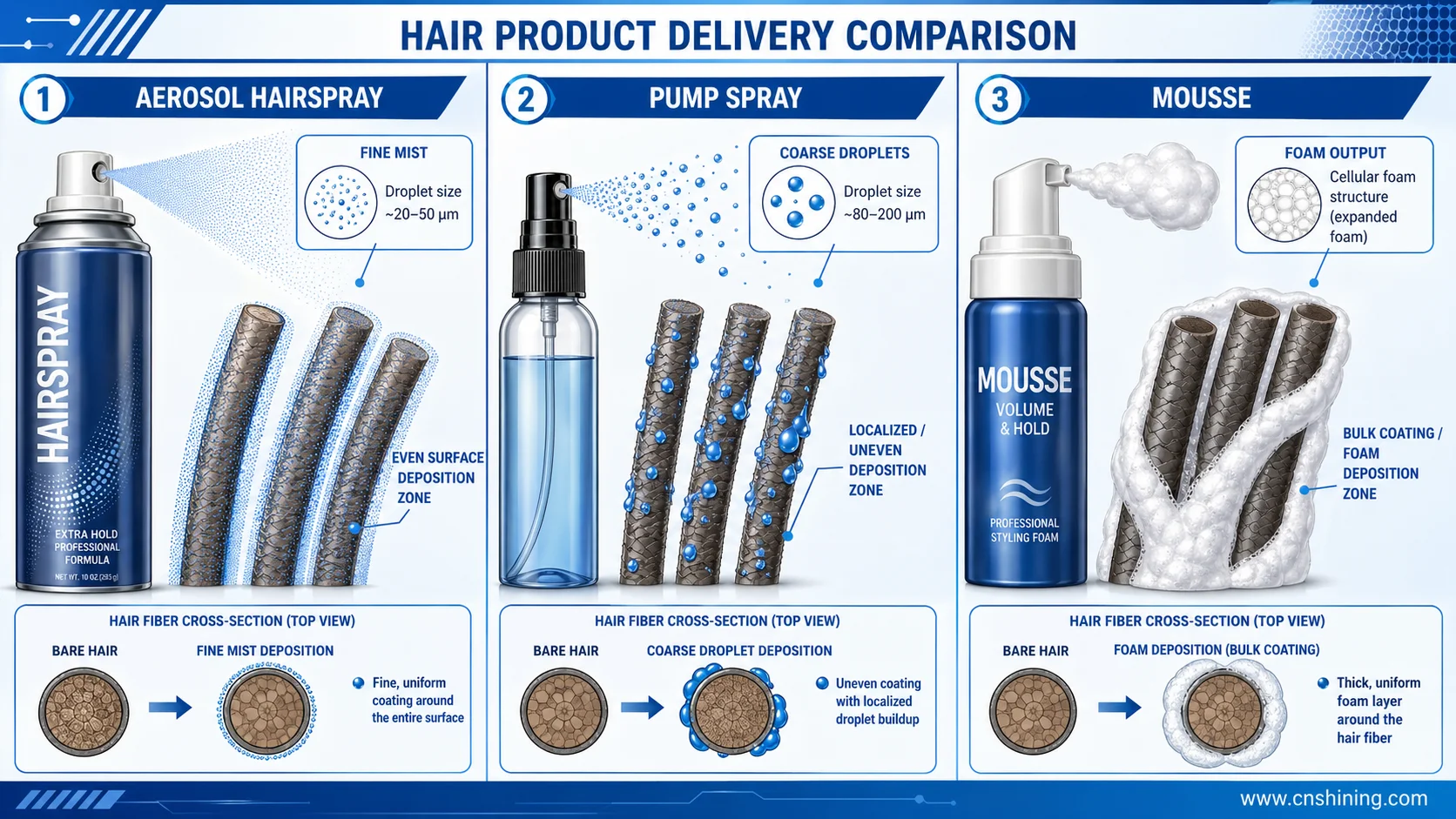
Aerosol hairspray is not a replacement for every styling format. It has a clear engineering advantage in the last styling step: fast, wide, even and continuous finishing. Pump sprays can reduce propellant pressure and shipping complexity, but they usually produce coarser droplets and heavier local deposition. Mousse is better for root support and section work, not final mist finishing.
| Format | Basic Principle | Typical Advantages | Typical Weak Points | Better Use Case |
|---|---|---|---|---|
| Aerosol hairspray | Pressurized continuous spray; valve and actuator control spray pattern and particle size | Fine mist, even coverage, fast drying, strong finishing efficiency | Flammability, pressure container, VOC limits, nozzle clogging and flaking sensitivity | Final fixing, humidity resistance, salon work, stage styling |
| Pump spray | Manual pump or trigger spray without pressurized propellant | Lower transport and regulatory pressure, usually propellant-free | Coarser droplets, heavier local loading, less cloud-like film formation | Local fixing, low environmental load positioning, fragrance-sensitive users |
| Mousse | Propellant and valve convert liquid into foam | Good root volume, grip and section control | Not a finishing mist; more noticeable feel | Before blow-drying, curls, root support |
4. Market Size and Growth Trend
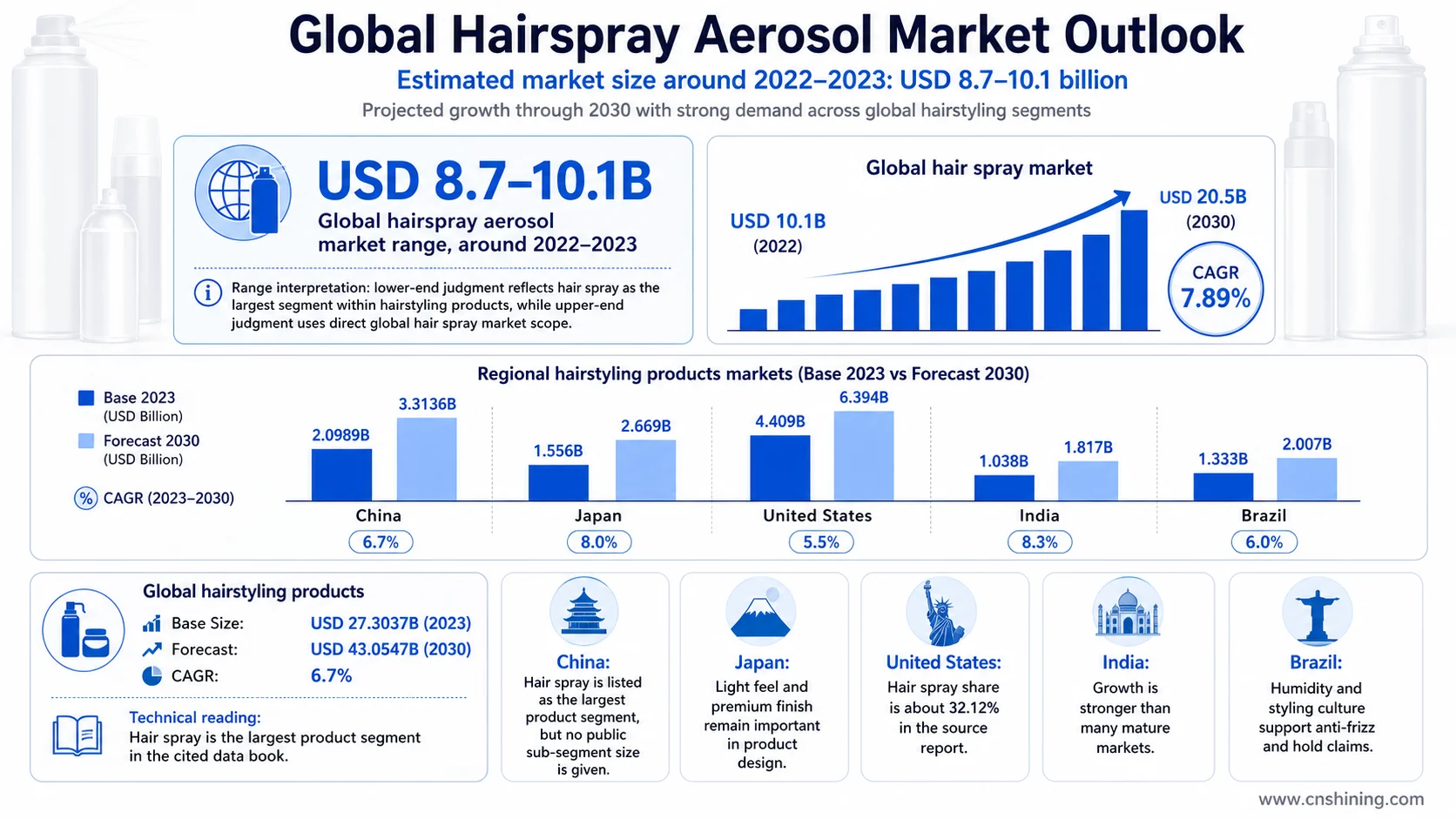
Public market data does not use one consistent definition for “hairspray” and “hairstyling products.” The safest reading is a range, not a single number. According to Grand View Research global hairstyling products data, the global hairstyling products market generated USD 27.3037 billion in 2023, with hair spray revenue at about USD 8.6781 billion. Another public hair spray market estimate reports USD 10.1 billion in 2022 and USD 20.5 billion by 2030, with a CAGR of 7.89%, as stated in this global hair spray market release.
The practical conclusion: the global hairspray market can reasonably be treated as an USD 8.7–10.1 billion class market around 2022–2023, with growth faster than many mature personal care categories.
| Market Scope | Base Size | Forecast | CAGR / Trend | Technical Reading |
|---|---|---|---|---|
| Global hairstyling products | USD 27.3037 billion, 2023 | USD 43.0547 billion, 2030 | 6.7% | Hair spray is the largest product segment in the cited data book. |
| Global hair spray market | USD 10.1 billion, 2022 | USD 20.5 billion, 2030 | 7.89% | Direct hair spray scope; useful for upper-range market judgment. |
| China hairstyling products | USD 2.0989 billion, 2023 | USD 3.3136 billion, 2030 | 6.7% | Hair spray is listed as the largest product segment, but no public sub-segment size is given. |
| Japan hairstyling products | USD 1.556 billion, 2023 | USD 2.669 billion, 2030 | 8.0% | Light feel and premium finish remain important in product design. |
| United States hairstyling products | USD 4.409 billion, 2023 | USD 6.394 billion, 2030 | 5.5% | Hair spray share is about 32.12% in the source report. |
| India hairstyling products | USD 1.038 billion, 2023 | USD 1.817 billion, 2030 | 8.3% | Growth is stronger than many mature markets. |
| Brazil hairstyling products | USD 1.333 billion, 2023 | USD 2.007 billion, 2030 | 6.0% | Humidity and styling culture support anti-frizz and hold claims. |
5. Formulation System and Professional Terms
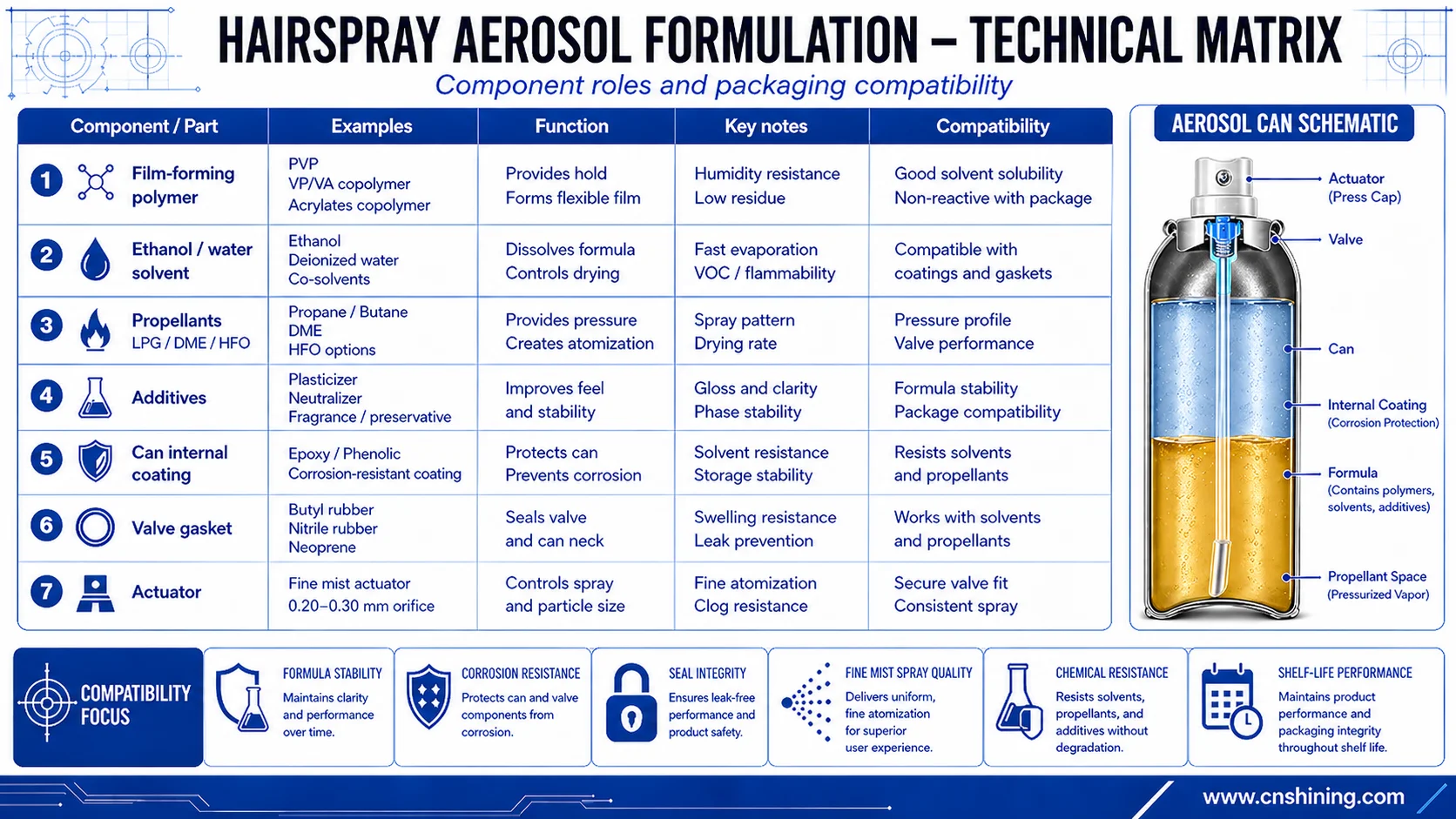
The minimum formulation logic is practical: resin controls hold and humidity resistance; solvent controls drying speed and feel; propellant controls spray behavior and regulatory status; additives control stability and user experience. The hard part is compatibility. The resin must dissolve. The solution cannot be too viscous. The spray must atomize. The dry film cannot turn white or brittle. The package cannot corrode.
5.1 Typical Raw Material Categories
| Raw Material Category | Common Examples | Main Role | Formula / Design Meaning |
|---|---|---|---|
| Film-forming polymers | PVP, PVP/VA, AMP-acrylates copolymer, PVM/MA half esters | Hold, curl retention, humidity resistance, brushability | Higher hold can raise brittleness and flaking risk. Resin acidity may affect can corrosion. |
| Solvents | Ethanol, isopropanol, water | Resin dissolution, drying speed, spray feel | High alcohol dries fast but increases odor and irritation. High water reduces VOC but makes spray engineering harder. |
| Propellants | LPG, DME, compressed air, nitrogen, HFO-1234ze(E) | Pressure supply, atomization, regulatory profile | LPG is cost-efficient but flammable. DME helps solubility. BOV and compressed gas can reduce odor and flammability concerns. |
| Neutralizers / pH adjusters | AMP, morpholine, amino alcohols | Resin solubilization, film behavior | Can affect clarity, brittleness, spray stability and compatibility. |
| Plasticizers / soft feel agents | Silicones, esters, soft hydrocarbons | Reduce brittle film, improve gloss and feel | Too much can reduce hold or create oily feel. |
| Conditioning agents | Dimethicone, volatile hydrocarbons, proteins | Smoothness, frizz reduction, lower roughness | Poor balance with resin can cause tack or buildup. |
| Corrosion inhibitors / preservatives | Benzoates, quaternary phosphate types | Can protection, formula stability | Water-rich and salt-containing systems need stronger package compatibility tests. |
| Fragrance | Fragrance blends | Mask alcohol and resin odor | A key user perception factor, but also a common complaint source. |
5.2 Representative Formulation Routes
| Example Route | Formula Character | Representative Composition |
|---|---|---|
| Ultra-low GWP aerosol hairspray | Uses HFO-1234ze(E) as propellant | Ethanol 49.7%, PVP/VA 10%, fragrance 0.3%, HFO-1234ze(E) 40% |
| Low VOC aqueous aerosol hairspray | High water, low alcohol, DME propellant | Water 30–90%, sulfonated styrene resin 2–20%, alcohol 0–30%, DME 5–50%, optional conditioning agent 0.1–2% |
| Low alcohol aerosol hairspray | Water-based concentrate with DME | Propellant 30–60%, styling liquid 40–70%; styling liquid contains water, polymer and about 0.05–2% alcohol |
| Traditional single-phase high VOC aerosol | High alcohol, hydrocarbon propellant, fast drying | Alcohol-rich solvent, DME co-solvent in some systems, hydrocarbon propellant can exceed 15% |
| Non-aerosol pump hairspray | No propellant gas | Resin about 5–10%, water 10–15%, lower alcohol 73–85%, minor additives no more than 2% |
The low-VOC water-rich route is not just a formula change. It is also a packaging challenge. The aqueous aerosol hair spray patent gives one example of high-water composition logic, while this ultra-low GWP hairspray formulation sheet gives a separate route using HFO-1234ze(E).
5.3 Professional Terms That Matter in Development
| Term | Plain Meaning | Design Meaning | Commercial Meaning |
|---|---|---|---|
| Hold / Fixation | Styling strength | Resin type and solid content set the ceiling | Direct shelf language |
| Flexible Hold | Hold without rigid feel | Requires resin and plasticizer balance | Reduces “helmet feel” complaints |
| HHCR | High humidity curl retention | Humidity-resistant polymer is key | Useful in humid markets |
| Tack | Sticky hand or hair feel | Solvent evaporation and resin migration control | Common negative review term |
| Flaking | White film fragments | Brittle film, high spray load and local buildup all contribute | Directly hurts repeat purchase |
| Spray Rate | Output per second | Valve orifice and propellant ratio work together | Affects perceived value and ease of use |
| Particle Size | Droplet size distribution | Controls coverage, wetness and inhalation exposure | Fine mist is often perceived as higher quality |
| Vapor Tap | Gas-phase sampling path | Can reduce droplet size significantly | Important for premium spray feel |
| MBU | Mechanical break-up structure | Further breaks liquid inside actuator | Defines soft, fine or coarse spray |
| BOV | Bag-on-valve system | Separates product from gas | Supports low odor and lower flammability positioning |
| Inner Lacquer | Internal can coating | Protects metal from alcohol, water and fragrance | Reduces leakage and corrosion claims |
| Valve Stem Gasket | Sealing elastomer around stem | Controls solvent resistance and gas tightness | Related to leakage, dead valves and tail-off spray instability |
6. Regulations and Compliance Framework
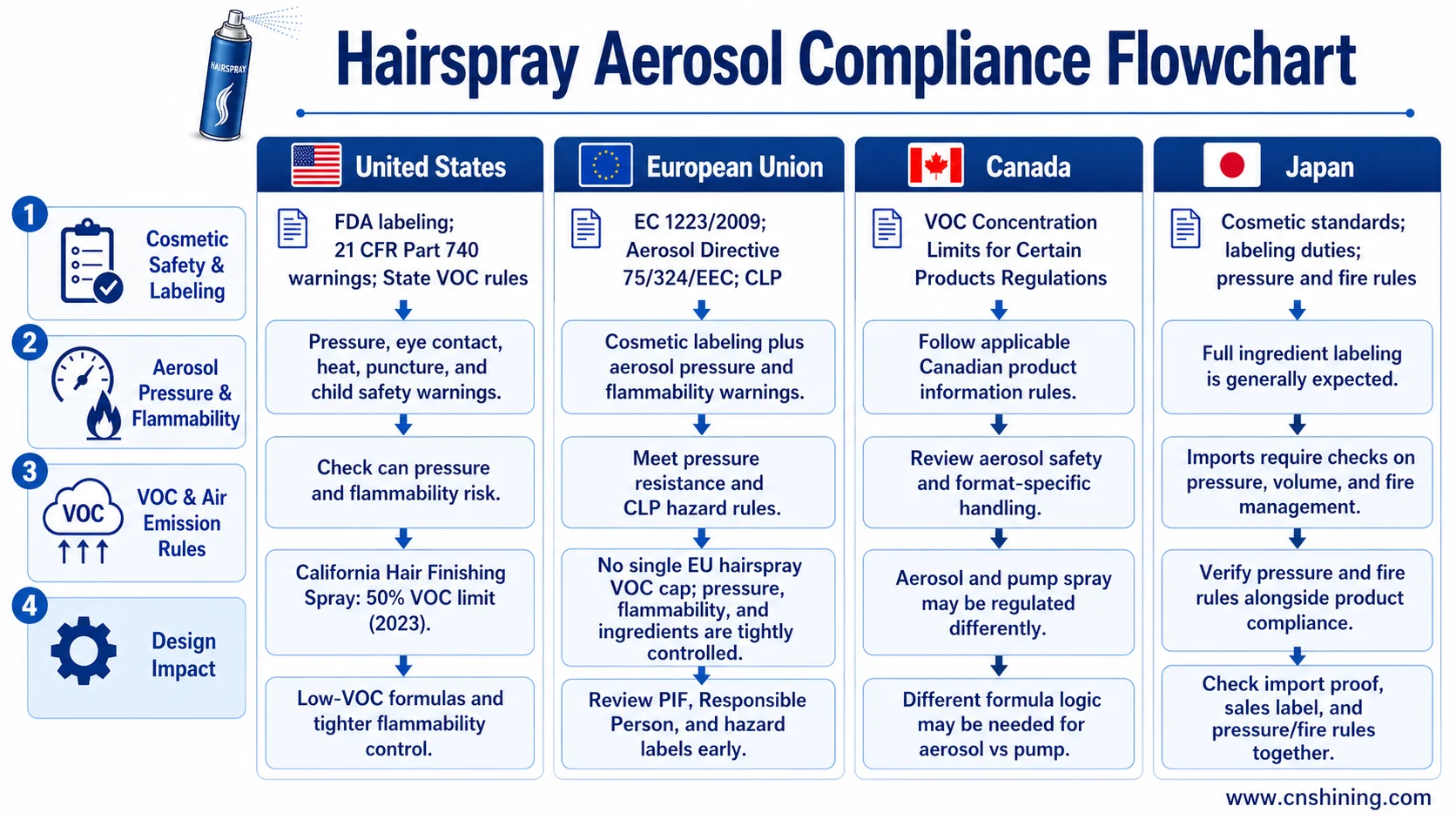
Hairspray aerosol compliance is a three-layer problem. Cosmetics rules control formula, label and safety. Aerosol and chemical rules control flammability, pressure and warnings. Air emission rules decide whether old high-VOC systems can still be used. A formula can work on hair and still fail in labeling, transport or VOC compliance.
| Region | Key Rules / Standards | Labeling Point | Propellant / VOC Point | Design Impact |
|---|---|---|---|---|
| United States | FDA cosmetic labeling requirements; 21 CFR Part 740 warning statements; state-level VOC rules | Self-pressurized cosmetics require pressure, eye contact, heat, puncture and child safety warnings. | California Consumer Products Regulation lists Hair Finishing Spray and shows a 50% VOC limit from 2023. | National labeling plus California VOC pressure push formulas toward low-VOC and tighter flammability control. |
| European Union | Regulation (EC) No 1223/2009 on cosmetic products; Aerosol Dispensers Directive 75/324/EEC; CLP rules | Cosmetic label rules apply, with aerosol pressure and flammability warnings where relevant. | No CARB-style uniform hairspray VOC number is commonly cited at EU level, but flammability, pressure and ingredient restrictions are tightly controlled. | Packaging pressure resistance, PIF, responsible person and hazard labeling need early review. |
| Canada | VOC Concentration Limits for Certain Products Regulations | Product information must comply with applicable Canadian rules. | Hairspray VOC control is relevant; aerosol and pump spray may be treated differently by definition. | The same brand may need different formulation logic for aerosol and pump spray formats. |
| Japan | Cosmetic standards, labeling duties, high-pressure gas and fire-service considerations | Full ingredient labeling is generally expected at sale. | Aerosol imports need attention to pressure, volume and fire-related management, especially alcohol-rich products. | Import proof, sales label and pressure/fire rules must be checked in parallel. |
7. Top 10 Brands in Hairspray Aerosol
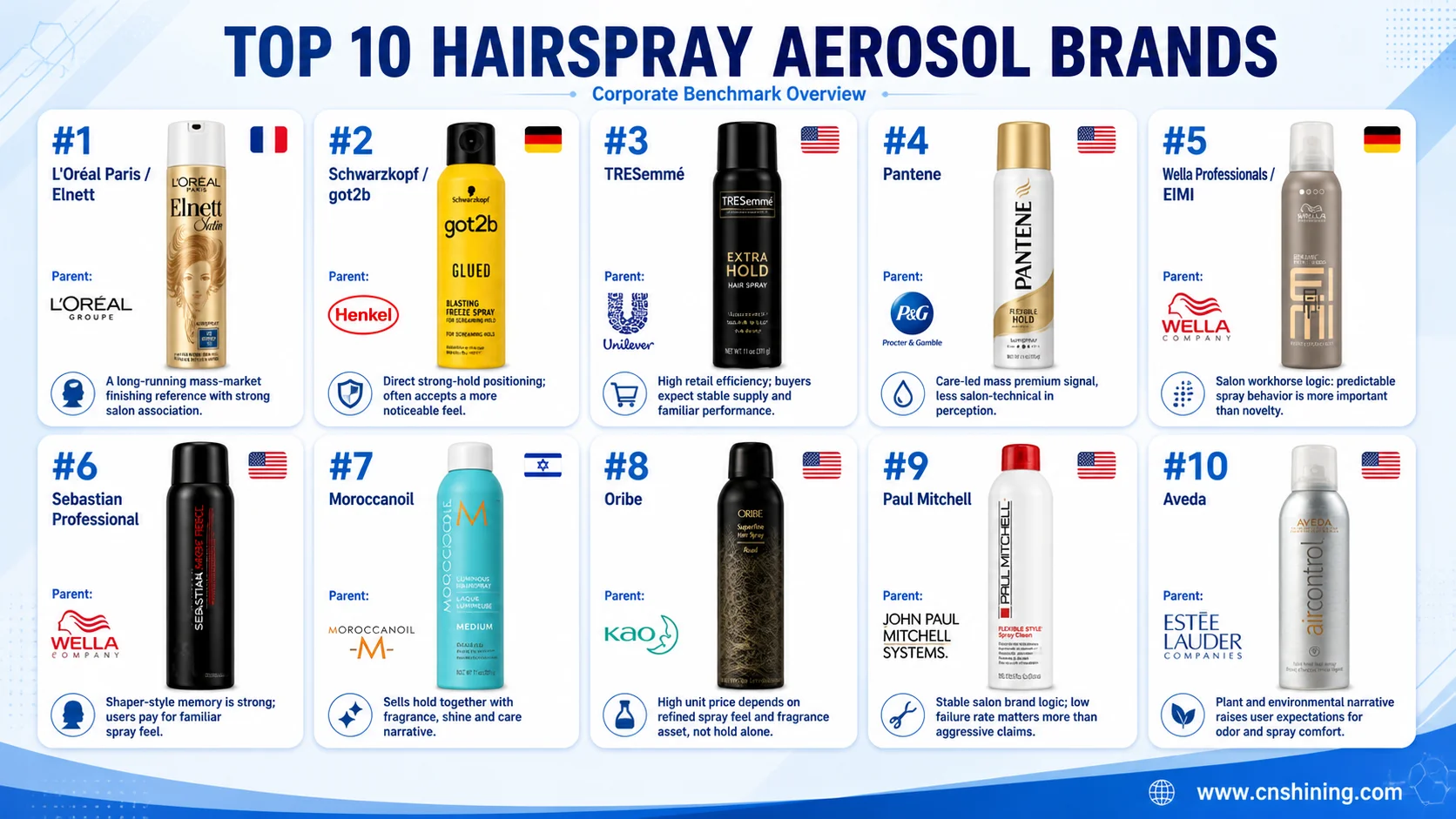
The brand table below is kept as a separate section because brand positioning affects technical expectations. The list reflects global awareness, retail visibility and professional channel influence. Prices vary by country, promotion and size, so the bands should be read as common public retail ranges, not fixed pricing.
| Brand | Brand Country | Parent Company | Typical Capacity | Common Price Band | Technical Reading |
|---|---|---|---|---|---|
| L’Oréal Paris / Elnett | France | L’Oréal Group | 75 mL / 200–300 mL / 11 oz | About US$12–20 | A long-running mass-market finishing reference with strong salon association. |
| Schwarzkopf / got2b | Germany | Henkel | 200–300 mL / 12 oz | About US$6–10 | Direct strong-hold positioning; often accepts a more noticeable feel. |
| TRESemmé | United States | Unilever | 8.5 oz / 11 oz | About US$7–14 | High retail efficiency; buyers expect stable supply and familiar performance. |
| Pantene | United States | Procter & Gamble | 10–11 oz | About US$5–9 | Care-led mass premium signal, less salon-technical in perception. |
| Wella Professionals / EIMI | Germany | Wella Company | 300 mL / 500 mL | About US$18–28 | Salon workhorse logic: predictable spray behavior is more important than novelty. |
| Sebastian Professional | United States | Wella Company | 10.6 oz / 300 mL | About US$20–30 | Shaper-style memory is strong; users pay for familiar spray feel. |
| Moroccanoil | Israel | Moroccanoil | 75 mL / 330 mL | About US$14–30 | Sells hold together with fragrance, shine and care narrative. |
| Oribe | United States | Kao | 2.2 oz / 9 oz | About US$24–48 | High unit price depends on refined spray feel and fragrance asset, not hold alone. |
| Paul Mitchell | United States | John Paul Mitchell Systems | 8.5 oz / 16.9 oz | About US$15–25 | Stable salon brand logic; low failure rate matters more than aggressive claims. |
| Aveda | United States | Estée Lauder Companies | 10 oz | About US$30–38 | Plant and environmental narrative raises user expectations for odor and spray comfort. |
8. Consumer Pain Points
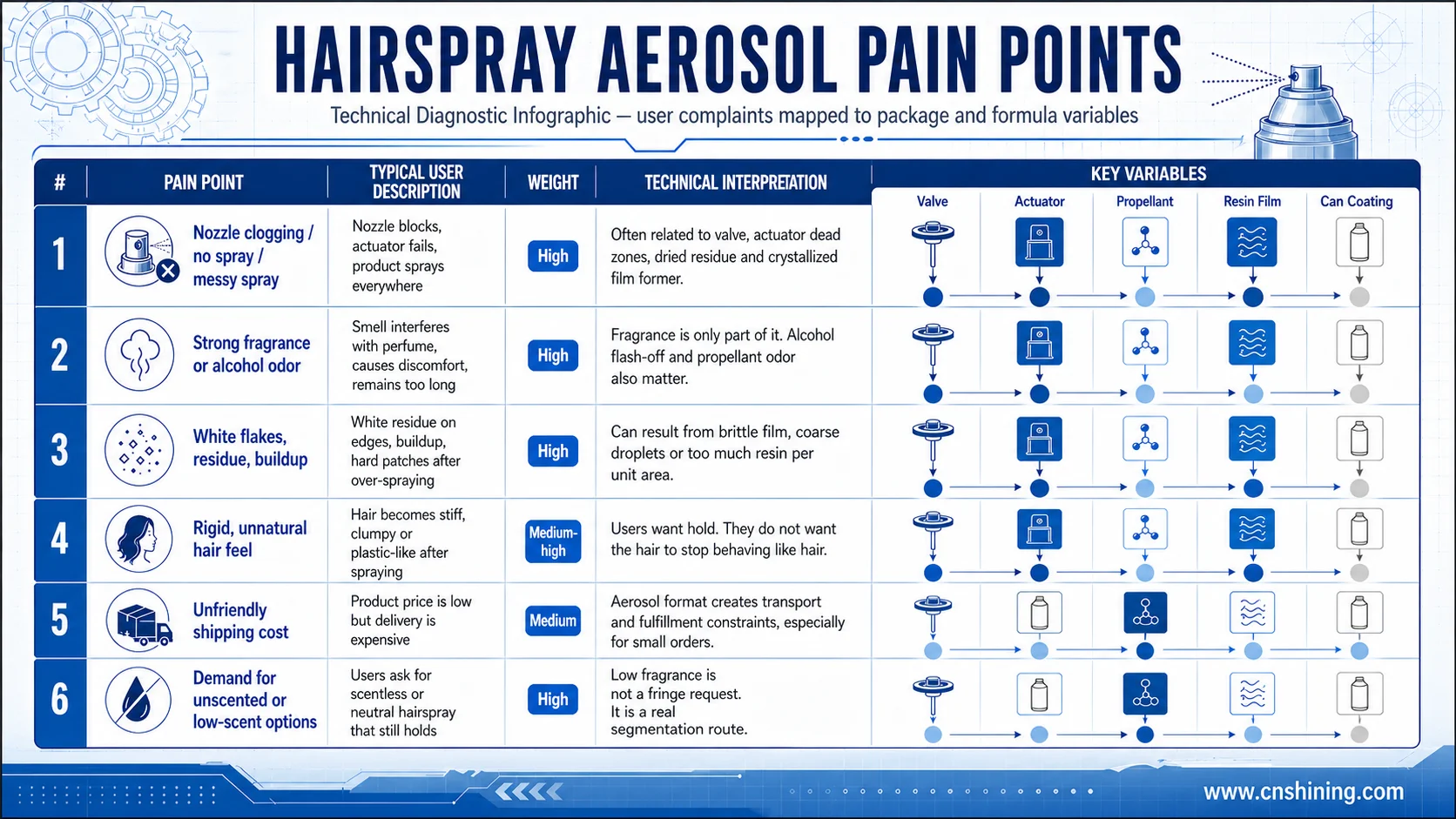
User complaints cluster around a few technical failures: clogged nozzle, coarse droplets, local hard spots, white residue, strong odor, rigid hair feel and unstable spray before the can is empty. These issues are not only formula problems. Many of them can be improved by actuator design, vapor tap selection, mechanical break-up structure, finger pad geometry, can coating and valve gasket material.
| Pain Point | Typical User Description | Weight | Technical Interpretation |
|---|---|---|---|
| Nozzle clogging / no spray / messy spray | Nozzle blocks, actuator fails, product sprays everywhere | High | Often related to valve, actuator dead zones, dried residue and crystallized film former. |
| Strong fragrance or alcohol odor | Smell interferes with perfume, causes discomfort, remains too long | High | Fragrance is only part of it. Alcohol flash-off and propellant odor also matter. |
| White flakes, residue, buildup | White residue on edges, buildup, hard patches after over-spraying | High | Can result from brittle film, coarse droplets or too much resin per unit area. |
| Rigid, unnatural hair feel | Hair becomes stiff, clumpy or plastic-like after spraying | Medium-high | Users want hold. They do not want the hair to stop behaving like hair. |
| Unfriendly shipping cost | Product price is low but delivery is expensive | Medium | Aerosol format creates transport and fulfillment constraints, especially for small orders. |
| Demand for unscented or low-scent options | Users ask for scentless or neutral hairspray that still holds | High | Low fragrance is not a fringe request. It is a real segmentation route. |
9. Packaging Engineering Recommendations
If the pain points are mapped to engineering variables, the improvement routes become clear. Clogging is about valve and residue control. Flaking is about particle size, spray rate and film thickness. Odor is about propellant, solvent and fragrance release. Rigid feel is about spray pattern and local deposition. Tail-off instability is about feed system and valve consistency.
| Pain Point | Packaging Priority | Suggested Action | Expected Effect |
|---|---|---|---|
| Nozzle clogging / failure | Valve + actuator | Use two-piece MBU actuator; start DOE around 0.008–0.010" channel depth; reduce internal dead corners; use solvent-resistant stem gasket material such as butyl or Viton direction for high-solid formulas. | Less dried residue, better long-term spray consistency. |
| Hard spots / wet spots / clumping | Vapor tap + actuator insert | Use vapor tap and insert combinations to narrow droplet size distribution; test 0.011–0.035" insert range instead of chasing high spray rate. | Finer mist, more even coverage and less local buildup. |
| Flaking / residue | Spray pattern + spray rate | Link output per second with resin solid content; avoid excessive full-round rate in strong-hold systems; consider soft or fine fan patterns. | Lower film thickness per area and fewer white flakes. |
| Heavy odor / gas smell | Propellant system | For premium or sensitive lines, consider compressed air, nitrogen or BOV; assess HFO-1234ze(E) where cost and regulation allow. | Lower odor attack and stronger low-burden positioning. |
| Unstable spray near empty | Feed system | Use BOV for premium SKUs; for conventional aerosol, tighten valve consistency and gas-liquid design window. | More stable spray feel across product life. |
| Leakage / rust / metallic odor | Can coating + can material | Avoid uncoated metal risk with alcohol, water and fragrance systems; use qualified internal lacquer on aluminum monobloc or tinplate cans; run formula-coating pack tests. | Lower corrosion, leakage and complaint risk. |
| Finger fatigue / poor control | Actuator ergonomics | Use larger finger pad and lower actuation force; prioritize controllable spray width for finishing products. | Better perceived spray quality and easier use. |
| Weak shelf recognition | Can shape and printing | Use a clear visual hierarchy for fragrance, hold level and humidity resistance; use matte and local gloss contrast for function zones. | Lower SKU confusion and clearer product selection. |
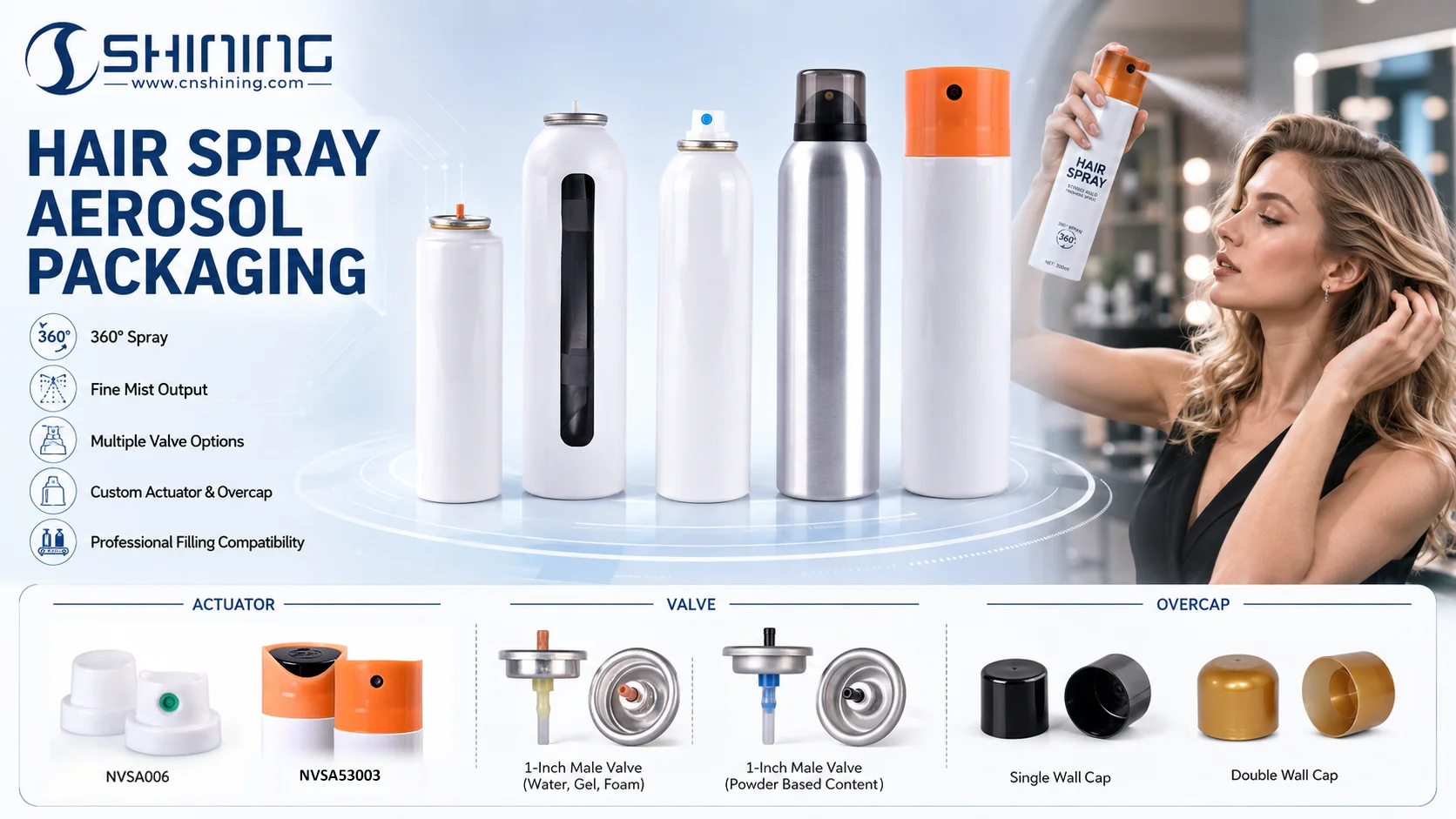
10. Shining Packaging Fit: Actuators, Aerosol Cans and Valves
For a hairspray aerosol project, Shining Packaging fits into the three package interfaces that usually decide whether the formula behaves well outside the lab: actuator, aerosol can and valve. The aim is not to make a stronger claim than the formula can support. The aim is to keep the intended spray performance stable in real use.
On the actuator side, the practical questions are spray width, droplet size, press feel and clogging resistance. On the valve side, the questions are spray rate, vapor tap, gasket swelling, solvent resistance and tail-off behavior. On the aerosol can side, the questions are pressure resistance, inner lacquer compatibility, corrosion control, print durability and filling reliability.
For hairspray aerosol, the package should be selected after formula screening, not before it. A low-VOC water-rich formula, a high-alcohol quick-dry formula and a BOV low-odor formula should not automatically use the same valve and actuator. That is where early package testing saves time.
11. Three Packaging Schemes by Product Tier
11.1 Mass Retail Line
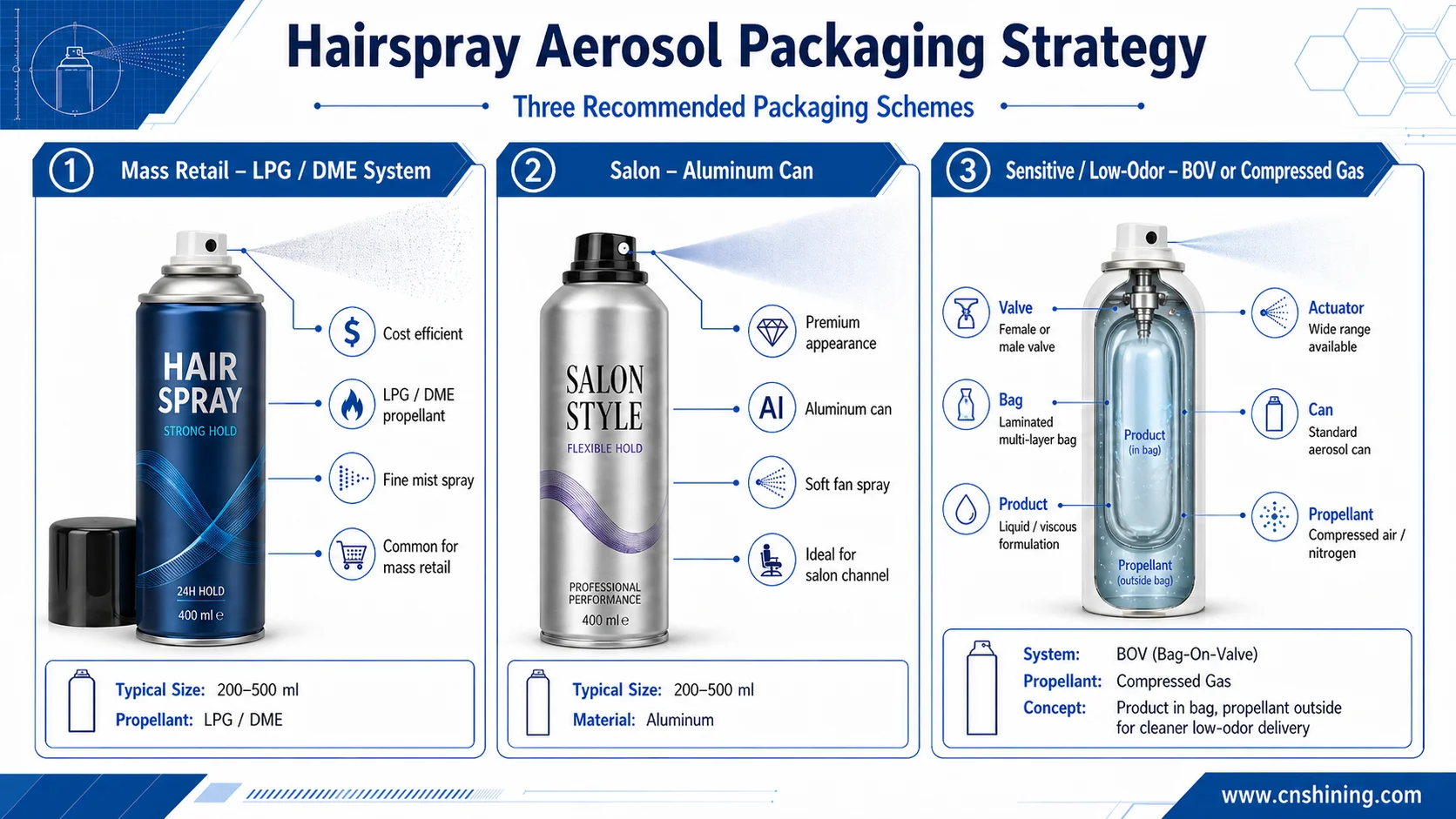
Conventional LPG or DME systems can still work. The budget should first go to valve consistency and actuator upgrade, not only thicker printing. Since steel aerosol cans are the primary choice for cost efficiency, the focus should be on mechanical reliability. A fine-spray MBU actuator, optimized vapor tap, qualified internal coating, and better gasket material often give more real value to mass consumers than another hold-level claim.
11.2 Mid-to-High Salon Line
A two-SKU spray feel structure is useful. One SKU can focus on extra hold with soft or fine fan spray to control local film thickness. The other can focus on workable hold, brushability, and low flake. Aluminum aerosol cans are the core here; their versatile shapes and premium finish justify the higher price. A better finger pad and clear brushability grade help professional users repeat the same high-end result.
11.3 Sensitive User / Lower-Burden Line
BOV or compressed air/nitrogen deserves early evaluation. The strongest claims here are usually low odor, lower flammability pressure, reduced gas smell and more stable lifecycle spray. HFO-1234ze(E) can also be considered where cost, regulations and filling capability support it.
12. Technical Frontier and Practical Takeaway
The new direction is not that hairspray will disappear. The direction is that traditional high-alcohol, high-flammability and rigid-hold logic is being replaced by light feel, cleaner spray, lower odor, lower flaking and lower environmental burden. That shift changes both the formula and the package.
On the formula side, the pressure is toward high-water, low-alcohol systems and better humidity-resistant polymers. The target is no longer just “it can hold hair.” The target is: it can spray, dry, resist humidity, remain flexible and avoid visible residue under lower VOC constraints.
On the packaging side, the actuator, valve, vapor tap, gasket and can coating become development tools. Consumer complaints show the same pattern: people rarely complain first that hold is too weak. They complain that the product clogs, smells strong, flakes, feels hard or sprays badly.
The practical conclusion is direct: hairspray aerosol is still an efficient finishing format. The next improvement will come from system engineering, not from resin selection alone.
13. FAQ: Hairspray Aerosol Technical Questions
Hairspray aerosol uses internal pressure and a valve-actuator system to atomize the formula continuously. This usually gives finer droplets, wider coverage and faster drying than pump spray. Pump formats avoid propellant but often produce heavier local deposition. For final finishing, aerosol remains more efficient when the target is even film formation over the full hairstyle.
Clogging usually comes from dried resin, local residue, actuator dead zones, valve material mismatch or high-solid formula behavior. It is not only a formula issue. The actuator channel, mechanical break-up insert, valve gasket and solvent evaporation rate all affect clogging. Testing should include repeated spray, storage and tail-off performance, not only first-use spray quality.
White flakes are normally linked to brittle polymer film, excessive local spray deposition, coarse droplets or repeated layering without brushing. Strong hold formulas are more exposed to this risk because they rely on higher film strength. A finer spray pattern, controlled spray rate and better resin-plasticizer balance can reduce visible residue without removing hold completely.
A vapor tap introduces part of the vapor phase into the liquid stream before atomization. This can help reduce droplet size and improve fine mist feel. Too much vapor contribution may create overspray or a dry spray that feels less controlled. The right vapor tap is selected together with actuator insert, propellant ratio and target spray rate.
VOC rules restrict the amount of volatile organic material that can be used in certain markets. This pushes formulas away from traditional high-alcohol systems and toward water-rich, lower-alcohol or alternative propellant routes. The challenge is maintaining drying speed, resin solubility, spray quality and humidity resistance while reducing VOC contribution and still passing package compatibility tests.
BOV can be suitable when the product target is low odor, reduced gas contact, stable lifecycle spray and lower flammability pressure. It separates the product from the propellant, which helps protect formula integrity. The tradeoff is cost, filling complexity and spray character. It is usually better suited to premium or sensitive-user lines than low-cost mass SKUs.
Inner lacquer protects the metal can from alcohol, water, fragrance components and other reactive formula parts. Poor coating compatibility can lead to corrosion, leakage, metallic odor or product instability. Water-rich low-VOC formulas often increase this risk. Pack testing should include the exact concentrate, propellant, valve, gasket and storage temperature range planned for production.
Strong smell may come from fragrance load, alcohol flash-off, residual propellant odor or the way the spray cloud hangs around the user. Masking with more fragrance is not always the answer. Low-odor development should review solvent level, propellant route, spray droplet size, evaporation profile and whether the target market needs unscented or low-scent positioning.
Start with a formula-package compatibility screen using the intended can coating, valve, gasket, actuator and propellant. Then run spray rate, particle size, clogging, leakage, corrosion and repeated-use tests. A formula that looks stable in bulk can fail after crimping and propellant charging. Early package testing prevents late-stage reformulation and filling problems.
The trend is toward fine mist, low VOC, low odor, low flaking and more natural feel. That requires combined work on resin chemistry, solvent balance, propellant choice, actuator geometry, valve consistency and can coating. The product value is shifting from “maximum hold” to controlled finishing that keeps the hairstyle stable without making the hair feel rigid.