
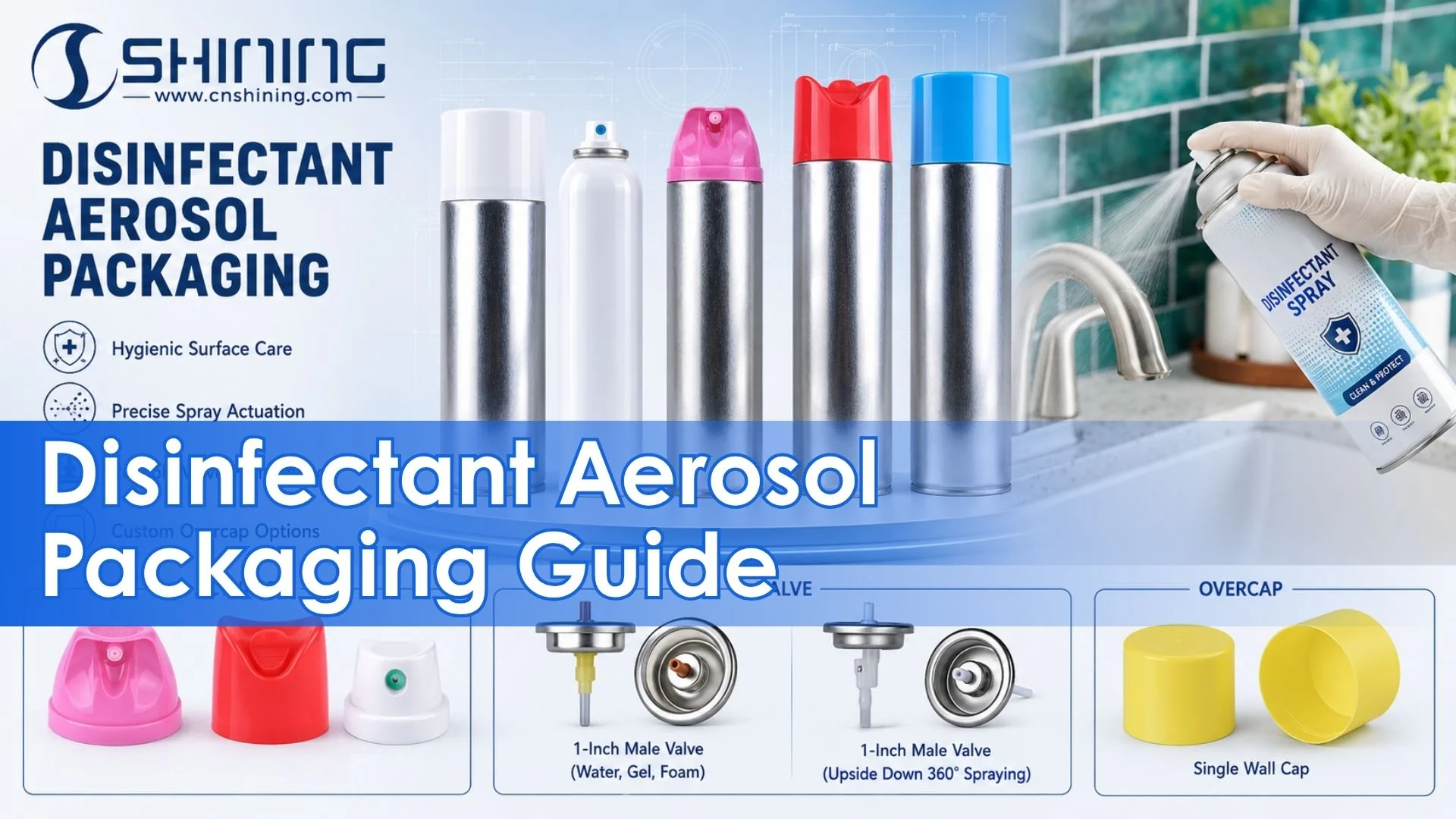
1. What Defines an Aerosol Disinfectant Spray?
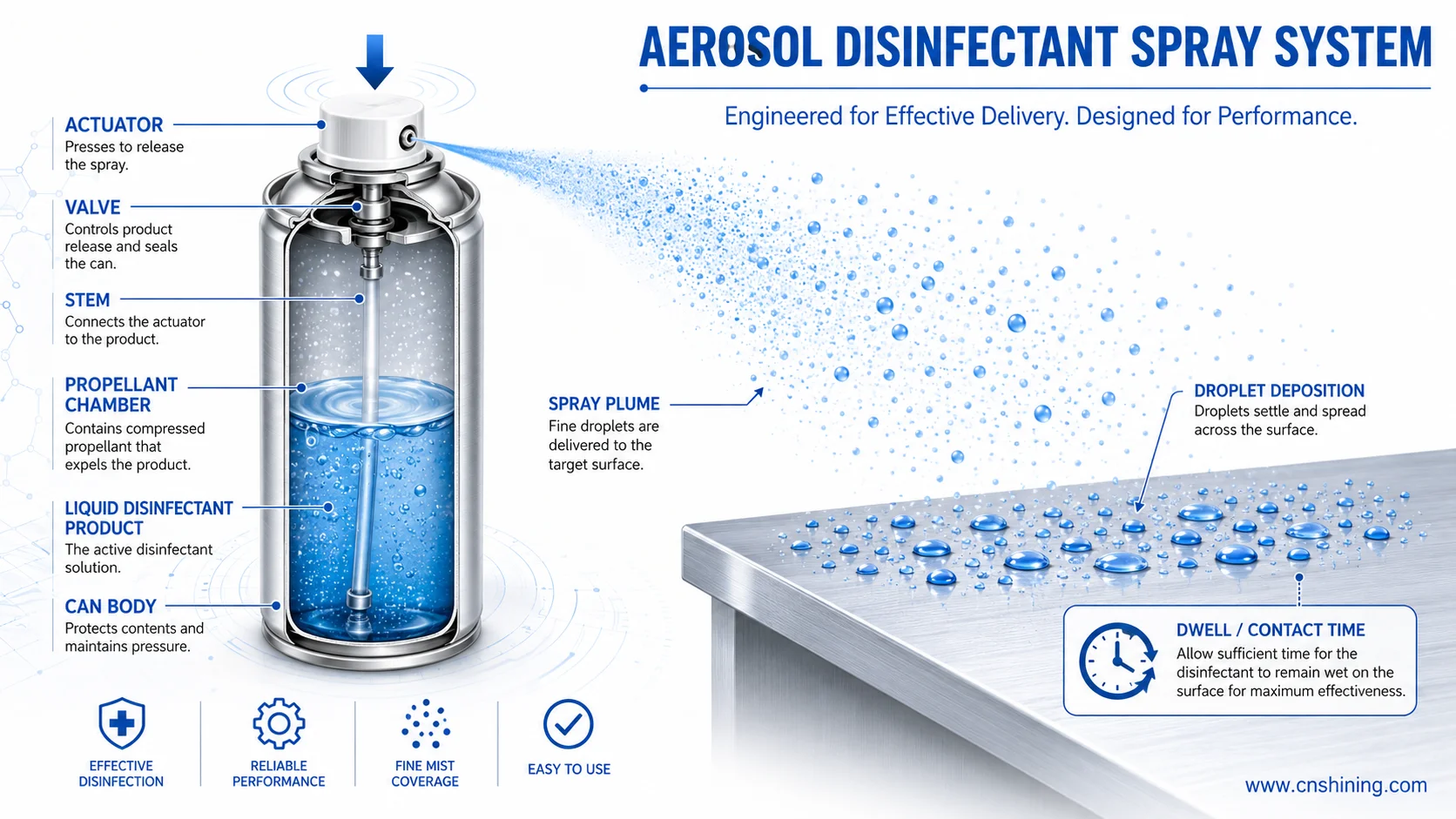
An aerosol disinfectant spray is a pressurized spray product carrying active antimicrobial or virucidal ingredients. The liquid formulation is packed in a pressure-resistant can and released through a valve, stem, and actuator. In a traditional two-phase aerosol system, LPG or compressed gas maintains pressure. In a Bag-on-Valve (BOV) system, the formulation stays inside a bag while the propellant or compressed gas remains outside the bag.
The regulatory point is simple: the product is not validated because it “looks like mist.” It is validated by its label claims, target surface, application method, and dwell time / contact time. If the product cannot keep a surface wet for the stated contact time, the spray pattern alone does not prove disinfection.
Public market data is easier to find for “disinfectant spray” and “surface disinfectant” than for a strict aerosol-only category. The disinfectant spray market was reported at USD 11.57 billion in 2024 and projected to reach USD 18.56 billion by 2030, with a 2025–2030 CAGR of 8.2% according to Grand View Research disinfectant spray market data. The key engineering reading is not “growth is guaranteed.” It is that spray formats remain useful where coverage speed, soft surface reach, and non-contact application matter.
2. Definition, Working Mechanism, and Packaging Architecture
From a packaging view, an aerosol disinfectant spray is a liquid formulation atomized from a pressurized container. From a regulatory view, spray products include aerosol, pressurized spray, trigger, and pump dispensers in EPA efficacy guidance for environmental surface disinfectants. From a consumer view, the product is usually understood as “pick up and spray.” That is where misuse starts. Scent is often mistaken for sanitation.
The operating sequence is practical and mechanical: storage, pressurization, valve opening, atomization, surface deposition, and wet contact inactivation. When the actuator is pressed, the stem moves down, the seal opens, internal pressure pushes the formulation through the valve and orifice, and the insert geometry shapes the spray. Spray rate, droplet size, spray angle, bounce-back, and drift are shaped by actuator design, valve selection, propellant type, formulation viscosity, surface tension, and fill ratio.
In a BOV aerosol disinfectant spray, the active formulation does not mix directly with the propellant. This can help with formulation protection, higher evacuation rate, multi-angle use, and lower direct VOC interaction. It does not automatically improve kill spectrum. The active chemistry and verified contact time still decide the claim.
3. Active Ingredients and Formulation Roles
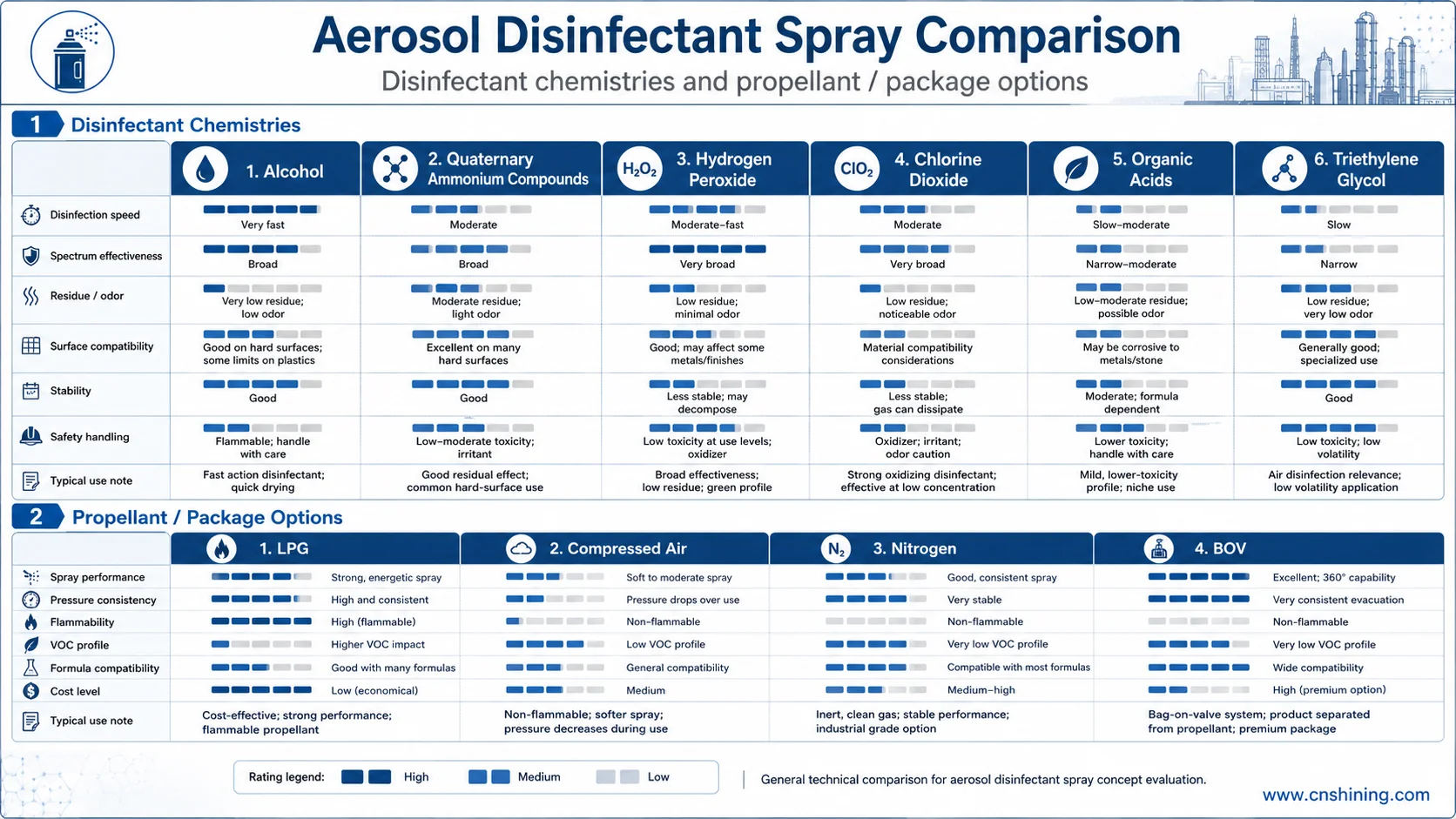
Most aerosol disinfectant spray formulas are built around alcohols, quaternary ammonium compounds, hydrogen peroxide or accelerated hydrogen peroxide, chlorine-based chemistry, organic acids, and some TEG-related pressurized systems. Public retail labels usually disclose active ingredients, but not full solvent, fragrance, propellant, and surfactant systems.
| Category | Common Components | Main Technical Role | Commercial Reading |
|---|---|---|---|
| Alcohols | Ethanol, isopropanol | Protein denaturation and lipid membrane disruption. Fast action on many vegetative bacteria, fungi, and enveloped viruses. | Fast drying and accepted in fabric or furniture use, but odor and flammability must be managed. |
| QACs | BAC, DDAC, ADBAC | Membrane disruption and protein inactivation. Often gives some cleaning behavior. | Useful on hard surfaces and low-corrosion claims. Watch hard water and cotton/cellulose absorption issues. |
| Hydrogen peroxide / AHP | H2O2, accelerated hydrogen peroxide | Oxidative damage to cellular components. | Fits low-residue positioning. Packaging compatibility and stability testing become more demanding. |
| Chlorine / chlorine dioxide | Sodium hypochlorite, chlorine dioxide | Strong oxidation. | More common in liquid systems. In pressurized formats, corrosion, odor, and material compatibility are hard gates. |
| Organic acids | Citric acid and related acid systems | pH reduction and membrane/protein stress. | Useful for low-irritation or QAC-free narratives, but spectrum and label claims need conservative validation. |
| TEG and blends | Triethylene glycol plus QAC systems | Odor control and surface or air-adjacent hygiene positioning. | Often used in “disinfection plus deodorization” household products. |
| Propellant system | LPG, compressed air, nitrogen, BOV | Pressurization, delivery, and atomization. | Controls spray feel, odor, VOC pressure, cost, evacuation rate, and transport constraints. |
| Example | Publicly Disclosed Information | Unknown or Limited Area |
|---|---|---|
| Sagrotan Hygiene-Spray | Public product information showed 60 g ethanol and 0.10 g ADBAS per 100 g, a typical high-alcohol plus low-QAC household aerosol direction. | Fragrance, solvent system, propellant, and full auxiliary ingredients are not fully disclosed. |
| Scrubbing Bubbles Multi-Purpose Disinfectant | EPA List N information identified a pressurized liquid product with triethylene glycol and quaternary ammonium active chemistry. | Percentages and complete inert ingredients are not fully public. |
| US6482392B1 Aerosol antimicrobial compositions | Patent disclosure describes an anionic polymer or prepolymer, QAC, water-soluble or dispersible organic solvent, propellant, and water. | Not a ready-to-copy commercial formula; patent context and claim limits must be read carefully. |
| WO2020176623A1 Hydrogen peroxide disinfectant composition | Patent disclosure refers to hydrogen peroxide source, aromatic alcohol, glycol or glycol ether, surfactant, and acid. | Packaging method and propellant structure are not fully determined from the abstract alone. |
4. Comparison with Wipes, Trigger Sprays, and Fogging Equipment
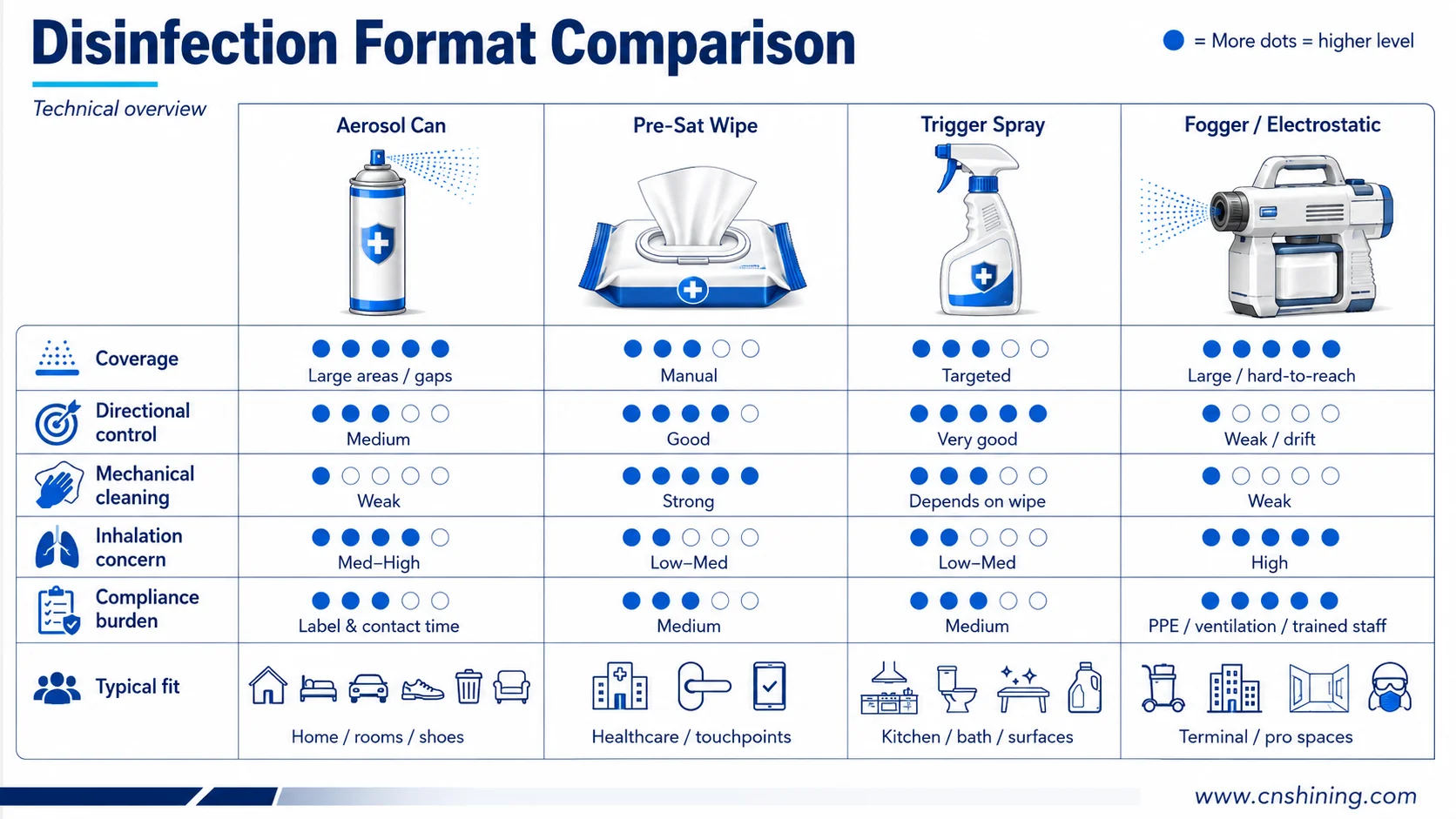
| Dimension | Aerosol Disinfectant Spray | Pre-Saturated Wipes | Trigger / Pump Spray | Fogger / Electrostatic Sprayer |
|---|---|---|---|---|
| Coverage efficiency | High for large areas, soft surfaces, shoes, bins, handles, and narrow gaps. | Moderate. Manual wiping limits speed. | Moderate. Strong directionality. | High for large or hard-to-reach spaces. |
| Directional control | Medium unless a directional actuator is used. | Good. | Very good. | Weak. Drift is expected. |
| Mechanical soil removal | Weak unless paired with cloth or paper. | Strong. Wiping removes soil. | Medium, depending on wiping step. | Weak. |
| Inhalation concern | Medium to high in enclosed spaces or heavy-fragrance products. | Low to medium. | Low to medium. | High. Needs controlled operation. |
| Compliance burden | Medium. Label and contact time education are central. | Medium. | Medium. | High. Often requires approved label method, empty room, ventilation, PPE, and trained staff. |
| Typical fit | Household deodorizing plus disinfection, fabrics, hotel rooms, cars, shoes, bins. | Healthcare touchpoints, controlled wiping, electronics when approved. | Kitchens, bathrooms, hard surfaces, refill systems. | Terminal disinfection and professional spaces. |
Aerosol disinfectant spray is an efficiency tool. Wipes are control tools. Trigger sprays are cost and direction tools. Foggers are professional-area tools. For most consumer brands, these formats should not fight each other. They should be arranged as a use-case matrix.
5. Regulatory Terms and Compliance Points
| Term | Plain Technical Meaning | Product Impact |
|---|---|---|
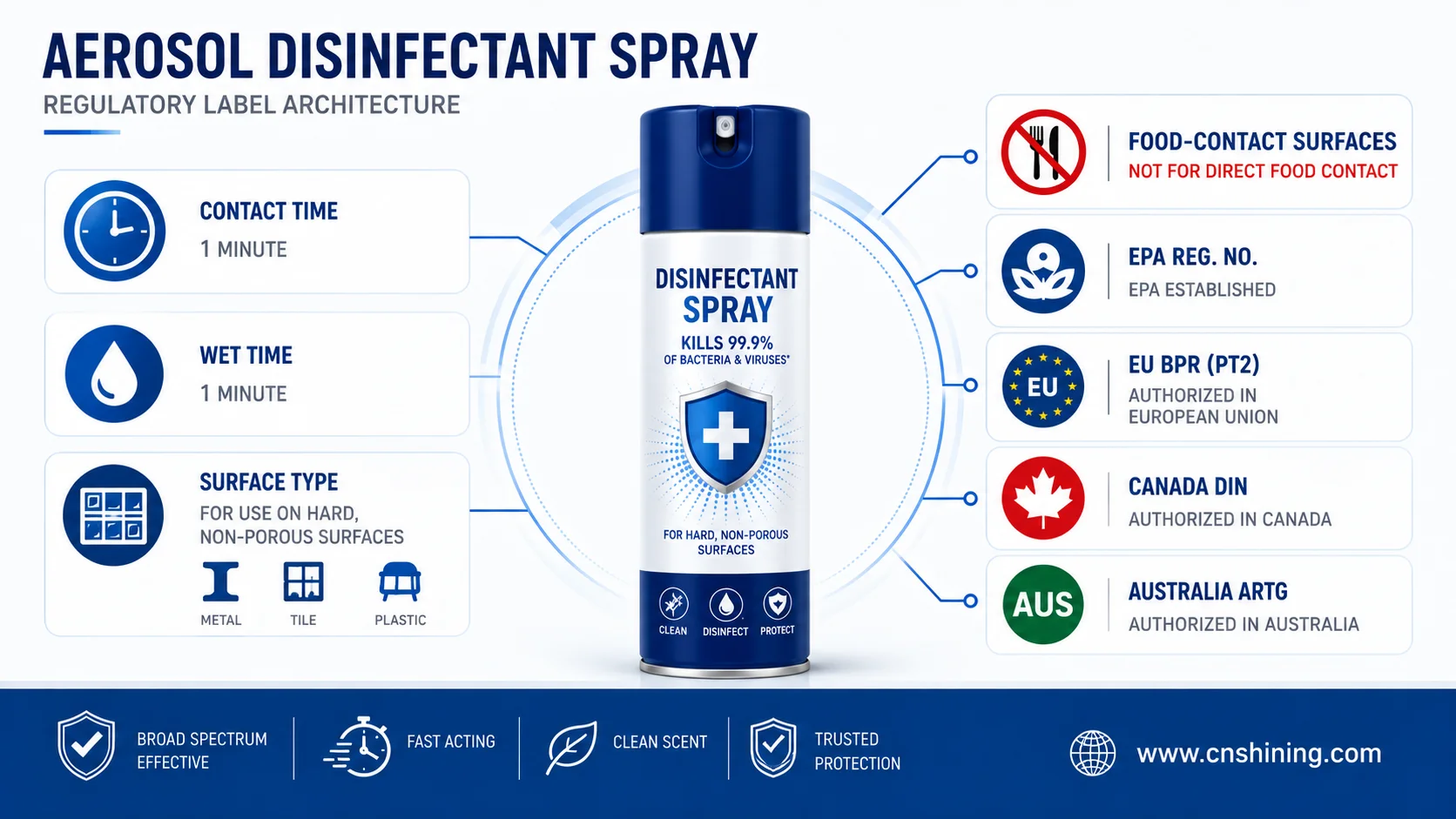
| Contact time / dwell time | The time the disinfectant must remain on the target surface. | Controls whether the label can claim 30 seconds, 1 minute, 3 minutes, or 10 minutes. |
| Wet time | The visible wet period after spray deposition. | Directly affects real user compliance. |
| EPA Reg. No. | U.S. EPA registration identifier. | A practical marker for legally registered U.S. surface disinfectants. |
| PT2 | EU BPR product type for surface disinfection not directly applied to humans or animals. | Shapes the EU authorization path and data package. |
| DIN | Canadian Drug Identification Number for hard surface disinfectants. | Relevant for Canadian market access. |
| BOV | Bag-on-Valve separation of formulation and propellant. | Can support low odor, high evacuation, 360° use, and better compatibility for some formulas. |
| Particle size | Droplet size distribution from the actuator and formula system. | Changes deposition, inhalation exposure, drift, and coverage uniformity. |
| Inner lacquer | Internal coating of the metal aerosol can. | Key for alcohol, peroxide, acidic, fragrance-heavy, or corrosive systems. |
| Market | Core Logic | Engineering Reading |
|---|---|---|
| United States | EPA / FIFRA registration for surface disinfectants. EPA OCSPP 810.2200 covers hard, non-porous surfaces and includes aerosol, pressurized spray, trigger, and pump products. | New pathogen claims, faster kill claims, or new application methods require data support. |
| European Union | Biocidal Products Regulation. Active substance approval comes first, then product authorization. PT2 applies to many surface disinfectants. | Do not rely on vague terms such as harmless, natural, or environmentally friendly unless the regulatory basis is clear. |
| Canada | Health Canada hard surface disinfectant monograph and DIN route. | The monograph lists permitted actives, minimum in-use concentrations, target organisms, contact times, and use areas. |
| United Kingdom | GB BPR after Brexit. HSE manages biocidal product authorization. | EU authorization cannot simply be treated as automatic UK authorization. |
| Australia | TGA guidance and ARTG relevance for disinfectants with specific claims. | Labels should clearly state pre-cleaning, dilution, application method, contact time, and surface limits. |
6. Technology and Market Trends
The first trend is movement from “strong kill” alone toward strong kill plus better user tolerance. Users care about odor, residue, whether the spray can be used on fabric, whether it is suitable around children or pets under label conditions, and whether nearby objects become wet by drift.
The second trend is BOV, compressed air, nitrogen, and lower-VOC architecture. These structures can reduce direct propellant-formula interaction, improve evacuation, support 360° use, and reduce propellant odor. They also raise package cost and require tighter supplier coordination.
The third trend is a shift from high-chlorine or heavy-odor concepts toward hydrogen peroxide, organic acid, bio-based, and low-toxicity perception. This does not mean “natural equals easier.” For disinfectants, mild language still needs a validated technical boundary.
The fourth trend is label visualization. A user cannot execute a 3-minute or 10-minute dwell time if that information is hidden in dense microtext. Better packaging information architecture is now part of the engineering solution.
7. Top 10 Aerosol Disinfectant Spray Brands
| Brand | Origin | Parent Company | Common Size | Public Retail | Technical Comment |
|---|---|---|---|---|---|
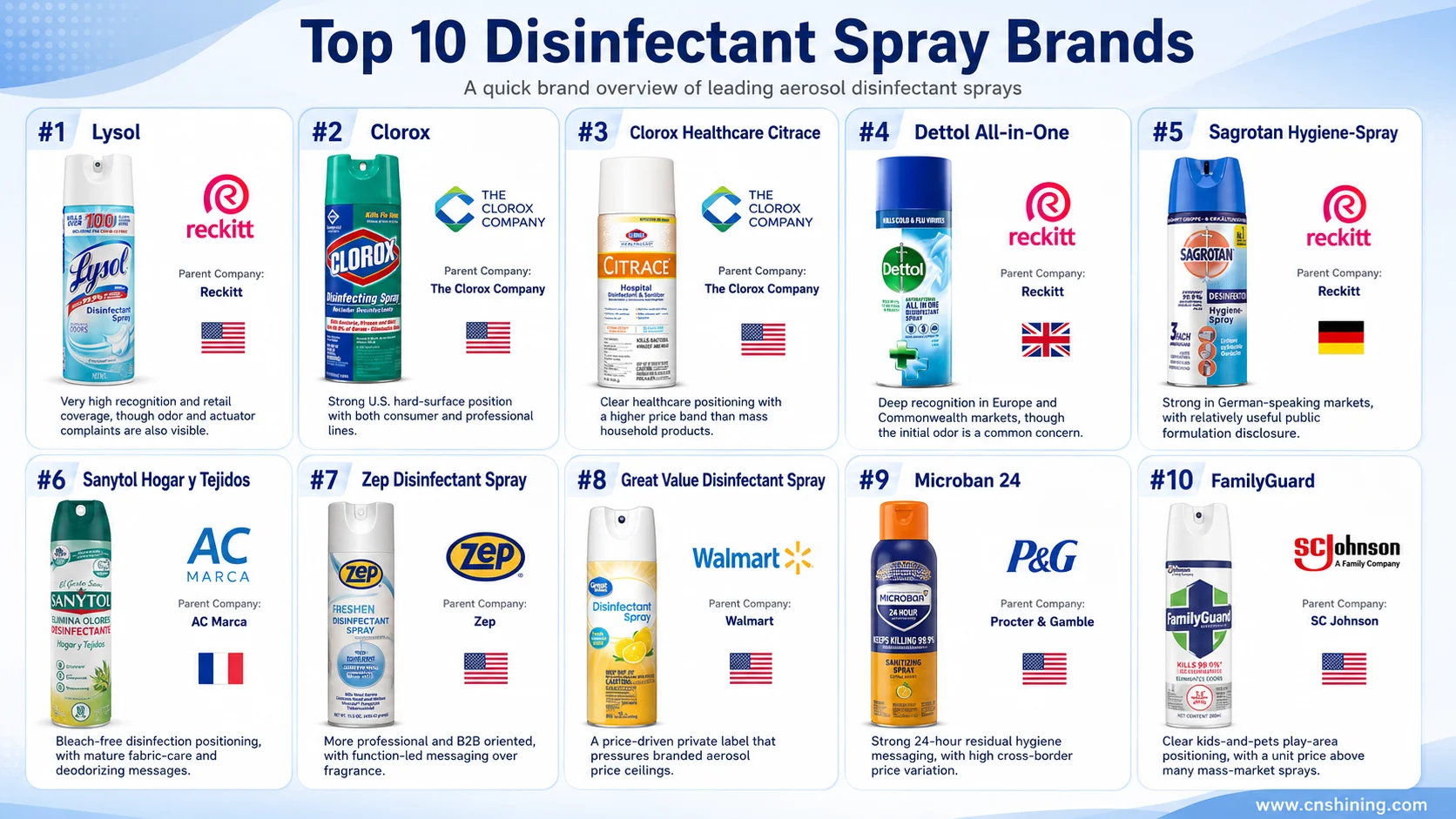
| Lysol | United States | Reckitt | 19 oz | about 6.3$–8.0$ per can | Very high recognition and retail coverage. Odor and actuator complaints are also visible. |
| Clorox | United States | The Clorox Company | 19 oz | about 4.5$–11.4$ per can | Strong U.S. hard-surface position with both consumer and professional lines. |
| Clorox Healthcare Citrace | United States | The Clorox Company | 14 oz | about 17$–18$ per can | Clear healthcare positioning. Higher price band than mass household products. |
| Dettol All-in-One | United Kingdom | Reckitt | 300–400 ml | about 5.8$–6.0$ per can | Deep recognition in Europe and Commonwealth markets. Initial odor is a common user concern. |
| Sagrotan Hygiene-Spray | Germany | Reckitt | 250–400 ml | about 1.7$–5.7$ per can | Strong in German-speaking markets. Public formulation disclosure is relatively useful. |
| Sanytol Hogar y Tejidos | France | AC Marca | 300 ml | about 5.0$ per can | Bleach-free disinfection positioning. Fabric and deodorizing messages are mature. |
| Zep Disinfectant Spray | United States | Zep | 15.5 oz | about 17$–18$ per can | More professional and B2B oriented. Function narrative is stronger than fragrance narrative. |
| Great Value Disinfectant Spray | United States | Walmart private label | 19 oz | about 4.77$ per can | Price-driven private label. It puts pressure on branded aerosol price ceilings. |
| Microban 24 | United States | Procter & Gamble | 15 oz / 425 g | about 12.99$ per can | Strong “24-hour” residual hygiene message. Cross-border price variation is high. |
| FamilyGuard | United States | SC Johnson | 17.5 oz | about 15.97$ per can | Clear “kids and pets play area” message. Unit price is above many mass-market sprays. |
8. User Pain Points and Packaging Improvement Priorities
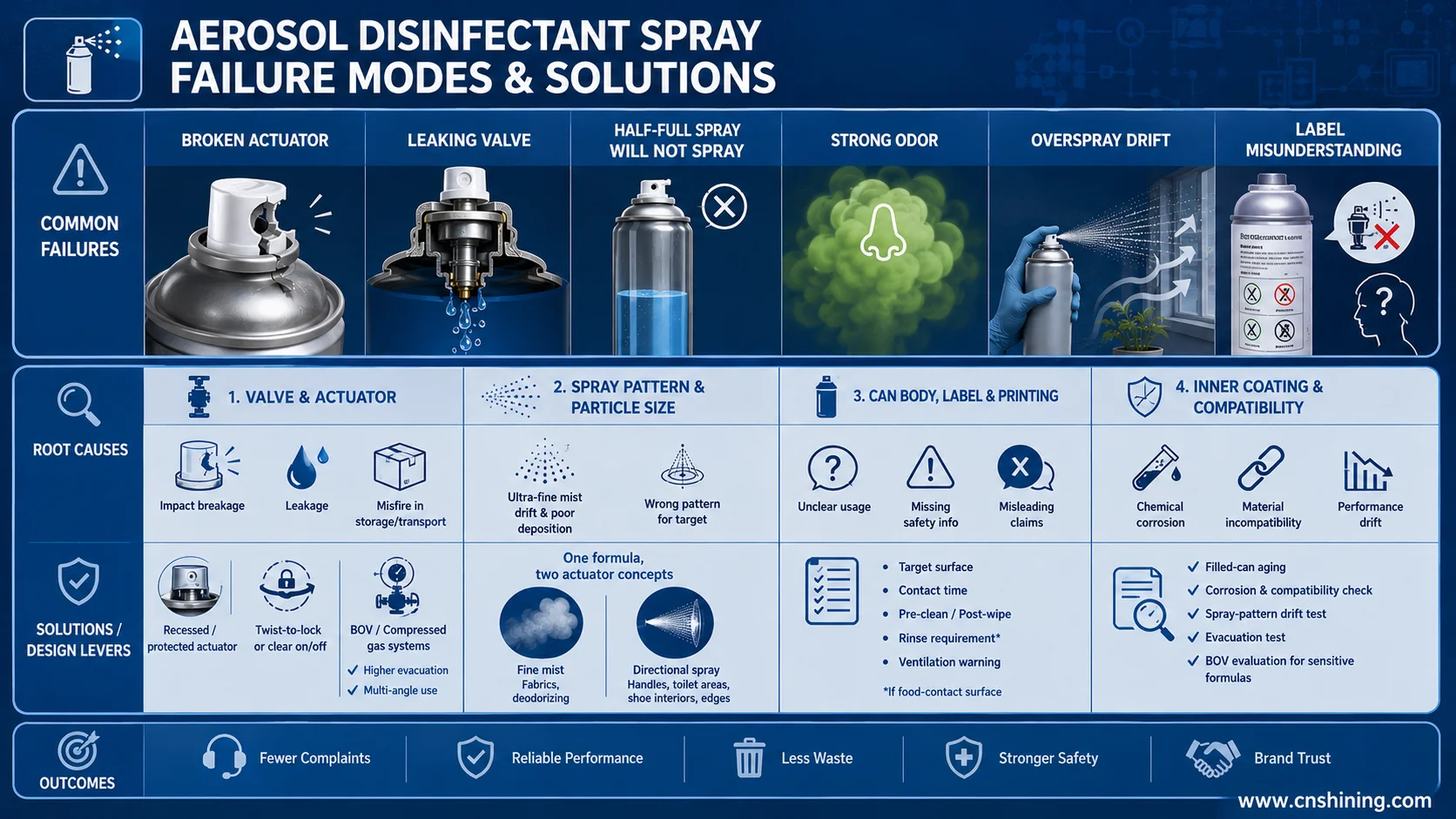
User complaints cluster into five groups: actuator or valve stem breakage, half-can no-spray failure, leakage, strong odor or respiratory discomfort, and residue or overspray on surrounding objects. These are not minor cosmetic issues. They point directly to valve, actuator, propellant balance, droplet size, sealing, and label design.
8.1 Valve and Actuator
If the target is reducing half-can failure, leakage, and broken nozzles, the first lever is not fragrance. It is the valve and actuator package. BOV or compressed gas systems should be tested for higher evacuation and multi-angle use. Recessed or protected actuator geometry can reduce impact breakage. Twist-to-lock or clear on/off structures can reduce transport or storage misfire.
8.2 Spray Pattern and Particle Size
Ultra-fine mist is not always the right answer. For household surface disinfection, slightly larger and more directional droplets can be more useful because they deposit on the target surface instead of staying airborne. One formula can be paired with two actuator concepts: fine mist for fabrics and deodorizing, directional spray for handles, toilet areas, shoe interiors, and edges.
8.3 Can Body, Label, and Printing
Many misuse cases come from unclear packaging language. The front panel should state target surface, contact time, pre-cleaning or post-wipe requirement, rinse requirement for food-contact surfaces when applicable, and ventilation warning. This is not decoration. It is part of the use system.
8.4 Inner Coating and Compatibility
High-alcohol, peroxide, acidic, or fragrance-heavy formulas can stress the metal can, valve spring, gasket, inner lacquer, and stem materials. New actives should go through filled-can aging, corrosion checks, valve compatibility, spray-pattern drift testing, and evacuation testing. For oxygen-sensitive or propellant-sensitive formulas, BOV should be evaluated early.
9. Shining Packaging Components for Aerosol Disinfectant Spray Projects
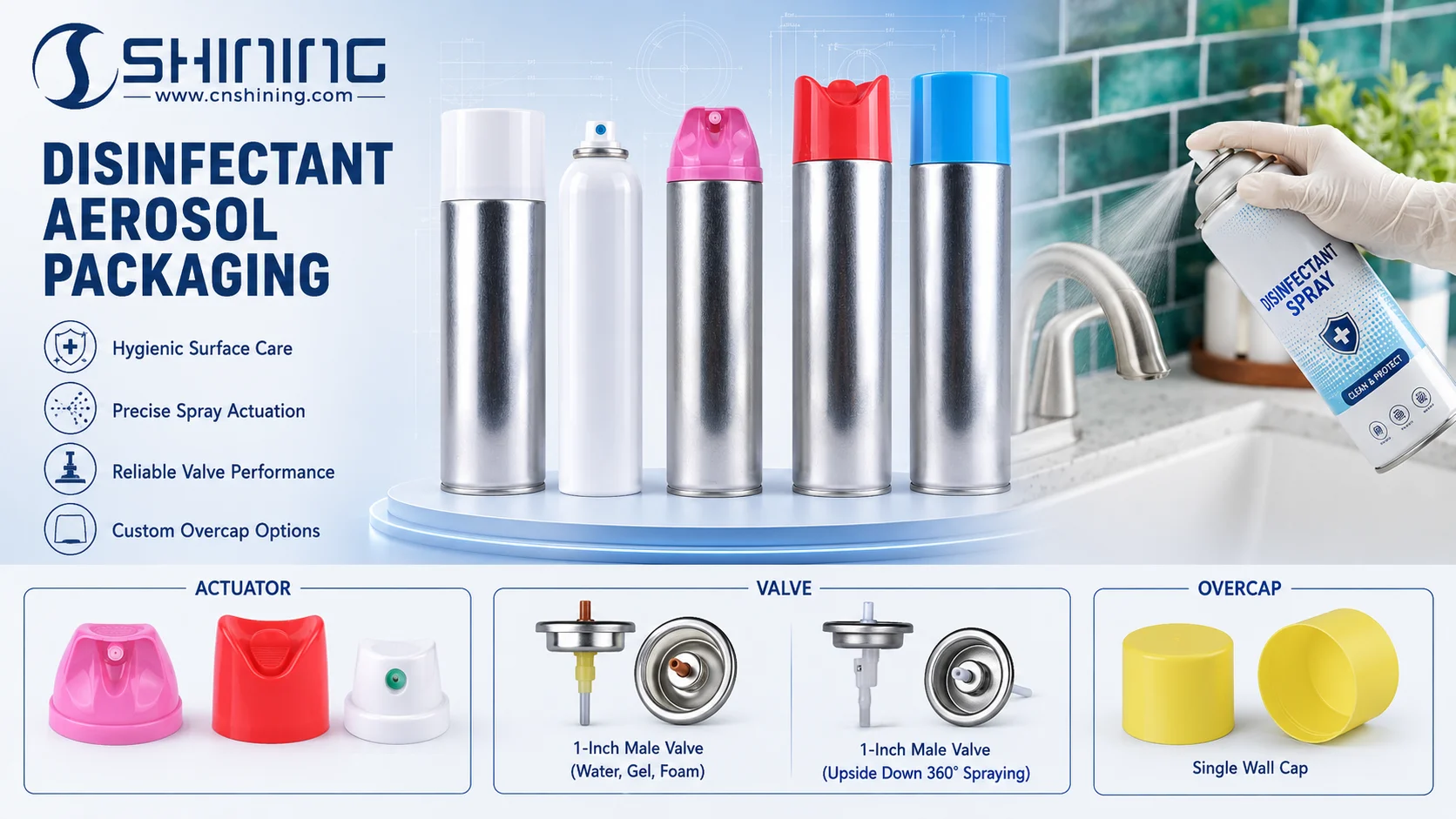
For aerosol disinfectant spray, Shining Packaging’s relevant work sits in three hardware interfaces: actuators, aerosol cans, and valves. These parts do not replace efficacy testing. They decide whether the verified formula can be delivered consistently, safely, and with acceptable user experience.
The actuator determines spray angle, droplet feel, finger comfort, directional control, and breakage resistance. The aerosol can must match pressure, corrosion behavior, lacquer compatibility, filling route, printing layout, and transport requirements. The valve controls sealing, spray rate, evacuation, formula compatibility, and long-term stability. A disinfectant spray project should not approve these parts separately. The package should be tested as a filled system.
Where BOV, compressed nitrogen, low-odor formulas, or directional actuators are being considered, Shining Packaging can frame the component selection around measurable checks: spray rate, particle behavior, leakage, actuator drop resistance, 360° performance, evacuation rate, and accelerated storage. That is usually more useful than arguing whether a spray feels “premium.”
10. Conclusion
Aerosol disinfectant spray still has a clear technical role: fast coverage, soft-surface reach, reduced dependence on wiping tools, and convenient household or commercial use. The weak points are just as clear: odor, inhalation exposure, VOC or flammability pressure, actuator failure, leakage, half-can no-spray problems, and poor label execution.
The practical direction is not another heavy-fragrance general spray. The more durable route is lower odor, better actuator protection, verified wet contact time, BOV or compressed gas where justified, stronger compatibility testing, and front-label instructions that users can execute. In this category, formula, package, and label are one system. Treating them separately is where many failures start.
11. FAQ: Aerosol Disinfectant Spray
An aerosol disinfectant spray uses internal pressure to push formulation through a valve and actuator. A trigger spray relies on manual pumping. The aerosol format usually gives faster coverage and better access to soft surfaces or gaps, but it also introduces propellant, pressure safety, VOC, inhalation, leakage, and evacuation-rate issues that a simple trigger bottle does not carry.
No. A finer mist can look uniform, but very small droplets may drift, remain airborne, or increase inhalation exposure. For surface disinfection, the key is enough liquid deposited on the target area and enough wet time to meet the label contact time. A slightly larger, more directional droplet can perform better in many household surface applications.
Contact time is the verified time that the disinfectant must remain wet on the surface to inactivate the claimed microorganisms. If the product dries too quickly or the user wipes it away early, the label claim may not be achieved in practice. The actuator, spray rate, solvent system, surface type, and user instructions all influence real contact time.
Common active systems include alcohols, quaternary ammonium compounds, hydrogen peroxide or accelerated peroxide, chlorine-based chemistry, organic acids, and triethylene glycol blends. Each system has different strengths. Alcohol dries fast but can smell strong and is flammable. Peroxide can support low-residue claims but requires careful compatibility and stability work with cans and valves.
Bag-on-Valve separates the formulation from the propellant or compressed gas. This can reduce direct propellant interaction, support high evacuation, allow multi-angle spraying, and improve compatibility for some sensitive formulas. It does not create a stronger disinfectant by itself. Efficacy still depends on active chemistry, surface deposition, contact time, and validated label use.
Half-can failure can come from valve blockage, poor gas-liquid balance, actuator damage, dip tube position, insufficient pressure, leakage, or formula incompatibility. It is a package-system problem, not only a consumer complaint. Development testing should include evacuation rate, multiple spray angles, aging, drop resistance, leakage, and spray-rate drift after storage.
Not completely. Aerosol spray is efficient for coverage, soft surfaces, shoes, bins, handles, and non-contact use. Wipes add mechanical removal of soil and give better control over exactly where the surface has been treated. In many professional settings, cleaning and wiping remain necessary before disinfection. The better strategy is matching the format to the task.
Basic testing should cover spray rate, droplet behavior, spray angle, leakage, actuator force, button comfort, drop resistance, clogging, valve gasket compatibility, corrosion risk, and evacuation rate. Testing should be done with the real formula in the real can. A valve that works with a fragrance spray may not work with alcohol, peroxide, acid, or QAC disinfectant formulas.
Disinfectant performance depends on user execution. If contact time, surface type, pre-cleaning, ventilation, food-contact instructions, and rinse or wipe requirements are hidden in small text, many users will apply the product incorrectly. A clear front-label structure can reduce misuse and complaints without changing the formula. It is part of technical risk control.
Not necessarily. Lower odor may require changes in solvent, fragrance, propellant, actuator droplet size, or BOV structure. These changes can affect drying, wet time, stability, corrosion, and perceived spray quality. Low odor should be treated as a system target: active ingredient, solvent, package material, valve seal, spray pattern, and label use conditions must be tested together.