
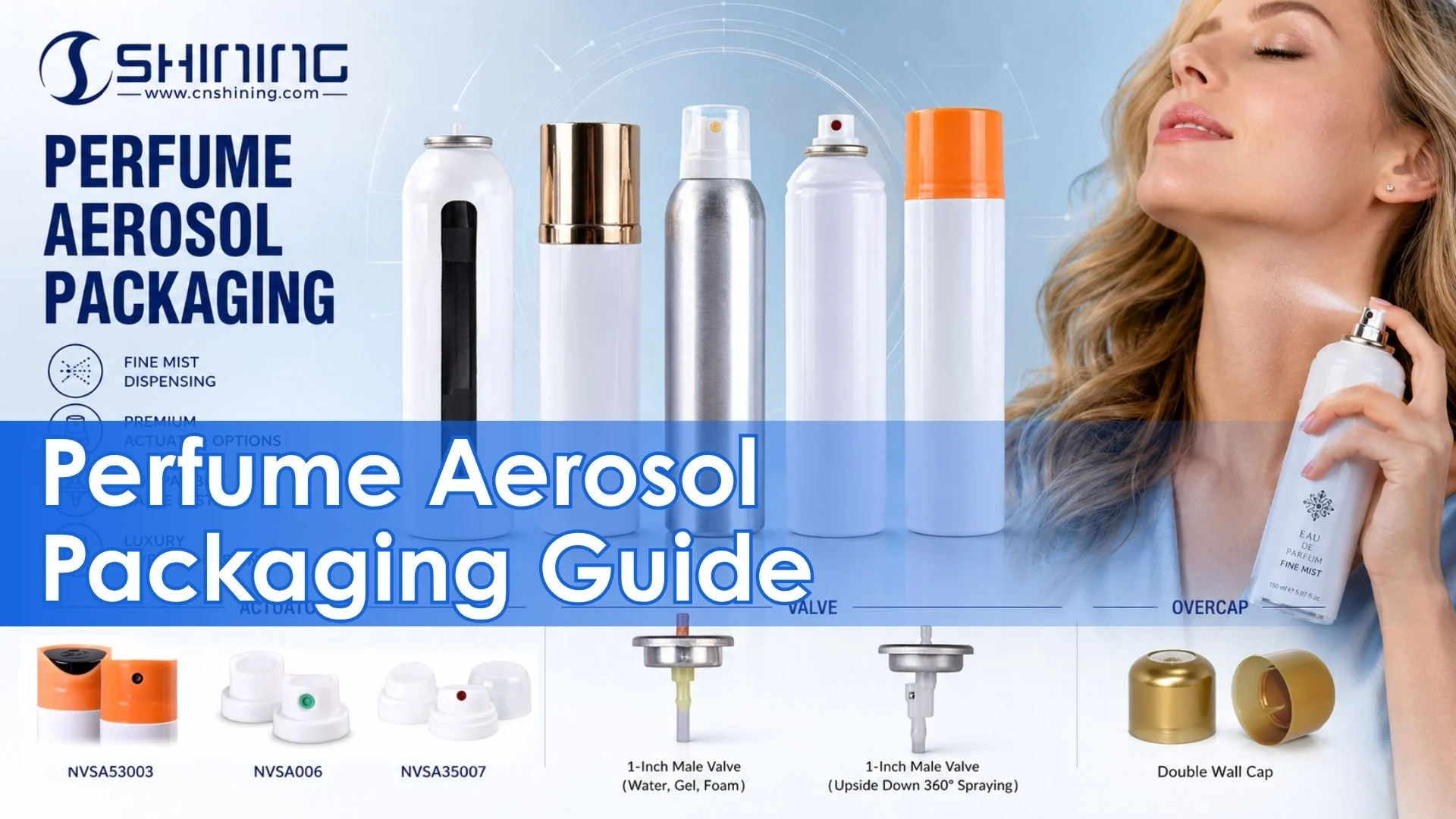
A perfume aerosol spray is not just perfume in another container. It is a fragrance delivery system built around pressure, propellant behavior, valve control, actuator geometry, and can compatibility.
The more accurate technical scope includes aerosol perfume, aerosol fragrance spray, body spray, fragrance body spray, fragranced deodorant spray, and fast-growing Bag-on-Valve fragrance mist. The difference from a traditional pump perfume is not the scent profile itself. The difference is the delivery system: an aerosol package uses internal pressure to atomize the formula, while a pump spray depends on short mechanical pressure from the user’s finger.
That one difference changes many downstream issues: spray stability, coverage area, VOC pressure, GWP discussion, transport risk, e-commerce leakage, actuator design, valve selection, and aerosol can engineering.
1. How the Aerosol Fragrance System Works
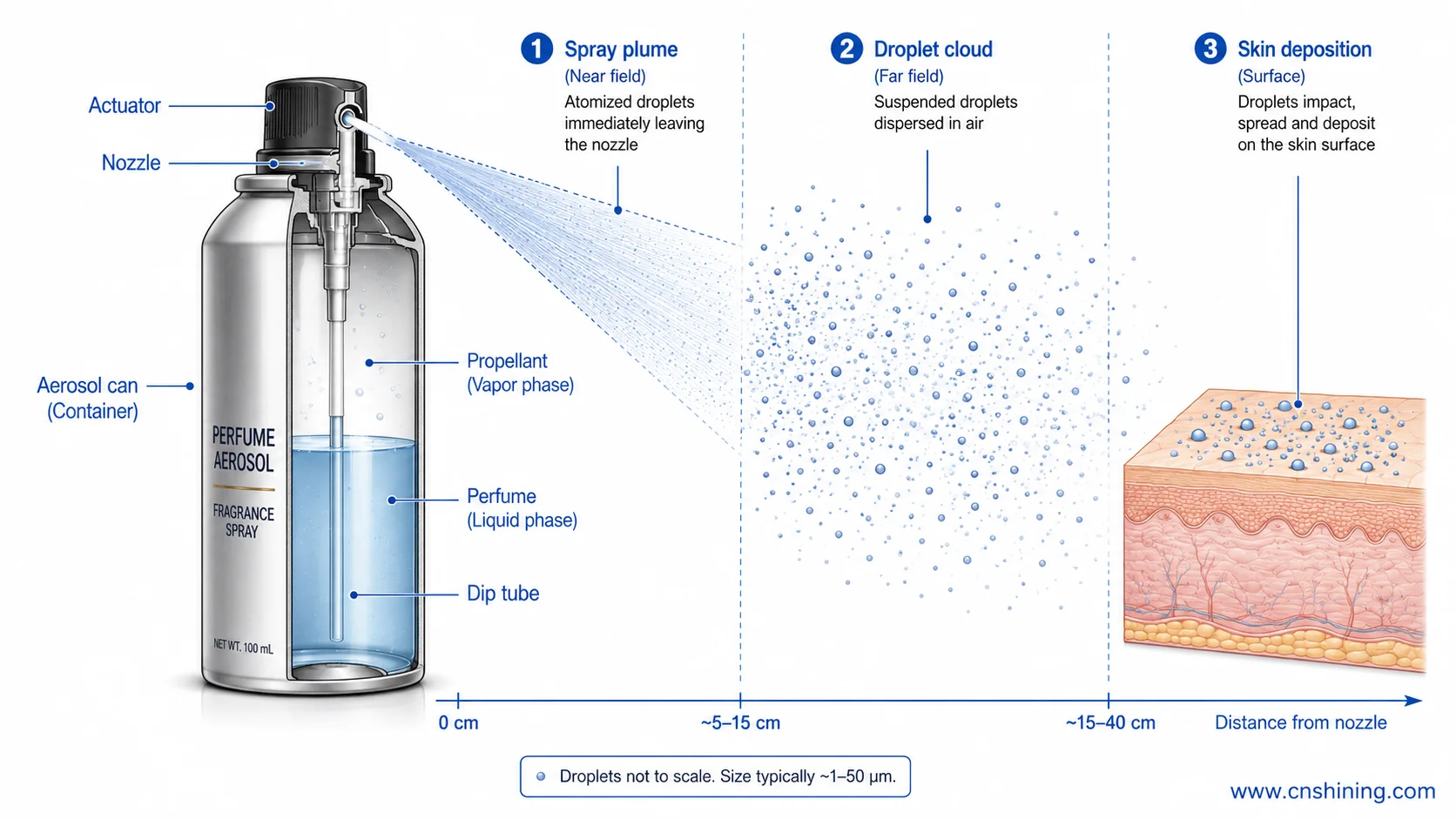
The working logic has four layers.
First, container thermodynamics. When liquefied gas propellants such as propane, isobutane, n-butane, or DME are used, the propellant exists as liquid and vapor in the can. When the valve opens, liquid propellant evaporates to replace vapor. This helps maintain relatively stable pressure during use. With compressed air, nitrogen, or carbon dioxide, there is no equivalent liquid-phase pressure recovery, so pressure normally drops as the product is emptied.
Second, valve and flow path. When the actuator is pressed, the valve opens. The pressure difference between the inside and outside of the can drives the formula through the dip tube, stem, valve passages, actuator insert, and nozzle.
Third, atomization. The liquid stream exits the nozzle, narrows, breaks, may flash-boil, and then forms a spray plume. Droplet size and plume angle are affected by propellant fraction, vapor phase, flow rate, nozzle geometry, insert design, and formula rheology.
Fourth, deposition and sensory feel. Smaller droplets give more uniform coverage, stronger cooling, and longer air suspension. Larger droplets feel wetter and deposit more locally. This is why two aerosol sprays with similar fragrance oil can feel very different in use.
BOV changes the physical logic. In a Bag-on-Valve aerosol valve system, the product sits inside a bag, while the compressed medium stays outside the bag. The product does not directly contact the propellant medium. This can reduce formula contamination, improve stability for sensitive fragrance systems, support continuous spray, and allow 360-degree dispensing.
Standard aerosol is closer to a stable pressure-spray tool. BOV is closer to a separated product-and-energy system. Both are useful. The choice depends on spray feel, cost, formula sensitivity, VOC target, and the failure risks the product must avoid.
2. Product Comparison, Formula Systems, and Technical Terms
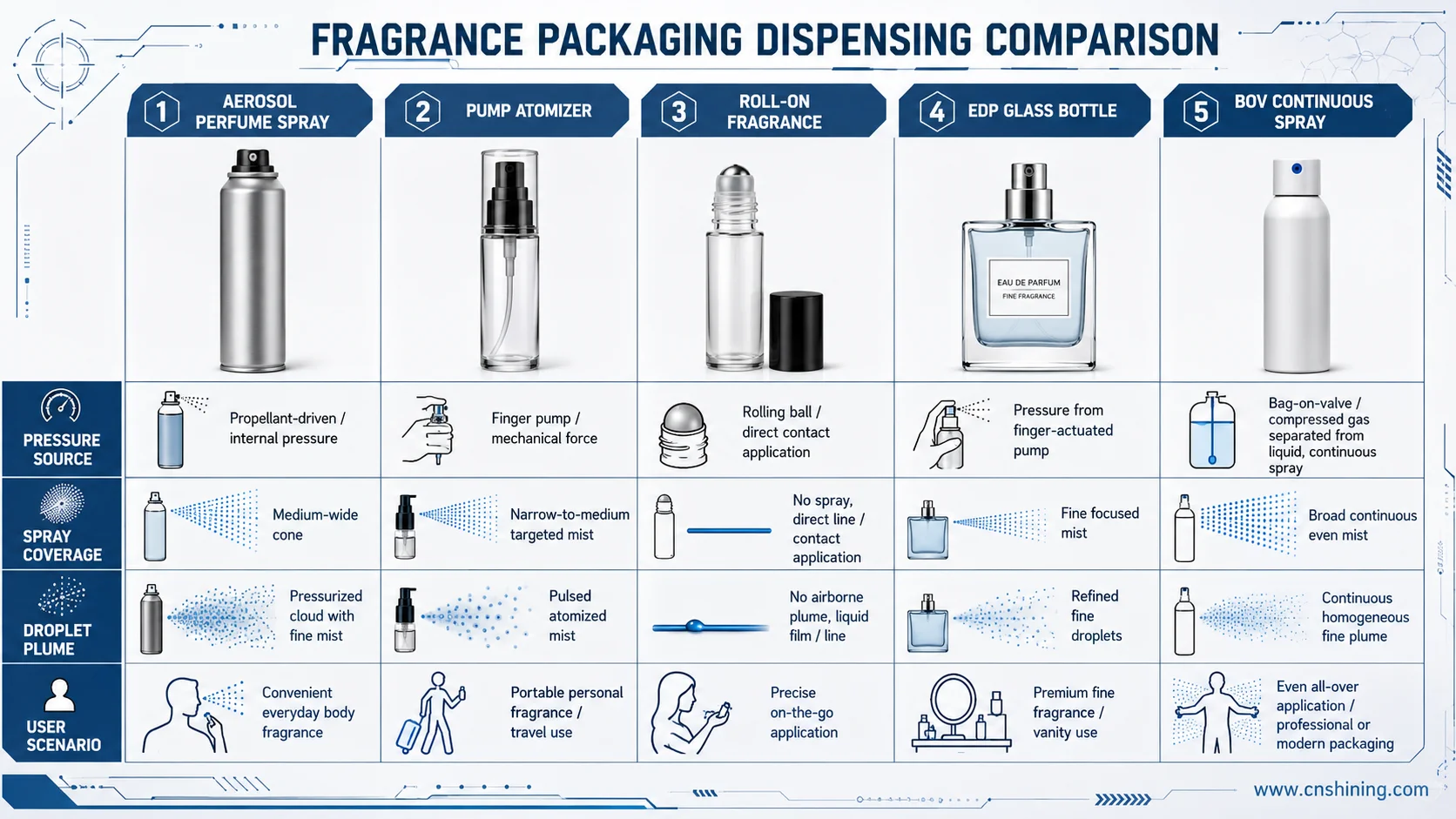
A perfume aerosol spray is best understood by comparing it with pump spray, roll-on fragrance, EDP glass bottles, and BOV continuous spray. The global perfume market still has Eau de Parfum as the largest product segment, with a 42.1% share in 2025 according to the source content. That confirms traditional higher-concentration glass perfume remains central.
Aerosol fragrance has a different job. It works better where the user wants larger coverage, faster reapplication, lighter use, post-sport freshness, commute-before-office spraying, or layering with a main fragrance.
| Product Type | Pressure Source | Typical Strength | Typical Weak Point | Better-Fit Scenario |
|---|---|---|---|---|
| Standard aerosol fragrance | Liquefied gas or compressed gas inside can | Consistent spray, wide coverage, fast re-spray | VOC, flammability, transport, and labeling complexity | Large-area body spray and quick fragrance refresh |
| Pump perfume spray | Finger-operated mechanical pump | Classic, precise, high formula freedom | Output depends on user action; smaller coverage | Formal fragrance use and local application |
| Roll-on fragrance | No atomization | Very low overspray; portable | Contact use, weak large-area fit, hygiene concern | Wrist and neck-side point application |
| EDT / EDP glass bottle | Usually pump spray | Strong brand language and clear concentration grade | Breakage risk and lower portability | Gift, collection, and main fragrance positioning |
| BOV continuous fragrance spray | Compressed medium outside the bag | Product separated from propellant, 360-degree use, neutral continuous mist | Higher cost and more complex structure | Premium body mist, hair and body layering spray |
2.1 Formula Families
Four formula routes are common.
Anhydrous alcohol fragrance aerosol is closest to traditional perfume evaporation logic. The main system is fragrance concentrate plus ethanol.
Hydroalcoholic body spray or body mist uses lighter fragrance loading and focuses on freshness and frequent re-spraying.
Hybrid deodorant-fragrance spray sits near deodorant spray ecology. It may combine odor masking, odor reduction, and fragrance extension.
BOV water-based or low-alcohol continuous spray focuses on skin feel, hair and body use, 360-degree dispensing, and lower direct interaction between product and propellant medium.
Perfume literature describes fragrance products as a top, middle, and base note system held in ethanol, water, or other solvent matrices, with stabilizers, colorants, UV filters, and other supporting materials. Base notes usually provide stronger substantivity.
2.2 Propellant Is Part of the Formula
In aerosol perfume, propellant is not an accessory. It changes pressure, spray curve, flame classification, VOC calculation, solvency, compatibility, cold feel, and droplet size.
Common options include hydrocarbon liquefied gases such as n-butane, isobutane, and propane. Evonik’s DRIVOSOL aerosol propellant information describes n-butane, iso-butane, and propane mixtures for personal and household care applications, with flexible pressure stages.
DME is another route. It is both a propellant and a strong solvent. The Chemours HP DME technical bulletin lists vapor pressure values of 63 psig at 70°F and 174 psig at 130°F, with 35 wt% solubility in water at 70°F under autogenous pressure. It also warns that pure HP DME is extremely flammable and that compatibility testing is needed for individual formulations.
Compressed air, nitrogen, and carbon dioxide are common in BOV or lower-VOC positioning. They help separate product and pressure medium, but pressure curve and evacuation need tighter design control.
2.3 VOC Sensitivity
VOC is one of the most practical constraints in perfume aerosol spray. Fragrance materials and solvents may contain VOC. Hydrocarbon and DME propellants also enter the discussion. Aerosol products are more visible to air-quality regulators because they combine fragrance with a propellant system.
CARB fragrance-use guidance explains California’s direction on consumer product VOC control and fragrance exemption changes. For aerosol personal fragrance products, the source content cites California limits of 70% VOC from 2023 to 2030 and 50% from 2031.
Atomization science also matters. The physics of droplet breakup and aerosol spray behavior affects sensory feel, inhalation exposure, overspray, and deposition efficiency.
2.4 Technical Term Sheet
| Term | Plain Technical Meaning | Business Meaning |
|---|---|---|
| Propellant | Material that builds and maintains spray pressure. | Controls regulation, cost, spray feel, and hazard label. |
| Liquefied gas propellant | Propellant that can evaporate during use to recover pressure. | Gives a more stable spray curve but often adds VOC and flammability pressure. |
| Compressed gas propellant | Gas that does not recover pressure like liquefied gas. | Useful for some environmental positioning but requires stronger system design. |
| BOV | Bag-on-Valve structure. | Suitable for continuous spray, product purity, and premium body mist positioning. |
| Vapor pressure | Pressure behavior of propellant vapor. | Affects actuation feel, spray speed, cooling, and evacuation. |
| Flash boiling | Rapid boiling during pressure drop at the nozzle. | Changes droplet size, plume angle, and skin feel. |
| Plume angle | Spray cone angle. | Controls coverage width and mist-like impression. |
| Droplet size / SMD | Droplet diameter measurement, often Sauter Mean Diameter. | Determines fine mist, wetness, inhalation discussion, and scent diffusion. |
| Valve cup / stem | Mounting and flow-control elements in the valve. | Affects sealing, compatibility, and actuation force. |
| Actuator insert | Internal actuator part that shapes flow and spray. | Controls output, spray pattern, and fine-mist quality. |
| Crimp | Mechanical sealing between valve cup and can. | Directly tied to leakage risk and transport reliability. |
| Inner lacquer / barrier liner | Internal coating or barrier layer. | Controls compatibility with alcohol, essential oils, terpenes, and metal. |
| VOC | Volatile organic compound. | Defines regional access cost and reformulation difficulty. |
| Substantivity | Fragrance retention on skin or fabric. | Affects repeat purchase, complaints, and concentration positioning. |
| Overspray | Spray lost outside the target area. | Affects waste, user experience, and indoor-air exposure. |
3. Regulations and Compliance Checkpoints
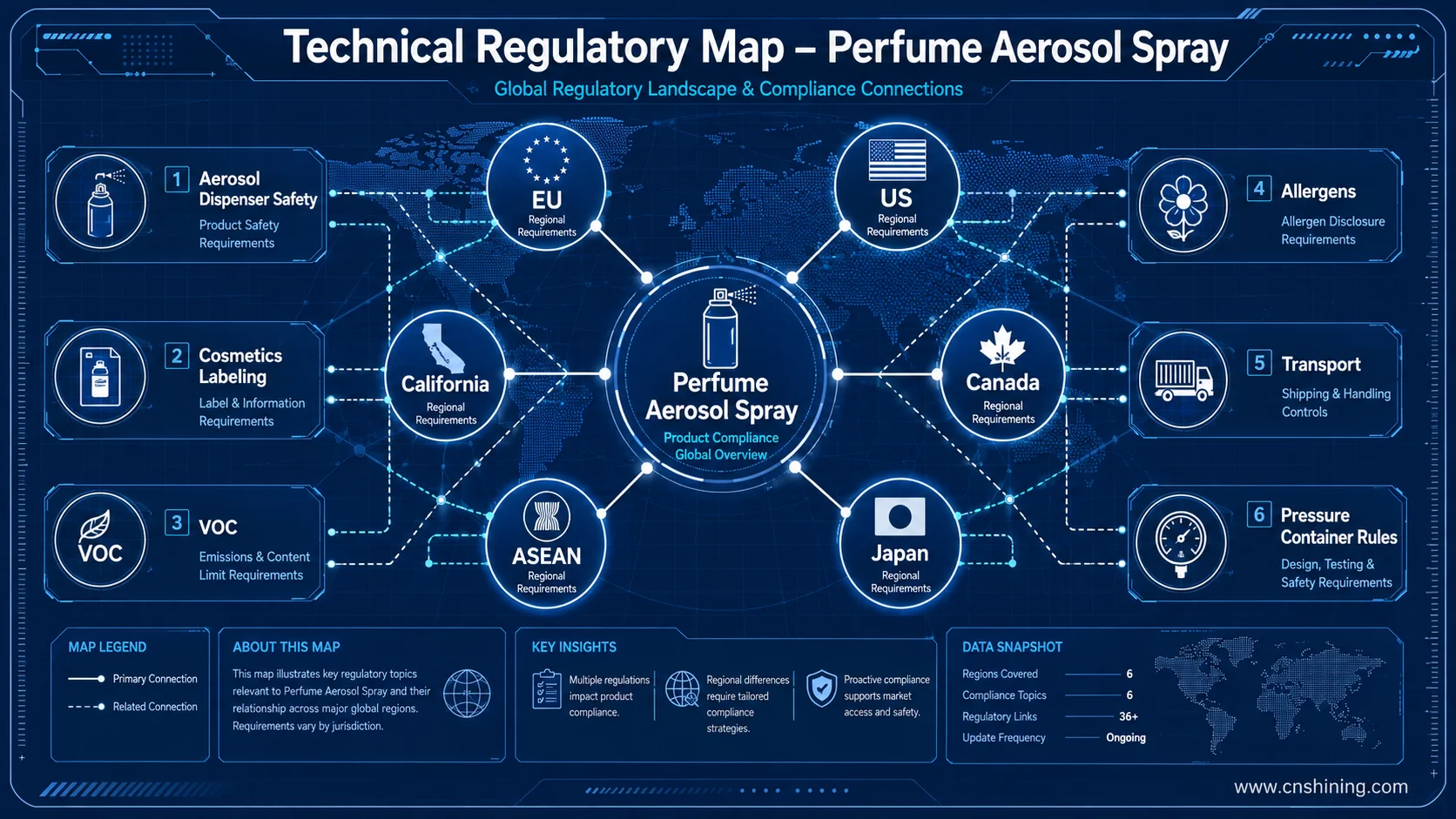
Perfume aerosol spray is a double-compliance product. It is a cosmetic or personal care product, and it is also a pressurized dispenser. The common mistake is to manage it only as perfume or only as an aerosol can. That misses real failure points.
| Region | Core Regulation / Standard | Key Requirement for Perfume Aerosol Spray | Typical Restriction / Label Point | Business Meaning |
|---|---|---|---|---|
| European Union | Aerosol Dispensers Directive 75/324/EEC; CLP; Cosmetics Regulation 1223/2009; Regulation 2023/1545 | Must meet both aerosol dispenser safety and cosmetics formulation and labeling rules. | H222/H223/H229 hazard statements may apply. Fragrance allergen labeling expands to 80+ allergens. New products by 2026-07-31; existing products by 2028-07-31. | EU is a high-threshold template market. Label space becomes a real packaging issue. |
| United States federal | FDA/FPLA; 21 CFR 701.3; CPSC/FHSA; OSHA HCS 2024 | Retail labels, pressure-container warnings, workplace SDS, and hazard classification must be managed together. | Fragrance may often be labeled as “Fragrance.” Pressurized containers require warnings such as contents under pressure and heat exposure limits. | The US is a layered compliance market: retail, transport, factory, and state air rules interact. |
| California | CARB Consumer Products Regulation | VOC control directly affects aerosol personal fragrance products. | Aerosol personal fragrance products: 70% VOC from 2023-2030; 50% from 2031. | California is a strong driver of North American formula redesign. |
| Canada | Cosmetic Ingredient Hotlist; cosmetic labeling guidance | Restricted ingredients and fragrance allergen disclosure need close tracking. | Expanded fragrance allergen list: new products by 2026-08-01; existing products by 2028-08-01. | Moves toward EU-style transparency with a North American execution path. |
| ASEAN / Singapore | ASEAN Cosmetic Directive; HSA local regulation | Seller is responsible for safety, labeling, and prohibited or restricted ingredients. | Must comply with ACD labeling and ingredient rules. | Regional SKU planning is possible, but member-state details still need checking. |
| Japan | High Pressure Gas Safety Act | High-pressure gas and container rules form the base requirement for pressurized products. | Container and pressure-gas management requirements apply. | More container-safety logic is involved, not only cosmetics logic. |
The EU Aerosol Dispensers Directive defines aerosol dispensers and focuses on pressure, flammability, inhalation-related hazards, and free movement within the EU. This is why actuator, valve, propellant, can, and labeling decisions need to be reviewed early.
California is often the more practical constraint for US fragrance aerosol development. Title 17 CCR Section 94509 lists VOC standards for consumer products. For companies selling into California, alcohol content, fragrance load, propellant selection, and BOV or compressed-gas options need to be discussed before stability testing is finished.
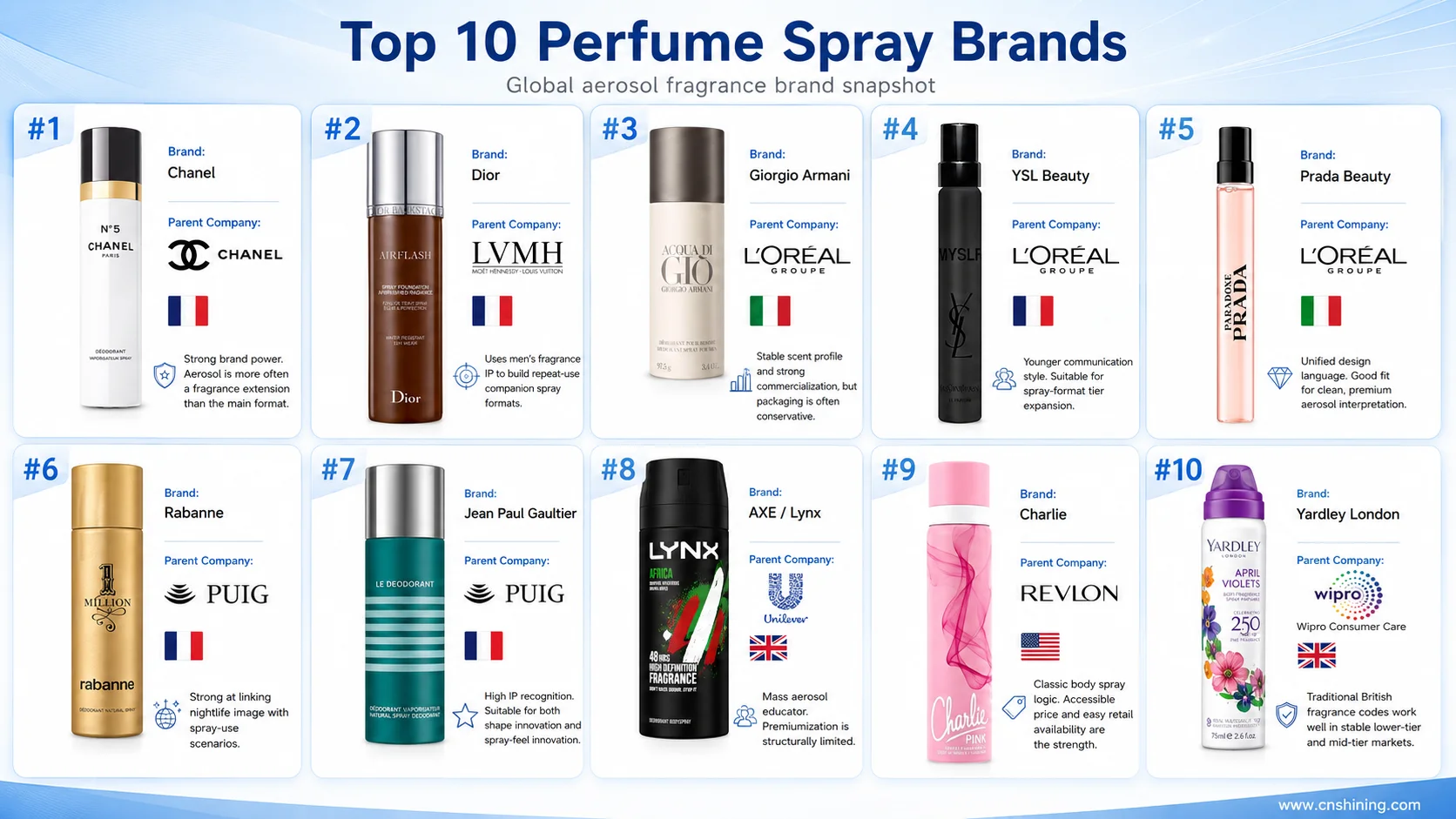
4. Top 10 Brands to Monitor in Perfume Aerosol Spray
| Brand | Country | Parent Company | Capacity | Technical Comment |
|---|---|---|---|---|
| Chanel | France | Chanel | 100-150 mL | Strong brand power. Aerosol is more often a fragrance extension than the main format. |
| Dior | France | LVMH | 100-150 mL | Uses men’s fragrance IP to build repeat-use companion spray formats. |
| Giorgio Armani | Italy | L’Oréal | 100-150 mL | Stable scent profile and strong commercialization, but packaging is often conservative. |
| YSL Beauty | France | L’Oréal | 100-150 mL | Younger communication style. Suitable for spray-format tier expansion. |
| Prada Beauty | Italy | L’Oréal | 100-150 mL | Unified design language. Good fit for clean, premium aerosol interpretation. |
| Rabanne | France | Puig | Around 150 mL | Strong at linking nightlife image with spray-use scenarios. |
| Jean Paul Gaultier | France | Puig | Around 150 mL | High IP recognition. Suitable for both shape innovation and spray-feel innovation. |
| AXE / Lynx | UK | Unilever | 150-200 mL | Mass aerosol educator. Premiumization is structurally limited. |
| Charlie | United States | Revlon | 75-150 mL | Classic body spray logic. Accessible price and easy retail availability are the strength. |
| Yardley London | United Kingdom | Wipro Consumer Care | 75-150 mL | Traditional British fragrance codes work well in stable lower-tier and mid-tier markets. |
5. Packaging Innovation: Actuators, Valves, and Cans
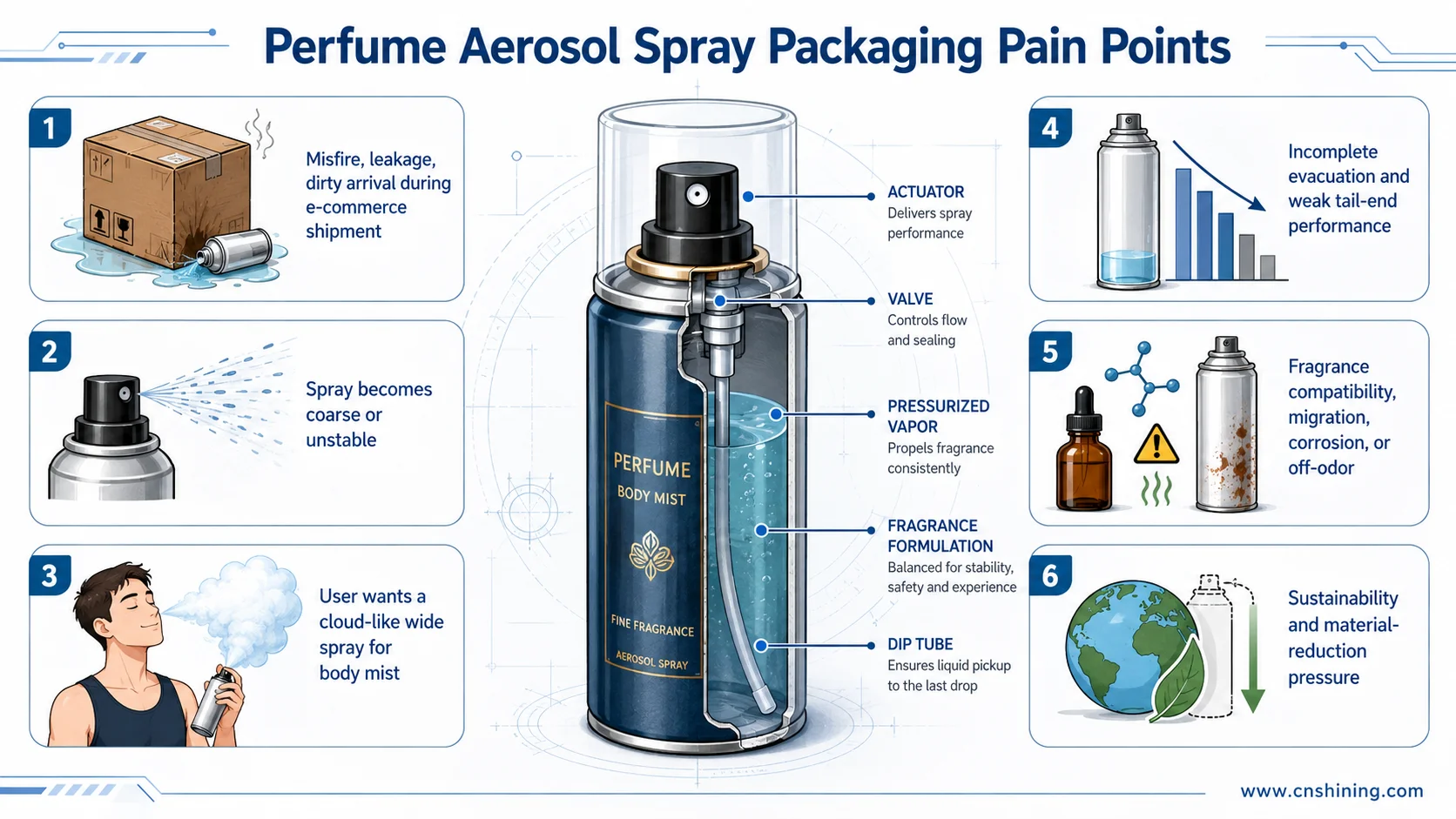
The practical packaging question is not “Can the can spray?” That is too basic. The better question is: Can it spray consistently, ship safely, match VOC strategy, protect fragrance stability, and avoid user complaints?
| High-Confidence Pain Point | Evidence from Source Content | Packaging Route | Expected Effect |
|---|---|---|---|
| Misfire, leakage, dirty arrival during e-commerce shipment | Twist-to-lock actuators are positioned for e-commerce reliability and on-the-go use. | Use hoodless twist-to-lock actuator. Add anti-misfire geometry if needed. | Lower accidental discharge, fewer returns, fewer visible leakage complaints. |
| Spray becomes coarse or unstable | Multiple actuator insert options allow spray fine-tuning. Spray research confirms geometry affects droplet size and plume angle. | Optimize actuator insert, orifice, swirl channel, valve output, and formula together. | Move from “it sprays” to “it sprays well.” |
| User wants a cloud-like wide spray for body mist | BOV and all-over spray concepts emphasize continuous spray, 360-degree dispensing, and neutral diffusion. | Use BOV continuous spray for premium body, hair, or fabric layering products. | Clear separation from pump perfume experience. |
| Incomplete evacuation and weak tail-end performance | BOV-related patent logic identifies pressure drop and incomplete evacuation as practical problems. | Improve bag-valve, liquid path, valve chamber, and bag-and-frit structure. | Reduce complaints that product remains but cannot be sprayed. |
| Fragrance compatibility, migration, corrosion, or off-odor | Barrier-layer and multilayer-bag concepts target product resistance and diffusion control. | Use suitable internal lacquer, barrier bag, or compatibility-tested valve gasket. | Reduce odor change, leakage, pitting, and shelf-life failures. |
| Sustainability and material-reduction pressure | Hoodless twist-to-lock and lightweight aluminum can directions reduce unnecessary material. | Use lightweight aluminum cans, hoodless locking actuators, and simplified decoration stacks. | Lower material footprint without sacrificing basic spray function. |
The Twist-to-lock aerosol actuator is a useful example of the e-commerce direction. Locking feedback and capless protection address accidental actuation, transport movement, and mobile use. For fragrance aerosol, this is not a cosmetic detail. It is part of complaint control.
6. Shining Packaging Components for Perfume Aerosol Spray Systems
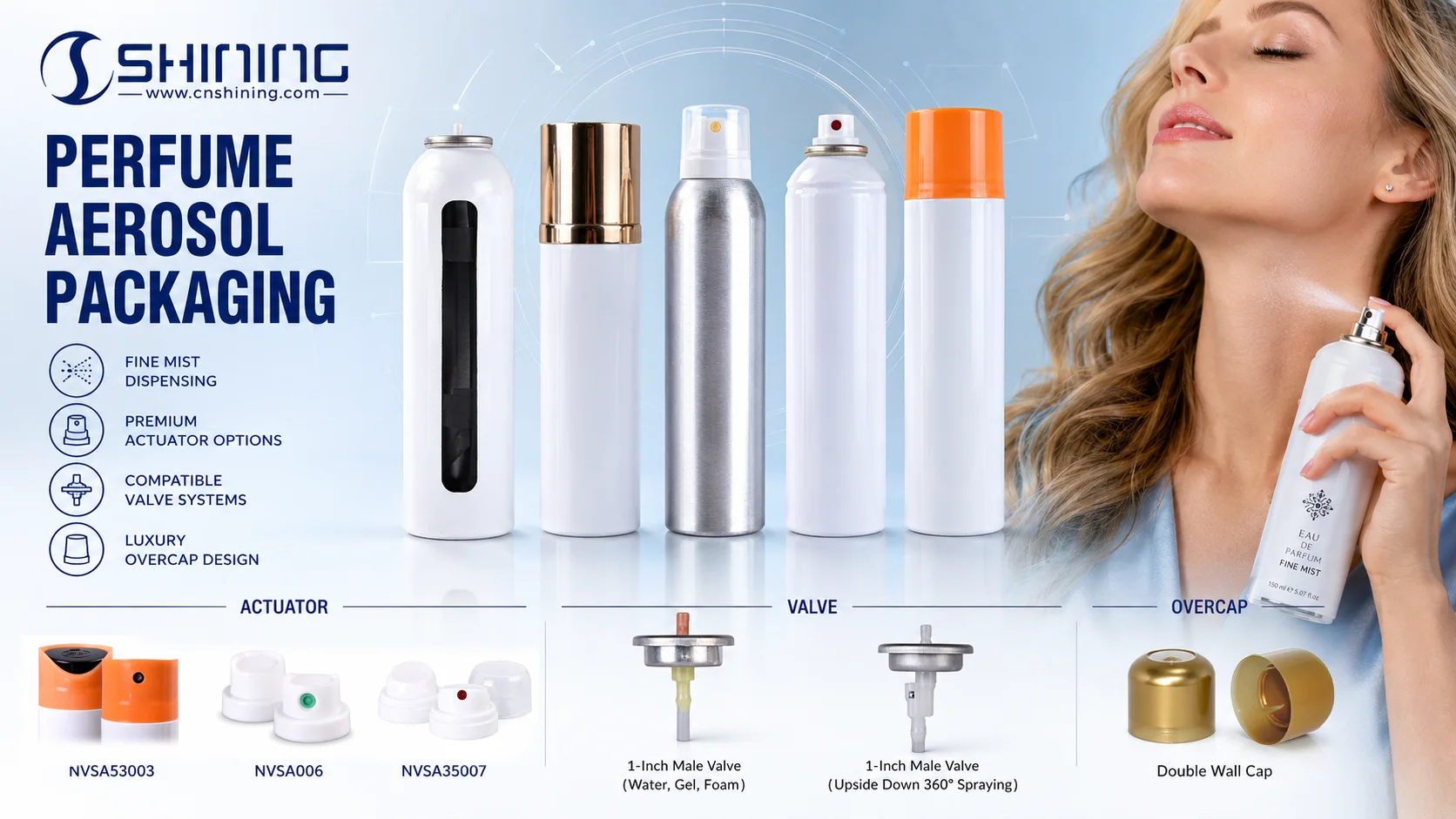
For perfume aerosol spray, Shining Packaging fits into the practical engineering layer: actuators, aerosol cans, and valves. These parts decide how the fragrance leaves the package. They also affect leakage risk, spray repeatability, cap or hood design, crimp quality, and compatibility with alcohol-based or water-alcohol fragrance systems.
In this category, the actuator should not be selected only by appearance. The insert, orifice, finger pad, locking structure, and spray direction all change the user’s perception of mist quality. The valve must match output target, formula viscosity, propellant system, corrosion risk, and crimp specification. The can must carry the pressure requirement, decoration requirement, internal coating requirement, and transport requirement.
A practical Shining Packaging discussion for perfume aerosol spray usually starts with these questions:
| Component | What to Check | Why It Matters |
|---|---|---|
| Actuator | Spray insert, orifice, finger force, plume shape, lock or cap requirement | Controls mist fineness, user comfort, over-spray, and shipment safety. |
| Valve | Output rate, stem gasket, cup material, dip tube, BOV or standard valve route | Controls discharge stability, sealing, formula compatibility, and evacuation. |
| Aerosol can | Aluminum or tinplate, pressure rating, inner lacquer, shoulder shape, decoration route | Controls safety, shelf life, appearance, corrosion resistance, and filling-line fit. |
The technical target is not to make the package look complicated. It is to keep the spray curve stable, the scent unchanged, the valve sealed, the can compatible, and the label compliant. That is where packaging parts create real value in perfume aerosol spray.
7. Technical Conclusion
The next three years are likely to be shaped by four lines. First, small-luxury and frequent re-spraying behavior will support body spray, body mist, and scent-stacking products. Second, BOV and compressed-gas routes will keep gaining attention because they address product separation, continuous spray, 360-degree dispensing, and part of the environmental discussion. Third, actuator and can material efficiency will matter more because e-commerce makes packaging a logistics object, not only a shelf object. Fourth, regulation is turning label space into a scarce engineering resource.
The conclusion is direct: perfume aerosol spray competition is no longer only fragrance competition. It is a system competition built from scent profile, spray feel, compliance path, actuator design, valve performance, and aerosol can compatibility. Companies that treat valves, actuators, and cans as experience-and-regulation design elements will have fewer technical surprises than companies that buy them as ordinary parts.
8. FAQ: Perfume Aerosol Spray Technical Questions
A perfume aerosol spray is a pressurized fragrance delivery system. It uses a propellant or compressed gas to push a fragrance formula through a valve, actuator, and nozzle. The formula is atomized into a droplet cloud. It can include aerosol perfume, body spray, fragrance body spray, deodorant spray, and BOV fragrance mist.
The main difference is pressure generation. Pump perfume creates pressure through finger action at each press. Perfume aerosol spray stores pressure inside the package and uses that pressure for atomization. This gives wider coverage and more consistent spray, but it also adds propellant, pressure-container, VOC, flammability, transport, and labeling issues.
BOV separates the fragrance formula from the pressure medium. The product sits inside a bag, while compressed gas stays outside the bag. This can reduce direct propellant contact, support continuous spray, allow 360-degree dispensing, improve evacuation, and help sensitive formulas. Cost and structure are higher than standard aerosol systems.
Common routes include hydrocarbon liquefied gases such as propane, isobutane, and n-butane; DME; and compressed gases such as air, nitrogen, or carbon dioxide. Hydrocarbons give stable pressure but raise VOC and flammability concerns. DME adds solvency. Compressed gases are often used with BOV or lower-VOC positioning.
Droplet size changes the user experience. Fine droplets give wider coverage, stronger cooling, and longer air suspension. Coarser droplets feel wetter and deposit more locally. Droplet size is affected by propellant ratio, valve output, actuator insert, nozzle geometry, formula properties, and flash boiling during pressure drop.
Aerosol perfume may contain VOC from fragrance materials, alcohol solvent, and propellant. California CARB rules are especially practical because they set VOC limits for consumer products, including aerosol personal fragrance products. A design that ignores VOC early may need reformulation, different propellant selection, or a move toward BOV or compressed gas.
Leakage can come from poor crimping, incompatible gaskets, valve defects, formula attack on seals, transport shock, accidental actuation, or pressure mismatch. High alcohol and fragrance oil systems need compatibility checks. For e-commerce, locking actuators, overcap strength, and tested secondary packaging help reduce accidental discharge and dirty arrival.
An actuator should be checked for spray pattern, output rate, plume angle, finger force, insert design, orifice size, lock function, and compatibility with the selected valve. Appearance is only one factor. In perfume aerosol spray, actuator geometry strongly affects mist fineness, overspray, skin feel, and user perception of quality.
Perfume aerosol formulas may contain alcohol, water, fragrance oils, terpenes, and other materials that can interact with metal or coatings. A poor internal coating can lead to corrosion, pitting, off-odor, color change, leakage, or shelf-life failure. Compatibility testing with the real formula and propellant system is needed before production.
No. EDP remains a main fragrance format, especially for prestige and high-concentration use. Perfume aerosol spray solves a different problem: larger coverage, lighter use, body spray, quick reapplication, and layering. Its value is strongest when spray feel, compliance, packaging engineering, and fragrance positioning are designed together.