
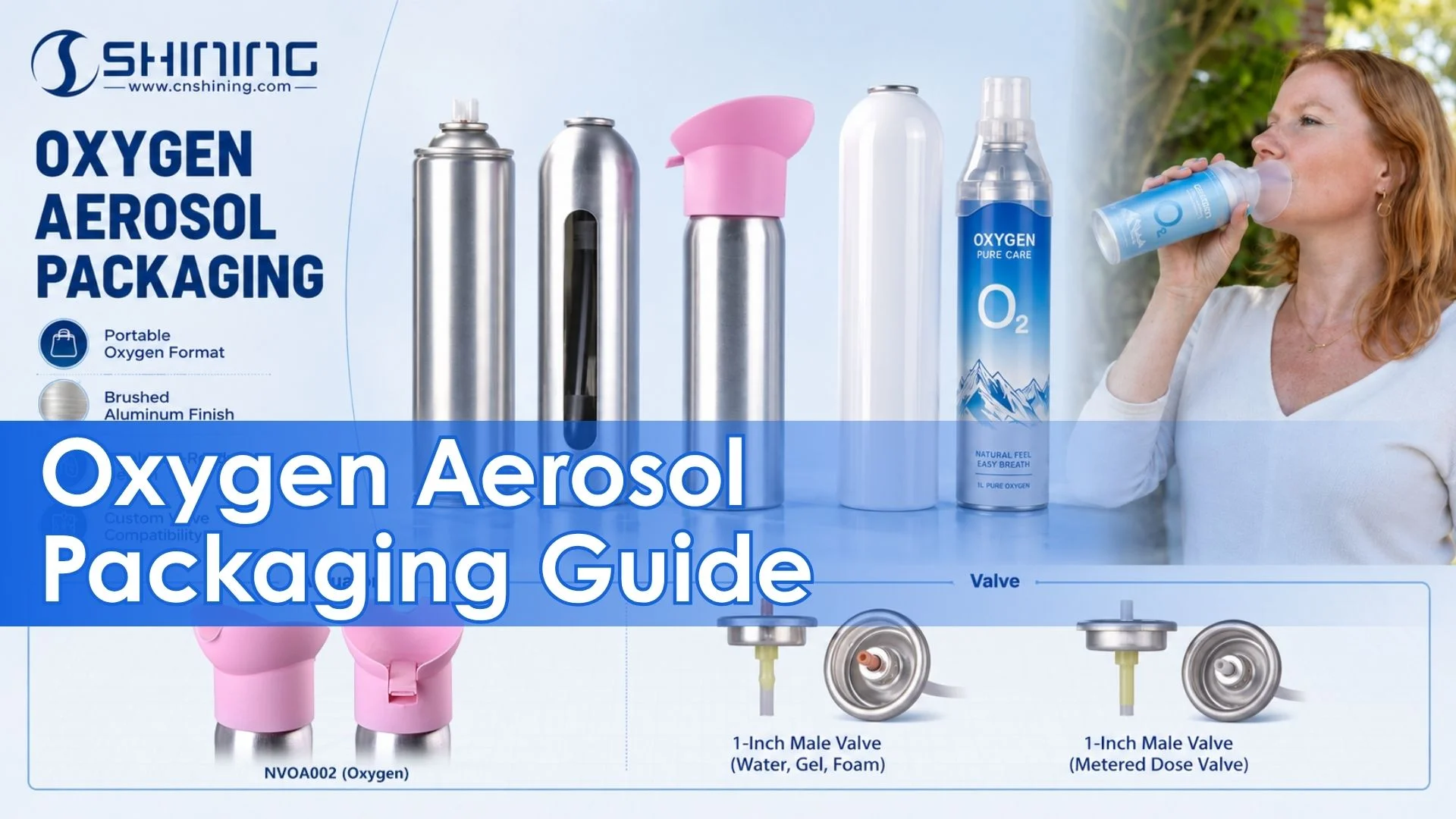
Portable oxygen canister, canned oxygen, recreational oxygen, supplemental oxygen can, oxygen inhalation can — these terms often point to the same retail category, but not always to the same engineering structure. In commercial use, an oxygen aerosol can usually means a small, portable, disposable or semi-disposable container filled with compressed oxygen and fitted with a valve, actuator, mask or mouthpiece. Strictly speaking, many of these products are not classic aerosol dispensers.
That distinction matters. A traditional aerosol relies on a propellant to discharge a product. Many oxygen cans are closer to pressurized oxygen containers without liquefied propellant. Boost Oxygen, for example, describes its retail oxygen products as canisters with no chemicals or propellants. For R&D, transport classification and labeling, this boundary can decide whether a product is treated closer to UN1072 Oxygen, compressed, UN1950 Aerosols, or another dangerous goods route.
1. Category Definition and Working Principle
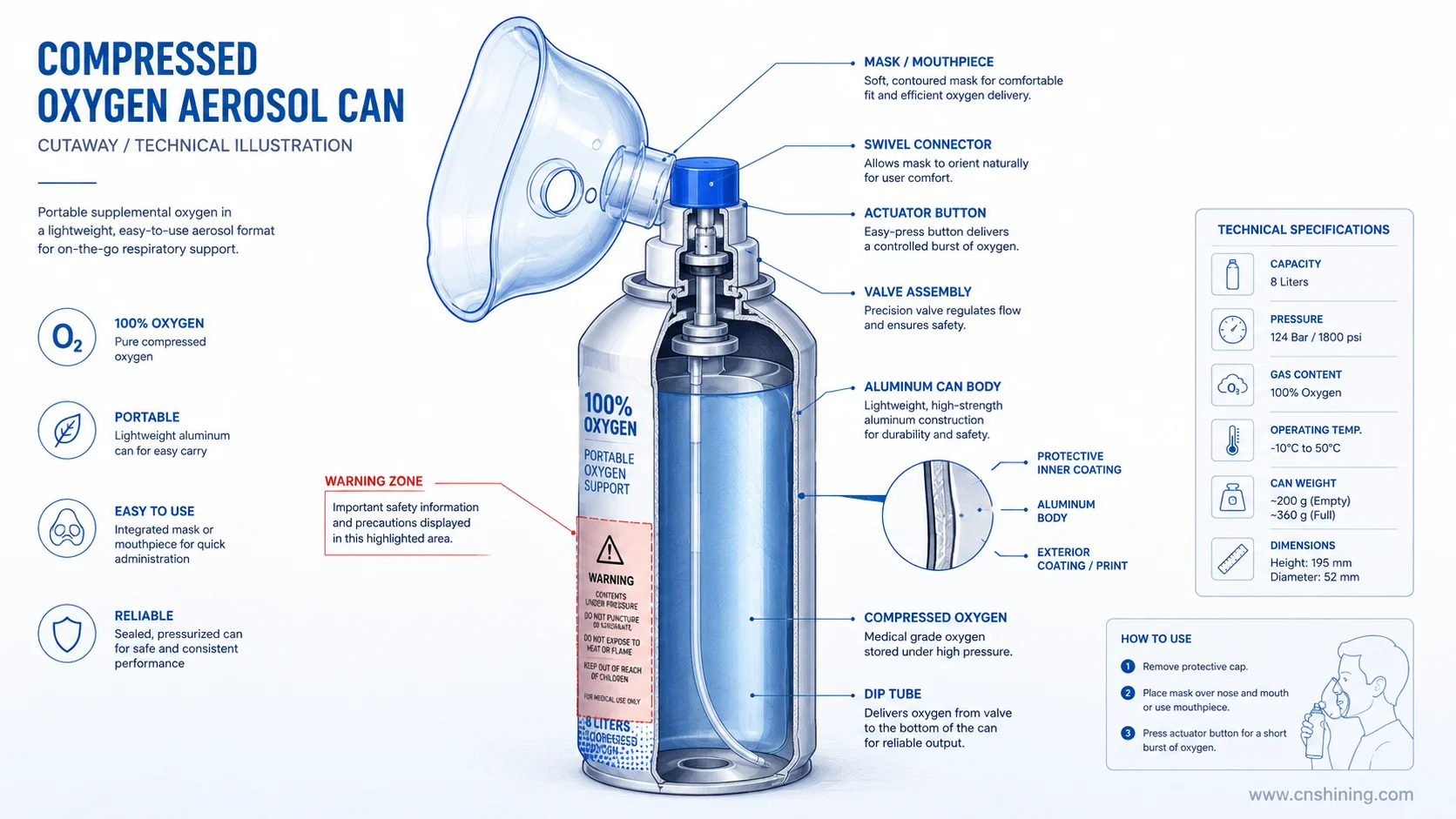
1.1 Terminology Boundary and Typical Structure
From a packaging engineering view, the market phrase “oxygen aerosol can” covers at least two structures. The first is a pressurized oxygen canister: the can is filled mainly with compressed oxygen and releases gas through a valve, actuator and mask or mouthpiece. It does not rely on liquefied propellant. The second is a true aerosol dispenser, where a propellant pushes product out of the package and may fall under the EU Aerosol Dispensers Directive. These structures should not be mixed in compliance files.
A typical consumer inhalation can includes an aluminum can or small pressure container, oxygen-compatible valve materials, an actuator, a mask or nasal/mouth interface, external labeling and misuse warnings. In stricter oxygen systems, the EIGA Doc 200/24 oxygen valve guidance discusses valve design, materials, installation and maintenance for oxygen service. NASA’s oxygen service material selection list also shows why ignition, combustion behavior and material compatibility cannot be treated as minor details in oxygen environments.
1.2 Gas Source Routes
The first route is high-pressure pure or high-purity oxygen. Retail claims often fall in the 95% to 99.9% range. The working principle is simple: the product temporarily increases the oxygen concentration in the inhaled gas stream, or FiO2, for a short time.
The second route is oxygen-enriched gas or Oxygen 93. The USP Oxygen 93 Percent monograph defines it as oxygen produced from air by a molecular sieve process, containing 90.0% to 96.0% oxygen by volume, with the balance mostly argon and nitrogen. The European Pharmacopoeia has also long separated 99.5% oxygen and Oxygen 93 monographs, as noted by EDQM oxygen quality documentation.
The third route is a chemical oxygen generator. The FAA oxygen equipment brochure describes sodium chlorate candles that release oxygen after thermal activation. This route is closer to aviation, military or emergency oxygen generation than normal OTC retail cans. It can deliver high oxygen volume from compact material, but heat generation, irreversible activation and dangerous goods classification make it a very different product.
2. Top 10 Oxygen Aerosol Can Brands for Benchmarking
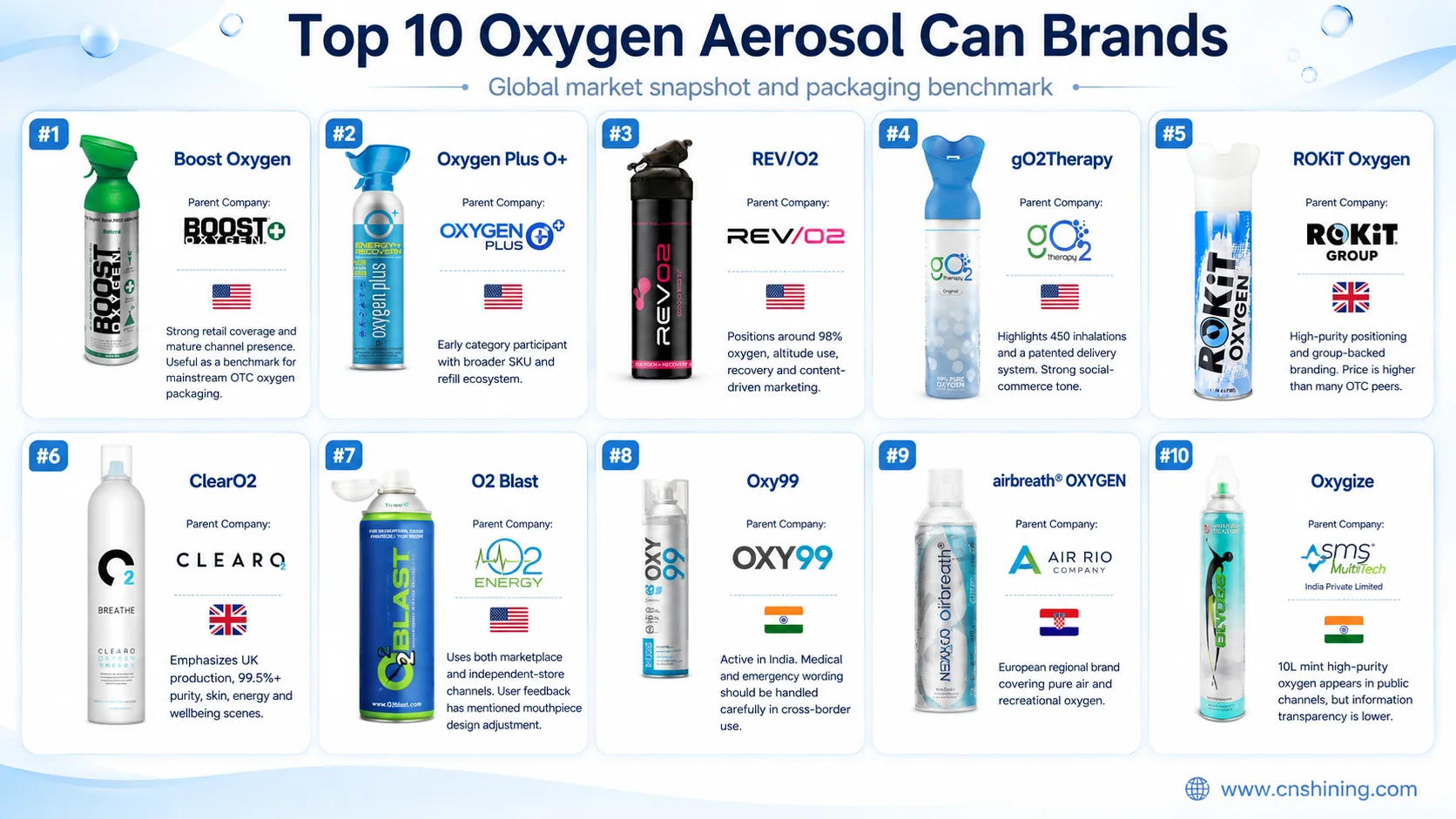
The following table is not a sales ranking. It is a researchable Top 10 list based on cross-platform visibility, independent website traceability and retail-channel presence. Some brands do not disclose a parent company or a stable single-can official price, so approximate public-channel prices are used where available.
| Brand | Country | Parent Company | Capacity Range | Typical Price | Technical Comment |
|---|---|---|---|---|---|
| Boost Oxygen | USA | Boost Oxygen LLC | 3L / 5L / 10L / 12L | 5L single can about 9.97$; 12L single can about 18.97$ | Strong retail coverage and mature channel presence. Useful as a benchmark for mainstream OTC oxygen packaging. |
| Oxygen Plus O+ | USA | Oxygen Plus | 1.55L / 3.42L / 11L | 11L single can about 21.99$; 3.42L about 9.99$ | Early category participant with broader SKU and refill ecosystem. |
| REV/O2 | USA | REV/O2 | Multiple aroma SKUs | Single can about 18.99$ | Positions around 98% oxygen, altitude use, recovery and content-driven marketing. |
| gO2Therapy | USA | gO2Therapy | 12L | Single can about 27.99$ | Highlights “450 inhalations” and a patented delivery system. Strong social-commerce tone. |
| ROKiT Oxygen | UK | ROKiT Group | 10.4L | Flight-ready version about 13.95$; aviation version about 14.99$ | High-purity positioning and group-backed branding. Price is higher than many OTC peers. |
| ClearO2 | UK | ClearO2 | 10L / 15L / larger replacement canisters | 10L about 17.20$; 15L inhaler cap about 26.47$; 15L mask-and-tube set about 29.12$ | Emphasizes UK production, 99.5%+ purity, skin, energy and wellbeing scenes. |
| O2 Blast | USA | O2 Energy | 4L / 10L | 10L single can about 14.96$ | Uses both marketplace and independent-store channels. User feedback has mentioned mouthpiece design adjustment. |
| Oxy99 | India | Oxy99 | 6L and related SKUs | Single can about 6.87$ | Active in India. Medical and emergency wording should be handled carefully in cross-border use. |
| airbreath® OXYGEN | Croatia | AIR RIO Company | 2L / 5L / 7L | 2L about 11.46$; 5L about 14.89$; 7L about 17.18$ | European regional brand covering pure air and recreational oxygen. |
| Oxygize | India | SMS MultiTech India Pvt Limited | 10L | 10L single can about 5.55$ | 10L mint high-purity oxygen appears in public channels, but information transparency is lower. |
3. Product Comparison: Consumer Cans, Medical Cylinders, POCs and Chemical Generators
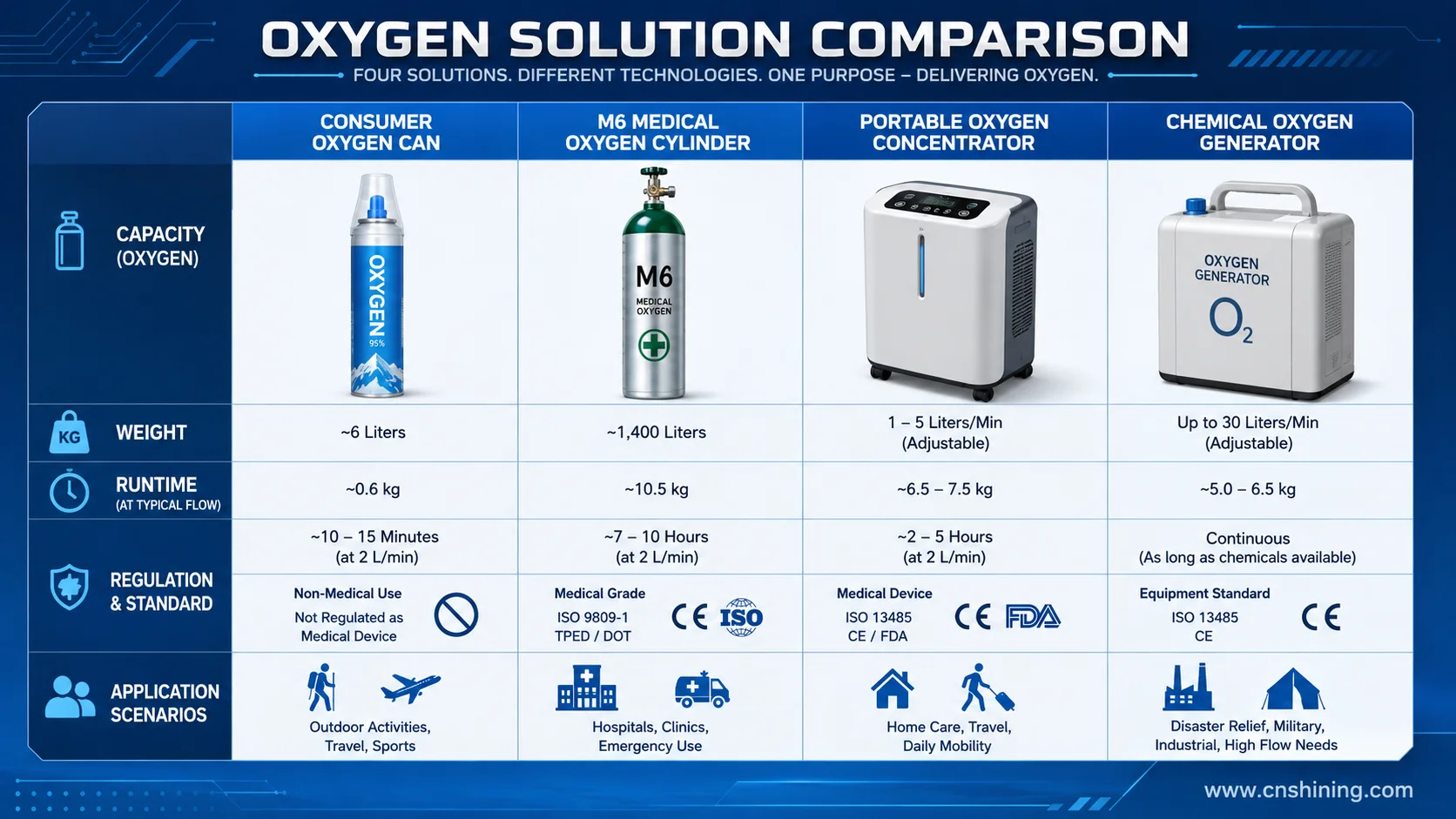
OTC oxygen cans convert oxygen use into a fast, light and low-entry consumer product. That does not mean they replace medical oxygen systems. Their strength is instant access and portability. Their weakness is total oxygen volume and sustained delivery.
| Type | Representative Product | Capacity / Delivery | Runtime | Weight | Regulatory Limits | Typical Scene |
|---|---|---|---|---|---|---|
| Consumer inhalation oxygen can | Boost 5L | 5L compressed oxygen, manual press release | About 100 one-second inhalations | About 0.31 lb | Non-medical use; compressed oxygen containers face strict passenger-aircraft limits | Short sports recovery, altitude discomfort, impulse retail, gift-pack format |
| Portable medical oxygen cylinder | M6 oxygen cylinder system | 165L, high-pressure cylinder plus regulator | About 1.3 hours at 2 LPM | Complete system around 4.5 lb | Prescription requirements; DOT/CTC cylinder logic; aviation carriage limited | Prescribed oxygen therapy, short outings, backup oxygen |
| Portable oxygen concentrator | Inogen Rove 6 | Concentrates oxygen from ambient air, pulse dose | Standard battery about 6h15m; extended battery about 12h45m | 4.8 lb | Prescription device; FAA-accepted models can be used onboard | Longer travel, flight, daily oxygen therapy |
| Chemical oxygen generator | Aviation chemical generator | Chemical reaction releases oxygen | Fixed-rate, often around 15-minute class in aviation use | Consumer data not found | UN3356; heat risk; hard to stop after activation | Aviation, military, enclosed-space emergency systems |
The practical conclusion is direct: a consumer oxygen can wins when the job is short and occasional. It loses when the job needs controlled flow, long runtime, prescription oxygen therapy or flight use. The FAA PackSafe oxygen page states that passengers may not carry compressed or liquid oxygen, including canned, recreational and flavored oxygen, in checked baggage, carry-on baggage or on their person.
4. Gas Composition, Formula Logic and Professional Terms
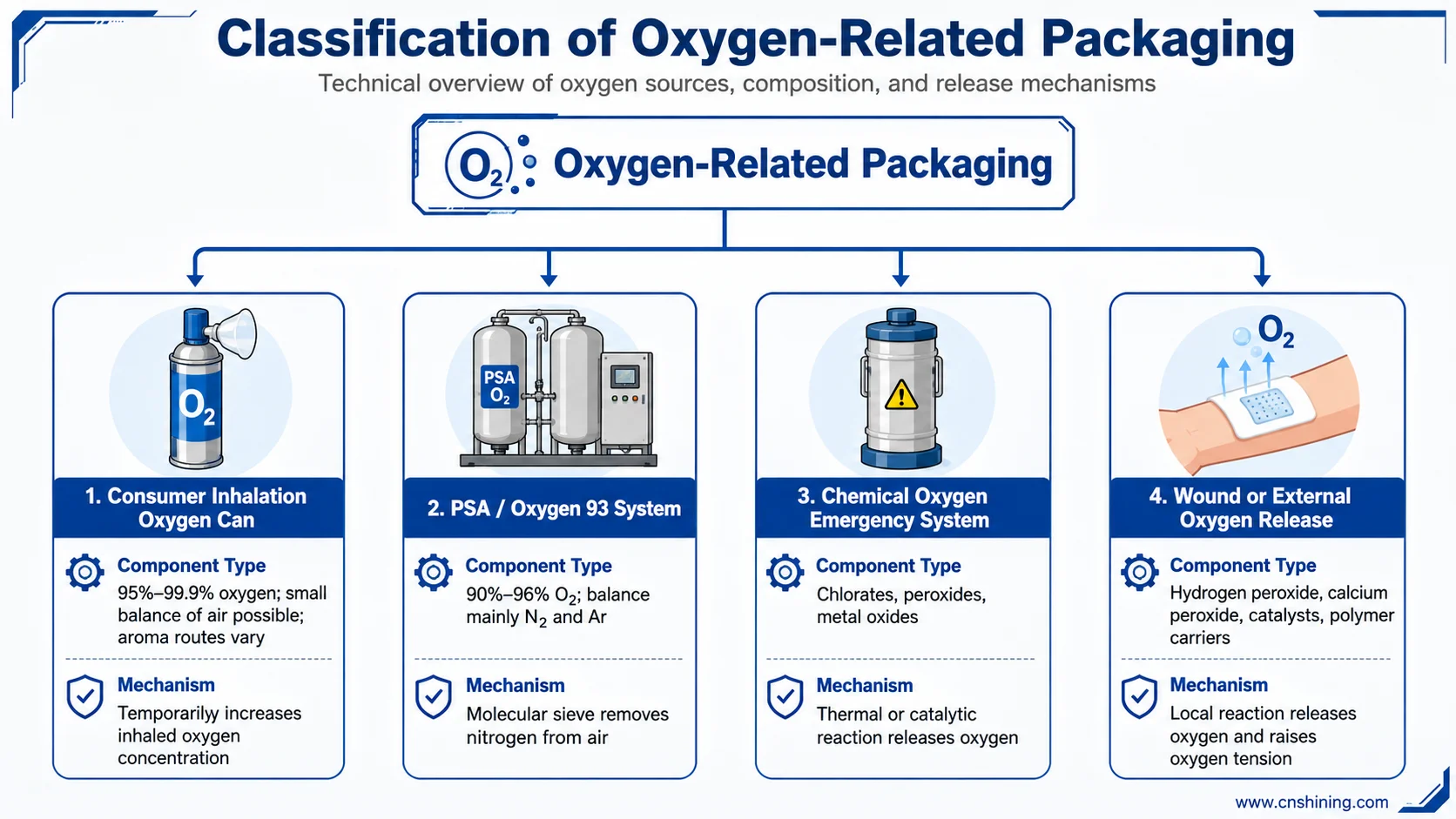
The “formula” of this category is not like hair spray or insecticide. For mainstream inhalation oxygen cans, the formula is mainly gas composition plus valve and delivery structure. The more complex branches are oxygen 93, chemical oxygen generation, external wound oxygen release and oxygen-sensitive cosmetic spray systems.
| Use | Component Type | Mechanism | Typical Public Example | Technical Note |
|---|---|---|---|---|
| Consumer inhalation oxygen can | 95%–99.9% oxygen; small balance of air possible; aroma routes vary | Temporarily increases inhaled oxygen concentration | Boost 95% ABO; REV/O2 98%; ClearO2 ≥99.5% | Most visible mass retail route. Aroma ingredients are often less transparent than oxygen purity claims. |
| PSA / Oxygen 93 system | 90%–96% O2, balance mainly N2 and Ar | Molecular sieve removes nitrogen from air | USP Oxygen 93 Percent; WHO medicinal oxygen references | Closer to onsite oxygen generation and pharmacopoeial oxygen systems than wellness cans. |
| Chemical oxygen emergency system | Chlorates, peroxides, metal oxides | Thermal or catalytic reaction releases oxygen | FAA sodium chlorate candle; US3702305A chemical oxygen generator | High heat, irreversible activation and higher dangerous-goods burden. |
| Wound or external oxygen release | Hydrogen peroxide, calcium peroxide, catalysts, polymer carriers | Local reaction releases oxygen and raises oxygen tension | US5792090A oxygen generating wound dressing | More relevant to medical dressing or tissue engineering than retail inhalation cans. |
Common Terms
| Term | Short Meaning | Commercial Meaning |
|---|---|---|
| ABO | Aviator’s Breathing Oxygen | Often used to suggest high purity and controlled oxygen quality. |
| Oxygen 93 | 90%–96% oxygen from molecular sieve production | Relevant to onsite oxygen generation and regulated supply systems. |
| Oxygen-enriched atmosphere | More than 23.5% oxygen by volume under OSHA wording | Fire, label and storage controls become more sensitive. |
| FiO2 | Fraction of inspired oxygen | The real technical variable affected by inhalation oxygen products. |
| Pulse dose | Oxygen delivered in a timed pulse | Common in portable oxygen concentrators; saves oxygen. |
| Continuous flow | Steady oxygen flow at a set LPM | Typical of cylinders and many medical systems; runtime depends directly on flow. |
| POC | Portable Oxygen Concentrator | More flight-friendly than compressed oxygen because it does not store oxygen. |
| BOV | Bag-on-Valve | Useful for oxygen-sensitive liquid formulas and propellant separation. |
| UN1072 | Oxygen, compressed | Directly affects dangerous goods shipping and aviation restriction. |
| UN3356 | Chemical oxygen generator | Usually unsuitable for ordinary consumer retail packaging routes. |
5. Regulatory and Compliance Requirements
5.1 Transport and Dangerous Goods
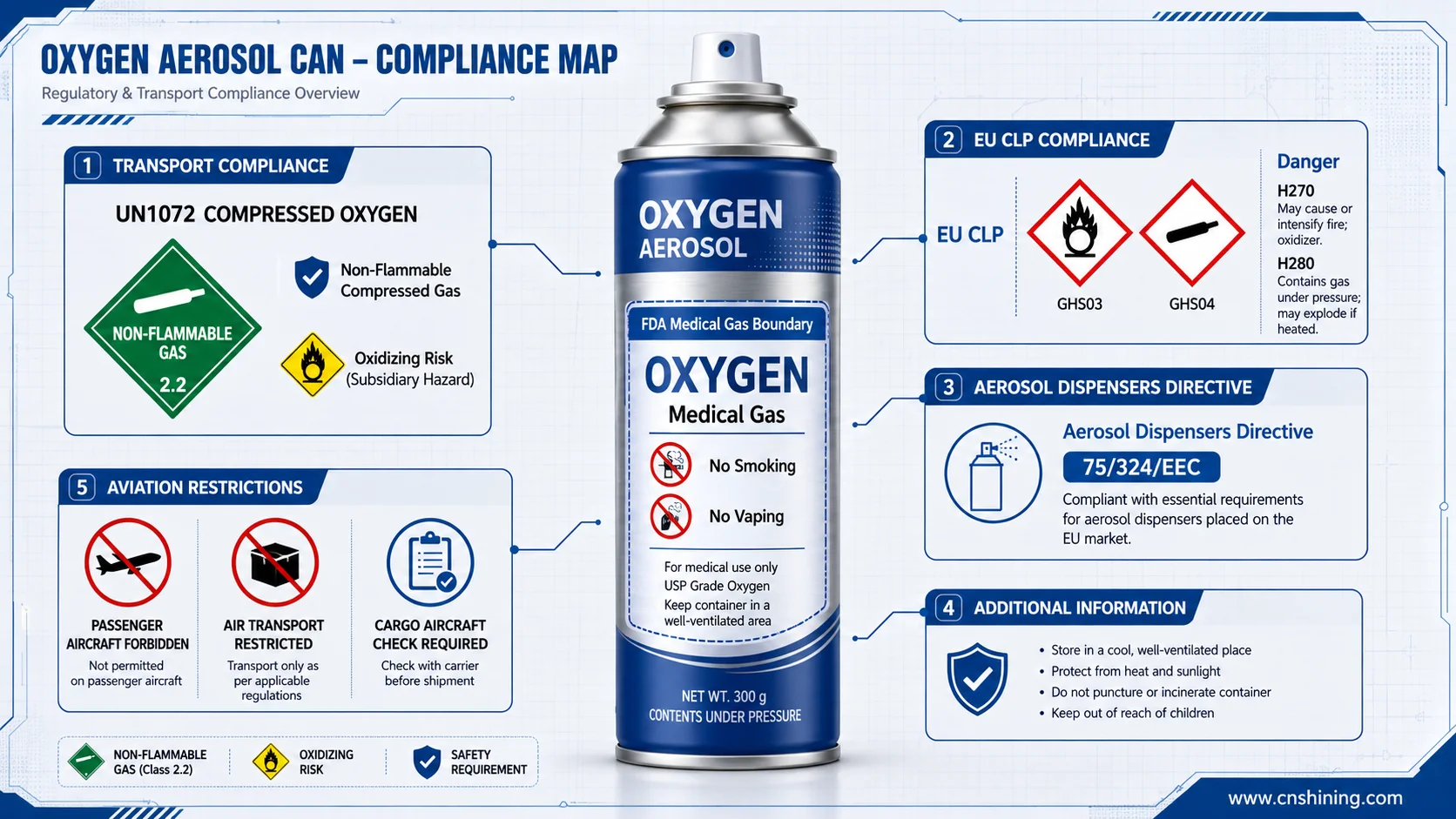
In logistics, oxygen aerosol cans should be treated first as a dangerous goods problem, then as a consumer product problem. PHMSA’s UN1072 interpretation letter states that small non-refillable compressed oxygen cylinders may have limited-quantity treatment for ground transport in a specific context, but equivalent relief is not available for air transport. TSA also states that personal oxygen cylinders are not permitted in the aircraft cabin.
The classification must match the actual structure: UN1072 for compressed oxygen, UN3356 for chemical oxygen generators, and UN1950 where the product is genuinely an aerosol dispenser. A logistics team cannot safely classify a product from the marketing phrase “oxygen can.”
5.2 Labeling, Composition and Medical Claims
The U.S. boundary between medical oxygen and consumer oxygen is mostly about intended use and claims. FDA’s medical gas rule establishes CGMP, certification, postmarketing safety and labeling requirements for certain medical gases. The 21 CFR 201.161 medical gas labeling rule includes warning language for oxygen containers and separates emergency trained-personnel use from other medical applications requiring prescription.
In Europe, the product language can split into pharmacopoeia, chemical classification and pressure/aerosol packaging safety. The ECHA CLP framework handles classification, labelling and packaging of hazardous substances and mixtures, while aerosol dispenser rules address consumer pressure safety when applicable.
6. User Pain Points and Packaging Failure Modes
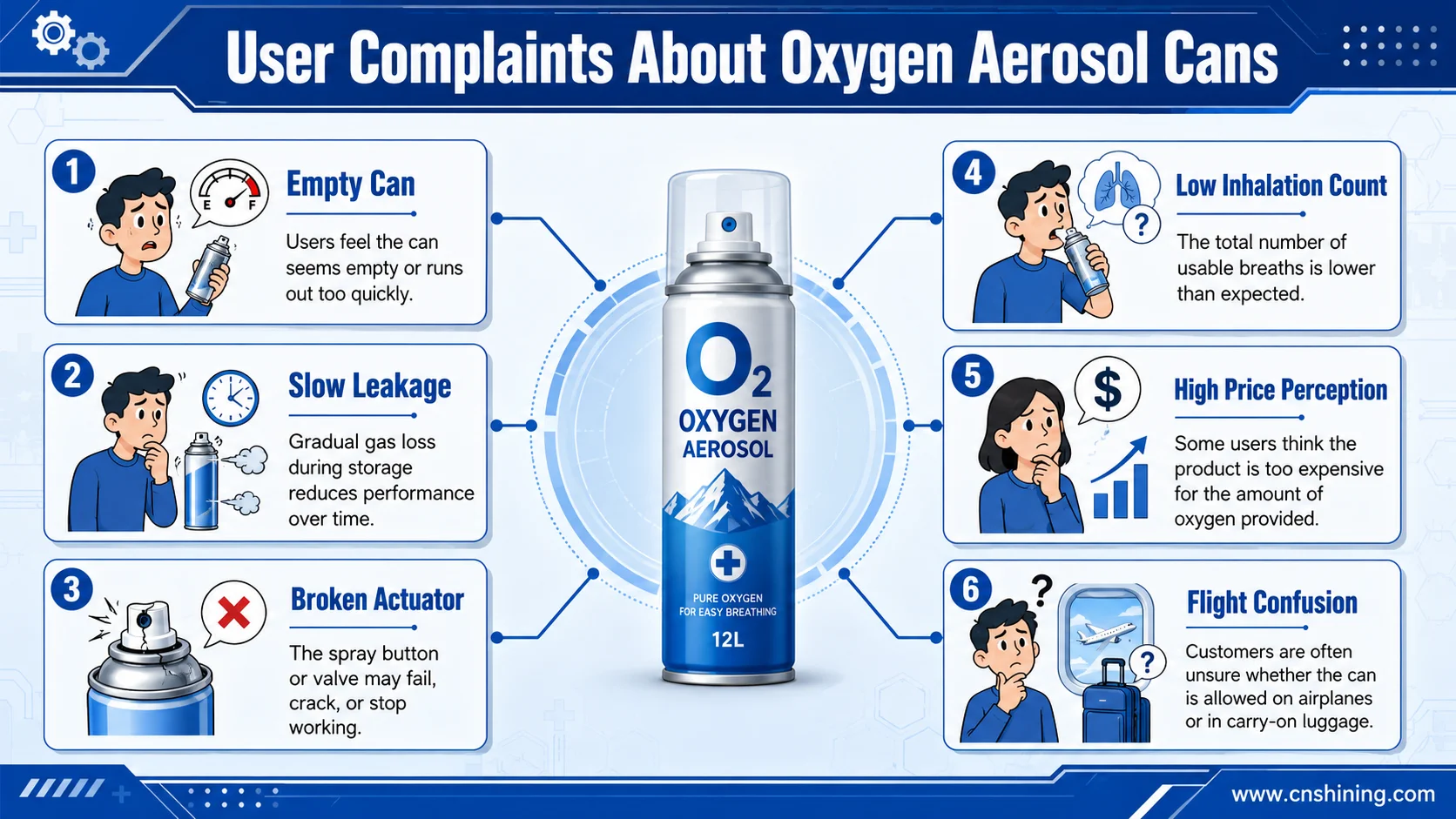
Customer complaints in this category are not mysterious. They usually fall into five groups: empty can or leakage, actuator or mouthpiece failure, lower-than-expected inhalation count, weak perceived effect for the price, and confusion about medical use or flight carriage. Most of these trace back to packaging, valve performance or communication, not the oxygen molecule.
| Feedback Type | Real Problem | Likely Packaging Cause | Practical Correction |
|---|---|---|---|
| “Does not work” or breaks on arrival | Actuator failure | Weak trigger rib, wide assembly tolerance, poor transport robustness | Strengthen trigger geometry, add cycle testing and drop/side-load testing. |
| “Empty when opened” | Leakage or slow pressure loss | Valve seal, crimp variation, mouth seal damage | Use final weight check, pressure decay sampling and batch traceability. |
| “Not close to advertised inhalations” | Definition mismatch | Flow window too wide; one inhalation not clearly defined | Publish test definition: fixed flow, fixed time, fixed actuation condition. |
| “Feels too light to be full” | User misreads lightweight aluminum can | Low tare weight and no fill-weight cue | Print “full can feels light” and batch fill-weight reference on label. |
| “Can I bring it on a plane?” | Flight misunderstanding | Aviation warnings hidden or absent | Place passenger-aircraft restriction on the primary or secondary label panel. |
| “Does not feel worth the price” | Effect expectation too high | Over-functional claim language | Use scene-based language: altitude, exertion, short supplemental use, non-medical. |
7. How Shining Packaging Fits This Product Type
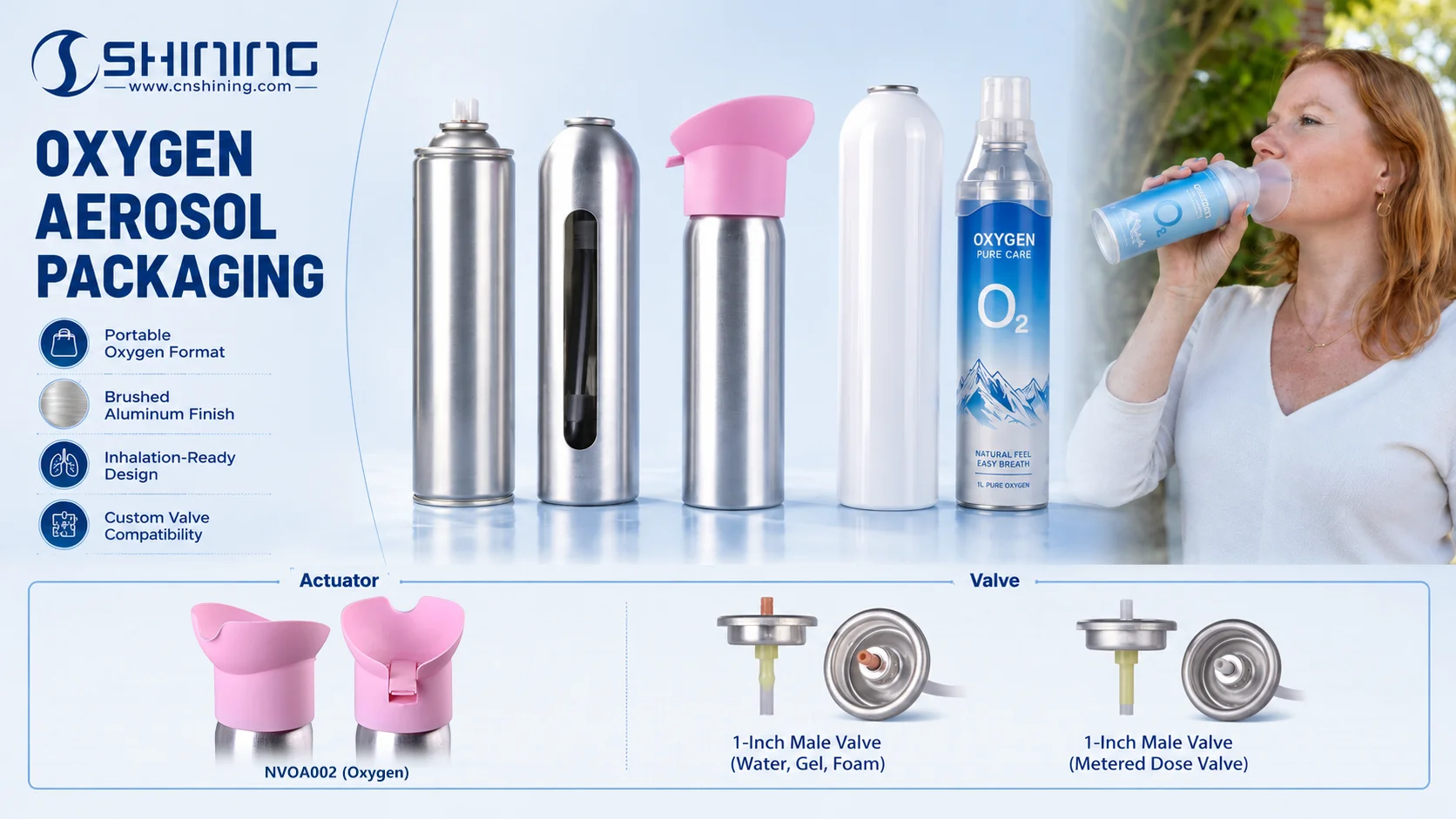
For an oxygen aerosol can project, the package is not a neutral shell. The actuator, valve and can body decide whether the product releases smoothly, survives transport and gives the user a clear first-use experience. This is where Shining Packaging can be discussed in technical rather than promotional terms.
The relevant product focus is three parts. First, the actuator needs a stable press feel, clear orientation and enough structural strength for repeated short bursts. Second, the aerosol can must support clean filling, suitable pressure performance, reliable crimping and readable safety labeling. Third, the valve must match the flow expectation, seal integrity and oxygen-service material requirement of the design.
For this category, a practical packaging review should ask four questions: Does the valve hold pressure through storage and shipping? Does the actuator resist accidental discharge? Does the mask or mouthpiece guide the user naturally? Does the label prevent wrong assumptions about medical use and air travel? These questions matter more than adding another purity claim.
8. Final Technical Takeaway
An oxygen aerosol can is not a simple “gas-in-a-can” business. It is a combined problem of packaging engineering, oxygen compatibility, dangerous goods logistics, compliance wording and user education. The brands that handle valve reliability, lightweight cans, transparent inhalation-count definitions, non-medical boundaries and flight restrictions with discipline will have fewer complaints and fewer compliance surprises.
9. FAQ: Oxygen Aerosol Can Technical Questions
Not always. Many retail oxygen cans are pressurized oxygen containers rather than classic aerosol dispensers. They release compressed oxygen through a valve, actuator and mask or mouthpiece. A true aerosol dispenser normally relies on a propellant to discharge product. This distinction affects testing, labeling, transport classification and which pressure-packaging rules may apply.
The gas source decides purity, filling route, compliance language and risk profile. High-purity compressed oxygen is common in OTC cans. Oxygen 93 is produced by molecular sieve systems and sits closer to regulated oxygen supply. Chemical oxygen generators release oxygen by reaction and bring heat and dangerous goods concerns. These routes should not share one design file.
Oxygen 93 is oxygen produced from air by a molecular sieve process. USP defines it as 90.0% to 96.0% oxygen by volume, with the rest mainly argon and nitrogen. It is useful in onsite oxygen generation systems. High-purity oxygen, often 99.5% or higher in pharmacopoeial terms, is a different quality route and may use different production controls.
No. Consumer oxygen cans provide short bursts and limited total oxygen volume. Medical oxygen therapy requires prescribed flow, duration, delivery method and monitoring. A small OTC can may temporarily raise inhaled oxygen concentration, but it cannot provide the continuous calibrated supply needed for many medical conditions. Claims should stay away from disease treatment unless the product is regulated for that use.
Lightweight aluminum cans can feel empty even when filled. Real leakage is also possible if the valve, crimp, gasket or actuator interface fails. The best packaging response is not only better sealing. It also includes filled-weight checks, batch traceability and label text explaining that a full can may still feel light because the gas volume has low mass.
The valve and actuator system is the usual weak point. Leakage, accidental discharge, broken triggers and poor mask fit all come from this area. Oxygen-compatible sealing material, stable crimping, trigger-lock design, cycle testing and transport simulation are more useful than adding claims on the front label. A good oxygen can starts with controlled gas release.
Compressed or liquid oxygen containers are generally not allowed in passenger carry-on or checked baggage. FAA guidance also includes canned, recreational and flavored oxygen in this prohibited group. Portable oxygen concentrators are treated differently because they do not store oxygen; they concentrate oxygen from ambient air. Product pages should not imply flight use for compressed oxygen cans.
Useful label content includes oxygen volume, typical one-second inhalation count, total continuous-use seconds, non-medical-use wording, fire warning, pressurized-container warning, aircraft restriction, batch code, fill date and child-use caution. This information reduces misuse and service disputes. It is more valuable than broad “energy” or “recovery” language that users may interpret as medical benefit.
BOV is relevant, but mainly for oxygen-sensitive liquid sprays rather than compressed inhalation oxygen cans. In BOV packaging, the product is held inside a bag and separated from the propellant. This can protect cosmetic, pharmaceutical or sensitive formulas from contamination and oxidation. It should not be confused with a can filled primarily with compressed oxygen gas.
Define the product structure before designing the label or sales claim. Confirm whether it is compressed oxygen, Oxygen 93, a classic aerosol dispenser, a BOV liquid spray or a chemical oxygen generator. Then match the valve, can, material compatibility, transport classification and claims to that structure. This prevents expensive redesign after compliance or logistics review.