
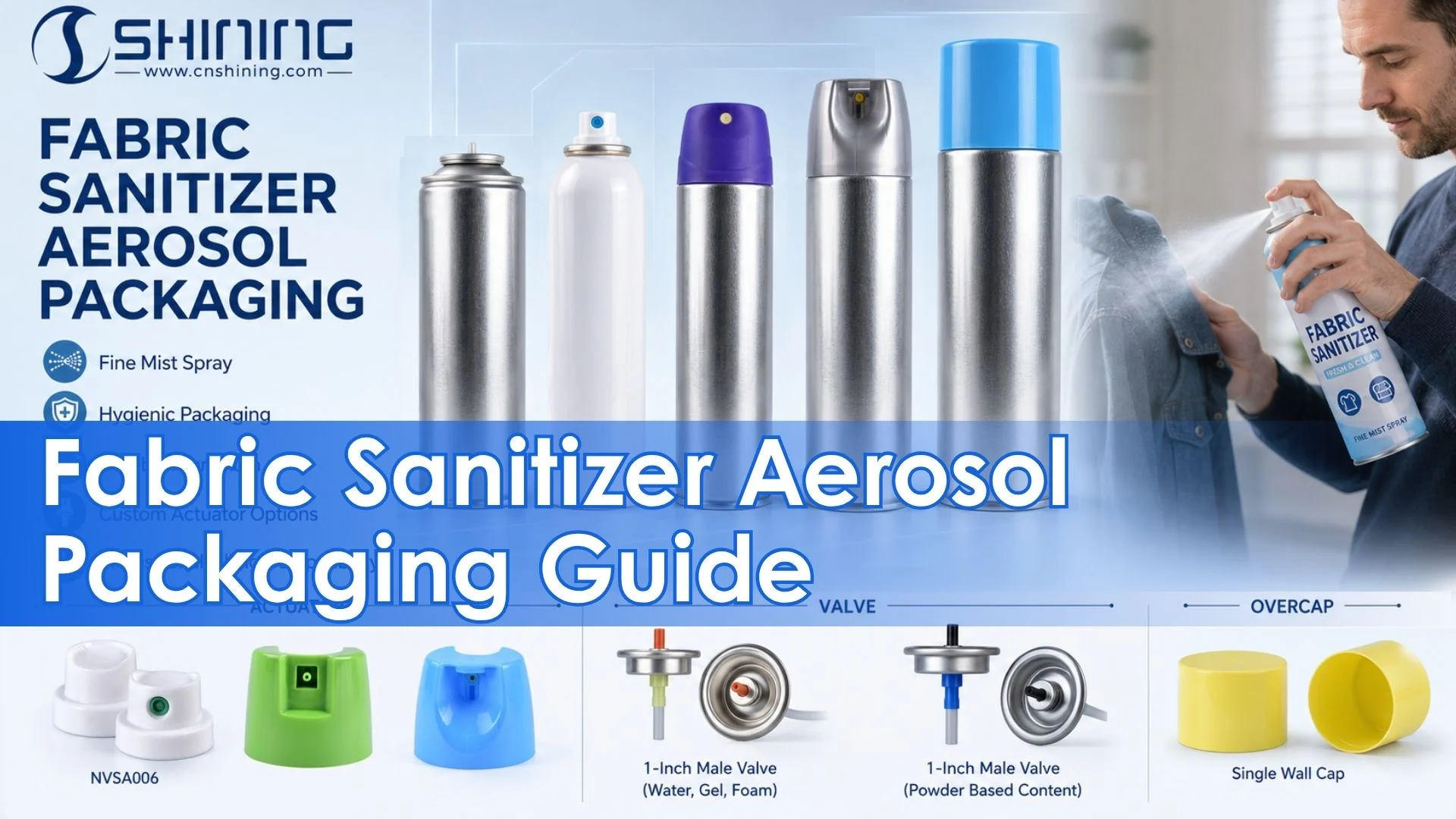
Fabric sanitizer aerosol spray, also described as fabric disinfectant spray, soft-surface sanitizer, textile sanitizer, or odor-control antimicrobial spray, sits between fabric care and surface disinfection. It is not simply a fragrance mist with a hygiene claim added later. The product has to deliver active ingredients onto fibers through a valve, actuator, propellant system, and spray pattern that keep the textile wet for the required contact time.
The category is technically awkward. The same shelf may contain a soft-surface sanitizer, a hard-surface disinfectant aerosol, an air sanitizer, a fabric refresher, and a laundry adjunct. They may look similar. Their claims are not similar. The difference is usually hidden in the label: target organism, material scope, contact time, test method, and use restriction.
1. What a Fabric Sanitizer Aerosol Actually Does
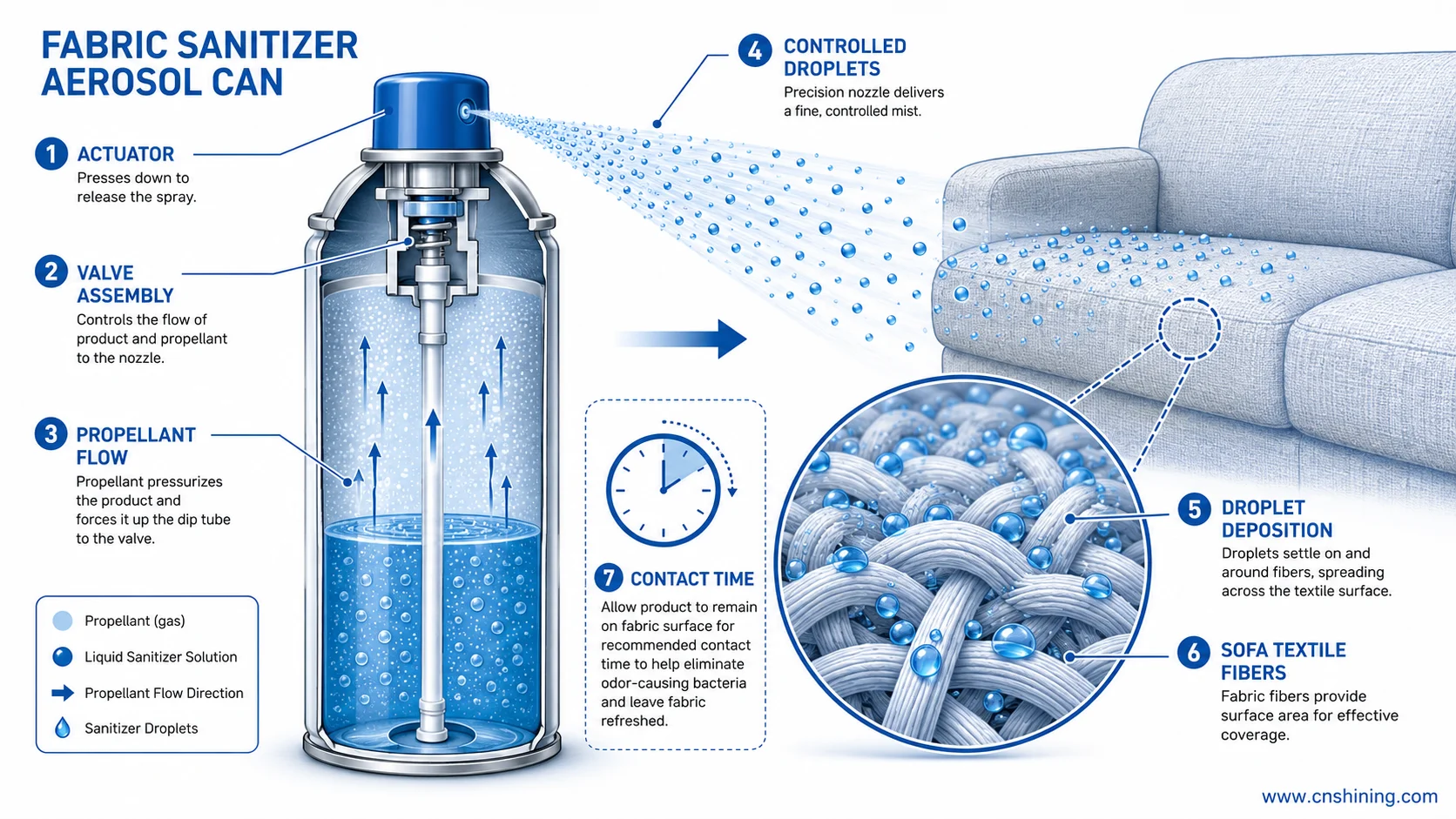
A fabric sanitizer aerosol is a ready-to-use antimicrobial formulation for fabric, clothing, upholstery, bedding, curtains, pet beds, car seats, and other soft surfaces. The aerosol package converts the liquid formulation into a controlled spray. The active ingredients then sit on the fiber surface long enough to achieve sanitizing or disinfecting performance.
There is a practical distinction between sanitizing and disinfecting. Sanitizing normally means reducing microorganisms to a public-health acceptable level, often with a narrower target spectrum and shorter contact time. Disinfecting requires stronger efficacy data and usually a longer contact time. Under the U.S. EPA soft-surface textile pathway, disinfectant claims for non-residential soft surface textiles are treated as a specific testing route rather than a casual label extension.
One public example shows the gap clearly. Clorox Fabric Sanitizer Aerosol Spray has been reported with ethanol as the main active route and a 30-second soft-surface sanitizing instruction. Similar multi-purpose disinfectant aerosols may require 5 minutes for hard-surface disinfecting. The words on the label matter more than the product name.
2. Formulation Routes: Alcohol, Quats, Peroxides and Organic Acids
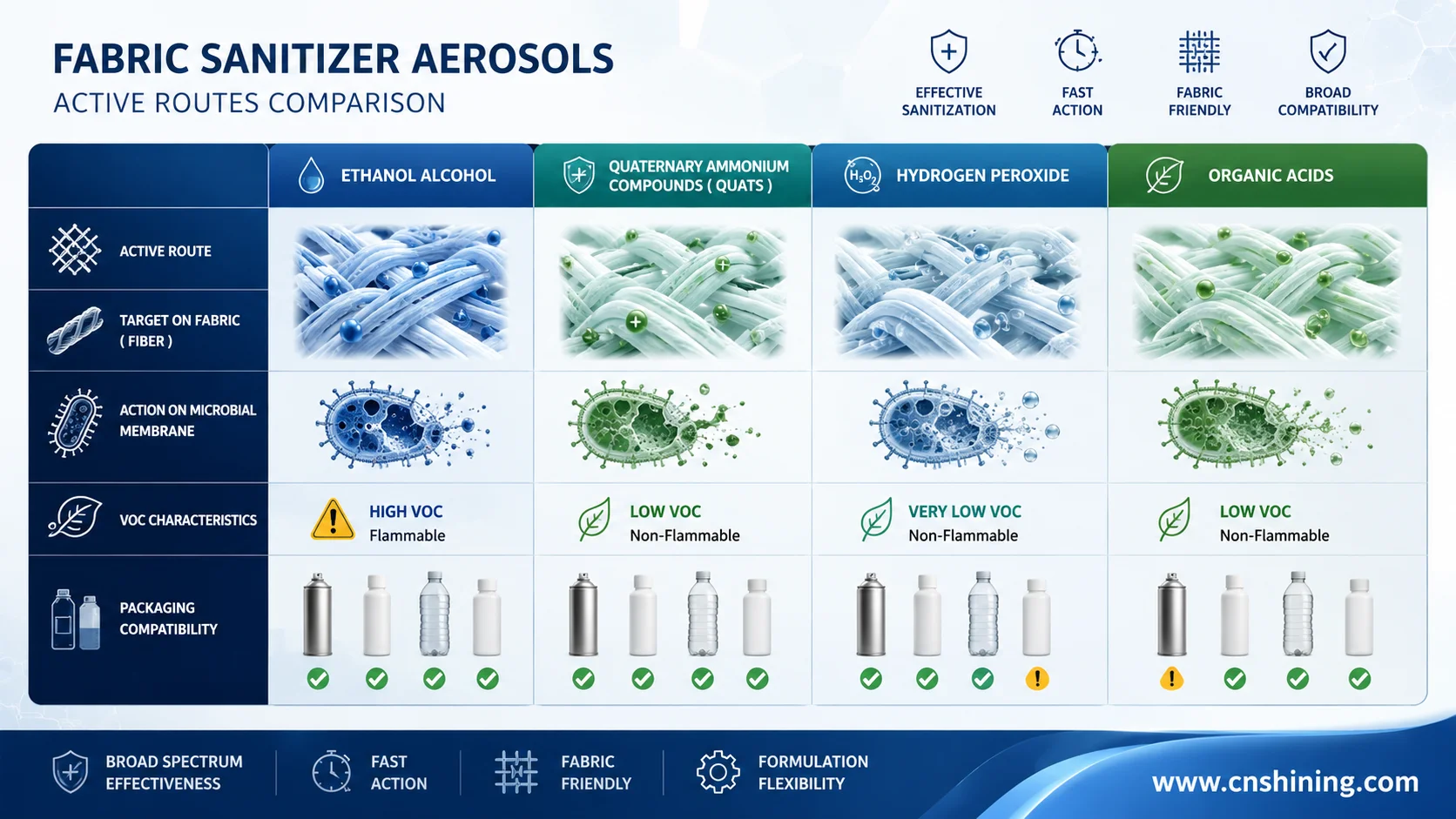
The public market still shows alcohol-based aerosols as the most direct consumer route. Ethanol is easy for users to understand. It dries fast, leaves limited residue, and works mainly through protein denaturation and lipid membrane disruption. The trade-off is also clear: high VOC, flammability, fast evaporation, and odor irritation. The CDC chemical disinfectants reference remains useful for understanding the general behavior of alcohols and other disinfectant chemistries.
Quaternary ammonium compounds, often shortened to quats, work differently. Their positively charged head groups attach to microbial membranes, while hydrophobic chains disturb the lipid layer and cause leakage. Quats can be useful where lower volatility, soft-surface compatibility, or residual positioning is desired. They also bring residue, adsorption, incompatibility with some anionic materials, and environmental scrutiny.
Hydrogen peroxide and accelerated hydrogen peroxide systems use oxidative damage. They can support a low-residue positioning, but packaging stability becomes harder. Light, pH, metal ions, and can coating compatibility all matter. A formula that looks stable in a glass lab bottle may behave very differently inside a pressurized metal package.
Organic acid and botanical routes, such as lactic acid, citric acid, or thymol-based systems, are attractive for bleach-free and lower-chlorine positioning. They are not automatically safer or less irritating. Odor, textile compatibility, and regulatory wording still need discipline. In the EU, biocidal advertising cannot simply present a product as harmless, non-toxic, natural, or risk-free. Article 72 of the BPR is clear on advertising discipline; see the BPR Article 72 advertising requirements.
| Formulation route | Typical public range or example | Main mechanism | Strength | Main technical risk |
|---|---|---|---|---|
| Alcohol | Ethanol route; effective alcohol systems are often discussed around 60–80% | Protein denaturation and lipid membrane disruption | Fast dry-down, low residue, familiar to users | VOC, flammability, odor, short wet contact time |
| Quaternary ammonium compounds | Patent literature includes aerosol antimicrobial compositions with quat ranges such as 0.01–5%; fabric spray concepts may discuss wider ranges | Membrane adsorption and lipid-layer disruption | Lower volatility and possible residual positioning | Residue feel, fiber adsorption, incompatibility with some ingredients |
| Hydrogen peroxide | Ready-to-use accelerated hydrogen peroxide systems are often discussed around 0.5% in public studies | Oxidative cell damage | Broad spectrum and low-residue concept | Can coating, pH, light, and metal-ion stability |
| Phenolic actives | Still seen in some household disinfectant systems, but less visible in modern fabric-specific aerosols | Protein and membrane disruption | Mature chemistry | Odor, residue, dye/material compatibility |
| Botanical or organic acid route | Lactic acid, citric acid, thymol concepts | Membrane destabilization or acid stress | Bleach-free and fabric-friendly positioning | Odor, claim limits, and “natural” wording risk |
Two formulation directions deserve attention. The first is low-alcohol or alcohol-free quat blends using co-solvents, polymers, glucamide chemistry, or glycol-type odor-control aids. The second is peroxide or organic-acid systems that need better packaging control rather than stronger claims. A useful patent signal is WO2025078195A1 on fabric spray chemistry, which points to current work around quaternary ammonium fabric spray stability.
3. Competing Product Types and Top Brand Landscape
Fabric sanitizer aerosol competes against more than other aerosols. The real replacement set includes disinfectant wipes, trigger fabric sprays, laundry sanitizers, fabric fresheners, air disinfectants, and multi-purpose hard-surface disinfectant aerosols.
| Dimension | Fabric sanitizer aerosol | Disinfectant wipes | Liquid fabric spray | Laundry sanitizer | Air disinfectant spray |
|---|---|---|---|---|---|
| Best use | Clothing, bedding, car seats, sofa, pet bed, “cannot wash now” cases | Hard surfaces | Localized fabric treatment | Machine-washable textiles | Air or room-volume treatment |
| Performance logic | Fast soft-surface coverage, but claim depends on label and contact time | Good wipe transfer on hard surfaces; weak for fibers | Can give deeper wetting and lower inhalation exposure | Best when cleaning and hygiene are combined in wash cycle | Air efficacy does not prove fiber-surface efficacy |
| Convenience | Very high | High for small hard areas | Medium to high | Medium; washing required | High, but target is different |
| Safety pressure | VOC, flammability, fragrance irritation, ventilation | More skin contact, lower inhalation exposure | Lower aerosol inhalation risk | Low inhalation risk, but residue and skin compatibility still matter | Misuse in closed spaces can cause coughing or discomfort |
| Residue and hand feel | Alcohol systems are lighter; quat systems may leave more feel | Can leave wipe marks | Depends on active and surfactant package | Controlled by rinse and wash process | Not optimized for textile hand feel |
The most serious substitutes are laundry additives and fabric-specific trigger sprays. They address the clothing problem more directly. Multi-purpose disinfectant aerosols are also strong because they already own retail shelf space and brand recognition.
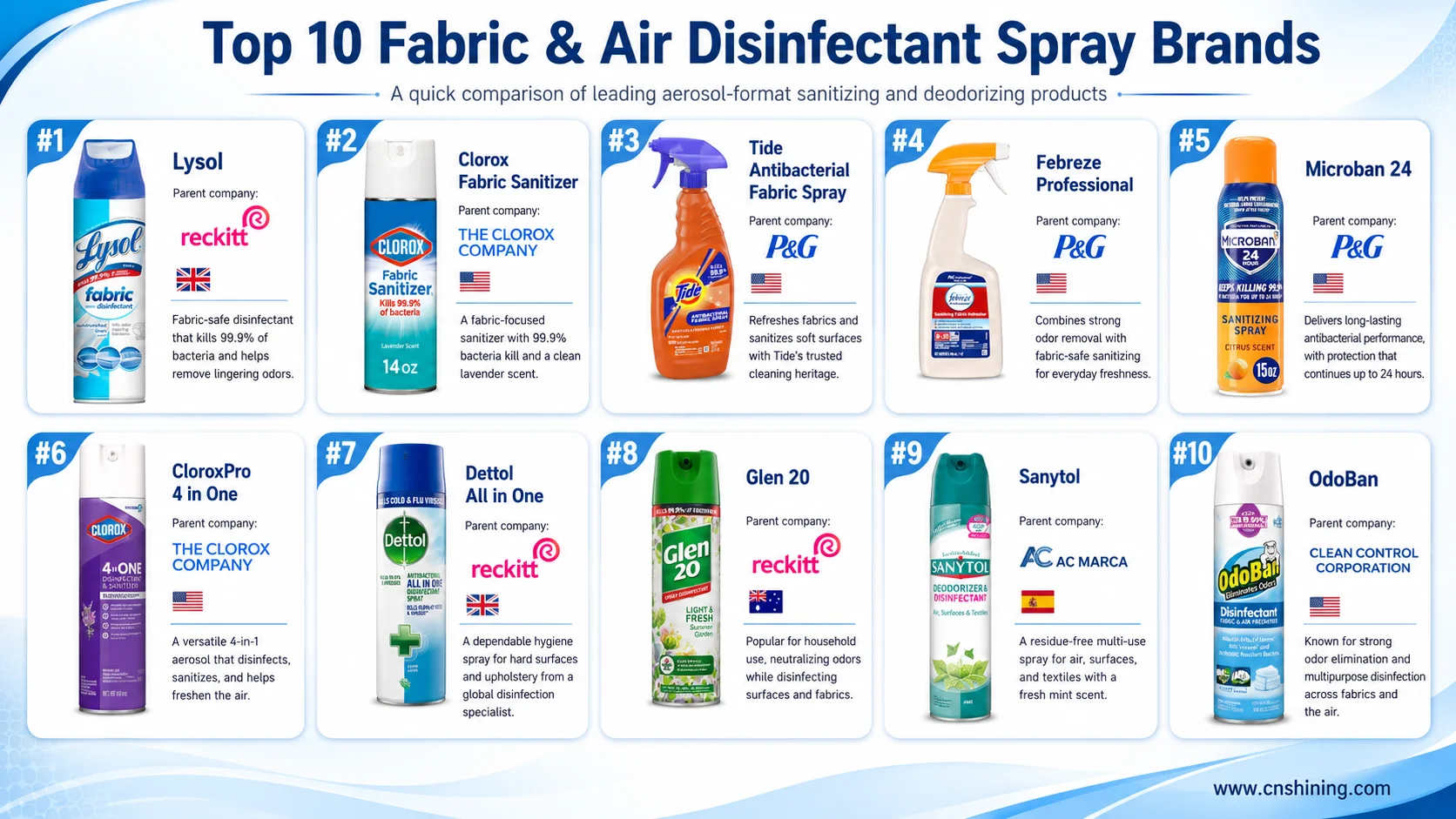
Top 10 Brands and Related Product Positioning
This brand section is kept separate because real consumers do not buy by regulatory category. They search for a solution to odor, clothing freshness, sofa hygiene, pet-bed odor, or car-seat treatment. Aerosol and non-aerosol products therefore appear in the same purchase set.
| Brand | Main market | Parent company | Main format or size | Typical public price signal | Technical read |
|---|---|---|---|---|---|
| Lysol | U.S. / global | Reckitt Benckiser | 15 fl oz fabric disinfectant aerosol | About US$7–8 per 15 oz | Strong channel and brand memory. Odor and irritation complaints remain common. |
| Clorox | U.S. | The Clorox Company | 14 oz aerosol; 5 oz travel size | About US$9.50 for 5 oz and US$12.29 for 14 oz | A clear public example of alcohol-route fabric sanitizing aerosol. Label clarity is a strength. |
| Tide Antibacterial Fabric Spray | U.S. | Procter & Gamble | 22 fl oz trigger spray | about 4.97$ per 22 oz | More garment-care oriented than general disinfectant aerosol. |
| Febreze Professional / Antimicrobial | U.S. | Procter & Gamble | 32 fl oz trigger format | About US$13.9 per 32 oz | Strong odor-control equity. More fabric-care than hard disinfection in user perception. |
| Microban 24 / Professional | U.S. | P&G / Microban Professional line | 15 oz aerosol | about 8.97$ per 15 oz | Long-lasting protection narrative suits schools, offices, and institutional soft surfaces. |
| CloroxPro 4-in-One | U.S. | CloroxPro / Clorox | 14 oz aerosol | about 6.60$ per 14 oz | Air, soft surface, hard surface, and allergen-reduction positioning gives it institutional range. |
| Dettol All-in-One Disinfectant Spray | U.K. / South Asia / global | Reckitt | 400–450 ml aerosol | about 5.10$ per 400 ml | International soft-and-hard-surface disinfectant spray, not always a fabric-only product. |
| Glen 20 | Australia / New Zealand | Reckitt regional brand system | 300 g aerosol | About AU$10 per 300 g | Strong regional soft-surface and home/office hygiene presence. |
| SANYTOL Textile Disinfectant | France / Spain / Europe | AC Marca | 500 ml textile spray | about 8.70$ per 500 ml | European textile-specific disinfectant route, more aligned with bleach-free fabric treatment. |
| OdoBan | U.S. | Clean Control Corporation / OdoBan Pro | 32 fl oz ready-to-use liquid | About US$4.99 per 32 oz | Strong price pressure against aerosol fabric sanitizers, even when not a classic aerosol. |
4. Regulatory Map: Claims Decide the Product
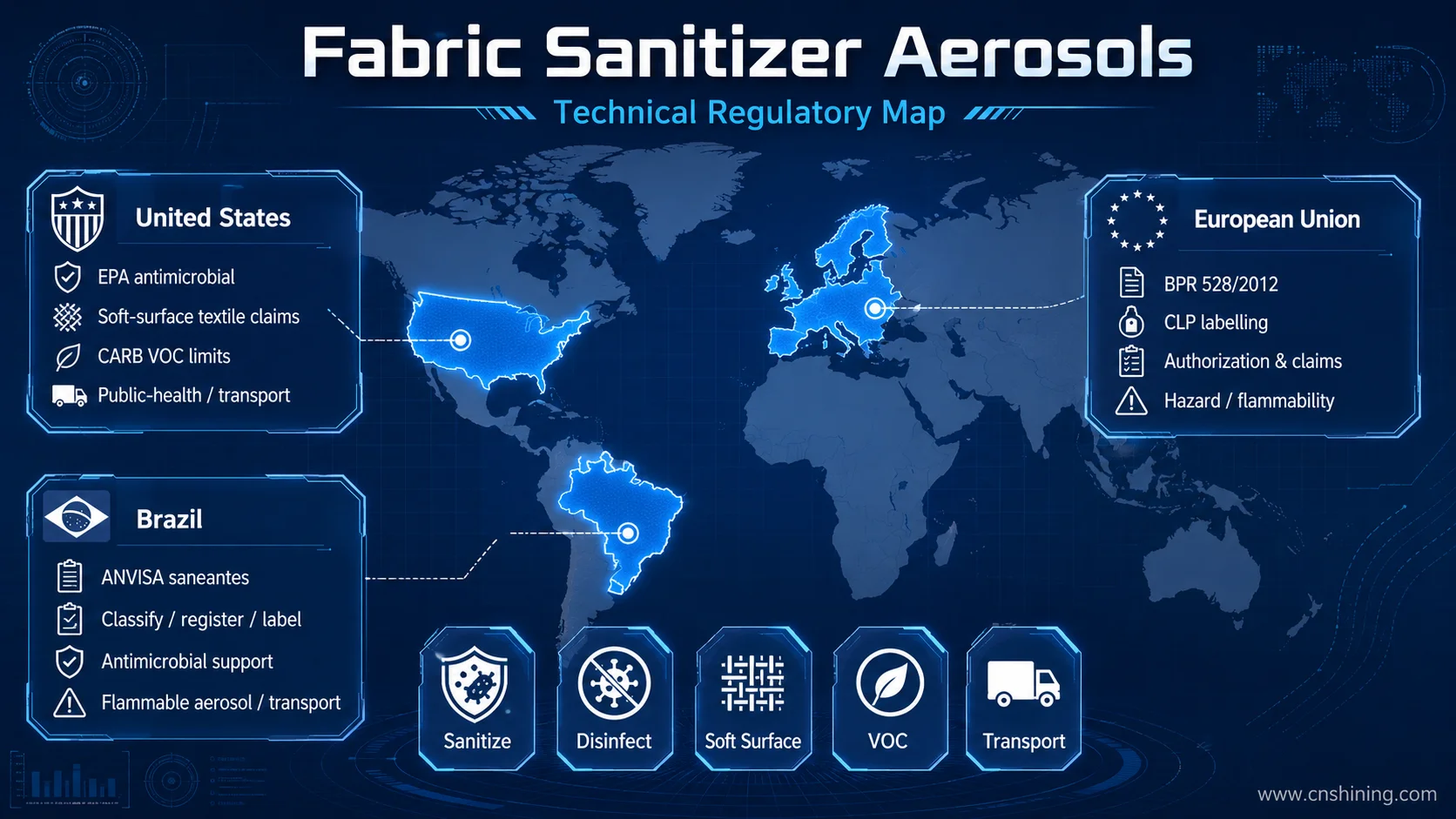
For this category, regulation is not paperwork after the formulation is finished. It defines what the product is allowed to be. The main decisions are: Is the product a fabric-care refresh spray, a sanitizer, a disinfectant, an air sanitizer, a soft-surface textile disinfectant, or a treated article?
| Market | Main framework | Claim and testing focus | VOC / hazard / transport issue |
|---|---|---|---|
| United States | EPA antimicrobial pesticide framework for public-health kill claims; CDC use guidance | Soft-surface textile disinfectant claims need specific data. EPA guidance points to representative textile carriers, bacterial and viral reductions, and compatibility observations. | CARB consumer product standards include VOC limits for disinfectant aerosol, sanitizer aerosol, and dual-purpose air freshener/disinfectant aerosol. See California Title 17 Section 94509 VOC standards. |
| European Union | BPR 528/2012 and CLP | Active substances and biocidal products need the right authorization route. Advertising claims must avoid low-risk or harmless implications. | CLP hazard labeling and aerosol flammability classification remain central. ECHA provides current pages for BPR legislation and CLP labelling and packaging. |
| Brazil | ANVISA saneantes framework | Classification, registration, labelling, and antimicrobial claim support are key. | Alcohol and aerosol products also trigger flammability and transport controls. See the ANVISA saneantes regulatory page. |
The practical risk is not one bad sentence on a label. The risk is a mismatch between claim, test method, material scope, and user instruction. “Soft surface,” “fabric,” “clothing,” “air,” “virus,” “mold,” and “residual efficacy” are not interchangeable terms.
5. User Pain Points and Packaging Improvements
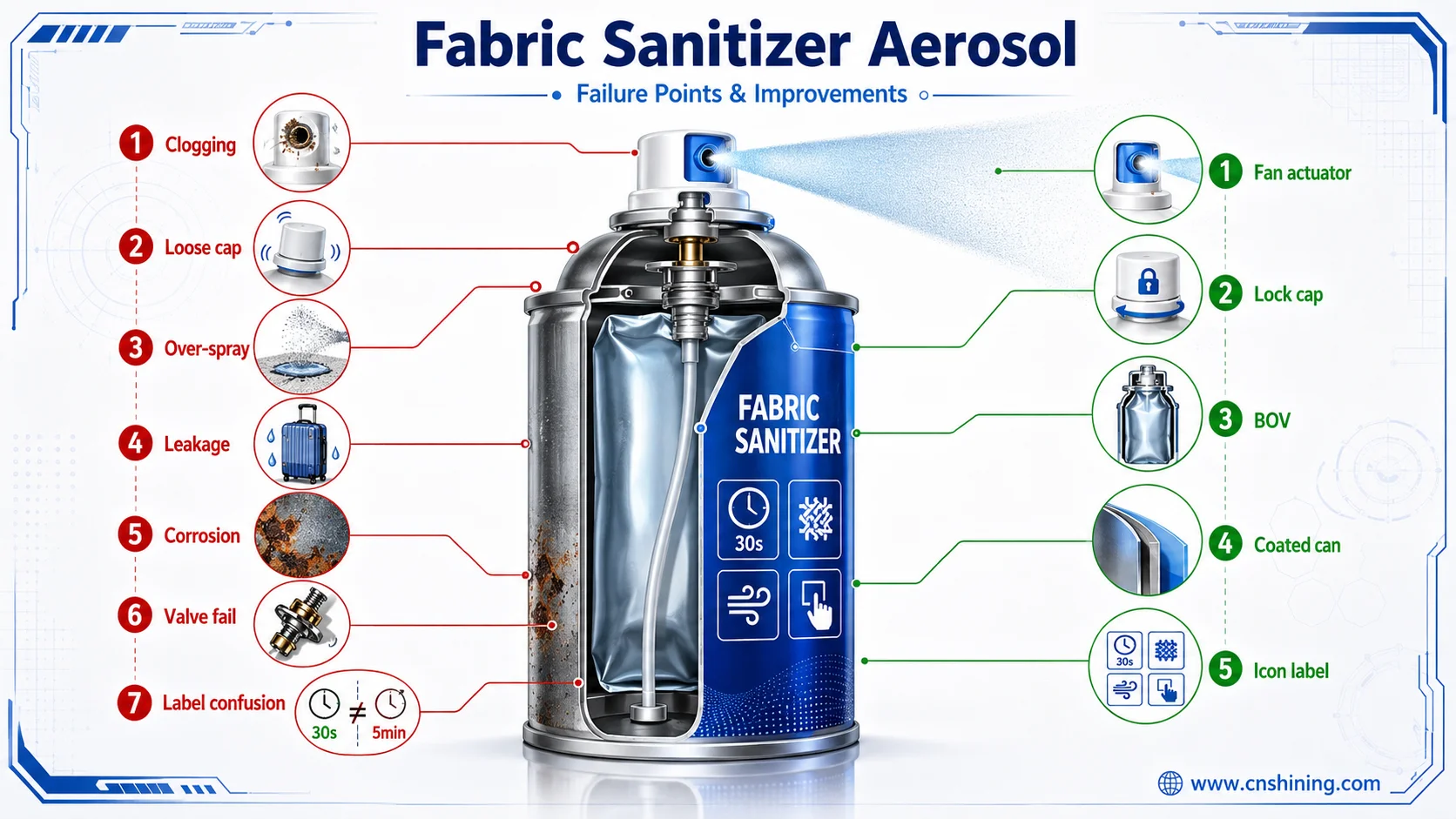
Public user feedback repeats the same problems: fragrance is too strong, sensitive users cough or get headaches, users cannot see whether the product “really sanitized,” spray caps fail, cans leak during transport, and price feels high for a product whose effect is invisible.
The packaging lesson is blunt. Many complaints are not about kill rate. They happen at the moment of spraying. If the actuator creates coarse wet spots or too much airborne mist, the product feels wrong. If the spray cap falls off or the valve does not work on arrival, the formula never gets a chance.
| Pain point | Packaging or structural improvement | Why it helps | Implementation difficulty |
|---|---|---|---|
| Over-spray, cough, and wet patches on fabric | Wide fan actuator plus flow-restricted valve insert | More even surface deposition, less local saturation, lower floating mist load | Medium |
| Loose cap or spray button failure | Lockable actuator, tighter cap retention, better tolerance control | Reduces arrival failures and direct consumer frustration | Low to medium |
| Travel leakage or accidental discharge | Overcap or lock-button design | Protects handbag, luggage, and small travel-size packs | Low |
| Water-based or acidic formula instability | Bag-on-Valve or better internal coating | Separates product from propellant and reduces corrosion or interaction risk | Medium to high |
| Confusion between 30 seconds and 5 minutes | Front-label icon system for contact time, fabric type, ventilation, and spot test | Turns regulatory language into usable instructions | Low |
| Vague recycling message | Material statement plus QR code for local aerosol can recycling guidance | More honest than saying every aerosol can is automatically recyclable everywhere | Low |
| Hand fatigue during large-area spraying | Slight waist or ergonomic shoulder on the can body | Improves grip control on sofa, curtain, bedding, and car-seat use | Medium |
| Invisible value | Coverage area, sprays per can, and recommended use-case icons | Users understand cost per sofa, garment, or pet-bed treatment | Low |
Bag-on-Valve technology is worth watching because it separates product and propellant, supports 360-degree dispensing, and can improve compatibility for some water-based or lower-VOC concepts. Actuator selection is just as important. Aerosol actuator designs and spray cap systems directly influence droplet size, spray angle, cap retention, and daily user control.
6. Shining Packaging: Actuators, Aerosol Cans and Valves for Fabric Sanitizer Packs
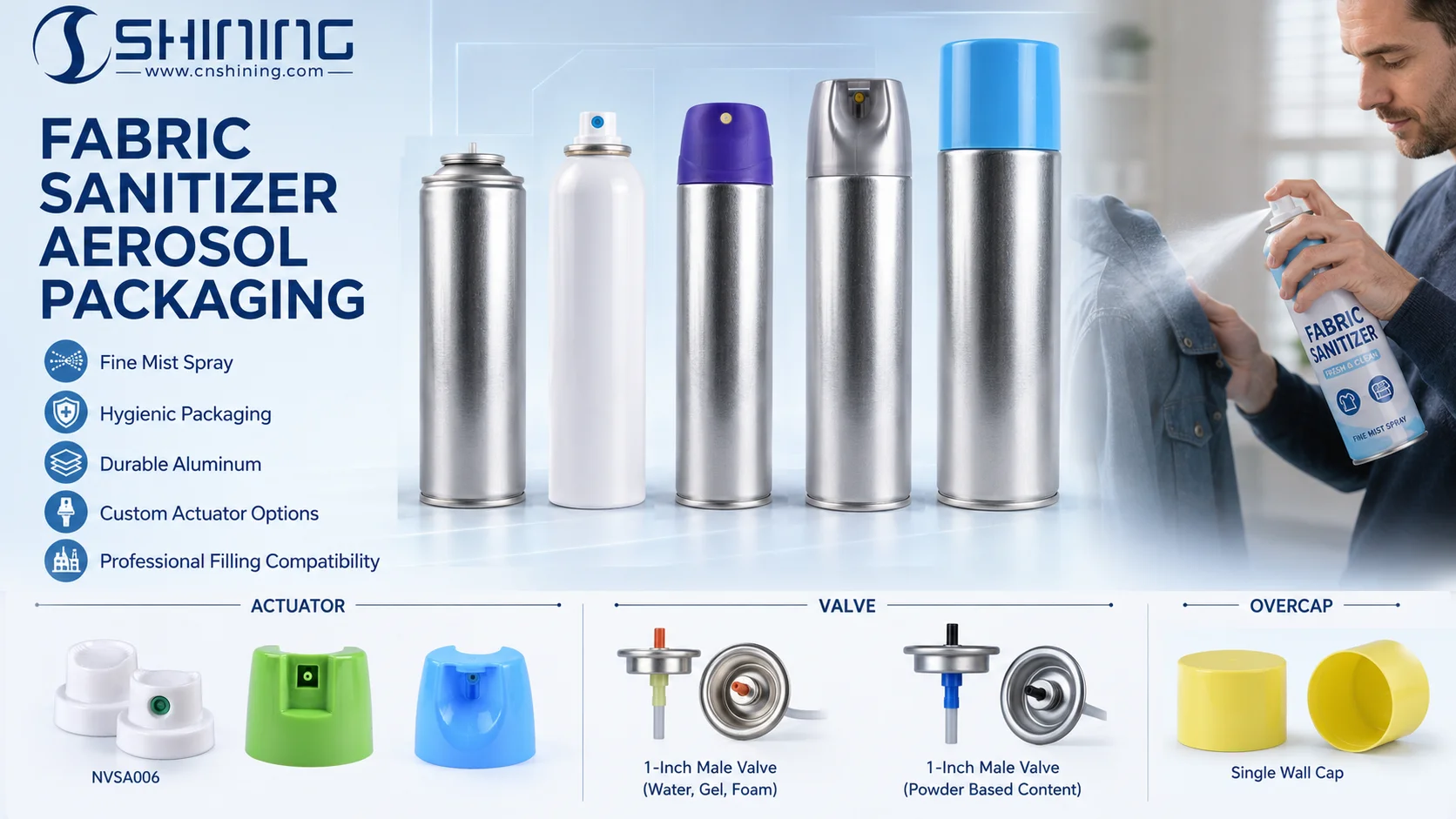
For fabric sanitizer aerosol, packaging is part of the performance system. Shining Packaging’s relevant components are actuators, aerosol cans, and valves. These parts should be selected against the formula route, contact-time requirement, spray feel, and transport risk rather than treated as generic hardware.
The actuator controls the user’s first impression: spray angle, droplet size, button force, wet spot size, and over-spray. A wide, controlled spray can help cover sofa, bedding, and clothing surfaces without soaking one area. A lockable cap or covered actuator is useful for travel-size fabric sanitizer because accidental discharge is a real complaint in this category.
The aerosol can has to match the formula. Alcohol systems bring flammability and VOC concerns. Organic acid or peroxide systems may need stronger corrosion assessment and coating selection. Water-based or low-VOC concepts may benefit from Bag-on-Valve evaluation, depending on formulation behavior and target cost.
The valve controls flow rate, sealing, compatibility, and shelf-life reliability. For a fabric sanitizer aerosol, a stable valve is not a minor detail. If the valve leaks, clogs, or delivers an unstable spray rate, the user may under-apply or over-wet the textile. Either case can undermine the label instruction.
Shining Packaging can be positioned naturally in this application as a packaging engineering partner for aerosol brands that need to match formula, claim, and user experience. The useful work is practical: choose the actuator, can, valve, cap, and internal coating that make the fabric sanitizer spray more predictable.
7. Terms Engineers Should Keep Straight
| Term | Meaning | Why it matters commercially |
|---|---|---|
| Sanitizer | Product or claim that reduces microorganisms to a defined public-health level | Supports fast and daily-use positioning, but the organism spectrum is usually narrower than disinfectant claims |
| Disinfectant | Product or claim for stronger reduction of specified pathogens | Stronger label value, higher testing burden, longer contact time, and more regulatory cost |
| Soft surface textile | Fabric, textile, or upholstered surface within a defined regulatory scope | Material scope decides whether a claim can be tested and used as written |
| Contact time | Time the treated surface must remain wet with active formulation | Thirty seconds and five minutes create very different user behavior |
| Kill claim | Label claim listing target bacteria, virus, fungi, or mold | Directly determines testing requirement and product differentiation |
| Residual efficacy | Continued antimicrobial effect after initial application | Attractive claim, but sensitive on soft textiles and not covered by every guidance route |
| VOC | Volatile organic compound | Influences odor, irritation, flammability, transport, and formula freedom |
| BOV | Bag-on-Valve aerosol system | Can separate product and propellant and support water-based or 360-degree use cases |
| PT2 / PT9 | EU BPR product-type references for disinfectant and fiber-preservation functions | Can affect active selection and authorization route for treated textile claims |
| UN1950 | Dangerous goods transport number commonly associated with aerosols | Impacts warehousing, shipping, labeling, and channel availability |
8. Conclusion
Fabric sanitizer aerosol is a useful category, but it is not forgiving. The formula must support the claim. The spray system must keep enough active material on the fabric for the contact time. The label must separate sanitize, disinfect, air, soft surface, and clothing language. The package must prevent the failures users actually complain about: harsh odor, over-wetting, leakage, loose caps, and dead valves.
The next stage of this market will not be won by repeating “99.9%” louder. It will be won by products that spray accurately, dry predictably, smell controlled, comply with the right claim route, and survive real logistics.
9. FAQ: Fabric Sanitizer Aerosol
No. A fabric freshener mainly targets odor perception and fragrance delivery. A fabric sanitizer aerosol must deliver antimicrobial active ingredients onto fabric or soft surfaces and keep them wet for a defined contact time. Some products combine odor control and sanitizing, but the hygiene claim still depends on approved actives, testing, label scope, and use instructions.
Contact time is the period during which the treated textile must remain effectively wet with the active formulation. If the spray evaporates too fast or the user under-applies it, the intended microbial reduction may not be achieved. A 30-second soft-surface sanitize instruction and a 5-minute disinfect instruction are different technical conditions, not interchangeable usage tips.
Alcohol systems are easy to understand, dry quickly, and leave limited residue. Ethanol works mainly by protein denaturation and lipid membrane disruption. The weakness is packaging and use safety: high VOC, flammability, odor intensity, and rapid evaporation can all create problems. The formula and actuator must support enough surface wetness without making the product harsh to use.
Quats can be suitable when low volatility, broad antimicrobial positioning, and soft-surface compatibility are needed. They act by binding to microbial membranes and disrupting membrane structure. The risks are residue feel, adsorption onto fibers, incompatibility with some anionic components, and environmental scrutiny. On textiles, the real question is whether active availability remains adequate after fiber interaction.
The common problems are not subtle: over-spray, wet spots, harsh airborne mist, loose spray caps, leaking travel packs, clogged valves, and cans that do not spray on arrival. These failures damage user confidence before the antimicrobial claim is even considered. Actuator geometry, valve flow rate, cap retention, internal coating, and transport testing all need attention.
Bag-on-Valve can make sense when the formulation is water-based, low-VOC, acidic, peroxide-based, or sensitive to propellant contact. It separates the product from the propellant and can support 360-degree dispensing. It is not automatically the lowest-cost option. The decision should be based on formula stability, evacuation rate, spray quality, target claim, and retail price tolerance.
Not automatically. Air treatment and fabric surface treatment are different exposure situations. A product that has an air sanitizing or space disinfection claim has not necessarily shown efficacy on textile fibers. Fabric claims require attention to surface wetting, material compatibility, contact time, and the test method used for the specific soft-surface or textile claim.
VOC control is difficult because many fast-drying aerosol systems rely on alcohol or volatile solvents. These ingredients improve dry-down and user convenience but increase flammability, odor, inhalation irritation, and regulatory burden. Lower-VOC systems are possible, but they often need different actives, better corrosion control, different valves, and more careful spray-pattern engineering.
Testing should cover antimicrobial efficacy under the intended claim route, real-textile wetting, contact-time retention, fabric staining, colorfastness, odor intensity, valve compatibility, actuator spray pattern, corrosion, leakage, clogging, shipping vibration, and high-temperature storage. A formula that passes microbiology in isolation can still fail commercially if the package sprays poorly or leaks in transit.
Users need clear icons and short instructions: contact time, fabric scope, “spray until damp but do not soak,” ventilation, flammability warning, and spot-test advice. If one product has different instructions for soft surfaces and hard surfaces, those conditions should be visually separated. Clear labeling reduces misuse and prevents unrealistic expectations about what the spray can do.