
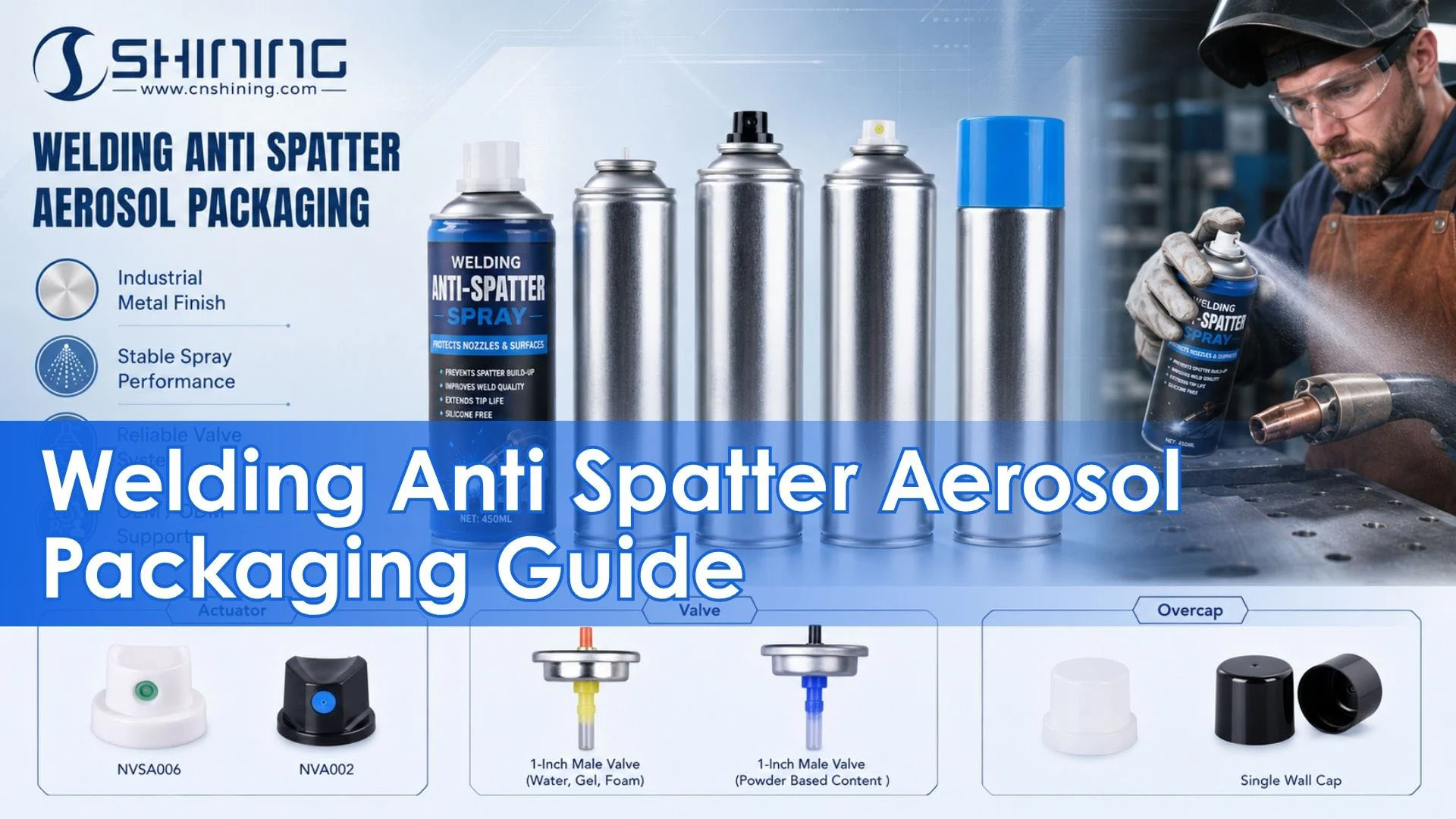
Weld spatter control starts after molten droplets have already formed. A Welding Anti Spatter aerosol Spray, also called anti-spatter spray, weld spatter release spray, nozzle protection spray, or welding release agent, does not remove the root cause of spatter. It builds a thin, low-adhesion film on the torch nozzle, contact tip, workpiece, fixture, or nearby metal surface. The aim is simple: reduce adhesion, reduce burn-on, and cut post-weld scraping, grinding, washing, and downtime.
The category has moved away from older oil-based and silicone-heavy systems. Current industrial development is more focused on water-based, silicone-free, low-VOC or VOC-free, non-flammable, biodegradable, ceramic dry film, and PFAS-free formulations. The aerosol format is a delivery system, not a formula type. That distinction matters.
1. Definition, Use Cases, and Working Mechanism
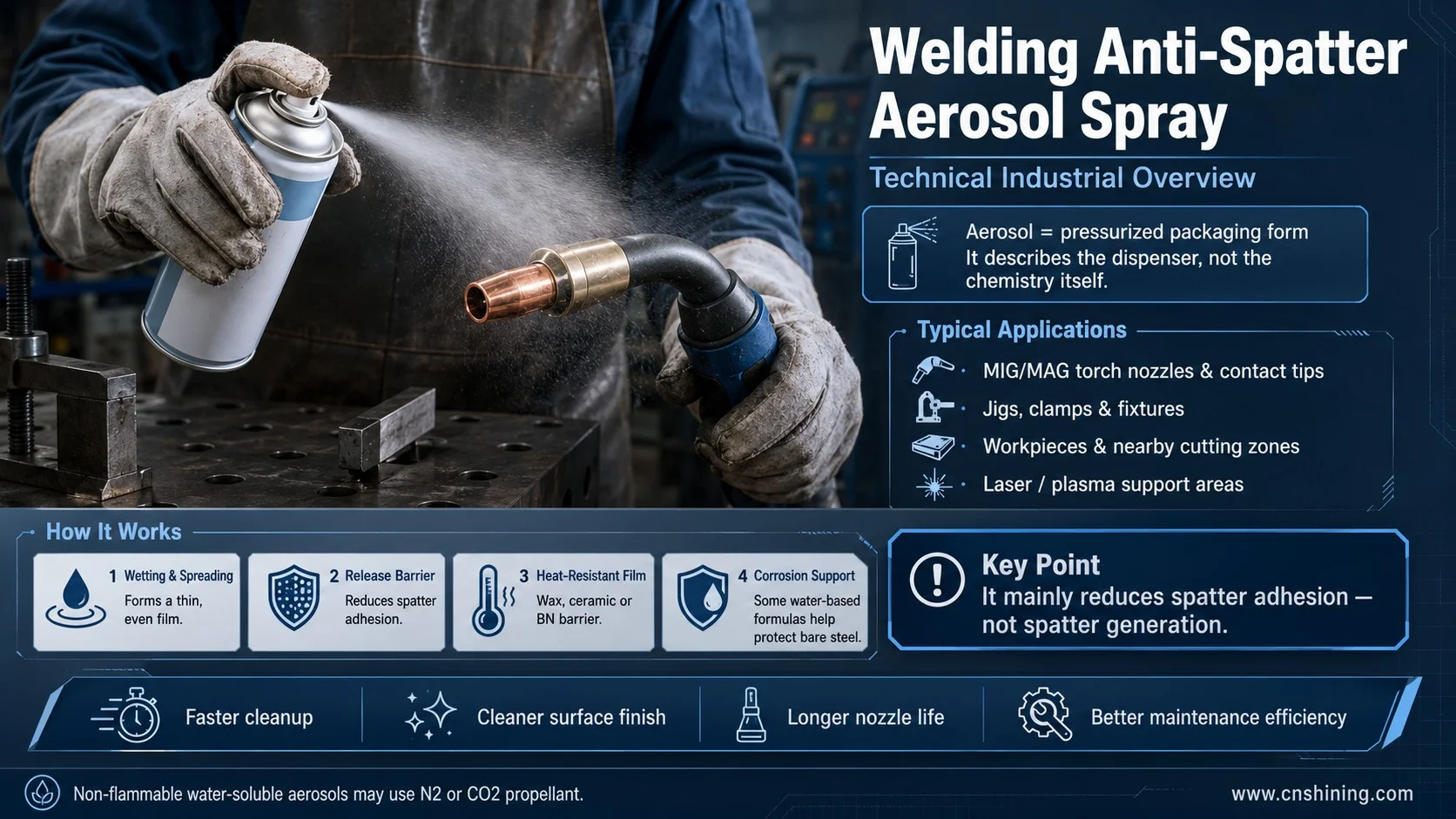
Under the EU Aerosol Dispenser Directive, an aerosol dispenser is a non-refillable metal, glass, or plastic container holding compressed, liquefied, or dissolved gas under pressure, fitted with a release device that discharges the contents as droplets, foam, paste, powder, or liquid. For welding anti-spatter products, this means “aerosol” describes the pressurized packaging and dispensing form, not the chemistry itself.
In practical welding work, anti-spatter aerosol spray is used before welding on MIG/MAG torch nozzles, contact tips, jigs, clamps, fixtures, workpieces, and nearby cutting zones. Some products are also positioned for laser cutting and plasma cutting support areas. A few water-based products include temporary rust or flash-rust resistance, which becomes relevant on bare steel.
The mechanism has two layers. The physical layer forms a continuous film that limits direct metal-to-metal contact and mechanical locking between hot spatter particles and the base surface. The chemical layer uses oils, esters, surfactants, film formers, waxes, ceramic particles, or boron nitride to create a low-surface-energy or heat-resistant sacrificial barrier. The droplet is more likely to bounce, weakly attach, or wipe off instead of sintering deeply into the base metal.
Does it reduce spatter generation? Usually no. It mainly reduces spatter adhesion. Field discussions from welders repeatedly point to the same conclusion: anti-spatter spray is a consequence-control tool, not a root-cause process fix.
Mechanism at a Glance
| Mechanism Layer | Typical Approach | Direct Performance Effect | Commercial Meaning |
|---|---|---|---|
| Wetting and spreading | Surfactants and wetting agents spread liquid into a continuous thin layer. | Reduces missed spots and point adhesion. | Uniform coverage makes performance easier for users to see. |
| Low-surface-energy barrier | Plant oil, fatty acid ester, silicone oil, or wax creates a release layer. | Reduces direct biting of molten particles into metal. | Cleaning time drops and appearance becomes more stable. |
| Film-forming protection | Low- or high-molecular film formers, resins, or waxes. | Film lasts longer and resists rapid thermal breakdown. | Useful for longer seams or fixture protection. |
| High-temperature dry film | Ceramic, boron nitride, or ceramic precursors. | Maintains low adhesion under high heat. | Better fit for robotic welding and long-duty-cycle stations. |
| Corrosion support | Flash-rust inhibitors or corrosion inhibitors. | Helps water-based systems protect bare steel. | Builds trust in “easy-clean but not rusty” positioning. |
| Aerosol delivery | Propellant, valve, actuator, and spray pattern control. | Fast application and consistent coverage. | Retail-friendly, but introduces DG transport and valve experience issues. |
Non-flammable water-soluble aerosols often use nitrogen or carbon dioxide as propellant. The droplets can appear less finely atomized than flammable solvent systems because the liquid retains its own surface tension in the propellant stream. That is not always a defect. It can be a safer wetting behavior for industrial work.
2. How Aerosol Spray Compares with Other Anti-Spatter Forms
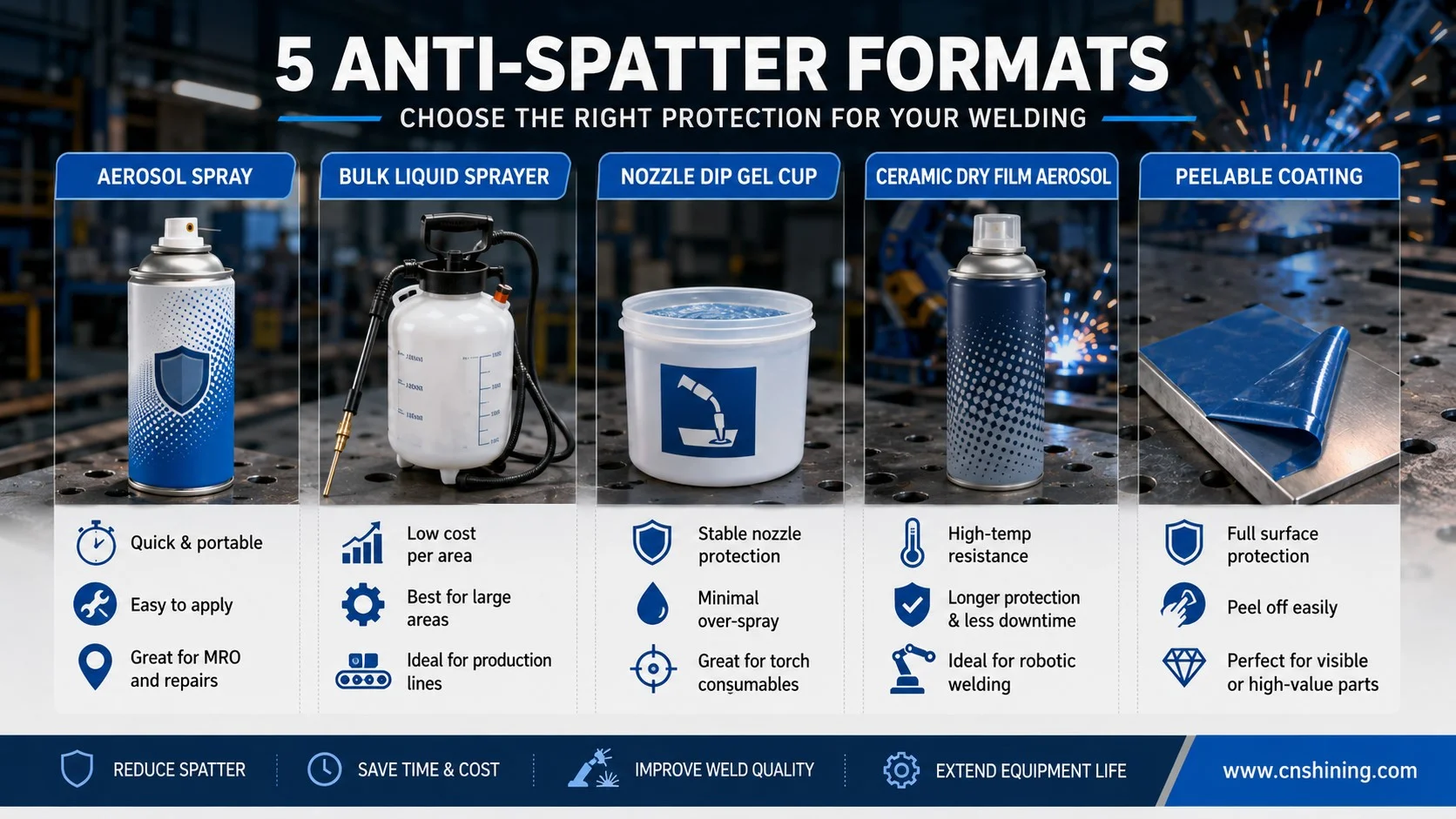
There is no single best anti-spatter product for every welding station. Aerosol spray is quick, portable, and easy to apply. It works well for maintenance, small and medium workpieces, scattered stations, and retail channels. For large-area continuous work, bulk liquid is usually more economical. For torch nozzle interiors, dip paste or gel is often more stable. For high-temperature robotic welding, ceramic or boron nitride dry film has a stronger case.
| Form | Typical Use | Main Strength | Main Limitation | Best Fit |
|---|---|---|---|---|
| Aerosol spray | Small to medium workpieces, maintenance, frequently changed stations. | Portable, ready to use, even coverage, retail-friendly. | Higher cost per effective coating area; overspray, valve clogging, DG logistics. | MRO, repair work, distributed welding stations. |
| Trigger spray or bulk liquid | Large workpieces, fixtures, and production lines. | Low coating cost per area. | Requires spray bottle or system; less portable. | Continuous industrial lines and jig protection. |
| Nozzle paste, gel, or dip | Nozzle and contact tip interior protection. | Stable internal nozzle protection with little overspray. | Not suitable for large-area workpieces; over-dipping may contaminate the process. | Welders focused on torch consumable life. |
| Ceramic dry film spray | High heat, long cycle, robotic welding. | Longer protection, better heat tolerance, less downtime. | Higher price and often stricter surface preparation. | Automated cells and long-running production stations. |
| Peelable or removable coating | Full-panel protection and high-value visible surfaces. | Forms a complete physical shield. | Application and removal become a separate process step. | High-value panels and appearance-sensitive work. |
3. Market Structure and Growth Forecast
The global anti-spatter agent market was roughly USD 780-842.7 million in 2023/2024, and is projected around USD 1.30-1.4515 billion by 2033. The independent size of aerosol spray within that market is not publicly standardized.
North America is one of the few regions with a published absolute number. Acumen gives about USD 303.4 million in 2024, about 36% of its global figure. Asia-Pacific is the most consistently described high-growth region, with Acumen citing more than 7.2% CAGR from 2025 to 2033. The demand logic is not complicated. Welding activity follows automotive, construction, shipbuilding, energy equipment, and general fabrication cycles.
| Region | Demand Drivers | Practical Reading |
|---|---|---|
| North America | Automotive, general manufacturing, construction, MRO. | Clearer public data, stronger purchasing power, visible demand for non-flammable and paint-compatible products. |
| Europe | Compliance pressure, German and Benelux manufacturing, automotive and fabrication. | Not necessarily the fastest by volume, but stronger in low-VOC, silicone-free, traceable products. |
| Asia-Pacific | China, India, ASEAN manufacturing, infrastructure, shipbuilding, automotive. | Fastest growth signal. More attractive for volume and OEM-style supply. |
| Latin America | Metalworking, automotive, energy, repair fabrication. | Currency and policy risk exist, but repair and value-oriented demand remains resilient. |
| Middle East & Africa | Oil and gas, heavy industry, ship repair, project manufacturing. | More project-driven. Price and safety both matter. |
The next 5-10 years look like stable, technical growth rather than a sudden breakout. Growth is more likely to come from safer chemistry, longer-life dry films, smarter packaging, and better traceability than from cheaper oil-based spray.
4. Formulation Families and Technical Terms
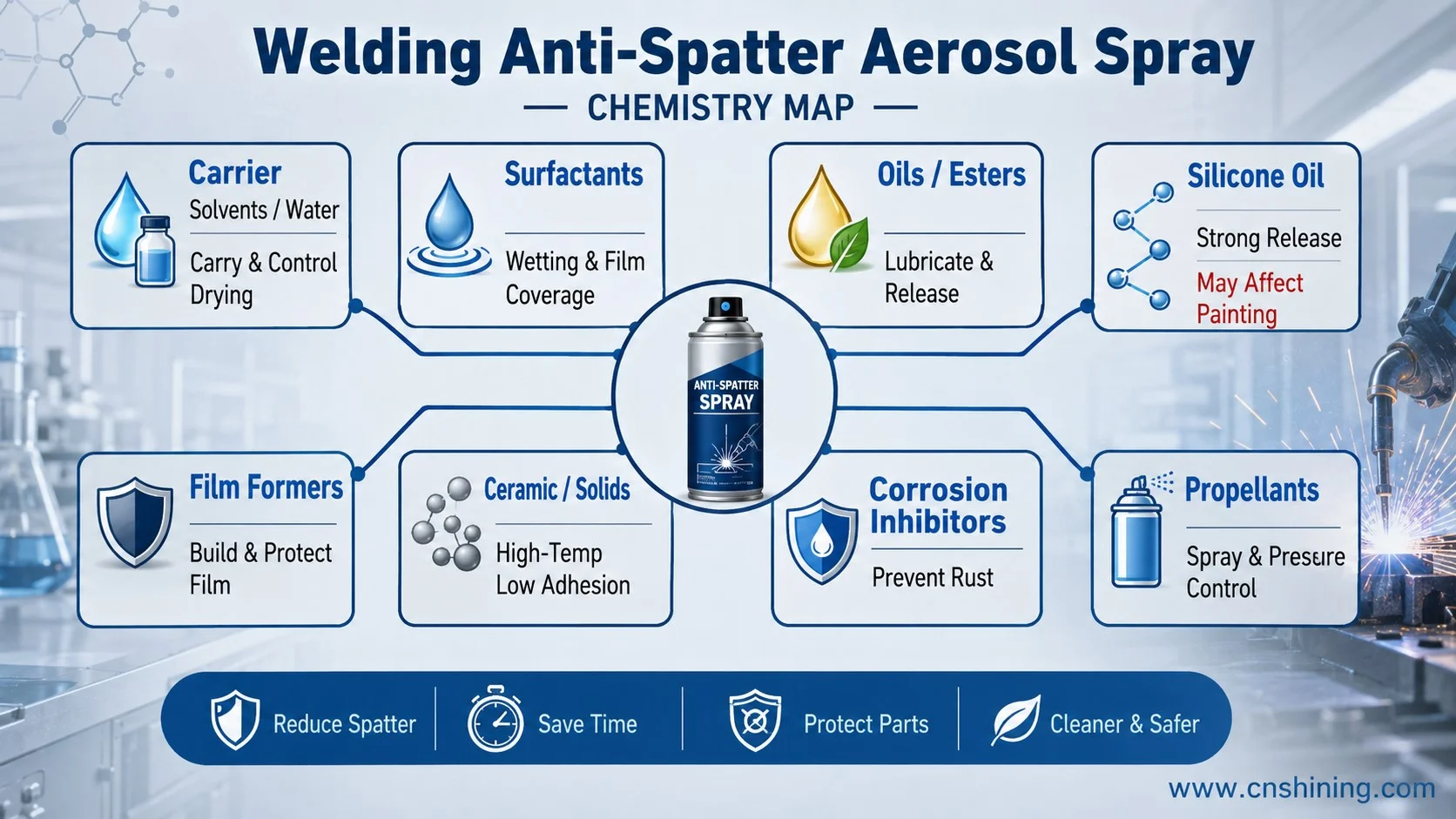
Today’s welding anti-spatter aerosol spray can be grouped into five formulation paths: water-based emulsion, oil or ester-based release layer, solvent-based system, ceramic or boron nitride dry film, and greener alternatives. These routes are not isolated. A water-based system may still use plant oil emulsion and corrosion inhibitor. A ceramic line may use an organic carrier and heat-resistant solid particles.
| Component Class | Examples | Main Function | Commercial Meaning |
|---|---|---|---|
| Carrier / continuous phase | Water, alcohols, light hydrocarbons, mixed solvents. | Carries active ingredients and controls drying speed and safety profile. | Water-based is safer; solvent systems may atomize finer but face more compliance pressure. |
| Surfactants / wetting agents | Nonionic surfactants and wetting additives. | Improve wetting and help form a continuous film. | Decides whether the product covers evenly or leaves missed spots. |
| Oils / fatty acid esters / triglycerides | Plant oils and lipid emulsions. | Create a lubricating release layer that reduces spatter adhesion. | Common in lower-toxicity and greener routes. |
| Silicone oil | PDMS and related low-surface-energy fluids. | Strong release effect. | Risky for later painting because it can cause craters or poor adhesion. |
| Film formers | Resins, waxes, low- or high-molecular film formers. | Build a more durable protective layer. | Affects adhesion, cleanability, and weld-through behavior. |
| Ceramic / high-temperature solids | Ceramic particles, h-BN, ceramic precursors. | Keep a low-adhesion film at high temperature. | Supports premium lines for robotic welding and long cycle work. |
| Corrosion inhibitors | Flash-rust inhibitors and anti-corrosion additives. | Offset the risk of water-based systems on bare steel. | Important for trust in water-based products. |
| Propellants | CO₂, N₂, LPG, DME. | Control spray pattern, pressure, and hazard class. | This is both a chemistry and packaging decision. |
| Source | Formula Clue | Technical Reading |
|---|---|---|
| WO2007062458A1 | Fats, oils, fatty acids, triglycerides, aqueous carrier, surfactants, stabilizers. | Low-toxicity anti-spatter chemistry has existed as a patent route for years. |
| CN103480986B | Low-molecular film former 5-30, high-molecular film former 1-5, wetting agent 1-10, drying agent 20-40, solvent 40-70. | Film formation, wetting, and drying speed are core balancing points. |
| LOCTITE SF 7900 | One-part, silicone-free, ceramic protective layer, up to 8 hours without reapplication. | The high-end line sells duty cycle and reduced stoppage, not only easy cleaning. |
| ABICOR Super Pistolenspray NF | Plant-oil water emulsion, silicone-free, wax-free, water-soluble, non-flammable. | A practical compromise for many paint-sensitive industrial parts. |
| WEICON Anti-Spatter / Ceramic | One line is VOC-free release emulsion; another is ceramic dry film. | Brands are separating mainstream safety lines from high-temperature long-life lines. |
A few terms decide whether the product works in production. Paintability means the part can still be painted or coated after cleaning. Silicone-free reduces the risk of coating defects. Dry film usually means longer protection at higher temperature. BOV, or Bag-on-Valve, separates product from propellant and can improve 360-degree spraying and evacuation.
5. Regulations, Labeling, and Transport
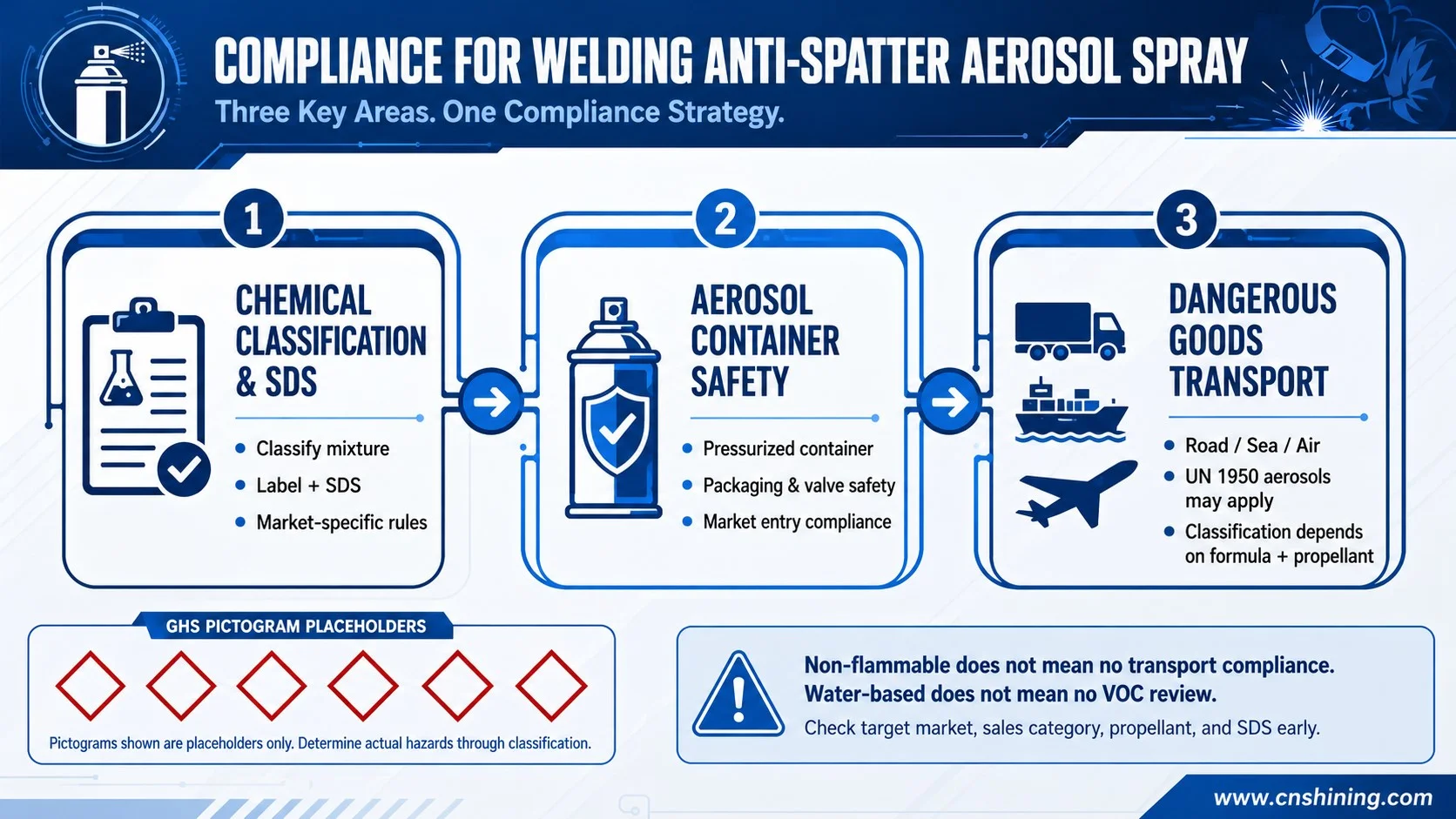
Compliance for welding anti-spatter aerosol spray is not one rule. It normally touches chemical classification and labeling, aerosol dispenser safety, dangerous goods transport, and workplace SDS obligations. That is why this product type often has higher compliance work than the same chemistry sold as bulk liquid.
| Market | Key Rule / System | Direct Product Impact |
|---|---|---|
| United States | OSHA Hazard Communication Standard, 29 CFR 1910.1200 | Hazardous chemicals must be classified and communicated through labels and SDS. OSHA’s 2024 final rule aligned key parts with GHS Rev. 7. |
| United States | EPA 40 CFR Part 59 Subpart E | If classified as aerosol coatings, PWR/VOC limits, labeling, records, and reporting may apply. Each SKU needs category judgment. |
| European Union | REACH, CLP, and Aerosol Dispensers Directive | REACH controls chemical obligations, CLP controls classification and labeling, and ADD controls aerosol container safety. |
| United Kingdom | Aerosol Dispensers Regulations 2009 | Products entering the UK market need to follow GB/NI aerosol dispenser requirements. |
| Brazil | GHS-BR / ABNT NBR 14725 system | Brazilian practice usually requires local safety information through FDS/FISPQ documentation. |
Aerosol container rules answer whether a pressurized can may be placed on the market. Transport rules answer whether that can may move by road, sea, or air. These are not the same question. Many non-flammable aerosol sprays still fall under UN 1950 AEROSOLS for transport, though the exact hazard class depends on formula and propellant.
6. Technology Direction and Customer Feedback
Recent technology direction is clear: cleaner chemistry, longer protection, lighter packaging, and better traceability. Formula claims increasingly highlight silicone-free, non-flammable, water-based, VOC-free, biodegradable, ceramic dry film, and PFAS-free. Packaging discussions are also more serious now: Bag-on-Valve systems, lighter actuators, low-carbon aluminum, BPA-NI or PFAS-free mounting cup solutions, and QR-based traceability all connect directly to user pain points.
Field feedback is consistent. Users buy anti-spatter spray to clean less. Complaints usually come from wrong application, over-application, or later processing problems. The spray can make cleanup easier, but too much material near the gas path can disturb shielding gas and raise porosity concerns. Painting compatibility is another common weak point. If the part must be coated, a clean weld bead is not enough.
| Platform / Channel | Typical Feedback | Pain Point | Technical Reading |
|---|---|---|---|
| Retail reviews | Cleanup is easier, less harsh smell, residue cleans quickly. | Cleaning efficiency, odor, and residue. | Users judge value by reduced grinding and wiping time. |
| Welder forums | Porosity or gas path contamination after spraying. | Over-application near nozzle and gas flow. | Application method can create the complaint, even if the formula is usable. |
| Ceramic spray discussions | Ceramic nozzle spray works well but costs more. | High-end dry film needs proof of longer life. | Premium price must be tied to duty cycle and fewer stoppages. |
| Nozzle dip comparisons | Nozzle gel can work better for the shroud. | Aerosol spray is not ideal for every torch area. | A multi-format line can be more honest than one spray for all uses. |
| Painting forums | Residue after cleaning may still affect paint surface. | Cleanability and coating compatibility. | “Paintable” must be validated under the real cleaning and coating process. |
The most useful customer lesson is blunt: do not position anti-spatter spray as a magic fix. It is a process aid. If a weld cell has poor parameters, contaminated wire, wrong polarity, weak gas coverage, or bad technique, spray will only hide part of the symptom.
7. Top 10 High-Visibility Brands and Product Lines
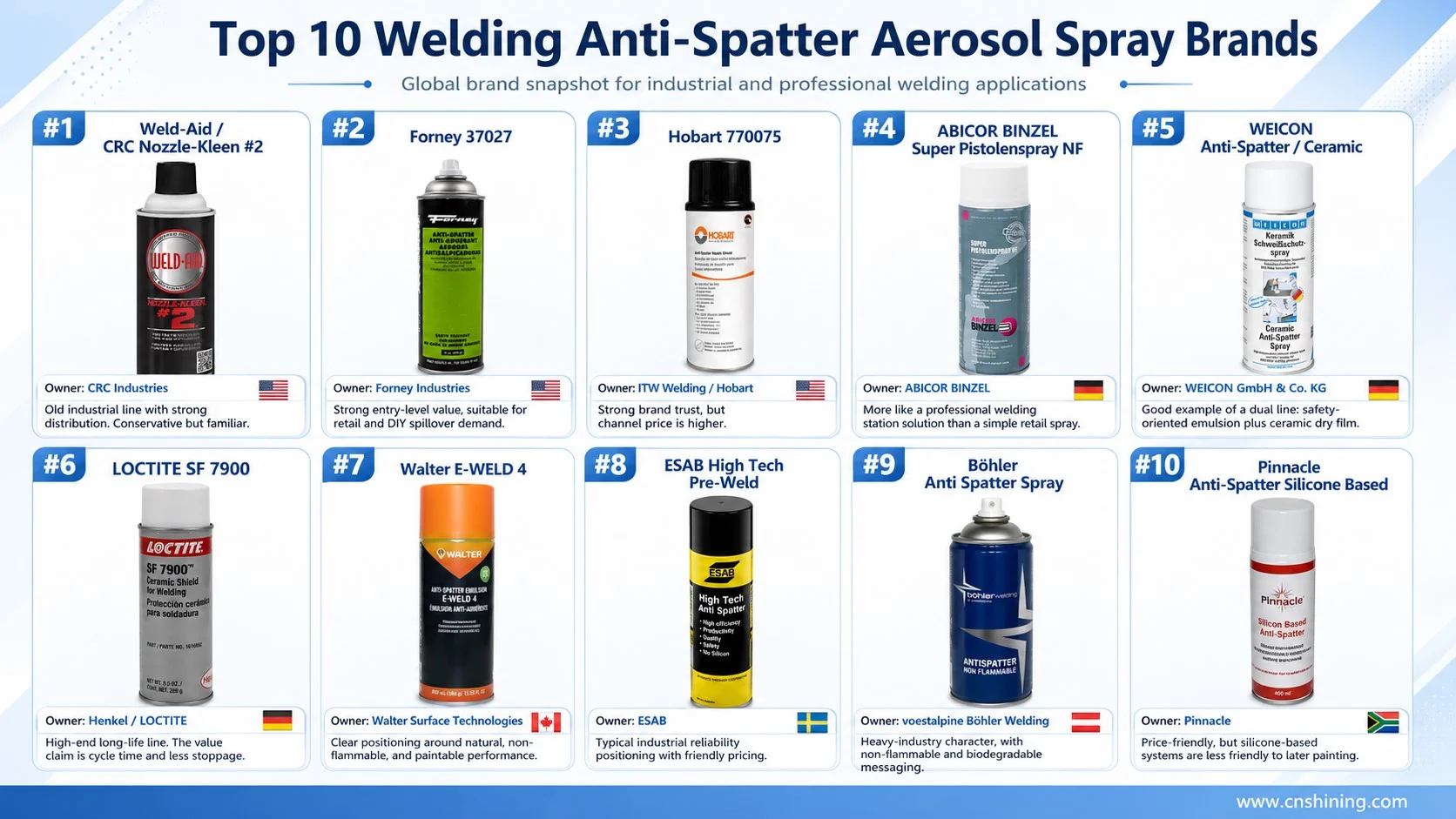
| Brand / Product Line | Country | Owner | Common Size | Sample Price Range | Practical Comment |
|---|---|---|---|---|---|
| Weld-Aid / CRC Nozzle-Kleen #2 | United States | CRC Industries | 14-16 oz aerosol | about 14.42$ | Old industrial line with strong distribution. Conservative but familiar. |
| Forney 37027 | United States | Forney Industries | 14.5-16 oz aerosol | about 8.99$–14.99$ | Strong entry-level value, suitable for retail and DIY spillover demand. |
| Hobart 770075 | United States | ITW Welding / Hobart | 16 oz aerosol | about 24.99$ | Strong brand trust, but channel price is higher. |
| ABICOR BINZEL Super Pistolenspray NF / Ceramic Spray | Germany | ABICOR BINZEL | 400 ml / 13.5 oz | about 18.97$–21.52$ | More like a professional welding station solution than a simple retail spray. |
| WEICON Anti-Spatter / Ceramic | Germany | WEICON GmbH & Co. KG | 400 ml | about 8.54$ | Good example of a dual line: safety-oriented emulsion plus ceramic dry film. |
| LOCTITE SF 7900 | Germany | Henkel / LOCTITE | 400 ml aerosol | about 48.86$–63.76$ | High-end long-life line. The value claim is cycle time and less stoppage. |
| Walter E-WELD 4 | Canada | Walter Surface Technologies | 400 ml / 13.5 oz | about 17.50$ | Clear positioning around natural, non-flammable, and paintable performance. |
| ESAB High Tech Pre-Weld | Swedish brand | ESAB | 400 ml | about 8.18$–13.60$ | Typical industrial reliability positioning with friendly pricing. |
| Böhler Anti Spatter Spray | Austria | voestalpine Böhler Welding | 400 ml | about 5.04$ | Heavy-industry character, with non-flammable and biodegradable messaging. |
| Pinnacle Anti-Spatter Silicone Based | South Africa | Pinnacle | 400 ml | about 4.25$ | Price-friendly, but silicone-based systems are less friendly to later painting. |
8. Shining Packaging Fit: Actuators, Aerosol Cans, and Valves
For Welding Anti Spatter aerosol Spray, packaging is part of the performance system. A good formula can still fail at the user level if the actuator floods the nozzle, the valve output is too high, the can is hard to hold with gloves, or the spray pattern cannot be controlled near the shielding gas path.
This is where Shining Packaging fits naturally into the product discussion. The relevant hardware is not only the aerosol can body. It includes the actuator, valve, mounting cup, dip tube, cap, and internal coating compatibility. For water-based and silicone-free formulations, the can and mounting cup need compatibility checks. For nozzle-focused sprays, the actuator should support controlled directional application. For industrial users, batch coding, QR access to SDS/TDS, and stable spray performance through the usable life of the can are practical requirements.
A sensible packaging specification for this category should start from the application problem. Is the product for workpiece surface coverage, torch nozzle protection, ceramic dry film, or general MRO use? The answer changes the actuator, valve output, spray width, can size, and label information.
9. Packaging Improvement Routes from Real User Pain Points
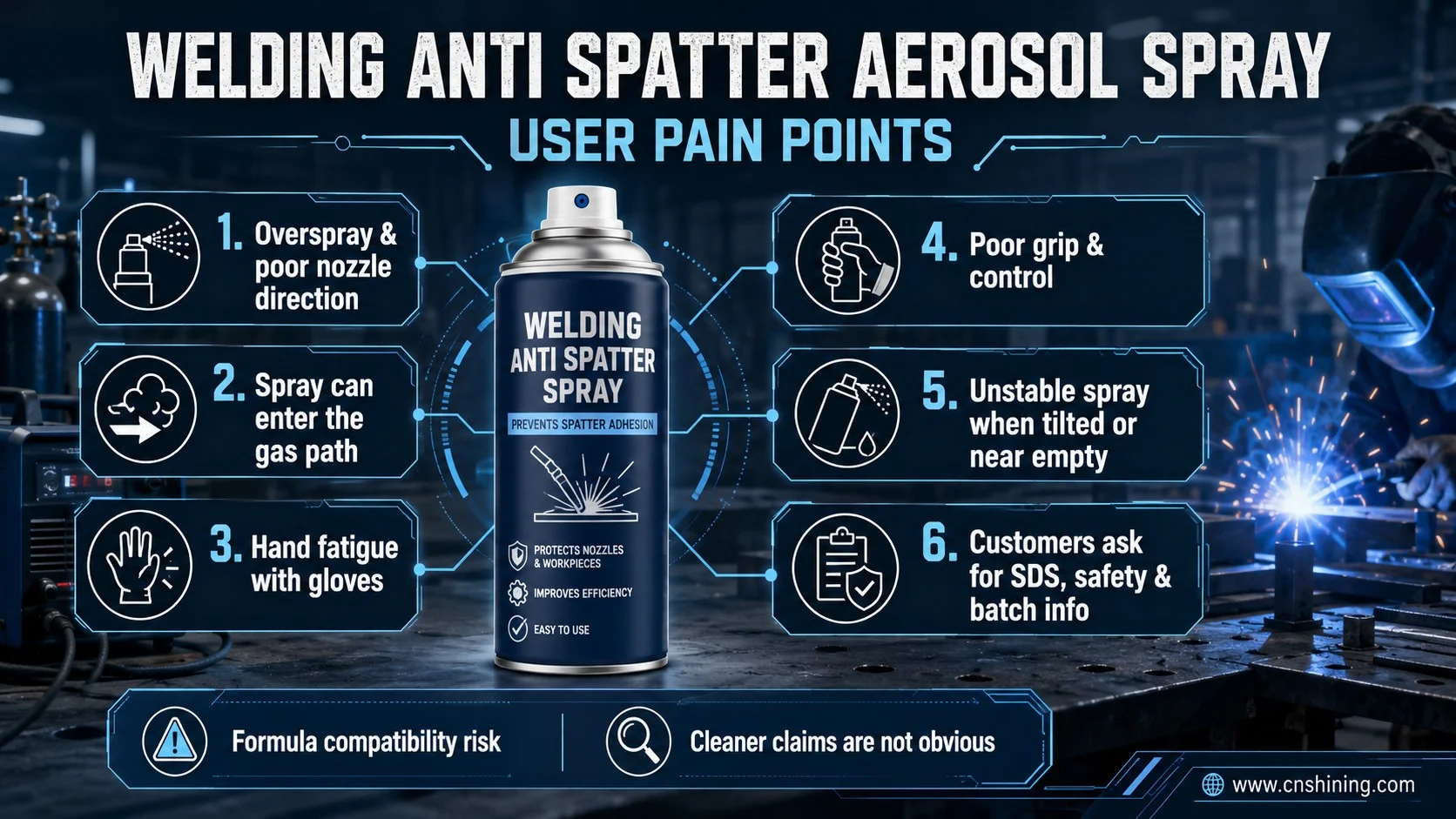
Packaging improvement should not start with appearance. It should start with complaints: too much spray, overspray into gas flow, poor glove handling, unstable spray at the end of the can, safety concerns, and repeated questions about SDS and batch identity.
| User Pain Point | Packaging Improvement | Implementation | Expected Benefit |
|---|---|---|---|
| Too much spray, poor direction, spray entering gas path. | Actuator and guide upgrade. | Directional actuator, narrower spray, lower-output valve, nozzle-use accessory. | Less over-application, lower porosity risk, reduced waste. |
| Hand fatigue and poor control with gloves. | Low-force actuator with larger finger pad. | Textured wide pad and lower starting pressure. | Better control, fewer accidental sprays, easier repeat use. |
| Sideways or upside-down use and unstable late-can spraying. | Bag-on-Valve or separated propellant system. | Nitrogen or compressed air BOV structure with 360-degree spray. | More flexible posture, better evacuation, less formula-propellant disturbance. |
| Industrial customers ask for safety and ESG data. | Lightweight actuator and lower-carbon can material. | Lightweight plastic design, PCR aluminum, or lower-carbon aluminum where feasible. | Material reduction and clearer sustainability story. |
| Poor grip with welding gloves. | Can shape and shoulder optimization. | Necked-in can design or adjusted shoulder and diameter combination. | Better one-hand handling, lower drop and mis-spray risk. |
| Water-based or green formula compatibility risk. | Internal coating and mounting cup upgrade. | Use BPA-NI or PFAS-free compatible solutions after formula testing. | Lower corrosion, odor migration, leakage, and shelf-life failure risk. |
| Customers keep asking for SDS, batch, and production date. | QR or DataMatrix traceability. | Print code on can or label linking to SDS, TDS, batch, and anti-counterfeit page. | Lower service workload and better B2B traceability. |
| Cleaner formula claims are not visible to users. | Label hierarchy redesign. | Front-label claims for silicone-free, paintable, non-flammable, VOC-free, PFAS-free, and application type. | Less misuse and clearer product selection. |
A practical SKU plan can be split into two routes. Route A is a mainstream industrial line: water-based + silicone-free + non-flammable + paintable, with directional actuator and QR access to SDS. Route B is a high-end long-life line: ceramic or h-BN dry film, with narrow spray, low-force actuator, and packaging tuned for robotic welding, hot nozzles, and long seams.
Do not try to make one can solve nozzle interiors, large workpiece coverage, appearance-part painting, extreme high temperature, and the lowest possible cost. That usually creates a product that is average everywhere and trusted nowhere.
10. FAQ: Welding Anti Spatter Aerosol Spray
No. It mainly prevents molten spatter from bonding tightly to the nozzle, fixture, or workpiece. Spatter formation still depends on welding parameters, wire feed, gas coverage, polarity, wire quality, and operator technique. Use the spray as a cleanup and protection aid, not as a process correction tool.
It is normally applied before welding on the torch nozzle exterior, contact-tip area, fixtures, clamps, jigs, and nearby workpiece surfaces. Avoid flooding the gas outlet or spraying excessive liquid into the nozzle interior. Too much product near shielding gas flow can create process instability and porosity concerns.
Silicone materials have very low surface energy, which helps release spatter but may create craters, poor wetting, or weak adhesion during later painting or coating. For automotive, appliance, or visible metal parts, silicone-free and cleanable products reduce downstream coating risk when used with proper washing.
Water-based products usually offer better safety, lower odor, and lower flammability risk, but they need corrosion control and good wetting design. Solvent-based systems may atomize more finely and dry faster, but they face stronger VOC, flammability, transport, and worker exposure considerations in many markets.
Ceramic dry film is more suitable for high-temperature, long-cycle, automated, and robotic welding stations. It can protect nozzles and surrounding tooling longer than ordinary wet films. The higher cost only makes sense when it reduces stoppages, cleaning frequency, or consumable replacement in measurable production conditions.
The product itself is not automatically the cause, but poor application can create risk. Heavy spraying around the gas path, trapped residues, or unsuitable formula near the weld zone may disturb shielding or contaminate the weld. Thin, controlled application and correct placement are more important than heavy coverage.
Aerosol hardware controls spray width, output rate, direction, pressure stability, and final evacuation. A formula that works in the lab can disappoint users if the actuator oversprays, the valve clogs, or the can cannot spray reliably in sideways positions. Packaging is part of the technical performance.
Bag-on-Valve separates the product from the propellant. It can support 360-degree spraying, better evacuation, and less formula-propellant interaction. It is especially relevant for cleaner formulations, water-based products, and applications where spray consistency through the can life matters more than the lowest packaging cost.
Paintability should be verified with the actual substrate, spray quantity, cleaning method, drying time, coating chemistry, and curing process. A product can look clean after wiping but still interfere with coating wetting or adhesion. Testing should include surface inspection, coating defects, and adhesion after normal production cleaning.
The practical direction is not cheaper oil-based spray. It is water-based, silicone-free, non-flammable, paint-compatible mainstream products, plus ceramic or boron nitride dry-film products for high-temperature and robotic cells. Packaging should add controlled actuators, compatible cans, stable valves, and QR-based SDS or batch traceability.