

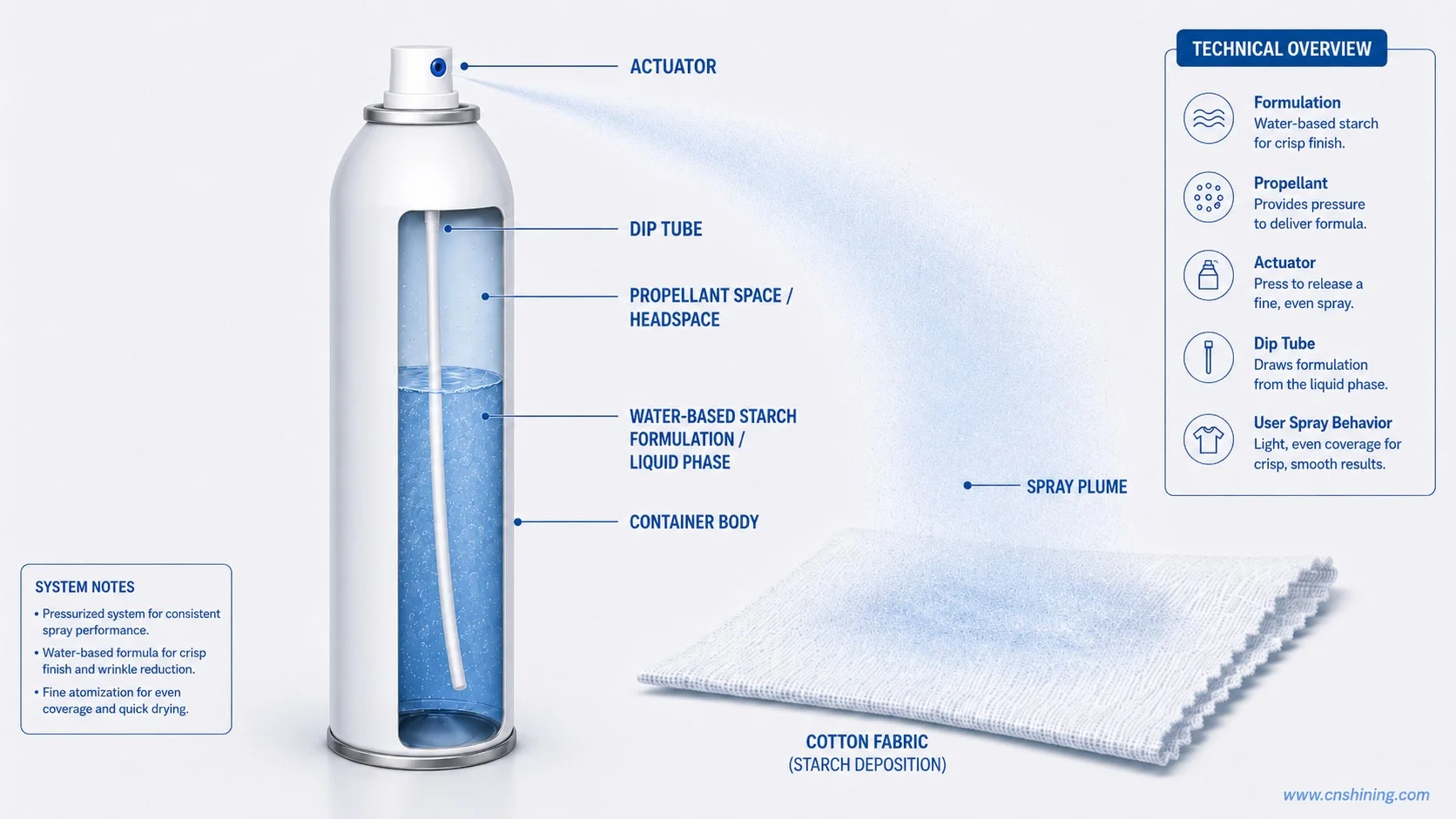
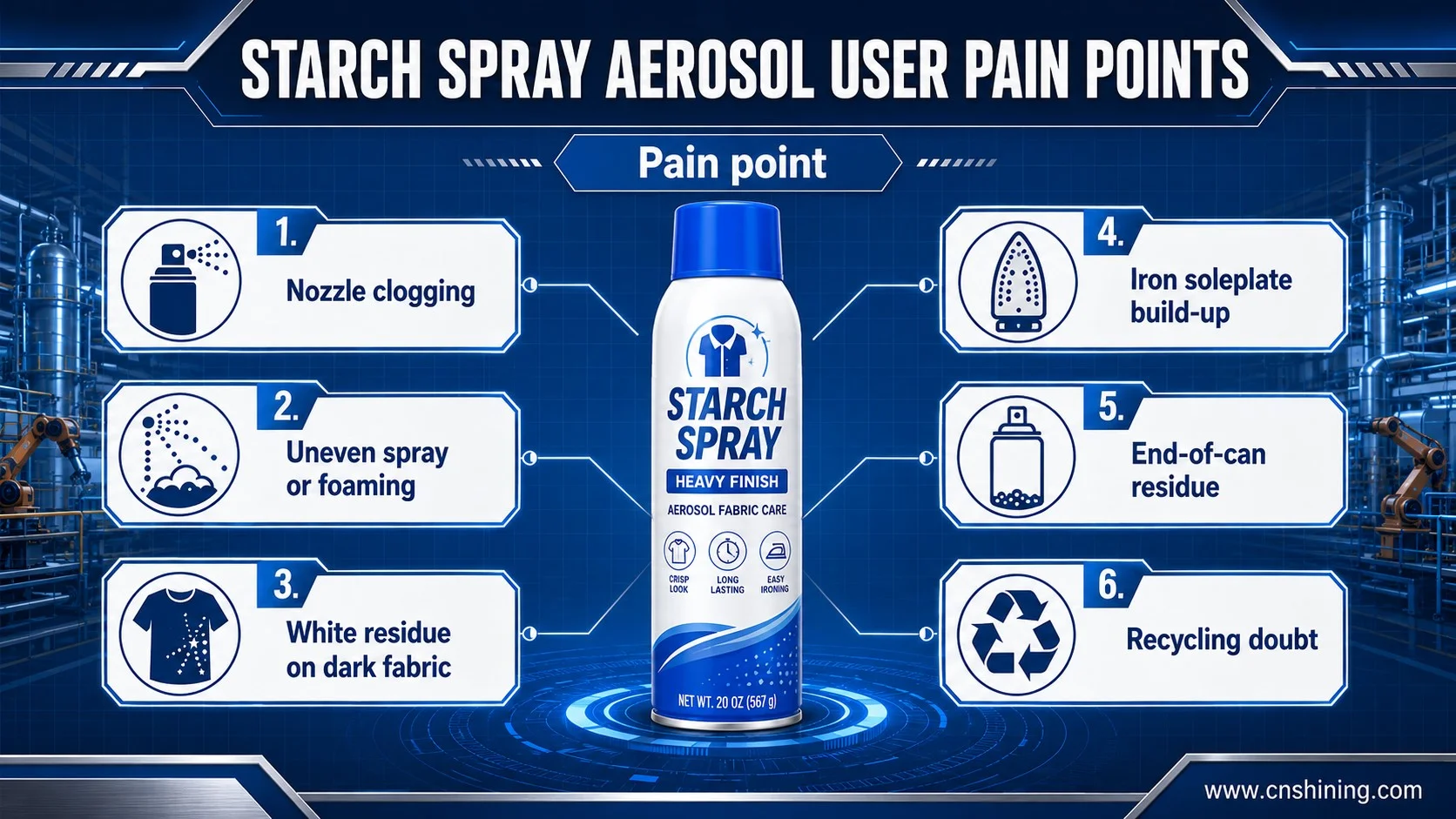
Starch aerosol spray is not starch water in a can. It is a pressure-packaged fabric care system built from formulation, propellant, valve, actuator, container, and user behavior. If one part is weak, the product fails in a very visible way: nozzle clogging, white marks, foaming spray, iron soleplate build-up, or poor emptying at the end of the can.
In narrow technical terms, starch aerosol spray refers to a pressurized container product that uses starch or modified starch as the main stiffening and sizing active. Liquefied gas or compressed gas drives the product through a valve and actuator, atomizing it onto fabric. In a broader buying context, it competes with non-aerosol spray starch, pump spray sizing, quilting sizing spray, liquid starch, powder starch, and non-starch easy iron spray.
The most practical conclusion is simple: the next stronger starch aerosol spray will not come from “more starch” alone. It will come from moderate solids, stable atomization, better actuator and valve matching, clearer user instructions, and a more credible recycling message.
1. Definition, Mechanism, and Product Boundary
The European Commission Aerosol Dispenser Directive page treats the container, valve, actuator, propellant, and active material as one regulated system. For starch aerosol spray, that system view is the only useful starting point.
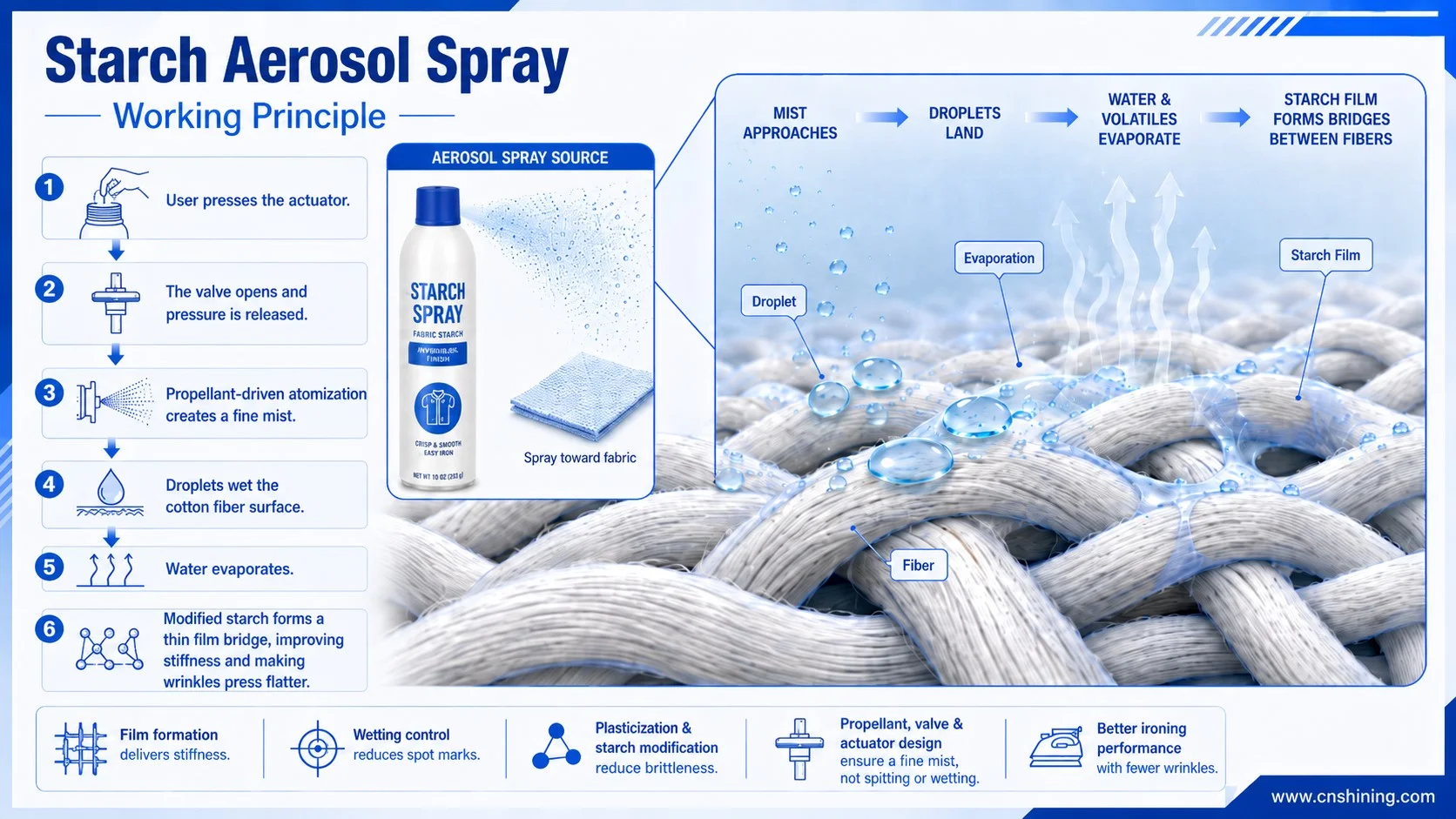
- The user presses the actuator.
- The valve opens and the internal pressure is released.
- Propellant expansion or compressed gas flow drives atomization.
- Liquid breaks into droplets and forms a spray pattern.
- Droplets hit and wet the fabric surface.
- Water and volatile components evaporate.
- Starch forms a thin film or bridge on fiber surfaces.
- Fabric stiffness improves and wrinkles press flatter under ironing.
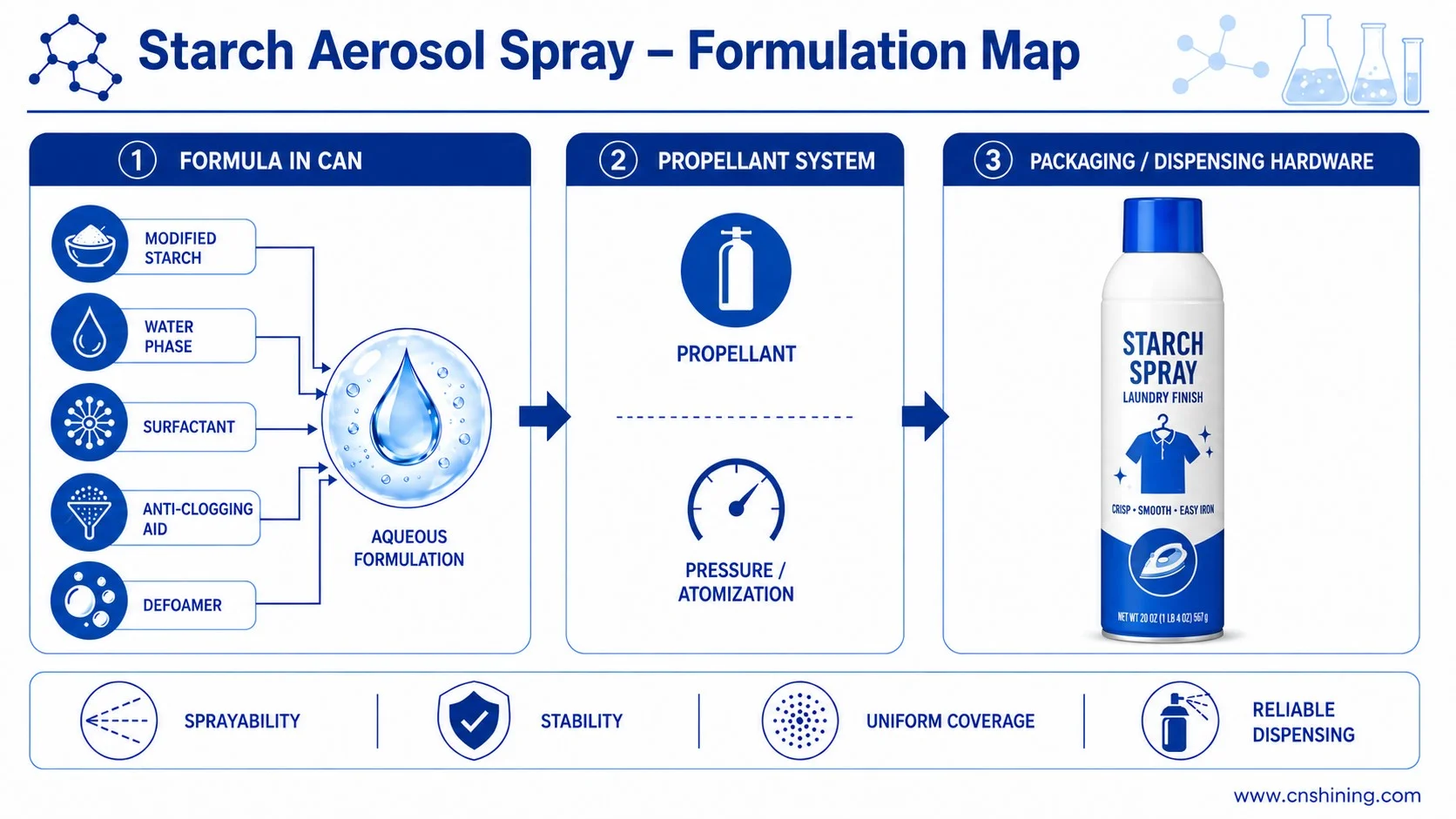
Older but still useful patent literature, including US4023978A on aerosol spray starch formulation, shows why this category is technically more sensitive than it looks. A typical household aerosol spray starch system uses water as the main phase, low single-digit starch solids, liquefied propellant, anti-clogging or humectant components such as polyethylene glycol, nonionic surfactant, defoaming or lubricating aids, and in some historical formulas boric acid or borax systems.
Film formation gives stiffness. Wetting controls spot marks. Plasticization and starch modification reduce brittle residue. Propellant, valve, and actuator design decide whether the product sprays as a useful mist or spits as a local wet patch.
2. Competitive Position
For mature markets, the main competition is not awareness. Users already know what spray starch does. The problem is performance consistency: nozzle blockage, white residue, fragrance disagreement, iron build-up, end-of-can waste, and recycling doubt. For emerging markets, the stronger use cases are school uniforms, workwear, formal shirts, religious garments, quick ironing, and fabric crafts.
| Segment | Current judgment | Technical note |
|---|---|---|
| Household | Main market | Home ironing remains the core application for aerosol spray starch. |
| Industrial | Small to medium | Industrial sizing is usually line spraying, padding, or size-press processing, not consumer aerosol. |
| Textile | Medium, mostly B2B | Modified starch, protein-starch, and bio-based blends are active research areas. |
| Food-adjacent | Very narrow or adjacent | Edible films and release sprays follow different regulatory logic from garment starch spray. |
| Other | Quilting, crafting, costume care, uniform care | These uses are highly visible in online communities and retail reviews. |
3. Formula Structure, Product Types, and Terminology
In real buying decisions, aerosol starch competes across formats. A consumer may compare a 20 oz aerosol can with a pump spray, a liquid starch refill, a quilting sizing spray, or a non-starch wrinkle releaser. The products solve related fabric problems, but their failure modes are different.
| Product type | Main advantages | Main drawbacks | Best-fit use | Relative judgment |
|---|---|---|---|---|
| Starch aerosol spray | Fast use, fine mist, quick coverage, strong “pressed shirt” effect | Flammable propellant risk, nozzle clogging, white residue, iron build-up, complex recycling message | Quick home ironing, shirts, uniforms, formal garments | Good balance of performance and convenience when spray pattern is controlled. |
| Powder starch | Low cost, concentrated active, stable storage, adjustable strength | Needs preparation, poor repeatability, higher user threshold | Low-cost bulk use or self-mixed starch solution | Closer to raw material than ready-to-use consumer product. |
| Liquid starch / pump spray | Refillable, usually lower flammability, easier sustainability message | Wetter droplets, slower drying, local overwetting risk, pump clogging possible | Frequent ironing, quilting, refill users | Can replace some aerosol demand, especially where flammability is a concern. |
| Non-starch wrinkle or easy iron spray | Less hard hand feel, can claim low residue or low white mark | Usually weaker crispness than starch | Daily garments, light business wear, dark fabrics | More fabric care than traditional sizing. |
| Industrial textile sizing | Custom performance, process control, lower unit cost at scale | Not a retail format, needs process equipment | Yarn sizing and textile finishing | Mechanically related, commercially different. |
3.1 Typical formulation framework
| Use | Active material | Functional aids | Continuous phase | Propellant | Function |
|---|---|---|---|---|---|
| Household aerosol spray starch | Corn starch or modified starch, often about 2–6% solids in public patent examples | PEG or polyol anti-clogging aids, silicone emulsion, nonionic surfactant, historical borate systems | Mainly water | Isobutane, propane, butane, LPG blends, or DME in some platforms | Sprayability, wetting, film formation, lower powdering, smoother ironing. |
| Non-aerosol pump starch | Starch or modified starch | Wetting aids, chelants, defoamers, preservatives | Water | None | Lower flammability and refill potential, but wetter application. |
| Quilting / crafting sizing spray | Modified starch or starch-polymer blend | Anti-clogging and hand-feel modifiers | Water | Aerosol or pump | Edge stability and fabric handling without excessive brittleness. |
| Textile B2B sizing | Cationic starch, hydroxypropyl starch, amylose-rich starch, blends with protein or polyurethane | Plasticizers, lubricants, defoamers, adhesion modifiers | Water | Usually not consumer aerosol | Adhesion, flexibility, abrasion resistance, desizing balance. |
| Food-adjacent spray film or release system | Starch may be a film former, but this is not the same as garment spray starch | Oils, emulsifiers, edible film aids | Water, ethanol, or oil phase depending on use | Only if permitted by relevant food rules | Different regulatory path from clothing starch spray. |
3.2 Useful terms for engineering discussion
| Term | Technical meaning | Commercial meaning |
|---|---|---|
| Propellant | Gas system that pushes product out and helps atomize it. | Controls flammability, spray feel, particle size, cost, and labeling pressure. |
| Continuous valve | Valve that sprays as long as the actuator is pressed. | Suitable for large fabric areas; consistency matters. |
| Actuator | Button or spray head pressed by the user. | Controls spray width, direction, comfort, droplet size, and clogging behavior. |
| PSD | Particle or droplet size distribution. | Links directly to coverage, residue, inhalation profile, and fabric deposition. |
| Dv10 / Dv50 / Dv90 | Volume-based droplet size points. | Useful when comparing actuator and valve combinations. |
| MMAD | Mass median aerodynamic diameter. | More relevant to inhalation exposure assessment. |
| Wetting | How droplets spread after fabric contact. | Poor wetting creates spots, white marks, and uneven stiffness. |
| Film formation | Dry starch forms a continuous or semi-continuous layer. | Determines crispness, crease hold, and hand feel. |
| BOV | Bag-on-valve system separating product from propellant. | Supports compressed gas, cleaner discharge, and better emptying claims. |
| VOC | Volatile organic compound. | Influences formulation route, sustainability claims, and market access. |
4. Regulatory and Compliance Framework
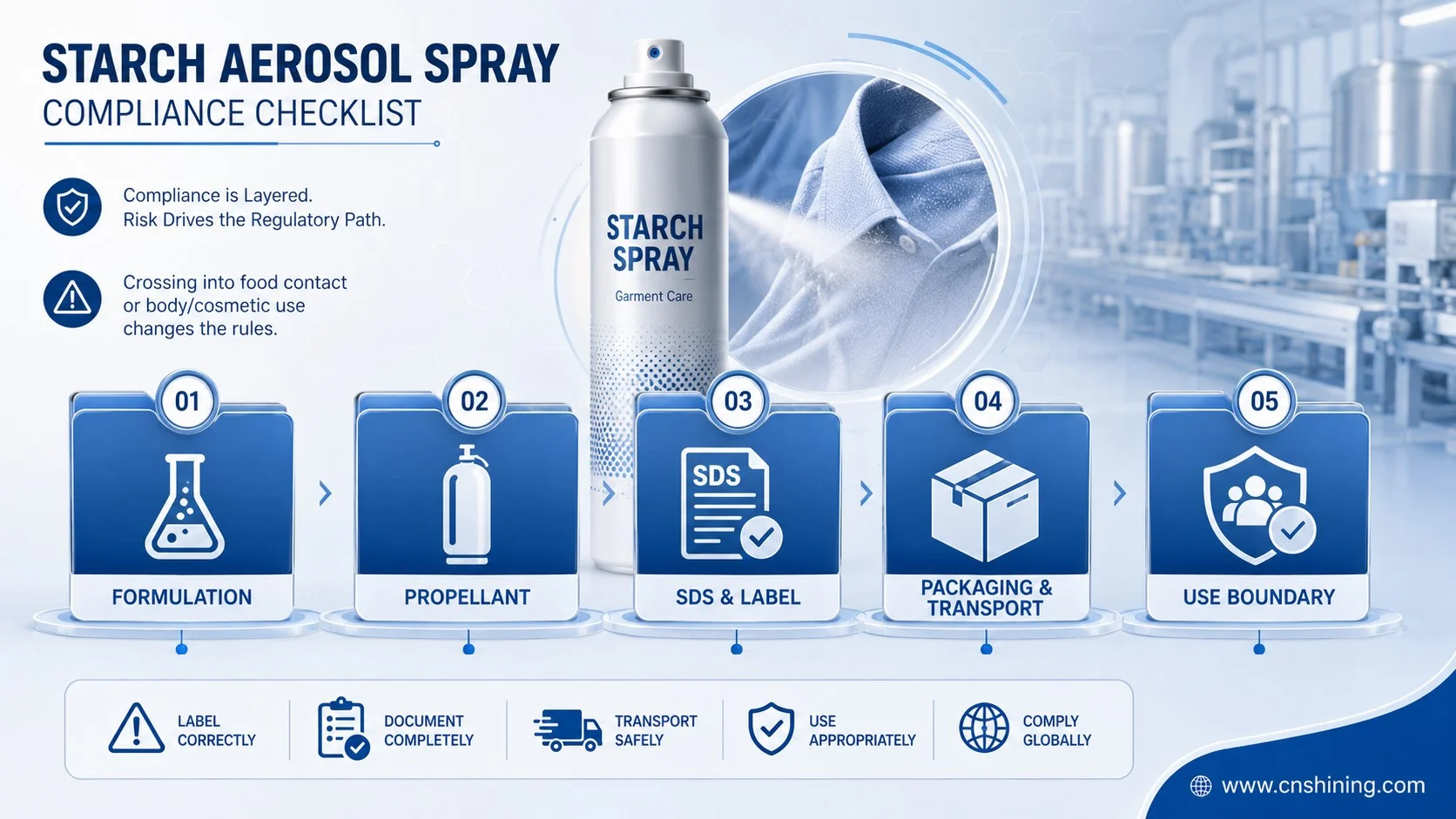
The key rule is direct: most garment starch aerosol sprays are household chemical consumer products, not food products and not cosmetics. Compliance is layered: aerosol container rules, chemical hazard labeling, transport requirements, and use-specific rules. If a product crosses into food contact, edible coating, body spray, or cosmetic claims, the regulatory path changes.
| Market | Core compliance point for garment starch aerosol | If food contact or edible use is involved | If body or cosmetic use is involved |
|---|---|---|---|
| United States | The CPSC FHSA guidance requires warning labels for hazardous household products. Aerosols also carry specific labeling concerns. | FDA food contact or food additive rules must be checked. Garment starch should not borrow food-safe language without a real basis. | Cosmetic spray logic moves toward FDA cosmetic requirements. |
| European Union | Aerosol Dispenser Directive, hazard classification, labeling, REACH, and packaging rules need parallel review. | Food contact material rules and migration limits become relevant. | Cosmetic spray use moves into cosmetic regulation. |
| Japan | Container, high-pressure gas, filling, and product safety requirements must be checked for ordinary garment spray starch. | Food-contact packaging uses the Japanese positive list route. | Cosmetic or quasi-drug claims move into the PMD Act system. |
For practical work, the compliance checklist should be split into five files: formulation substance list, propellant and flammability table, SDS and label file, packaging compatibility and transport file, and use-boundary claim file. The risk is rarely starch itself. It is more often fragrance, propellant, corrosion, leakage, labeling, or a claim that moves the product into food or body-contact territory.
5. Technology Direction, User Pain Points, and Packaging Improvement
Recent improvement work has moved from “make starch spray out” to “make the experience stable.” On the formula side, PEG, surfactants, silicone emulsion, borate systems, modified starch, cationic starch, hydroxypropyl starch, and bio-based blends all aim to improve sprayability, adhesion, flexibility, lower residue, and processing behavior. On the packaging side, compressed gas and BOV platforms are used where cleaner discharge, lower flammability positioning, or better emptying are worth the added system complexity.
The Bag-on-Valve benefits page presents common BOV advantages such as separation of product and propellant, compressed gas use, improved emptying, and multi-angle spraying. These features are relevant to starch aerosol spray, but they are not automatic fixes. A water-based starch formulation still needs the right valve, actuator, pouch material, and stability test.
5.1 User pain points
| Pain point | Likely technical cause | Practical reading |
|---|---|---|
| Nozzle clogging | Drying at the orifice, starch aggregation, local evaporation in the spray path | This is often the most sensitive repeat-purchase failure. |
| Uneven spray or foaming | Mismatch between spray pattern, valve output, and high surface-tension water phase | A narrow plume can overload one spot before the user notices. |
| White residue on dark fabric | Heavy local deposition, brittle film, spraying too close, ironing before absorption | Spray width and label instruction can matter as much as formula. |
| Iron soleplate build-up | Excess starch transfer during wet pressing | Waiting time and dosage control should be visible on the front or main instruction area. |
| End-of-can residue | Poor dip-tube pickup, viscous water-based phase, declining pressure | BOV or optimized valve/dip tube matching can reduce complaints. |
| Recycling doubt | Consumers do not know whether empty aerosol cans can be recycled locally | Clear empty-can instructions reduce friction. |
5.2 Packaging improvement table
| Pain point | Packaging or structure improvement | Material or implementation route |
|---|---|---|
| Nozzle clogging | Start with actuator and insert optimization before changing the whole formula. Use a more anti-drying spray path, tighter overcap, and a removable or rinsable spray head where suitable. | PP or PE actuator body, POM or engineering plastic insert, high-fit overcap, conservative orifice for higher solids. |
| Uneven spray and spotting | Use wider fan spray or broader spray geometry. Stabilize discharge during short presses. Place recommended spray distance clearly on pack. | Horizontal household actuator, optimized stem orifice and actuator insert combination. |
| White marks | Reduce wet spots through better pattern distribution. Add dark-fabric test instruction and waiting time guidance. | Lower instantaneous output, fan pattern, clear label icons. |
| Iron build-up | Move “wait 15–60 seconds before ironing” and soleplate cleaning guidance into the main instruction area. | High-contrast printed warning box, QR operation video if needed. |
| Poor emptying | For higher-end SKUs, evaluate BOV or compressed gas platforms. For conventional cans, improve dip tube and valve matching. | PE/PP bag in aluminum or tinplate can, air or nitrogen propellant, tested valve set. |
| Leakage or transit damage | Strengthen pack compatibility, leak testing, drop testing, and corrosion testing for high-water formulas. | Aluminum monobloc can or compliant tinplate can with verified internal coating. |
| Environmental concern | State empty-can disposal and recycling steps clearly. The HCPA Aerosol Recycling Initiative is a useful U.S. reference for recycling access and on-pack messaging. | Recyclable aluminum or steel can, single-resin overcap where possible, clear “empty before recycling” instruction. |
| Poor handling | Improve grip, finger pad area, matte finish, and front-push ergonomics for horizontal spraying. | Wide actuator pad, matte varnish, waist grip, tactile coating. |
6. Product Fit: Shining Packaging Actuators, Cans and Valves
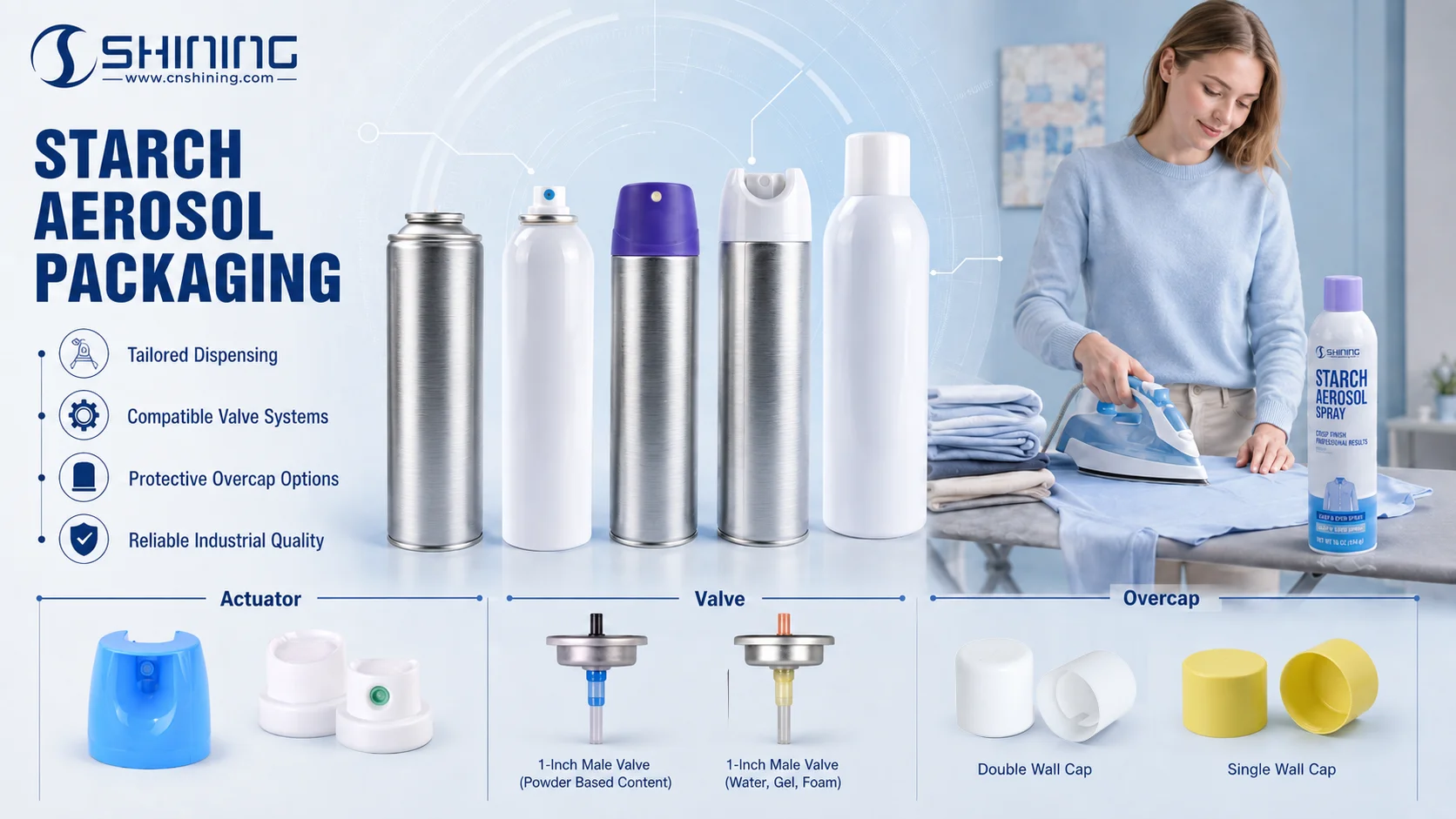
For starch aerosol spray, Shining Packaging should be discussed at the package-function level, not as a formula supplier. The relevant scope is actuators, aerosol cans, valves, overcaps, and component matching. These parts decide whether the starch formulation lands as a controlled mist or as a wet spot that later becomes a white mark.
The actuator deserves early testing. Starch spray is usually water-based and more clog-sensitive than many solvent-based aerosols. A small change in insert geometry, button comfort, spray direction, or discharge rate can change user perception immediately. A wider and more stable spray pattern may reduce local over-application, especially on shirts, uniforms, quilting cotton, and dark fabrics.
The valve and can should be selected after compatibility testing, not by catalog habit. Water-rich starch formulas need corrosion review, internal coating checks, valve gasket compatibility, dip tube pickup testing, and storage stability evaluation. For standard retail starch spray, aluminum or tinplate cans remain practical. For higher-end positioning, compressed gas or BOV can be evaluated when better emptying, multi-angle spraying, or a lower-flammability message is needed.
7. Top 10 Starch Aerosol Spray Brands
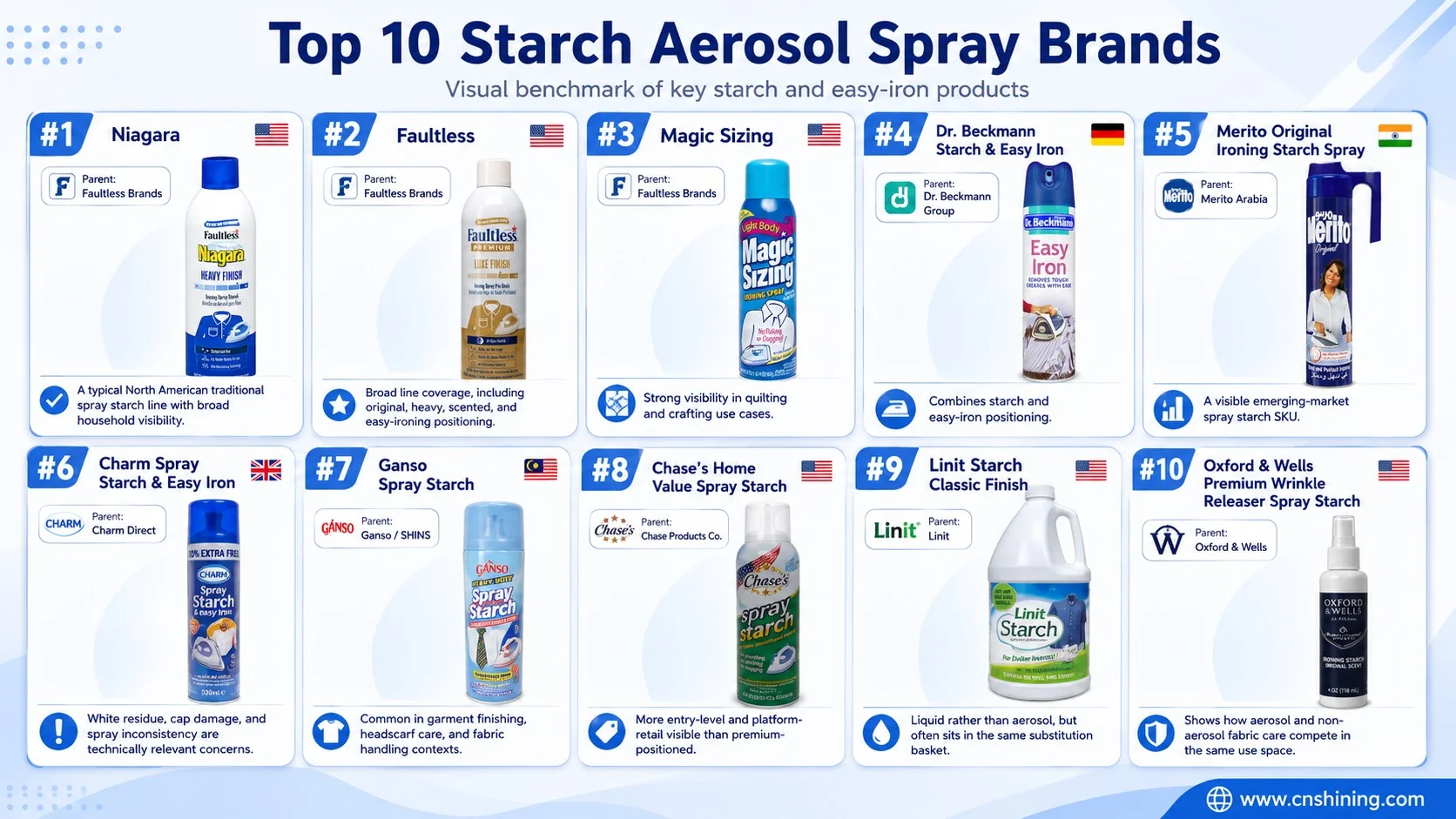
| Brand / series | Main market | Price visibility | Technical comment |
|---|---|---|---|
| Niagara | United States | 20 oz aerosol; about 9.99$ | A typical North American traditional spray starch line with broad household visibility. |
| Faultless | United States | 20 oz aerosol; about 3.39$ | Broad line coverage, including original, heavy, scented, and easy-ironing positioning. |
| Magic Sizing / Magic Spray Starch | United States | 20 oz aerosol; about 6.66$ per can in a 3-pack | Strong visibility in quilting and crafting use cases. |
| Dr. Beckmann Starch & Easy Iron | Germany | 500 ml; about 8.88$ | Combines starch and easy-iron positioning. |
| Merito Original Ironing Starch Spray | India | 500 ml; about 5.15$ | A visible emerging-market spray starch SKU. |
| Charm Spray Starch & Easy Iron | United Kingdom | 330 ml; about 4.51$ | User comments around white residue, cap damage, and spray inconsistency are technically relevant. |
| Ganso Spray Starch | Malaysia | 368 g; about 1.26$ | Common in garment finishing, headscarf care, and fabric handling contexts. |
| Chase’s Home Value Spray Starch | United States | 12 oz; about 1.50$ | More entry-level and platform-retail visible than premium-positioned. |
| Linit Starch Classic Finish | United States | 64 oz liquid; about 16.87$ | Strictly more liquid starch than aerosol, but often sits in the same substitution basket. |
| Oxford & Wells Premium Wrinkle Releaser Spray Starch | United States | 128 oz non-aerosol; about 60.24$ | Shows how aerosol and non-aerosol fabric care compete in the same use space. |
8. Practical Conclusion
Starch aerosol spray remains a narrow but persistent fabric care format. Its value is clear: fast application, crisp fabric appearance, and convenient ironing support. Its weak points are also clear: clogging, white residue, fragrance disagreement, iron build-up, poor emptying, flammability concerns, and uncertain recycling behavior.
The practical development route is not complicated. Keep starch solids moderate. Control droplet size and spray width. Test the actuator and valve early. Validate can compatibility with the water-based formula. Put use instructions where users can see them. Treat recycling and disposal instructions as part of the package design, not as legal text buried on the back panel. That is where most real product improvement will come from.
9. FAQ: Starch Aerosol Spray Technical Questions
Starch aerosol spray is a pressurized fabric care product that atomizes a water-based starch or modified starch formulation onto fabric. The propellant, valve, actuator, and can work together to create the spray. After deposition, water evaporates and starch forms a thin film on fibers, increasing stiffness and helping wrinkles press flatter during ironing.
Nozzle clogging usually comes from dried starch near the actuator orifice, starch aggregation in the spray path, or local water evaporation after storage. A formula change may help, but actuator insert design, cap sealing, discharge rate, and user cleaning behavior often matter more. High-solids formulas need especially conservative spray-path matching.
White marks usually mean too much starch was deposited in one spot or the film dried as a brittle, visible residue. Spraying too close, ironing before the fabric absorbs the droplets, or using a narrow spray pattern can make the problem worse. Better fan spray distribution and clearer waiting-time instructions reduce this risk.
No. Higher starch solids can increase stiffness, but they also increase viscosity, clogging risk, residue, and iron build-up. A practical aerosol formula needs enough starch to form a useful film while staying sprayable through the chosen valve and actuator. For many products, atomization stability is more valuable than simply raising active content.
The actuator controls spray direction, spray width, droplet breakup, user comfort, and clogging behavior near the orifice. A narrow or unstable plume can overload the fabric locally and create white spots. For water-based starch systems, actuator insert geometry and discharge rate should be tested with the actual formula, not selected only by appearance.
The valve controls product flow from the can to the actuator. Stem orifice size, gasket compatibility, dip tube design, and valve output all influence spray rate and consistency. In starch aerosol spray, the valve must handle a water-based formula that may contain suspended or structured starch components, making clogging and end-of-can pickup important test points.
Bag-on-valve can be used when the formulation, pouch material, valve, and actuator are compatible. It can support compressed gas, product-propellant separation, improved emptying, and multi-angle spraying. It is not a universal fix. Water-based starch formulas still require storage tests, spray-pattern validation, pouch compatibility checks, and residue testing on fabric.
The mechanism is related, but the product logic is different. Textile sizing in industrial production is usually applied by line spraying, padding, or size press systems to improve yarn or fabric processing. Household starch aerosol spray is a ready-to-use consumer product for ironing and fabric appearance, with packaging usability and residue control as major concerns.
Garment starch aerosol spray is usually regulated as a household chemical aerosol product. Key issues include aerosol container rules, flammability, hazard labeling, SDS accuracy, transport requirements, corrosion stability, and disposal instructions. If the product makes food-contact, edible, body-care, or cosmetic claims, the regulatory route changes and must be checked separately.
Core tests should include formula stability, can corrosion, valve and gasket compatibility, actuator clogging, spray pattern, discharge rate, droplet distribution, fabric residue, dark-fabric marking, iron soleplate build-up, leakage, drop resistance, and end-of-can emptying. The best test is not only laboratory spray quality, but repeated use after storage under realistic conditions.