
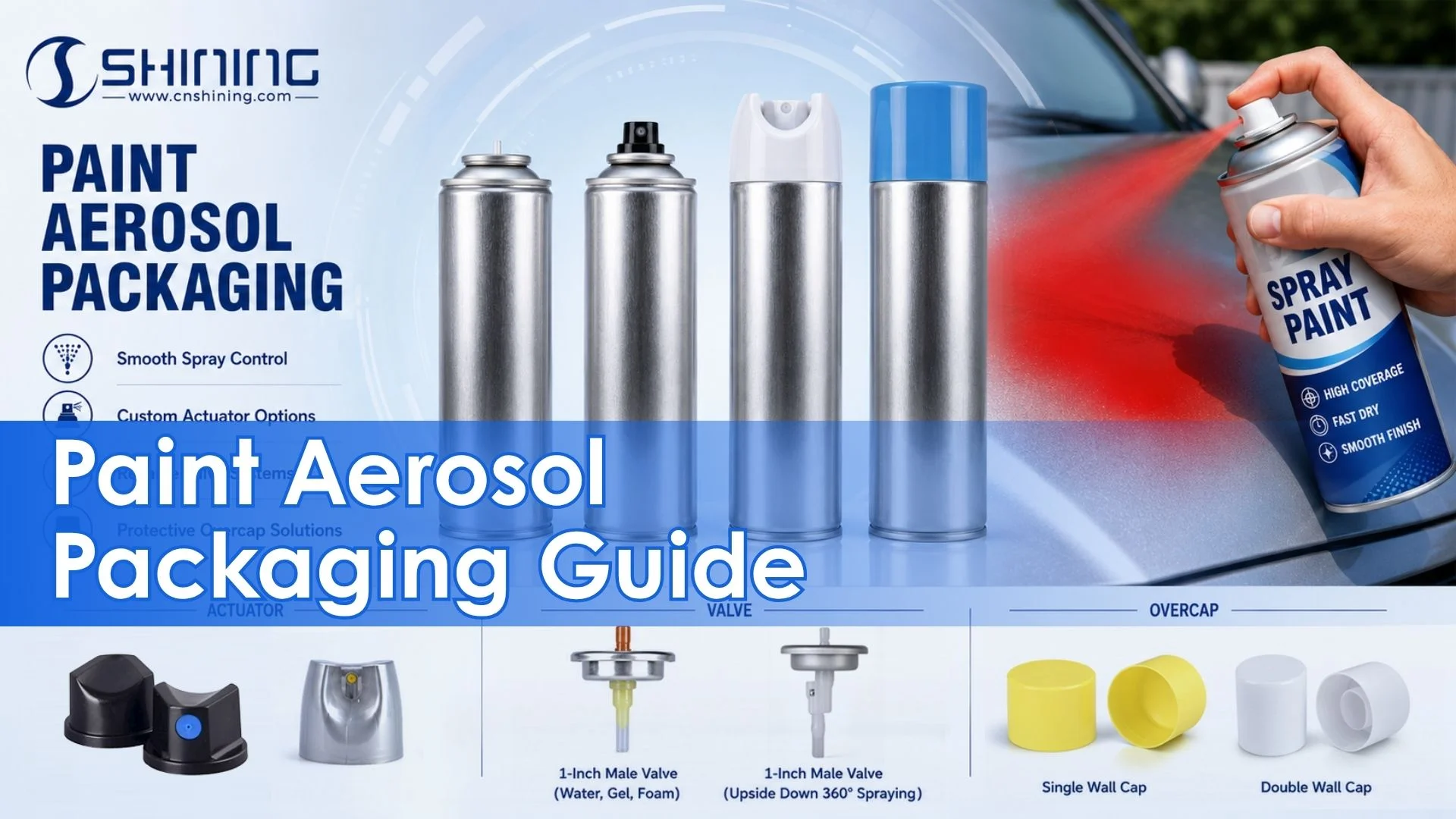
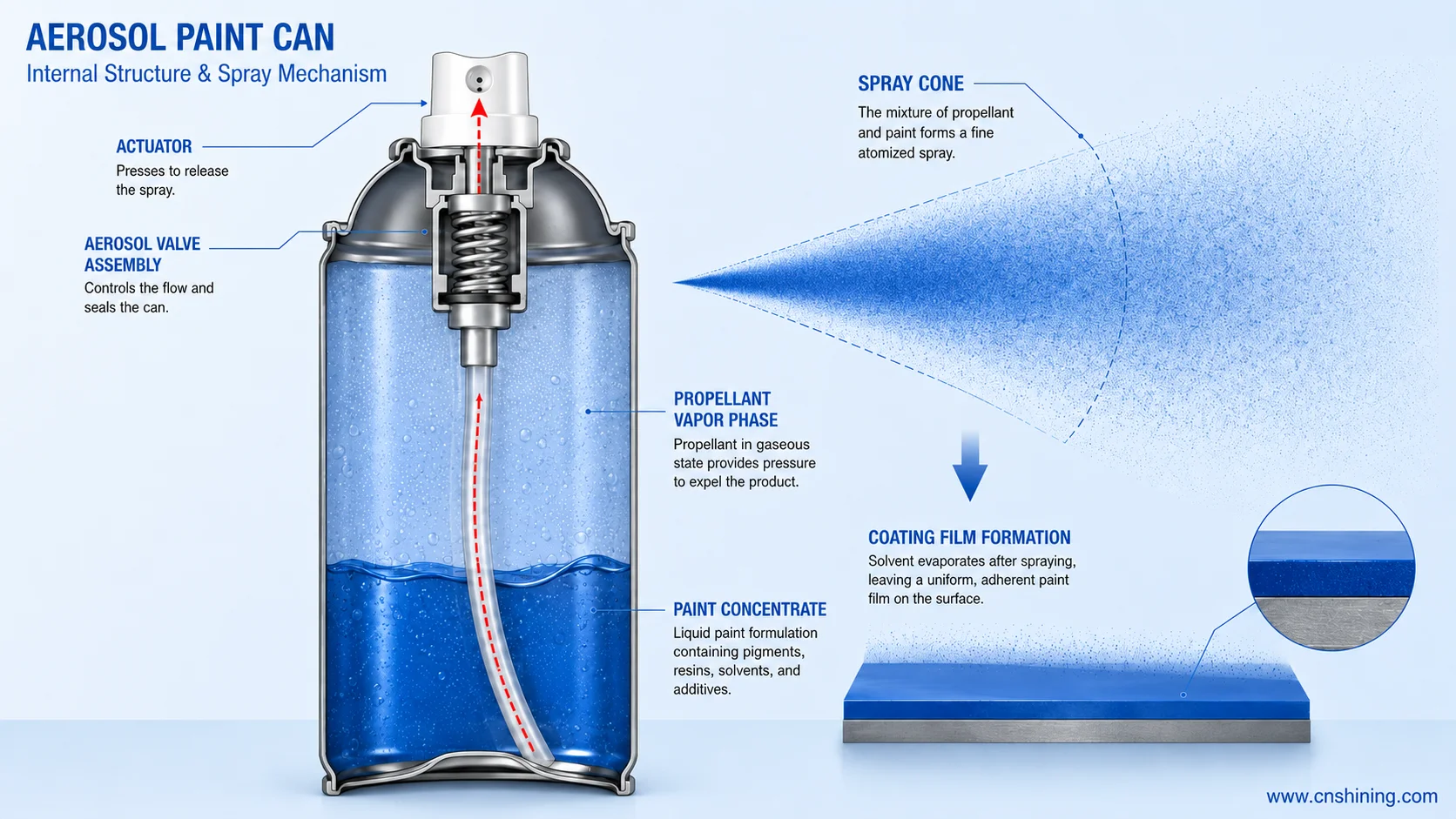
An aerosol paint can is a combined system of paint concentrate, propellant, valve metering parts, actuator, and a sealed pressure container. When the actuator is pressed, the stem opens, liquid is pushed through the dip tube and valve, and the nozzle breaks it into droplets that form a coating film on the substrate.
The commercial value is not the empty can. It is the ability to package portable spray painting, repeatable dispensing, low equipment cost, visual finish, and storage stability into one disposable pressurized system. For engineers, the hard questions are direct: Will it spray evenly? Will it clog? Will the valve leak? Will the coating meet VOC or reactivity rules? Will the can survive transport and shelf life?
1. Product Definition and Working Mechanism
Under the EU aerosol dispenser framework, an aerosol dispenser is a non-refillable pressure container fitted with a valve system for releasing contents. CARB defines aerosol coating products as pressurized coating products containing pigments or resins and expelled by propellant from a disposable aerosol container. For an aerosol spray paint can, atomization is only one part of the job. The larger requirement is safe, transportable, storable, and repeatable release.
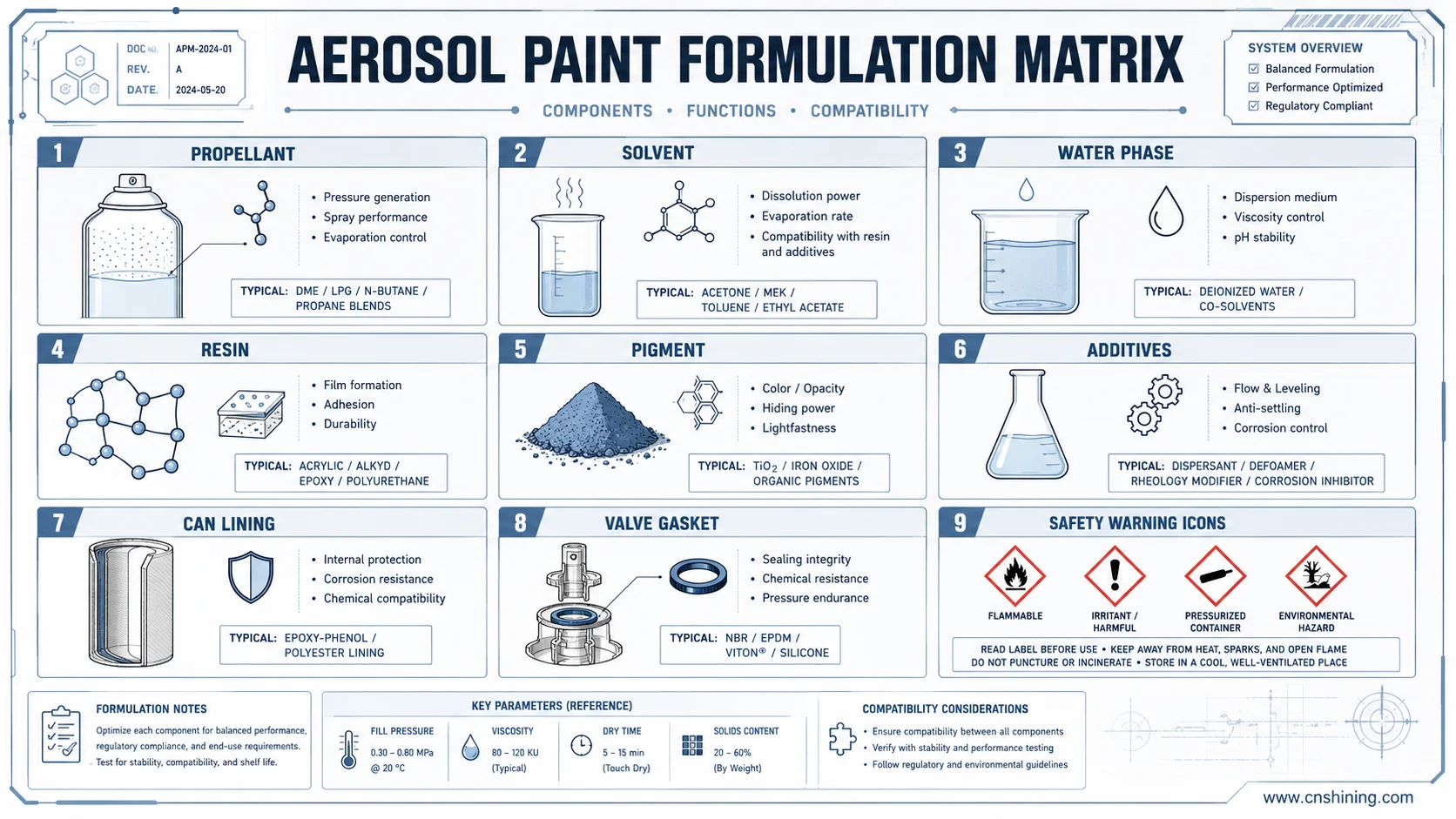
A typical aerosol paint can has seven functional layers:
- Can body: steel or aluminum pressure container.
- Paint concentrate: resin, solvent or water phase, pigment, filler, and additives.
- Propellant: LPG, DME, compressed air, nitrogen, or other inert gas options.
- Valve assembly: mounting cup, housing, spring, gasket, and stem.
- Dip tube: liquid transfer path from can bottom to valve.
- Actuator and orifice: user interface and spray pattern control.
- Internal coating, print, and misuse-prevention parts: compatibility and user handling layer.
Stem bore, gasket material, spring return force, valve chamber geometry, actuator orifice, and swirl structure affect output rate, droplet size, leakage, and user feel.
With liquefied propellants such as LPG or DME, liquid and vapor phases coexist. As product leaves the can, more propellant vaporizes and helps maintain pressure. With compressed air or nitrogen, pressure drops as the contents are discharged, so the end-of-life spray curve can weaken faster.
Pressure is not the only variable. Temperature, can diameter, fill ratio, formulation viscosity, pigment dispersion, propellant compatibility, and lining compatibility all change spray behavior. Low temperature reduces vapor pressure. Users describe this as weak spray, uneven spray, or “spitting.” High viscosity or poor pigment dispersion increases local buildup near the nozzle and can distort the spray pattern.
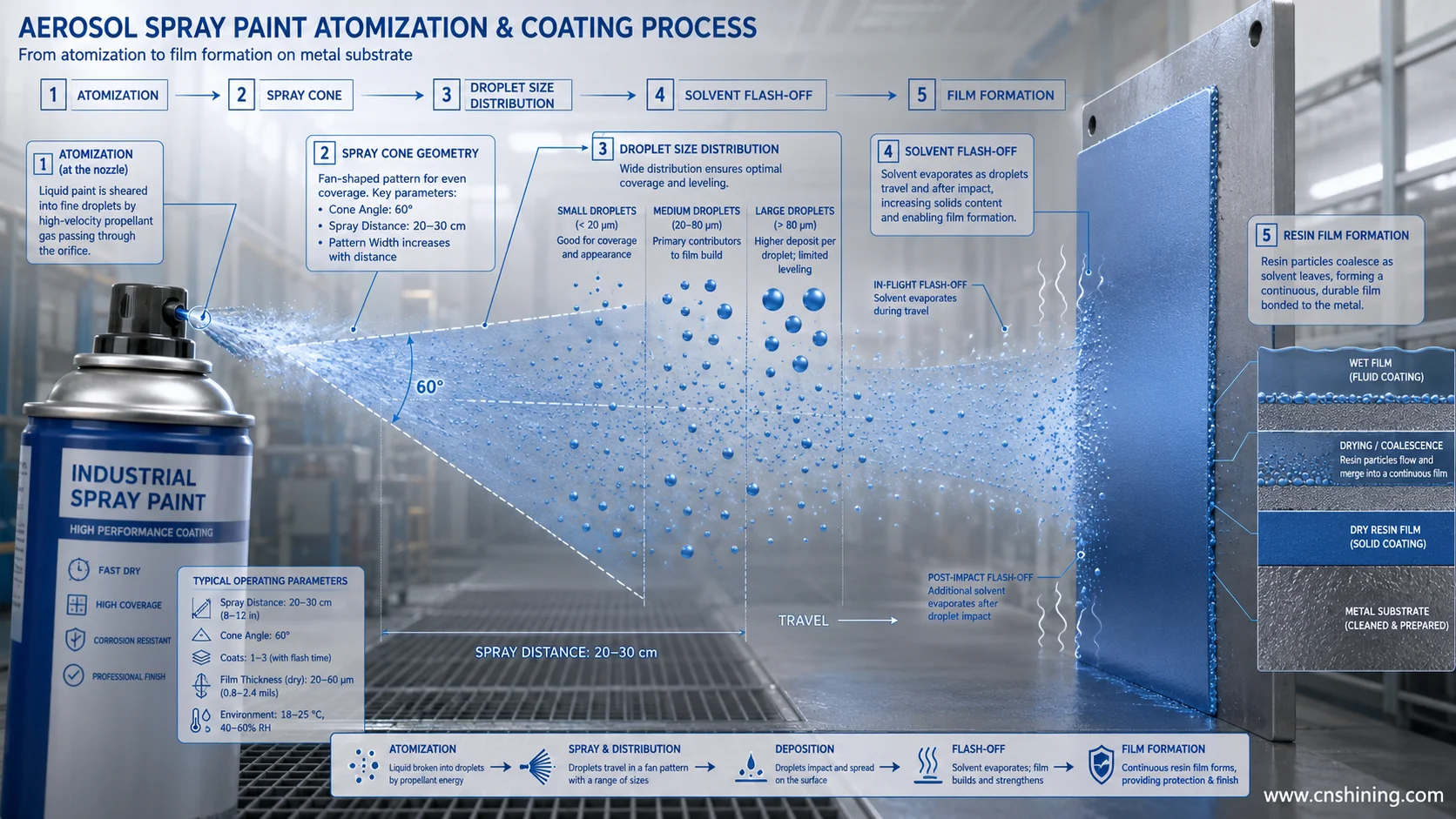
From an application view, the actuator uses the orifice and swirl chamber to break liquid into small droplets. Those droplets land on the substrate, solvent or water flashes off, resin forms a film, and pigments or metallic flakes orient inside the coating layer. If the pattern is too narrow or droplets are too large, defects such as mottling, runs, rough edges, and heavy overspray appear. If solvent release is too fast, dry spray, orange peel, or weak adhesion can appear.
2. Competitive Position and Substitute Products
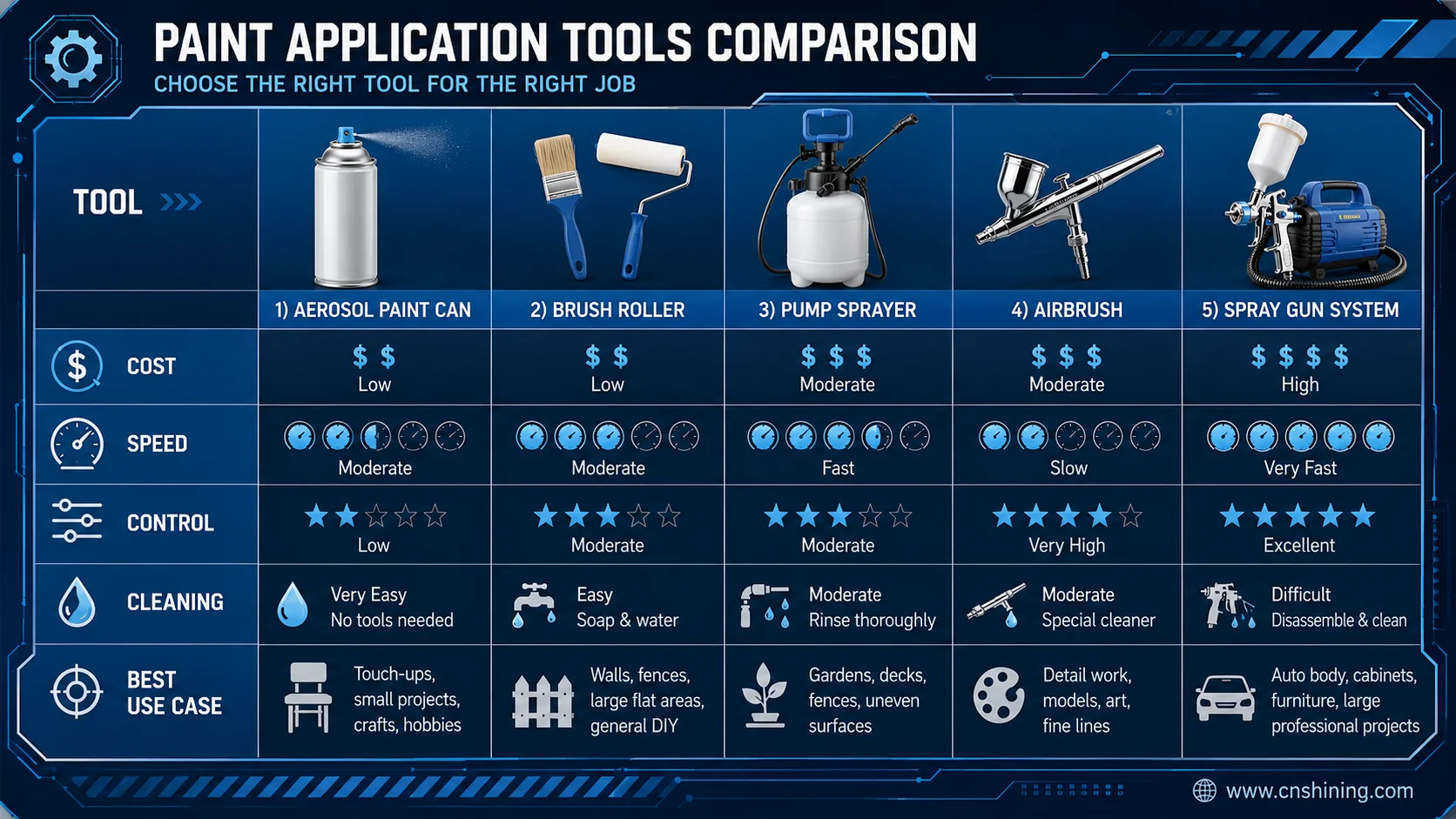
Aerosol paint cans are not the highest-quality coating method in every case. They win where setup cost, portability, speed, and acceptable finish quality matter more than maximum film control.
| Solution | Equipment Cost | Ease of Use | Speed | Fine Control | Large Area | Film Consistency | Cleaning | Best Use Case | Threat to Aerosol Cans |
|---|---|---|---|---|---|---|---|---|---|
| Aerosol paint can | Low | Low | High | Medium | Medium | Medium-high | Very low | Local repair, DIY, art, portable work | Baseline product |
| Brush / roller | Very low | Low | Medium | Low-medium | High | Highly operator-dependent | Low | Walls, flat large surfaces, low-cost renovation | Strong substitute for large surfaces |
| Pump sprayer | Low-medium | Medium | Medium | Low-medium | Medium | Limited by liquid viscosity and pump head | Medium | Garden, cleaning, low-viscosity liquids, some waterborne tasks | Weak for high-viscosity decorative coatings |
| Airbrush | Medium-high | High | Low-medium | Very high | Low | High | High | Models, gradients, texture, detailed art | Strong in precise small-area work |
| Spray gun system | High | High | High | High | Very high | High | Very high | Professional coating, full automotive panels, industrial production | Strong in professional coating work |
If we only judge handling, aerosol paint cans are strong: no compressor, no mixing, no pressure adjustment, no hose cleaning. Modern products use fan nozzles, any-angle spray, and wider finger pads to reduce handling failure.
For final coating quality, the limits are built in: can pressure curve, nozzle bore, formulation window, and pack volume. Aerosol cans remain weaker than spray gun systems for large surfaces, high film-build control, long continuous spraying, or complex multi-layer systems. They are usually weaker than airbrushes for micro-detail and very low overspray. The useful middle ground is clear: good-enough finish, fastest setup.
3. Formula Systems, Terms, and Safety Boundaries
3.1 Main Formula Categories
| Category | Typical Resin / System | Typical Function | Commercial Position | Risk Point |
|---|---|---|---|---|
| Solvent-based | Alkyd / acrylic modified, alkyd, NC, PU-modified systems | Fast dry, strong adhesion, low-temperature film formation, wide application tolerance | Still a main revenue category | VOC, flammability, aromatic and ester / ketone solvent exposure |
| Water-based | Waterborne acrylic, waterborne alkyd, PU-modified waterborne systems | Lower VOC, lower odor, easier regulatory fit | Growth direction | Storage stability, leveling, weathering, gasoline resistance |
| Lacquer | Fast-drying high-solids paint, common in automotive detail and quick repair | Gloss, fast repair, friendly recoat window | Automotive and DIY quick repair | Solvent irritation and dry spray from fast evaporation |
| Enamel | General decorative and industrial repair systems | Application tolerance, durability, outdoor appearance | General retail category | Slower drying than ultra-fast systems; environment-sensitive window |
| Acrylic | Art, general decoration, waterborne or NC-acrylic hybrid routes | Color expression, coverage, low-pressure spray design | Strong in art and DIY | Waterborne stability; VOC pressure in NC versions |
| Metallic | Aluminum flake or pearlescent pigment systems | Metallic appearance for automotive and decorative demand | Higher visual-value SKU group | Flake orientation, clogging, spray-pattern consistency |
| Clearcoat | Modified alkyd, PU-modified, or acrylic clear systems | Protection, gloss, UV resistance, scratch and fuel resistance | Strong demand in automotive and premium DIY | Yellowing, weathering, intercoat adhesion |
3.2 Functional Ingredients and Typical Weight Ranges
The table below is not a single formula. It is a practical commercial range built from patents and SDS evidence. Real formulas depend on resin type, target film thickness, pigment volume, propellant compatibility, valve gasket compatibility, and internal coating.
| Ingredient Group | Main Function | Common Range by Weight | Representative Evidence |
|---|---|---|---|
| Propellant: propane, n-butane, LPG, DME, compressed air, inert gas | Provides discharge pressure; changes atomization and spray curve | 10%-35% for conventional solvent-based systems; 10%-50% in some waterborne DME routes | Rust-Oleum SDS lists propane 10%-25%, n-butane 2.5%-10%; waterborne patents give wider DME ranges. |
| Main solvent / co-solvent: acetone, n-butyl acetate, PMA, light aromatics, DMC | Dissolves resin, adjusts viscosity, flash-off, and leveling | 20%-45% | Commercial SDS ranges include acetone, n-butyl acetate, PMA, and light aromatic naphtha. |
| Water / waterborne continuous phase | Base phase for waterborne systems; reduces VOC load | 4%-60% | Older and recent waterborne patents both show wide waterborne windows. |
| Resin / film former: acrylic, alkyd, PU-modified | Film formation, adhesion, weathering, hardness, flexibility | 10%-60% in waterborne patent ranges; commercial products often around 10%-30% | Waterborne patents and commercial clearcoat / lacquer examples. |
| Pigment / filler: TiO2, carbon black, color pigment, aluminum flake, pearl | Hiding, color, metallic effect, rheology support | 5%-25%; high-hiding white may be higher; clearcoat near zero | White spray paint SDS may list TiO2 at 10%-25%. |
| Additives: leveling, dispersing, defoaming, anti-settling, preservative, drier | Storage stability, anti-clogging, application window, surface quality | 0.1%-5% | Common commercial practice; patents often list various additive ranges. |
| Corrosion and lining compatibility factors | Prevents DME / waterborne attack on metal and lining | Trace to 1%+, but mainly dependent on lining system | Waterborne DME systems need lining and gasket compatibility checks. |
The important variable is DME in waterborne paint. One early patent route describes water-soluble modified alkyd resin, water, water-soluble organic solvent, and DME. A later waterborne aerosol paint patent gives broad windows for DME, resin, and waterborne solvent. See US5196459A water-based aerosol coating compositions and EP3592813B1 water-based aerosol paint.
The difficulty is not “putting water into the can.” The difficulty is making resin, propellant, can lining, gasket, valve, and long shelf life work together.
3.3 Safety Boundary
Commercial SDS documents are direct. Typical solvent-based spray paint is often classified as extremely flammable aerosol and a pressurized container that may burst if heated. It may also carry eye irritation, narcotic-effect, or chronic exposure warnings. The Rust-Oleum SDS example shows propane, butane, acetone, hydrocarbon solvent, aromatic solvent, trimethylbenzene, xylene, ethylbenzene, and TiO2 ranges.
Water-based does not mean harmless. Waterborne systems can reduce VOC and odor pressure, but spray mist and vapor exposure still need ventilation, respiratory protection, and dangerous goods management.
3.4 Useful Technical Terms
| Term | Short Meaning | Commercial Meaning |
|---|---|---|
| Actuator | User-pressed spray head. | Directly affects finger feel, spray pattern, and product identity. |
| Valve assembly | Mounting cup, stem, gasket, spring, and housing. | Controls leakage, spitting, durability, and compatibility. |
| Dip tube | Tube moving liquid from can bottom to valve. | Affects usable residue and any-angle design. |
| DME | Dimethyl ether; propellant and solvent-like behavior. | Useful for waterborne / low-VOC routes but can challenge lining. |
| PWR | Product-weighted reactivity. | Core U.S. federal aerosol coating compliance metric. |
| MIR / PWMIR | Maximum incremental reactivity / product-weighted MIR. | Core CARB reactivity compliance metric. |
| Fan pattern | Flat spray pattern. | Affects leveling, speed, and edge control. |
| Spitting | Uneven droplet discharge. | One of the most common user complaints. |
| Orange peel | Textured film defect. | Usually from atomization and leveling imbalance. |
| Flash time | Time for solvent / water to partially evaporate. | Controls recoat efficiency and run risk. |
| BOV | Bag-on-valve. | Separates product from propellant for cleaner discharge in selected systems. |
| Comfort tip | Wide finger pad actuator. | Reduces finger fatigue during continuous spraying. |
4. Regulations and Compliance Framework
4.1 United States
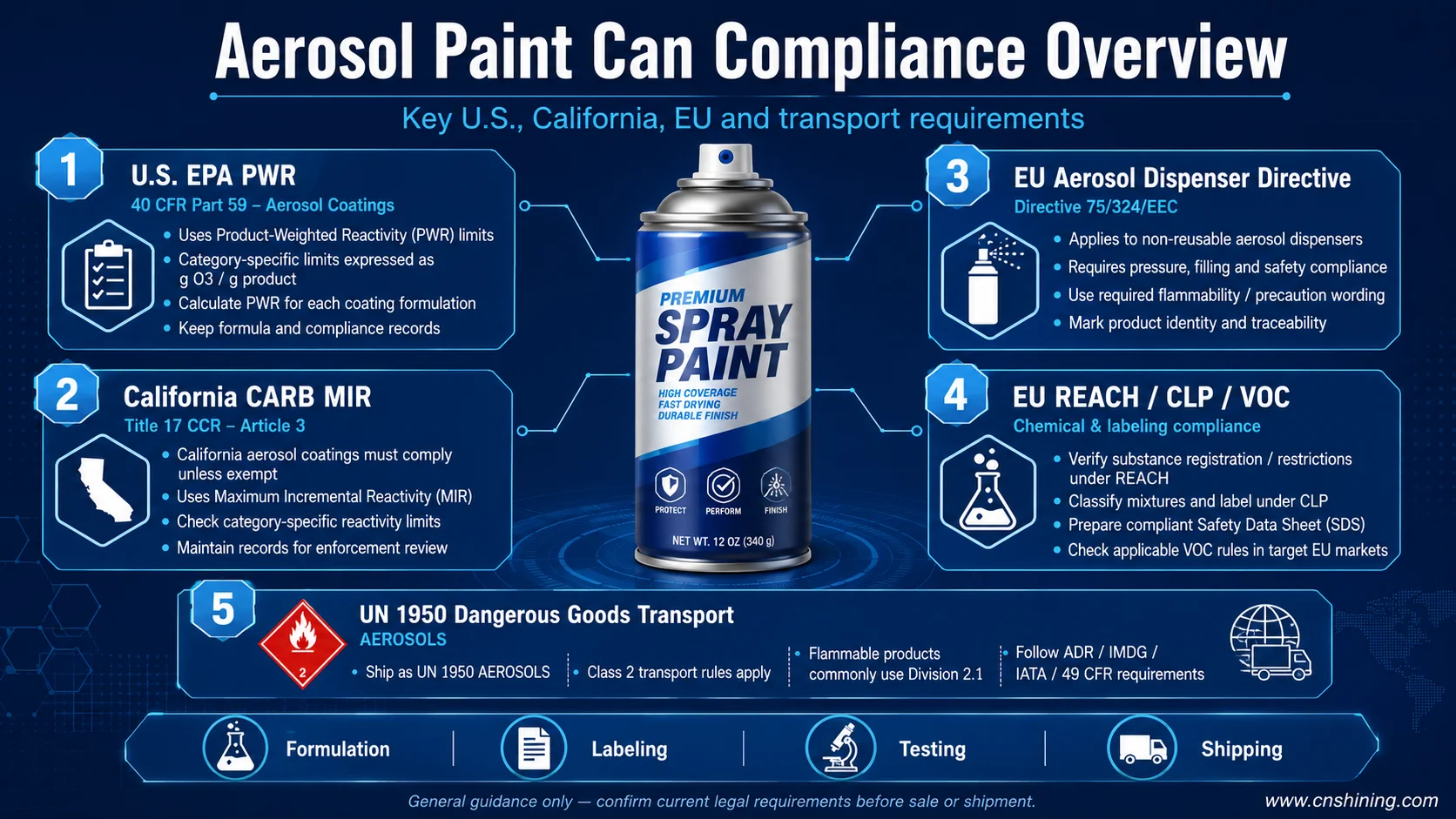
At the U.S. federal level, aerosol coatings are covered by 40 CFR Part 59 Subpart E. The rule is not only a grams-per-liter VOC framework. It uses product-weighted reactivity, or PWR, with category limits, labeling, records, and reporting obligations.
California is more specific. The CARB Aerosol Coating Product Regulation defines aerosol coating products, uses MIR and PWMIR logic, separates general and specialty coatings, and requires category and reactivity limit labeling. It also restricts substances such as methylene chloride, perchloroethylene, trichloroethylene, and ozone-depleting compounds.
Transport is a separate issue. Aerosols often connect to UN 1950 and limited quantity logic. In U.S. dangerous goods rules, 49 CFR §173.306 is relevant to limited quantities of compressed gases. This affects warehouse routing, e-commerce acceptance, air shipment, and packaging design.
4.2 European Union
The EU compliance structure has three layers. First, the Aerosol Dispensers Directive 75/324/EEC deals with pressure product safety, flammability, structural resistance, hazard analysis, and testing. Second, REACH and CLP handle chemical registration, evaluation, classification, labeling, and packaging. Third, Directive 2004/42/EC controls VOC content for selected paints, varnishes, and vehicle refinishing products.
For aerosol paint cans, the EU is not a single-rule market. It is a compound compliance zone: pressure safety, chemical rules, VOC rules, transport rules, and packaging waste rules all interact.
4.3 Latin America, Middle East, and Africa
These markets are not absent. The difficulty is that regulatory openness and uniformity are weaker than in North America, the EU. In practice, multinational brands usually adapt country by country using UN 1950 transport logic, GHS / SDS, local VOC or hazardous chemical rules, and import label requirements.
5. Technology Trends, Patents, and Brand Landscape
The useful trend is not the broad word “green.” The technical direction is more specific.
- Low VOC and low reactivity: U.S. federal and California rules use reactivity-based frameworks, while China and the EU push source control and chemical compliance.
- Waterborne aerosol paint as system engineering: Patents keep focusing on resin compatibility, DME behavior, shelf stability, and lining protection.
- Propellant route split: LPG and DME remain relevant, but compressed air, inert gas, BOV, and low-GWP options are getting more attention.
- Actuator ergonomics: comfort tip, fan spray nozzle, spray-anyway, low-pressure artist caps, and replaceable cap families are no longer minor accessories. They control failure rate.
- Recyclability and lightweighting: PCR actuators, reduced plastic mass, metal recyclability, and PPWR-related design choices are becoming engineering requirements.
Representative Patents, Standards, Associations, and Papers
| Type | Name | Why It Matters |
|---|---|---|
| Patent | US5196459A / EP0068771A3 water-based aerosol coating compositions | Early route for water + water-soluble resin / solvent + DME. |
| Patent | WO2018162801A1 / EP3592813B1 water-based aerosol paint | Focuses on PU-modified resin, higher dry weight, shelf stability, and low-VOC / non-flammable direction. |
| Patent | US11390756B1 water-based aerosol composition | Shows continued large-brand interest in waterborne aerosol technology. |
| Patent | US4923097A solvent-based DME aerosol paint | Represents DME’s combined propellant and solvent role in solvent-based systems. |
| Standard | EPA 40 CFR Part 59 Subpart E | Main U.S. federal aerosol coating compliance backbone. |
| Standard | CARB Article 3 / 17 CCR 94520-94524 | One of the stricter aerosol coating reactivity systems. |
| Standard | EU 75/324/EEC, REACH, CLP, 2004/42/EC | EU pressure safety, chemical, and VOC compliance structure. |
| Transport | UN 1950, 49 CFR §173.306, IATA DGR | Directly affects warehousing, e-commerce, and air freight feasibility. |
| Associations | FEA, HCPA, BAMA, AEROBAL, ACCPF | Useful sources for industry data, regulation tracking, and packaging direction. |
The practical lesson is simple: long-term aerosol paint work requires reading four document types together: patents, regulations, SDS, and user complaints.
6. Top 10 Aerosol Paint Can Brands
| Brand | Country / Region | Parent Company | Typical Capacity | Typical Retail Price (USD) | Technical Comment |
|---|---|---|---|---|---|
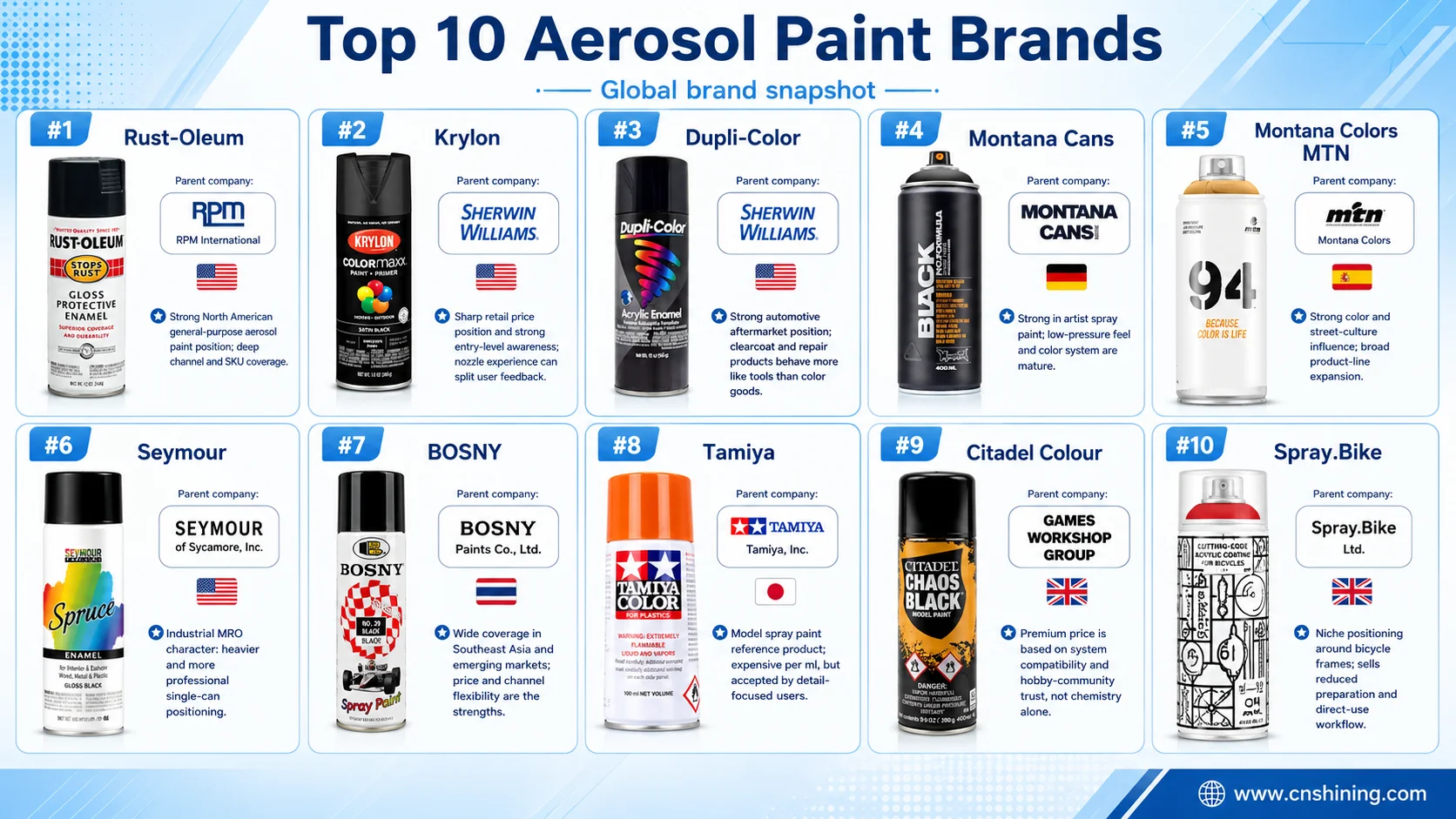
| Rust-Oleum | United States | RPM International | 12 oz | 6-9 | Strong North American general-purpose aerosol paint position; deep channel and SKU coverage. |
| Krylon | United States | Sherwin-Williams | 12 oz | 4.5-8 | Sharp retail price position and strong entry-level awareness; nozzle experience can split user feedback. |
| Dupli-Color | United States | Sherwin-Williams | 8 oz / 12 oz / 16 oz | 8-16 | Strong automotive aftermarket position; clearcoat and repair products behave more like tools than color goods. |
| Montana Cans | Germany | Montana Cans GmbH | 400 ml | 8-12 | Strong in artist spray paint; low-pressure feel and color system are mature. |
| Montana Colors MTN | Spain | Montana Colors | 400 ml | 6-10 | Strong color and street-culture influence; broad product-line expansion. |
| Seymour | United States | Seymour of Sycamore, Inc. | 16 oz | 10-18 | Industrial MRO character; heavier and more professional single-can positioning. |
| BOSNY | Thailand | Bosny Paints Co., Ltd. | 400 cc / 600 cc | 3-7 | Wide coverage in Southeast Asia and emerging markets; price and channel flexibility are the strengths. |
| Tamiya | Japan | Tamiya, Inc. | 100 ml | 8-12 | Model spray paint reference product; expensive per ml, but accepted by detail-focused users. |
| Citadel Colour | United Kingdom | Games Workshop Group | 400 ml | 20-25 | Premium price is based on system compatibility and hobby-community trust, not chemistry alone. |
| Spray.Bike | United Kingdom | Spray.Bike Ltd. | 400 ml | 11-18 | Niche positioning around bicycle frames; sells reduced preparation and direct-use workflow. |
7. Shining Packaging Components for Aerosol Paint Can Projects
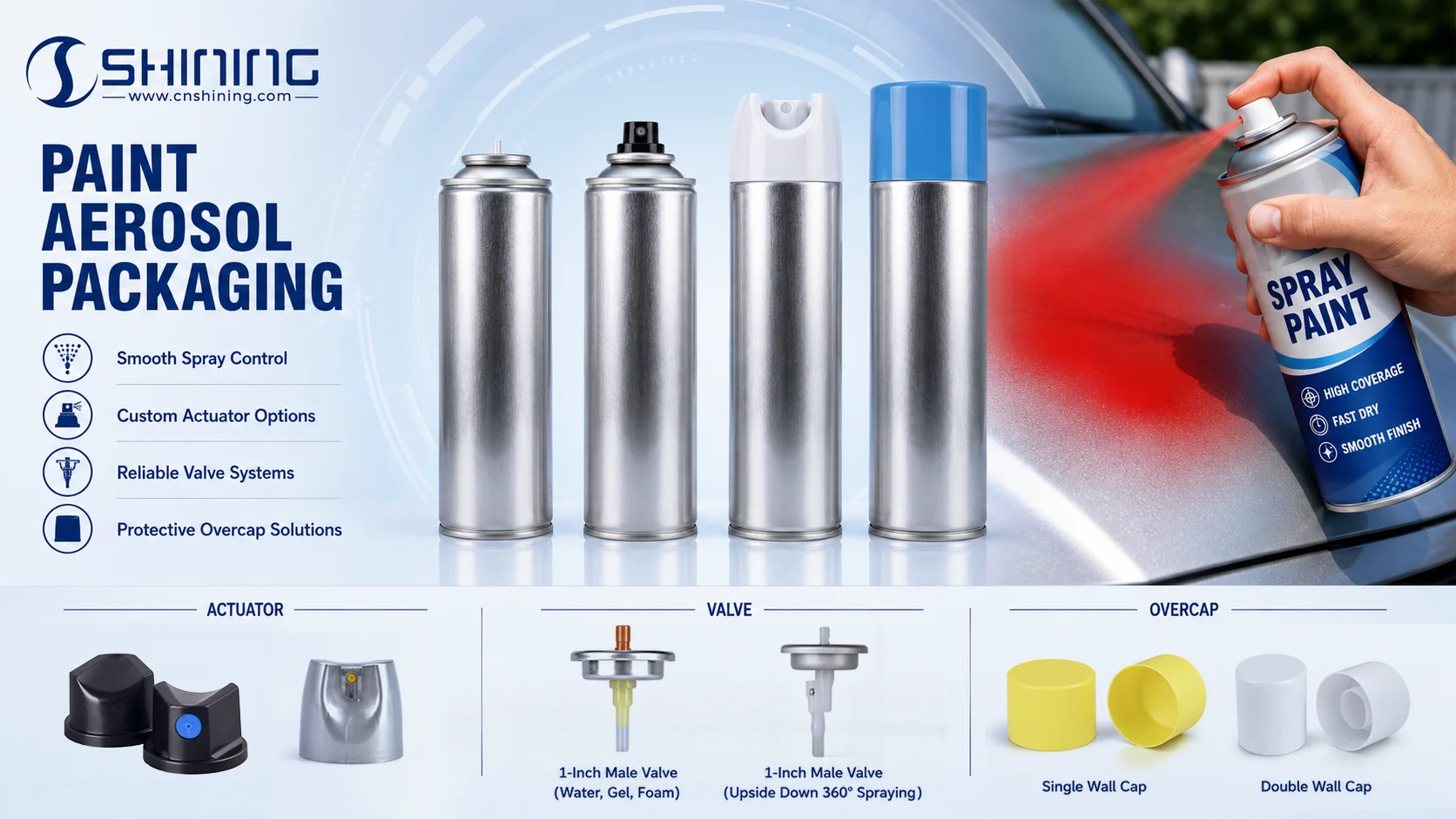
For aerosol paint can projects, Shining Packaging’s relevant product scope sits at the interface between formulation and user experience: actuators, aerosol cans, and valves. This is exactly where many field failures appear. A good resin system can still be judged as poor if the actuator spits, the valve leaks, the spray pattern is unstable, or the can lining is not compatible with the propellant system.
For paint and coating packs, the actuator should match the expected spray task: narrow spray for detail, standard cone for general repair, fan spray for faster panel coverage, or comfort-type trigger structures for longer use. The valve and gasket need to be checked against solvent, DME, waterborne phase, pigment loading, and pressure curve. The can body and internal coating need to support shelf life, corrosion resistance, transport safety, and printing requirements.
This is not a decorative accessory decision. In aerosol paint, the package is part of the dispensing machine. Shining Packaging’s component selection should therefore be reviewed together with viscosity, propellant ratio, filling weight, spray rate target, and expected storage conditions.
8. User Pain Points and Packaging Improvement Ideas
User complaints around aerosol paint cans cluster around four packaging engineering points: valve, actuator, color communication, and lining compatibility. Users may describe the failure as “bad paint,” but the root cause is often delivery failure.
8.1 Where Complaints Concentrate
Common field signals include leaking nozzles, dripping around the actuator, hard-to-press buttons, clogged caps, spitting, globs, poor low-temperature spray, and color mismatch. Replacement caps, thin caps, fat caps, direct-fit caps, and trigger handles exist because the original package does not always match the task.
Color communication is also underestimated. A cap color does not always represent the film on real substrate, especially for metallic, pearlescent, clearcoat, or low-hiding colors. That gap causes test spraying in stores, returns, and “wrong color” complaints.
8.2 Pain Point to Packaging Fix
| User Pain Point | Public Signal | Packaging / Component Fix | Why It Works |
|---|---|---|---|
| Nozzle leakage, dripping, paint on fingers | Reviews often point to nozzle leaks and drips. | Improve stem-gasket fit, tolerance control, front-end shutoff, suck-back, or actuator geometry. | The failure often occurs at the valve-actuator interface, not only from user error. |
| Clogging, spray dots, spitting | Search demand around clogged spray paint cans is high. | Use solvent-resistant low-retention actuator materials, removable caps, spare cap in overcap, and clearer upside-down clearing instructions. | Embedding maintenance into packaging is more reliable than hoping users remember instructions. |
| Finger fatigue and high press force | Users report hard pressing; trigger handles sell as accessories. | Use integrated trigger actuator, wider finger pad, lower actuation force, or clip-on trigger accessory. | Fatigue shortens continuous spray time and changes spray consistency. |
| Unstable pattern, rough edge, poor detail control | Thin / fat cap accessory markets show pattern demand. | Offer narrow, standard, and fan actuator options on one platform with clear pattern labeling. | Users do not need one universal cap. They need a cap matched to the task. |
| Unreliable color communication | Users test spray because cap color is not trusted. | Use 360-degree real-color ring, QR real-spray swatches, and substrate-effect notes for metallic and pearl colors. | Reduces store damage, returns, and color-difference complaints. |
| Waterborne / DME lining attack | Technical sources warn that high-DME waterborne systems can attack linings. | Use more compatible BPA-NI epoxy or polyester lining routes and upgrade valve gasket material. | Without packaging compatibility, waterborne upgrades become shelf-life failures. |
| Low-temperature weak spray | Users frequently discuss warming cans before use. | Adjust propellant vapor-pressure window for cold markets; add temperature icons; consider winter SKU split. | One propellant ratio does not fit every climate. |
| Heavy pack, logistics cost, sustainability pressure | European packaging trends push lightweighting and recyclability. | Use lightweight can design, PCR actuators, reduced overcap parts, and recyclable metal packaging. | Regulatory pressure, freight cost, and carbon reporting all move in the same direction. |
The core conclusion is blunt: many bad reviews are not formula failures. They are packaging engineering failures that prevent the formula from being delivered properly. If the valve leaks, the actuator loads with paint, the fan pattern collapses, or the color cue is wrong, the user will blame the can.
9. Conclusion
An aerosol paint can should be treated as a pressure-packaged dispensing system, not a simple metal container. The paint formula, propellant, valve, actuator, can lining, and user instructions all decide the final coating result. When the system is matched well, the can gives fast, low-equipment, repeatable spray work. When it is not matched, users see leaks, clogging, spitting, uneven film, color mismatch, or premature pressure loss.
The next practical gains will come from low-VOC or low-reactivity formulation work, waterborne-DME compatibility, lighter and more recyclable packaging, better actuator ergonomics, and tighter valve-platform control. For manufacturers, the packaging team is not a support role. In aerosol paint cans, packaging is part of the machine.
10. FAQ: Aerosol Paint Can Questions
The spray pattern is mainly controlled by actuator orifice design, swirl chamber geometry, valve output rate, propellant pressure, paint viscosity, and pigment dispersion. A fan pattern needs stable pressure and suitable droplet size. If the nozzle is too narrow, viscosity too high, or pigment poorly dispersed, the pattern can become rough, narrow, or uneven.
Spitting usually means the liquid and gas flow are no longer stable at the nozzle. Common causes include low temperature, low can pressure, clogged actuator passages, high formulation viscosity, pigment settlement, poor shaking, or valve and actuator mismatch. The user sees droplets or globs, but the root cause may be inside the formulation, valve, propellant system, or can storage condition.
Liquefied propellants such as LPG or DME exist as liquid and vapor inside the can. As product is discharged, more liquid propellant vaporizes and helps maintain pressure. Compressed gases such as air or nitrogen do not replenish pressure in the same way. Their pressure drops as the can empties, so late-stage spray performance can decline more visibly.
Solvent-based aerosol paints remain common because they dry fast, atomize well, form films at lower temperatures, and often give strong adhesion and surface appearance. They also tolerate many DIY application conditions. The tradeoff is clear: flammability, VOC exposure, odor, transport control, and stricter reactivity rules. That is why low-reactivity and waterborne alternatives keep gaining attention.
Water-based aerosol paint is difficult because water, resin, DME or other propellant, valve gasket, can lining, and long shelf life must all be compatible. Lower VOC alone is not enough. The system must still atomize cleanly, level properly, resist corrosion, avoid pigment settlement, and maintain pressure behavior over storage and use.
In the United States, aerosol coating compliance requires category classification, product-weighted reactivity limits, labeling, records, and reporting under federal rules. California adds MIR and PWMIR logic with detailed general and specialty coating categories. Transport classification also matters because the same product may need UN 1950 aerosol handling and limited quantity packaging checks.
Aerosol paint cans have fixed can volume, fixed valve output, changing pressure behavior, and limited nozzle control compared with spray gun systems. For large surfaces, film thickness, overlap control, and continuous spray time become harder to manage. A spray gun usually gives better control, lower unit coating cost, and more consistent results for full panels or industrial work.
The actuator decides finger force, spray direction, orifice size, fan shape, droplet breakup, and paint retention near the outlet. A poor actuator can leak, clog, spit, fatigue the user, or distort the pattern. A better actuator does not fix a bad formulation, but it can help deliver a good formulation consistently to the surface.
Color matching is affected by film thickness, substrate color, primer, spray distance, number of coats, metallic flake orientation, gloss level, and drying condition. Cap color or printed color blocks can only approximate the final result. Metallic, pearlescent, clearcoat, and low-hiding colors show the gap more clearly, so real-spray samples or QR swatches are useful.
The most useful packaging changes target common failure points: better stem-gasket tolerance, lower-retention actuator materials, replaceable or spare caps, fan-pattern options, wider comfort tips, trigger actuators, stronger lining compatibility, clearer temperature icons, and real-color communication. These changes reduce leakage, clogging, fatigue, spray instability, shelf-life failure, and color mismatch complaints.