
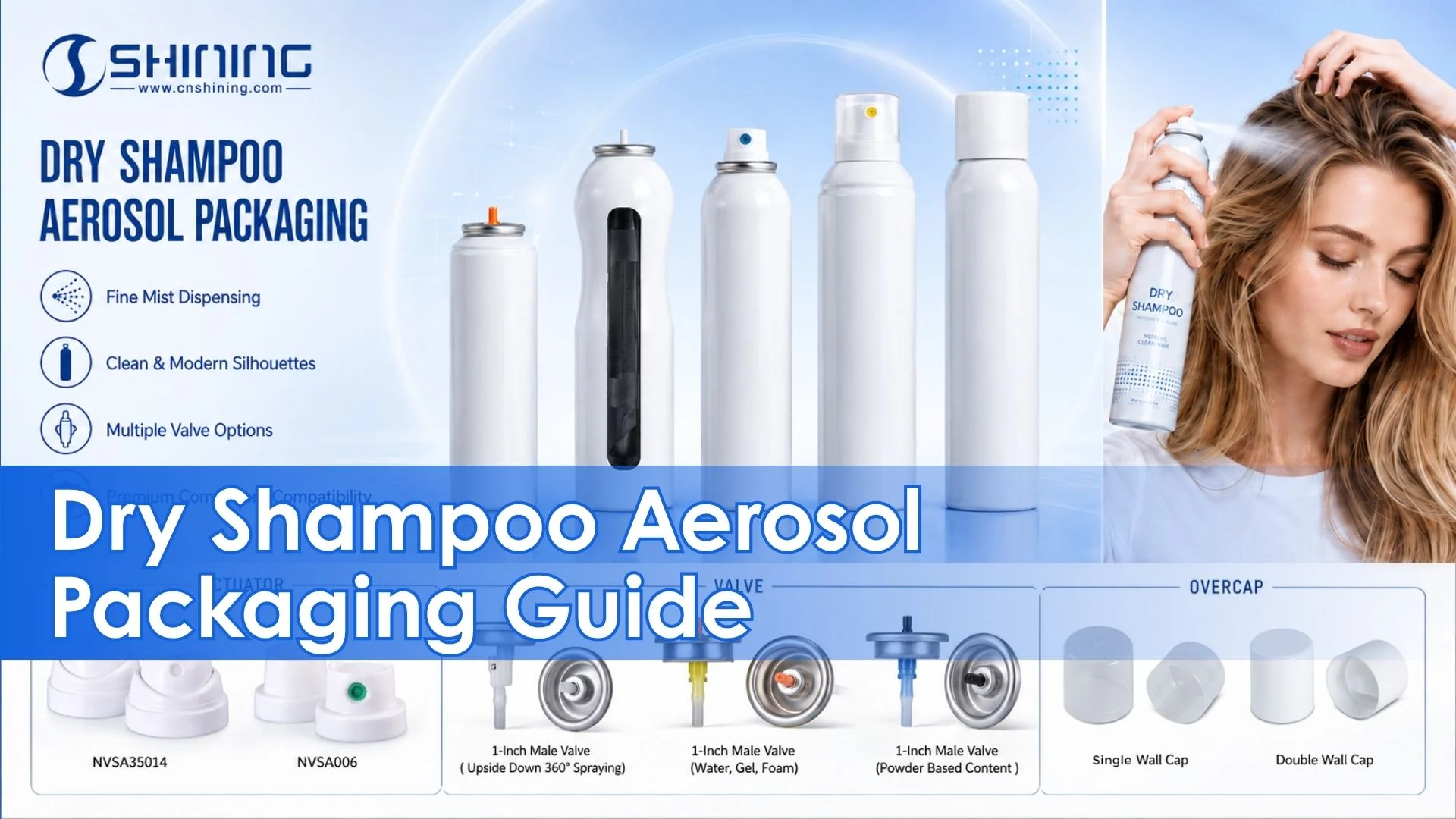
Aerosol dry shampoo works by spraying oil-absorbing powder and a volatile carrier onto the hair root under container pressure. The result depends on a full system: propellant pressure, valve flow, actuator atomization, solvent flash-off, powder absorption and residue removal.
That sounds simple. It is not. A product can contain the right starch and still fail because the spray plume is too wet, the actuator insert is wrong, the valve is not tolerant of powder loading, or the can lining is not stable with ethanol and fragrance. In this category, formulation and packaging are not separate workstreams.
1. Definition and Working Principle
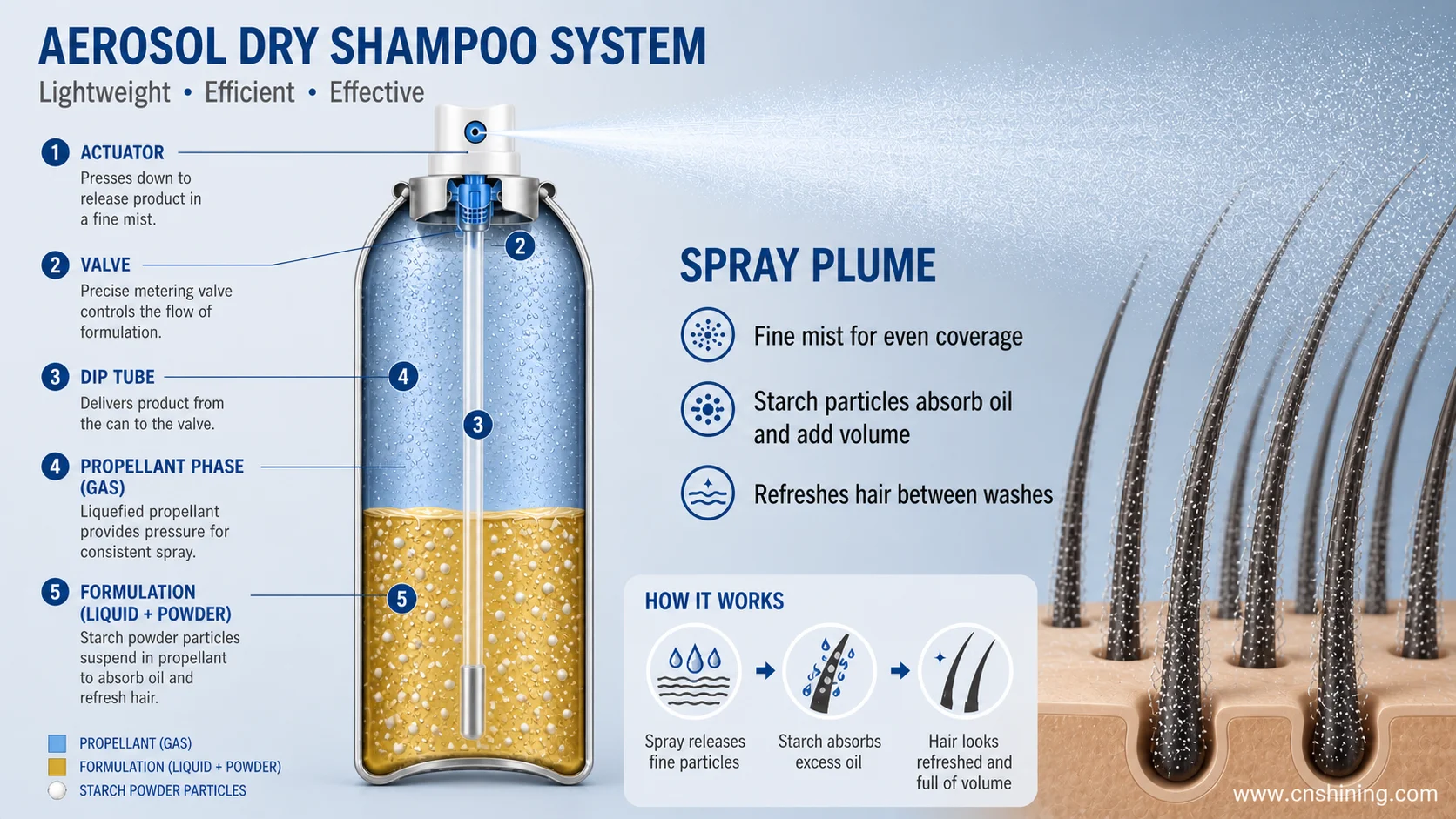
Aerosol dispenser is a non-refillable metal, glass or plastic container containing gas under pressure and fitted with a release device. The contents can be ejected as droplets, foam, paste, powder or liquid. The system includes the container, actuator, valve, propellant and active produc.
For dry shampoo, the use case is narrower: the product is applied to dry hair and scalp, absorbs oil and dirt, then remains partly on the hair after massage and brushing. Aerosol dry shampoo usually releases loose absorbent powder in a breathable spray cloud, so inhalation exposure and particle behavior have to be considered during development.
The working chain can be broken into five steps:
- The propellant builds vapor pressure inside the can.
- Pressing the actuator opens the valve and releases concentrate, powder and propellant.
- The jet forms a spray plume; ethanol or another volatile carrier flashes off quickly.
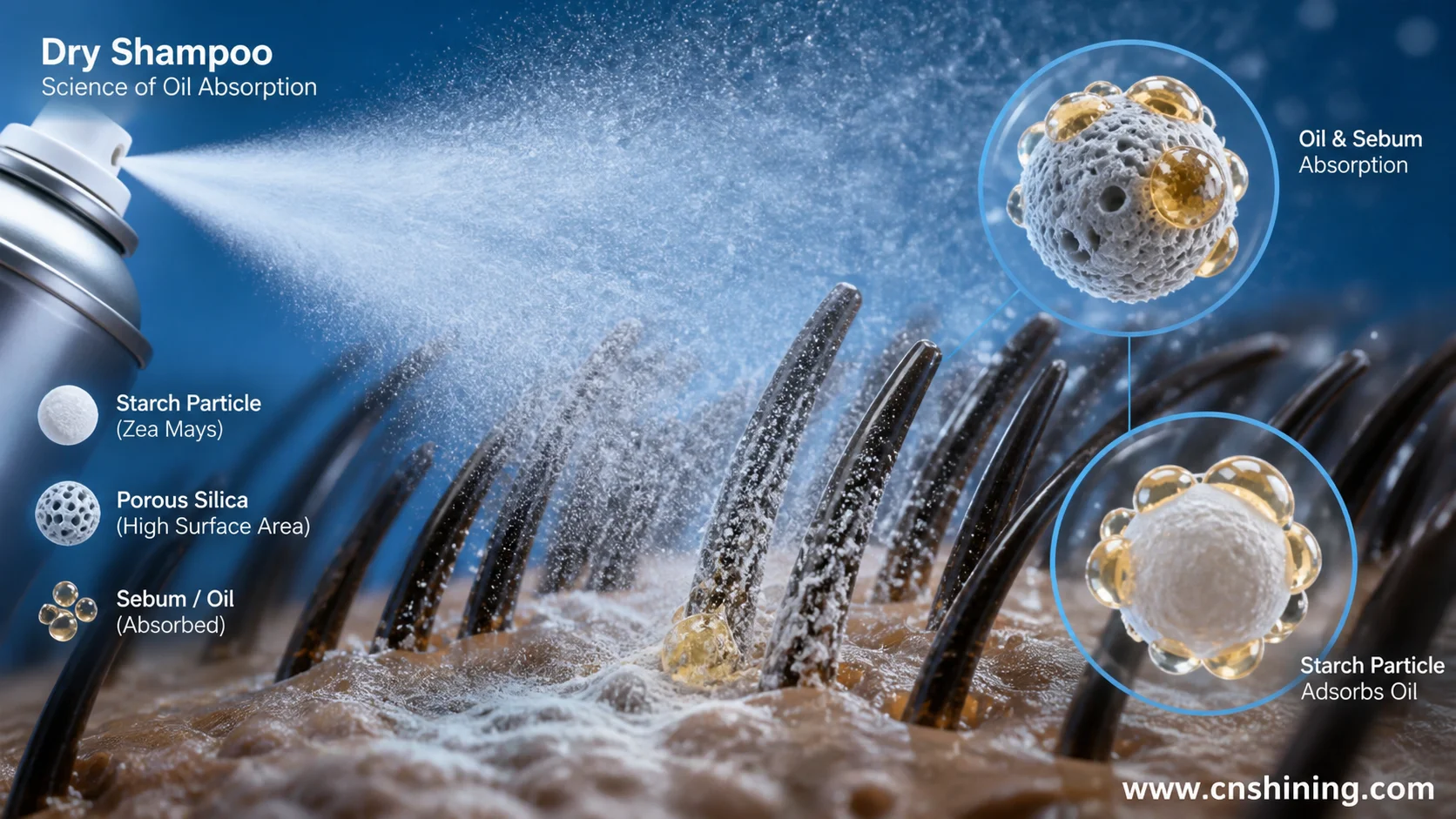
- Rice starch, tapioca starch, corn starch, modified starch, clay or porous silica contacts sebum and absorbs or adsorbs oil.
- The user massages, waits, brushes or blow-dries to remove excess powder and keep only the portion needed for lower greasiness, better friction and visible volume.
Propellant pressure → actuator press → valve release → spray plume → solvent flash-off → powder contacts sebum → massage/wait → brush-out → visible oil control and volume
A key point is often missed: looking cleaner and removing more sebum are not the same measurement. White cast is an optical problem as much as an absorption problem. Particle refractive index, particle size distribution, pore structure and how the powder mixes with sebum all affect whether residue becomes transparent after use.
2. Product Forms and Competitive Logic
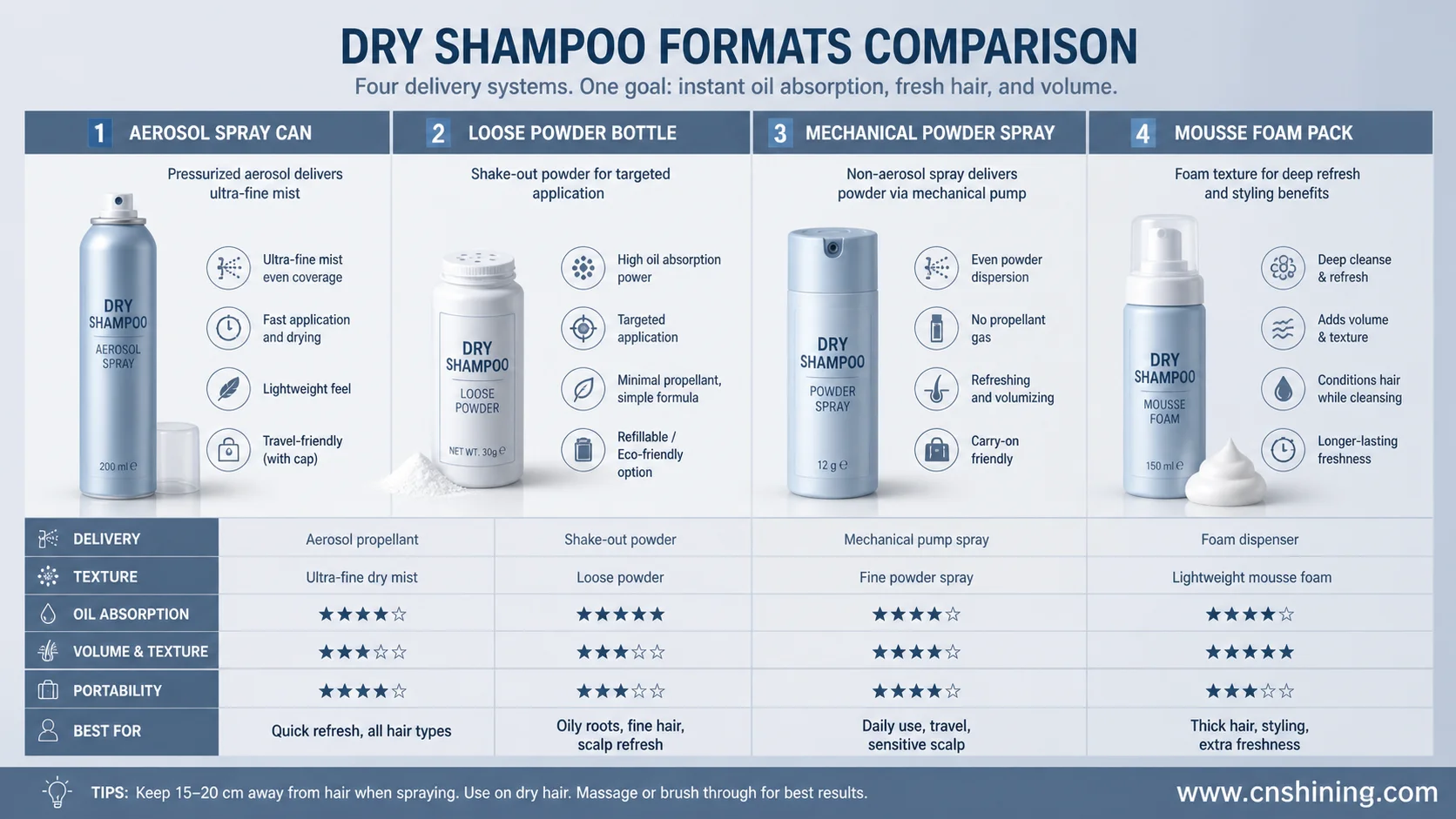
| Form | Main Advantage | Main Weakness | Typical Use Case | Technical Judgment |
|---|---|---|---|---|
| Aerosol spray | Most even distribution, fastest use, wide plume, strong root rescue effect. | Highest VOC and flammability pressure; clogging, continuous spray, white cast and inhalation exposure are more concentrated issues. | Mass market, commuting, post-gym, quick hair refresh. | Mainstream format, but it needs stronger formulation and packaging engineering. |
| Loose powder | Simple formulation, no propellant, lower VOC and easier low-ingredient positioning. | Uneven dosing, local powder buildup, stronger white cast risk on dark hair. | Clean beauty, travel, lower-carbon positioning, sensitive scalp users. | Good niche route, hard to replace aerosol in mass use. |
| Non-aerosol powder spray | Can support eco-friendly and recyclable claims. | Plume and coverage usually feel closer to a refined powder dispenser than a true aerosol. | Stricter regulatory markets and sustainability-focused users. | Useful as a regulatory buffer line, less powerful in instant-use experience. |
| Foam / mousse | Lower visible residue and more care-like feel are possible. | More complex formulation; instant oil-control feel is usually less direct than dry powder spray. | Salon, premium care, hybrid cleansing and styling. | Interesting branch innovation, not the main replacement. |
The practical product-manager view is simple: aerosol dry shampoo does not win because it has the strongest oil absorption on paper. It wins because it changes hair from visibly oily to presentable with the lowest learning cost.
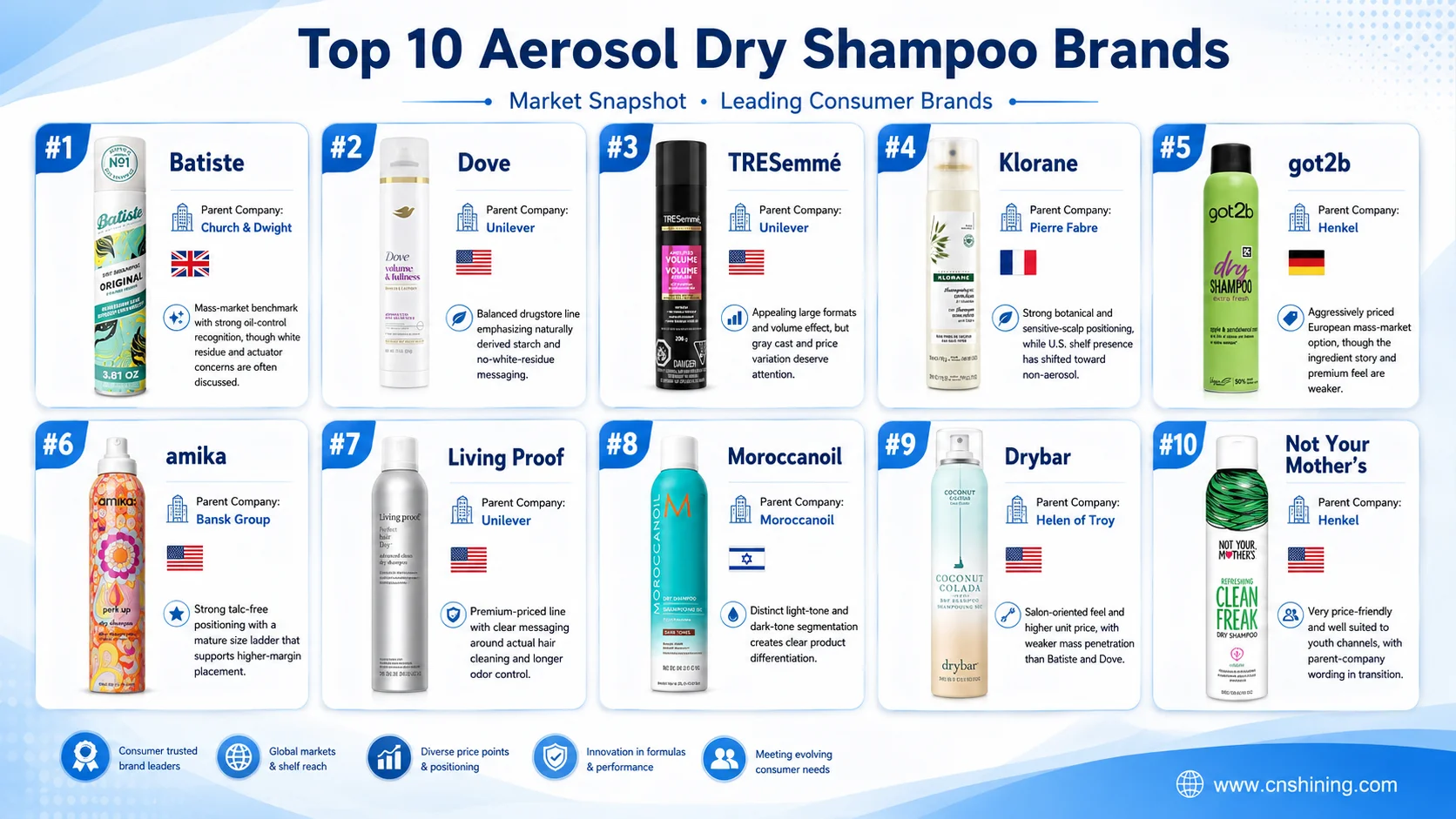
3. Top 10 Aerosol Dry Shampoo Brands
| Brand | Country of Origin | Parent Company | Typical SKU Size | Price Band | One-Line Technical |
|---|---|---|---|---|---|
| Batiste | United Kingdom | Church & Dwight | 1.6 oz, 5.71 oz, 13.4 oz | About US$8.52-11.54 for regular 5.7 oz | Mass-market benchmark with strong oil-control recognition and channel strength, but white residue and actuator failure discussions are also common. |
| Dove | United States | Unilever | 5 oz common | About US$7.94 upward | Drugstore balanced line; emphasizes naturally derived starch and no-white-residue messaging. |
| TRESemme | United States | Unilever | 4.3 oz, 5.3 oz, 7.3 oz | About US$12.99-19.29 | Large formats and volume effect are attractive, but gray cast and online price variation need watching. |
| Klorane | France | Pierre Fabre | 3.2 fl oz older U.S. aerosol; 50 g non-aerosol | About US$25 for older 3.2 oz | Strong botanical and sensitive-scalp positioning; U.S. public shelf presence has shifted visibly toward non-aerosol. |
| got2b | Germany | Henkel | 100 ml, 200 ml | About EUR 4.99 / 200 ml | European mass-market line with aggressive pricing; ingredient story and premium feel are weaker. |
| amika | United States | Bansk Group | 1.8 oz / 64 ml, 2.5 oz / 89 ml, 5.3 oz / 189 ml, 9.5 oz / 358 ml | About US$18-45 | Strong talc-free narrative and mature size ladder, suitable for higher-margin positioning. |
| Living Proof | United States | Unilever | 2.4 oz, 5.5 oz, 9.9 oz | US$18 / 33 / 45 | Higher price band; communicates actual hair cleaning and longer odor control more clearly than many peers. |
| Moroccanoil | Israel | Moroccanoil | 1.7 fl oz, 5.4 fl oz | US$14-30 in U.S. | Light-tone and dark-tone segmentation is a clear differentiation point. |
| Drybar | United States | Helen of Troy | 3.8 oz, 7.0 oz | About US$16-44 | Salon feel and higher unit price; weaker mass penetration than Batiste and Dove. |
| Not Your Mother’s | United States | Henkel | 1.6 oz, 7.0 fl oz | US$4.99-11.99 | Very price-friendly and suitable for youth channels; parent-company wording is in a transition window. |
The brand table supports two conclusions. First, the mass segment is still held by wide-coverage, mid-low-price brands, while premium brands rely more on residue control, care feel, talc-free positioning, shade matching and salon credibility. Second, shade segmentation and size ladders are already mature category tools: travel size, regular size, jumbo size, light-tone and dark-tone versions have all been validated by visible brands.
4. Formulation Modules and Technical Terms
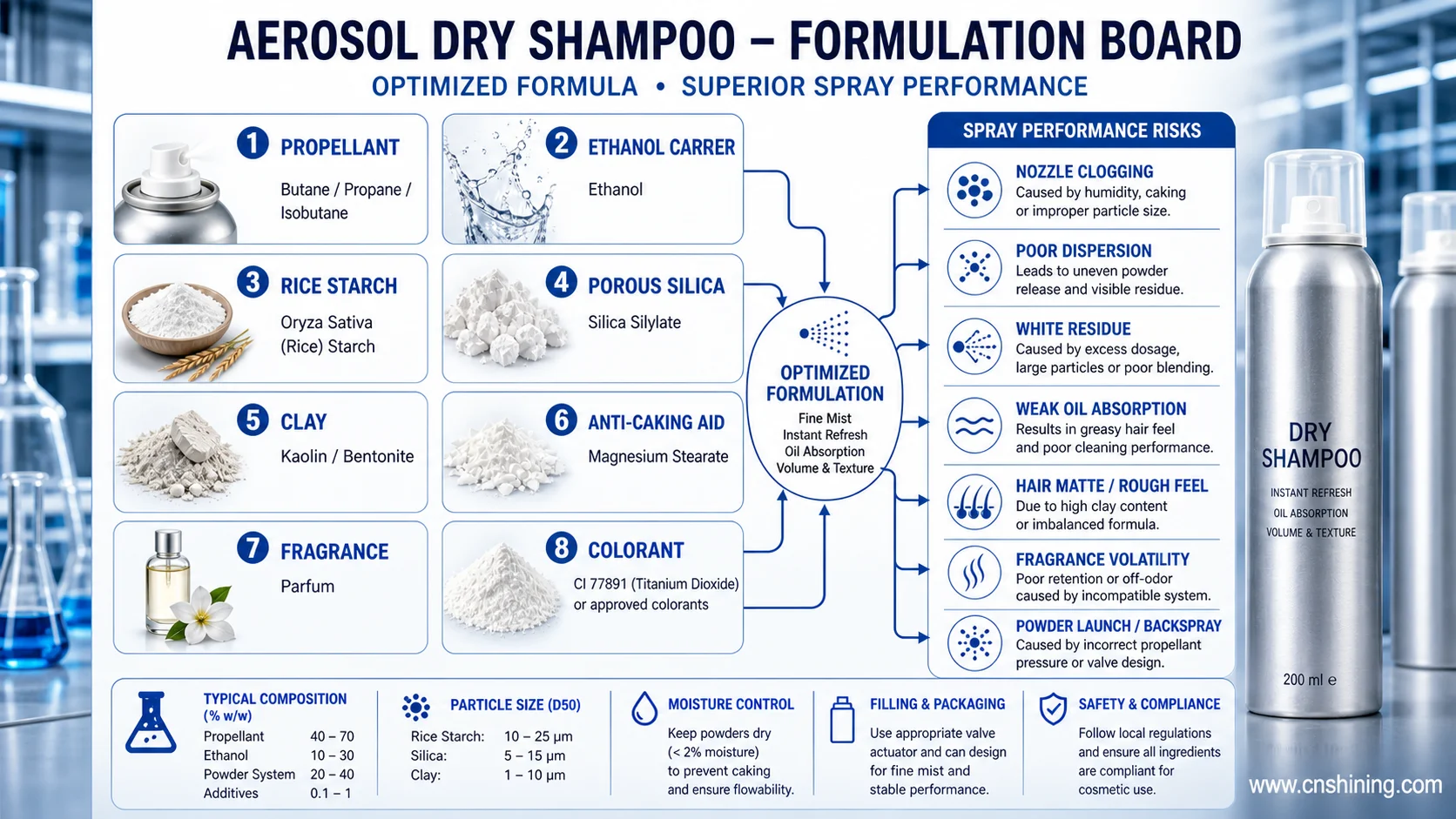
A typical aerosol dry shampoo formula can be divided into five modules: propellant system, volatile carrier, oil-absorbing powder, rheology / anti-caking system, and odor / feel system. Commercial products are usually not minimal formulas. They are compromises around these modules.
| Dimension | Common Route | Typical Range or Public Example | Development Meaning |
|---|---|---|---|
| Propellant | LPG, propane, butane, isobutane, HFC-152a, DME, compressed gas / nitrogen | Commercial benchmark often uses 70%-90% propellant; low-VOC routes may use HFC-152a or nitrogen. | Controls pressure, plume dryness, VOC/GWP path and regulatory burden. |
| Oil absorber | Rice, tapioca or corn starch; ASO; porous silica; clay | Starch often appears around 3%-8% in public references; non-traditional routes can go higher. | Controls oil absorption, white cast, feel and brushability. |
| Talc vs starch | Current market narrative favors starch and talc-free systems. | Commercial examples emphasize rice starch, plant-based powders and talc-free claims. | Talc-free is easier to communicate, but it does not automatically mean residue-free. |
| Alcohol level | Low to medium-high ethanol routes | Commercial benchmark around 4%-8%; some patent examples use 18%; CARB example uses ethanol 30. | Affects drying speed, cooling, flammability, VOC and can lining compatibility. |
| Fragrance | Instant masking, delayed fragrance, stronger base note | Commercial benchmark often 0.1%-1.0%; patents allow wider variation. | A repeat-purchase factor, but also a common complaint trigger. |
| Colorant | Light-tone / dark-tone tint; iron oxides or other pigments | Colorant ranges in public patent material can be 0.01%-5%. | Critical for dark hair white-cast control, but transfer to hands, hats or pillows must be managed. |
Ingredient Roles and Compatibility Risks
| Ingredient Group | Main Role | Public Typical Range | Common Issue |
|---|---|---|---|
| Propane / butane / isobutane | Pressure, spray force, fast dry feel | 70%-90% in benchmark references; some patent examples around 75%-80% | High flammability, VOC pressure, valve and actuator must tolerate powder loading. |
| HFC-152a | Representative low-VOC propellant route | 29%-33% in CARB representative formula | Can help VOC logic, but greenhouse gas and GWP discussions become more visible. |
| Nitrogen / compressed gas | Inert, lower flammability, lower VOC / lower GWP direction | Appears in patent and actuator development routes | Needs specialized valve and actuator design to create an acceptable dry spray feel. |
| Ethanol | Dispersion, fast drying, cooling, reduced wet clumping | 4%-8%, 18%, 30% depending on route | Higher ethanol stresses can lining, flammability labeling and scalp tolerance. |
| Rice / tapioca / corn starch | Main oil absorption phase | 4%-8%, 0.1%-15%, higher in some non-standard routes | White cast, chalky feel, caking and stronger risk on dark hair. |
| Aluminum starch octenylsuccinate | Oil absorption, feel and suspension stability | 3%-5% in common routes; higher in some medicated concepts | Can increase powder feel if clay and silica are not balanced. |
| Porous silica | Oil absorption and transparency improvement | Used with starch; one example has total powder around 7% | Excess can make hair feel dry and increase airborne powder. |
| Clay / bentonite / hectorite | Structure, suspension and oil absorption | Clay often around 2%-4% | May thicken, clog valves and create stiff hair feel. |
| Quats / anti-caking aids | Reduce agglomeration and improve combing | Very low levels, often 0.001%-0.1% | Too little raises clogging risk; too much can reduce volume. |
| Pigments / iron oxides | Reduce white cast and support root color matching | 0.01%-5% | Transfer and shade stability need stronger plume control. |
The practical rule is blunt: white cast, clogging and “wet mud spray” are rarely caused by one ingredient. They usually come from mismatch between powder size, powder volume fraction, ethanol level, propellant evaporation speed, valve orifice and actuator insert.
5. Representative Formula Routes
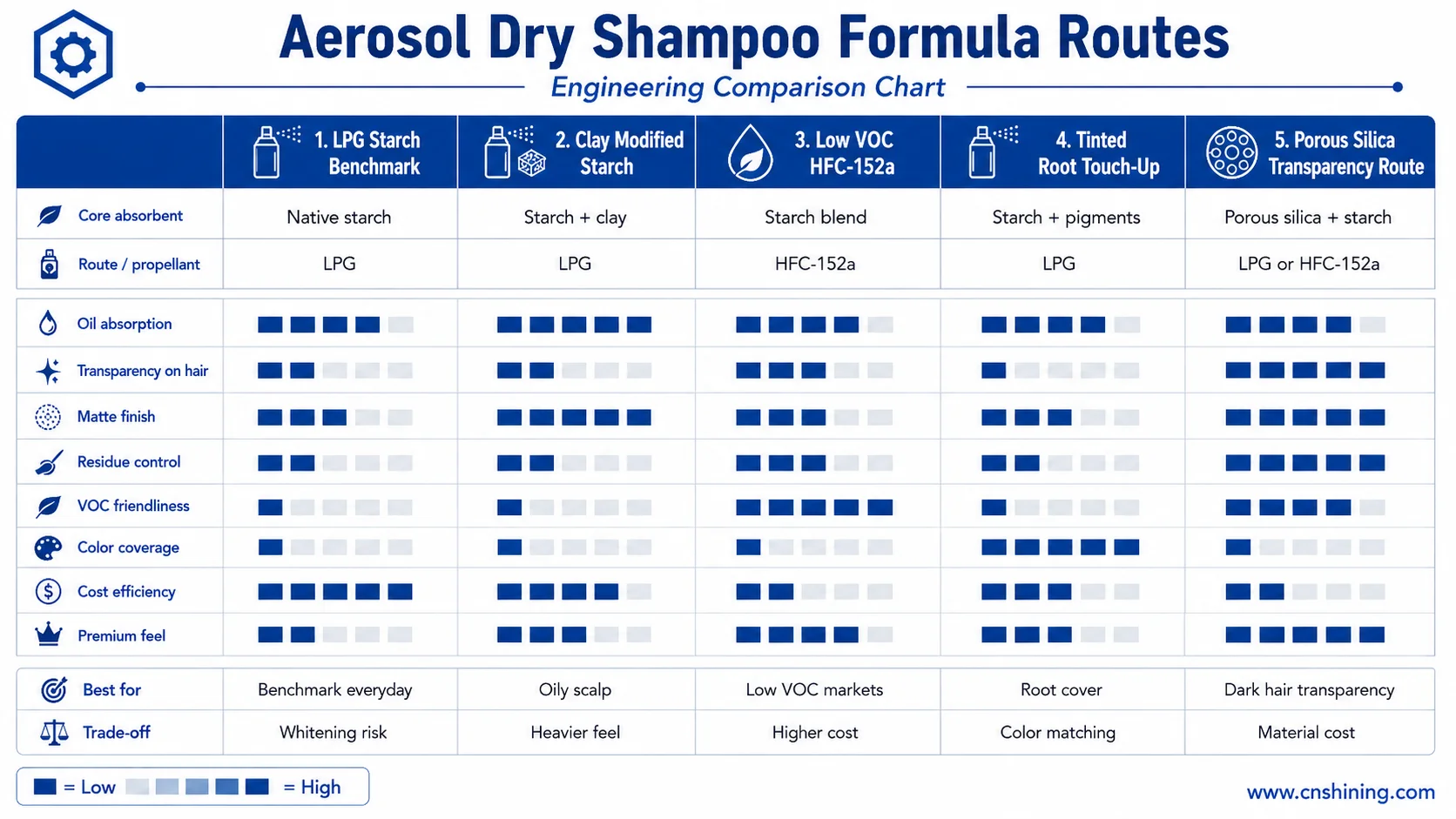
| Route | Representative Public Formula Logic | Observation |
|---|---|---|
| Mass-market benchmark | Butane / isobutane / propane 70%-90%; rice starch 4%-8%; alcohol denat. 4%-8%; fragrance 0.1%-1%; flow aid 0.001%-0.1%. | Closest to the mainstream shelf logic. |
| Clay + modified starch | Stearalkonium hectorite 2%-4%; ASO 3%-5%; ethanol 1%-20%; cyclomethicone 0.1%-15%; silica 0.1%-0.5%; isobutane 75%-80%. | Strong oil absorption and adjustable feel, but harder on actuator and valve design. |
| Low VOC | CARB representative formula: ethanol 30; HFC-152a 29-33; fragrance 0.2; other VOC / LVP-VOC 26.8-30.8; non-volatiles / exempt 10. | A compliance example, not automatically the best consumer feel. |
| Transparency improvement | Starch + porous silica 7%; ethanol 18%; LPG 75%. | Targets better transparency after sebum uptake. |
| Tinted / root touch-up | Starch 0.1%-15%; colorant 0.01%-5%; fragrance 0.01%-3%; propellant often 76%-90%, with a wider 20%-98% patent range. | Useful for dark hair residue control and root blending. |
| Term | Plain Meaning | Business / Engineering Meaning |
|---|---|---|
| Propellant | Gas or liquefied gas that pushes product out under pressure. | Controls spray feel, cost, flammability and regulatory route. |
| Type A propellant | CARB wording for CO2, N2, N2O or compressed air. | Often discussed as low-VOC or lower-flammability innovation direction. |
| VOC | Volatile organic compound. | Directly affects formula freedom and U.S. state-market access. |
| LVP-VOC | Low vapor pressure VOC. | A practical tool for managing VOC budget. |
| White cast | Visible white powder mark, especially on dark hair. | A repeat-purchase killer and a reason for shade-specific development. |
| Oil absorption | Powder capacity to absorb sebum or oil. | Controls whether the first spray gives visible effect. |
| Spray plume | Shape and distribution of sprayed material. | Controls evenness, waste and pigment transfer risk. |
| MBU / non-MBU insert | Internal actuator insert / orifice design. | A small part that determines whether the product sprays like mist or grit. |
| Compatibility testing | Testing formula, valve, actuator, can, coating and propellant as a system. | If skipped, complaints often become the real testing program. |
| CPNP | EU Cosmetic Product Notification Portal. | EU launch requires notification, not only label printing. |
6. Regulatory Requirements
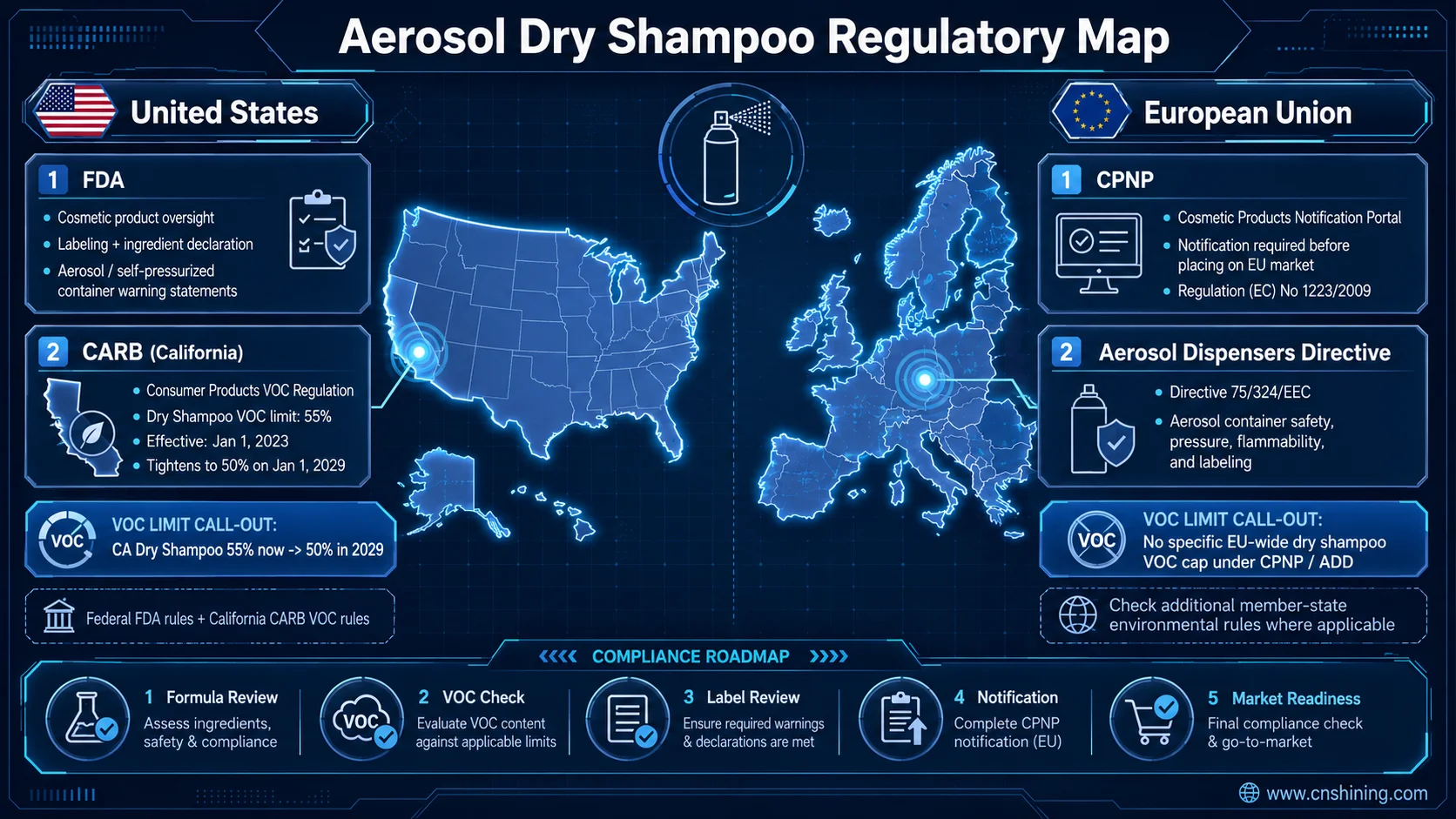
Aerosol dry shampoo is more complex than ordinary shampoo because it sits on four lines at once: cosmetic ingredient compliance, aerosol pressure safety, flammable warning requirements and VOC / environmental constraints.
| Region | Core Framework | Most Relevant Requirement | Commercial Meaning |
|---|---|---|---|
| United States | FDA cosmetic labeling; EPA / TSCA chemical framework; state VOC rules | Self-pressurized cosmetic products require proper warnings when necessary. Supply chains must manage chemical identity for U.S. manufacture, processing or import. | Federal focus is label and chemical identity. Formula space is often more restricted by state VOC rules. |
| California | CARB Consumer Products Regulation | Dry shampoo is separated as its own category. VOC limit is 55% from 2023-01-01 and 50% from 2029-01-01. | For many national brands, California becomes the practical baseline because a separate California SKU is inefficient. |
| European Union | Cosmetics Regulation (EC) No. 1223/2009; Aerosol Dispensers Directive; REACH / CLP | Cosmetic product notification is required through CPNP. Aerosol safety analysis must consider pressure, flammability and inhalation hazards. | The EU is a dual-compliance market: cosmetic documentation plus aerosol safety design. |
| European Union ingredients | REACH + cosmetics legislation | Cosmetic ingredients can still be affected by REACH restrictions, CMR status and candidate-list discussions. | Do not check only the cosmetics regulation. Raw-material identity and restriction status also matter. |
The most overlooked regulatory point is that aerosol dry shampoo is no longer treated by some regulators as just another hair styling spray. California has already separated it as a dry shampoo category. That changes the VOC budget, claim boundary and replacement route.
A practical international strategy is usually three-layered: global formula skeleton for ingredient safety, regional propellant system for VOC / GWP / flammability, and local label layer for language, warnings, electronic labels or filing numbers.
7. Patent Direction and Packaging Engineering
The patent direction moved in a predictable way. Around 2011, public documents focused on making aerosol dry shampoo work with clay, starch, carrier and high isobutane content. Around 2018, public benchmarks focused more on care feel, low residue and color matching. By 2024, the focus had shifted toward low VOC, pigment stability, fragrance release and low-GWP propellant routes.
| Direction | Representative Public Material | Technical Point | Commercial Meaning |
|---|---|---|---|
| Classic clay-starch aerosol | US20120282190A1 | Hectorite + ASO + ethanol + cyclomethicone + isobutane; high-propellant, low-powder classic structure. | Still close to many mass-market product logics. |
| Commercial benchmark disclosure | US20180153782A1 | Propellant 70%-90%, rice starch 4%-8%, alcohol 4%-8%. | Useful for cost modeling and competitor formula reverse thinking. |
| Tinted / root touch-up | AU2021226179A1 | Starch and colorant can be designed together; colorant ranges around 0.01%-5% in public material. | Supports dark-hair residue control and root-blending subsegments. |
| Low VOC | US20240058228A1 | Uses low-viscosity volatile silicone carrier and targets product VOC at or below 55%. | Direct response to California-style VOC pressure. |
| Transparency / low white cast | JP2018150271A | Starch + porous silica ratio is used to improve transparency after sebum uptake. | One of the most relevant directions for dark-hair complaints. |
| Fragrance release | US20240041750A1 | Pro-perfume / haloscent concept linked to dry shampoo actives. | Targets the “fresh at first, oily odor returns later” complaint. |
One warning is useful here: low VOC does not automatically mean low climate impact. HFC-152a may help one VOC calculation, while nitrogen or hybrid propulsion routes may help another sustainability narrative. Future aerosol dry shampoo development will need to manage VOC and GWP at the same time.
8. User Pain Points and Packaging Design
User complaints concentrate around four areas: white cast and chalky feel, clogged actuators, uncontrolled continuous spray or leakage, and fragrance that feels too strong or unnatural. These complaints match the technical directions seen in patents and packaging supplier materials.
| Pain Point | Packaging / Engineering Response | Reasoning |
|---|---|---|
| Actuator clogging or no spray | Use powder-oriented continuous-spray valves. Test one-inch male valve systems and actuator inserts designed for powder-based products. | Powder suspension and valve geometry are tightly linked. |
| Plume too wet, clumpy or locally white | Choose directional but well-atomized powder actuators. If using nitrogen or hybrid propulsion, use actuators designed for inert gas spray behavior. | Dry spray feel depends on particle break-up, vaporization and spray rate. |
| Corrosion or instability from ethanol, propellant or water | Run full formula-valve-actuator-can-lining compatibility testing. | Solvent level, fragrance load and powder chemistry can all affect internal coating and valve performance. |
| Dark-hair version still looks gray | Do not only add pigment. Adjust spray amount, nozzle direction, pigment distribution and front-label usage instructions. | Shade matching fails if pigment density or plume uniformity is poor. |
| Weak shelf recognition | Use slim aluminum cans, clear shade blocks and shoulder or cap-level secondary identification. | Light-tone and dark-tone SKUs are easy to confuse without strong packaging coding. |
| Sustainability story feels thin | Consider PCR aluminum, water-based external coatings and non-aerosol companion lines where appropriate. | Sustainability claims need packaging evidence, not only formula language. |
For a mainstream aerosol dry shampoo, a practical starting pack is a 150-200 ml slim aluminum can, powder-oriented valve, directional dry-spray actuator and large-area matte decoration. Travel size can sit around 50-65 ml, but the press feel should match the full-size pack. A travel pack that clogs more often damages the line more than its volume suggests.
Deep-tone SKUs need extra caution. White cast tolerance is low, and user comments show that even brunette versions can leave residue. A dark-hair version should tune pigment, spray rate, nozzle angle and instructions together. The front pack should make four steps easy to see: shake, distance, wait time and brush out.
For California and EU-oriented long-term programs, two technical pre-projects make sense: one for ≤55% VOC formulation and one for nitrogen or hybrid propellant with dedicated actuator design. Both require early valve and actuator supplier involvement.
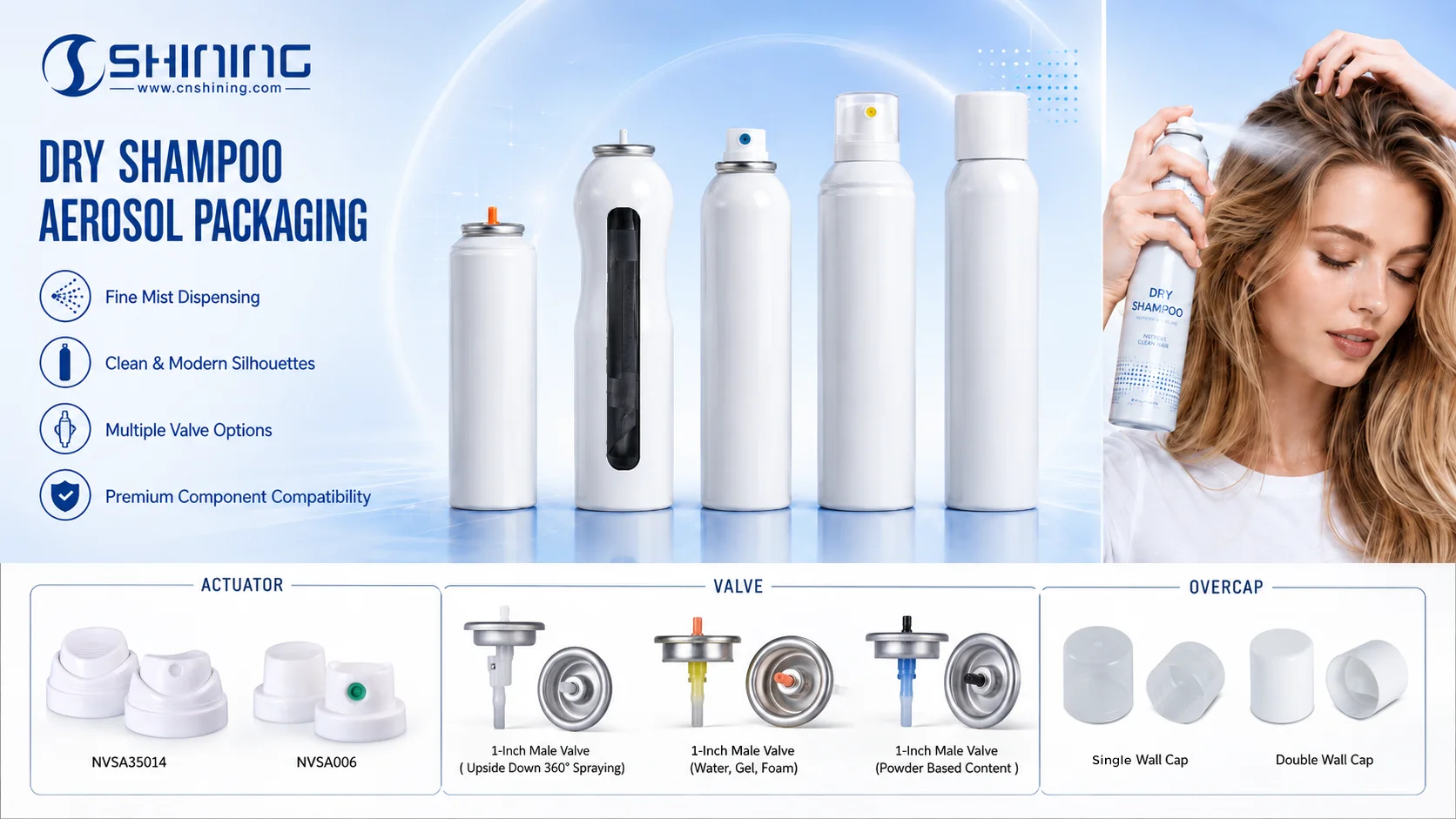
9. Product Fit: Shining Packaging Actuators, Cans and Valves
For aerosol dry shampoo, the package has to control powder delivery before it tries to look attractive. Shining Packaging can fit naturally into this work through three components: actuators, aerosol cans and valves.
The actuator should be selected around powder behavior, not only cap appearance. A dry shampoo actuator needs a stable finger force, controlled plume direction and an insert that does not turn starch into coarse particles. For tinted dry shampoo, spray uniformity matters even more because pigment transfer and gray cast are both visible defects.
The aerosol can needs enough internal compatibility margin for ethanol, LPG or alternative propellant systems, fragrance and powder. Aluminum aerosol cans are common for slim personal-care packs because they support light weight, good decoration and recycling logic. Internal coating choice should follow formula testing, especially for formulas with higher alcohol or pigment load.
The valve is where many dry shampoo complaints start. Powder loading, anti-caking aids and solvent balance all pass through the valve. A valve that works for a clear hair spray is not automatically suitable for starch-based dry shampoo. Shining Packaging should position the valve discussion around spray rate, clog resistance, stem fit, actuator pairing and aging stability.
This is not a “one component solves all” category. The better project path is simple: define formula type, powder load, propellant route and target plume first; then match actuator, valve and can as a tested set.
10. Conclusion
Aerosol dry shampoo remains the main engine of the dry shampoo category, but the engineering fight has moved from “can we spray powder?” to “can we hold low VOC, low complaint rate, high compatibility and strong shade fit in one stable pack?”
11. FAQ: Aerosol Dry Shampoo Technical Questions
Aerosol dry shampoo uses propellant pressure, a valve and an actuator to distribute oil-absorbing powder in a fine spray plume. Loose powder relies on manual dosing. The aerosol route gives faster and more even root coverage, but it also brings VOC, flammability, inhalation and clogging risks.
White residue comes from powder optics and distribution, not only from too much starch. Particle size, refractive index, porous structure, pigment balance and sebum mixing all matter. Dark hair makes the problem more visible. Better transparency usually needs powder and plume tuning together.
Clogging usually comes from powder agglomeration, poor suspension stability, wrong valve geometry, unsuitable actuator insert, or formula aging. Starch, clay, silica and pigments can all increase risk. A valve that works with clear hair spray may fail with powder-loaded dry shampoo.
Common propellants include LPG blends such as propane, butane and isobutane. Some low-VOC routes use HFC-152a, while nitrogen or compressed-gas systems are being explored for lower VOC and lower flammability positioning. Each route changes spray feel, regulation and actuator requirements.
No. Talc-free formulas often use rice, tapioca or corn starch, which supports current market claims. But starch can still leave visible residue if particle size, powder load, oil absorption, colorant and plume density are not controlled. Talc-free is a positioning route, not a performance guarantee.
California separates dry shampoo as its own consumer product category and sets VOC limits. This directly affects propellant and solvent choices. Many brands treat California as a practical U.S. baseline because creating separate state-specific SKUs is usually inefficient and operationally risky.
Porous silica can improve oil absorption and help reduce visible residue when balanced with starch. It can also make hair feel dry or increase airborne powder if overused. The useful range depends on starch type, solvent level, propellant, spray rate and intended hair color segment.
Dry shampoo formulas can contain ethanol, fragrance, pigments, modified starch, clay and propellant. These may interact with internal coatings, valves or gaskets during storage. Compatibility testing helps detect corrosion, pressure loss, clogging and spray change before launch rather than after complaints.
Tinted dry shampoo should not be treated as standard dry shampoo plus pigment. Pigment size, transfer risk, plume uniformity, spray amount and shade identification all need control. Dark-tone SKUs also need clear use instructions because over-application can create gray cast or staining.
Test spray rate, plume pattern, residue on light and dark hair, actuator clogging, hot and cold storage, valve leakage, can lining compatibility, fragrance stability, flammability labeling and VOC compliance. The formula, valve, actuator and can should be aged and tested as one pack system.