
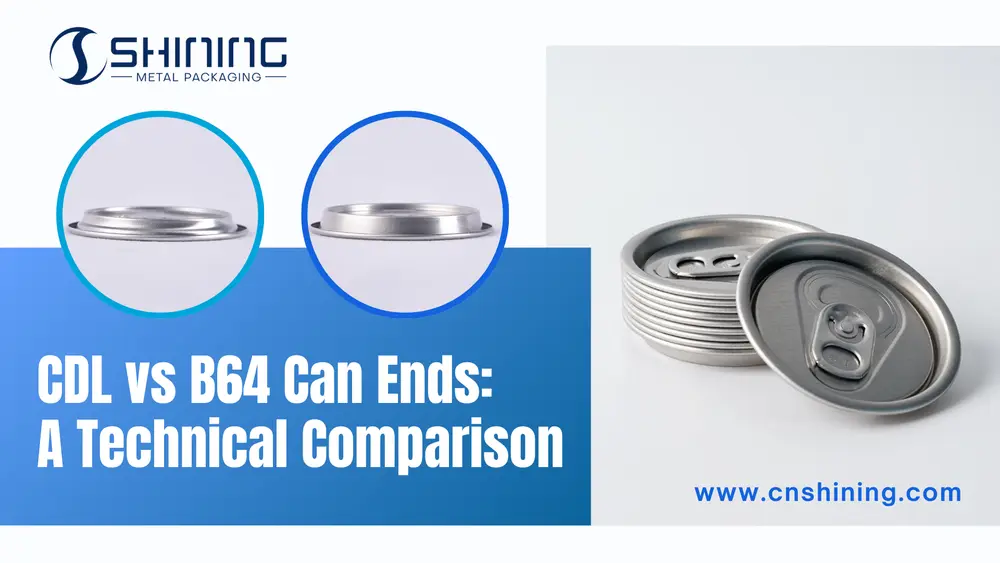
In beverage packaging, the can end (lid) is critical for sealing and preserving the drink. Two common end types are the traditional B64 end and the newer CDL end. Each has its own design and performance traits that affect sealing, strength, and production. Understanding the differences between CDL and B64 helps brewers and packagers choose the right lid for their product.
What Is a B64 Can End?
The B64 end is a classic, long-established beverage can lid. It is a traditional easy-open aluminum end designed for standard beer and soft drink cans. The B64 end features a pre-formed curl that interlocks with the can body flange through double seaming. This simple design provides excellent versatility and compatibility—it can be used on virtually any existing seaming equipment without modification.
Because B64 ends are made of thicker material, they offer high strength and durability. The aluminum alloy used for B64 is prized for its structural strength and excellent corrosion resistance. In practice, this means B64 lids easily withstand the rigors of filling, transportation, and stacking, and they reliably keep carbonated beverages pressurized. For many standard beer and soft drink cans, producers choose B64 ends for this proven reliability.
Applications
B64 ends are widespread in traditional beer, soda, energy drink, and juice cans. They’re the “go-to” standard for any beverage can that doesn’t require an ultra-tight seal or an especially lightweight design.
What Is a CDL Can End?
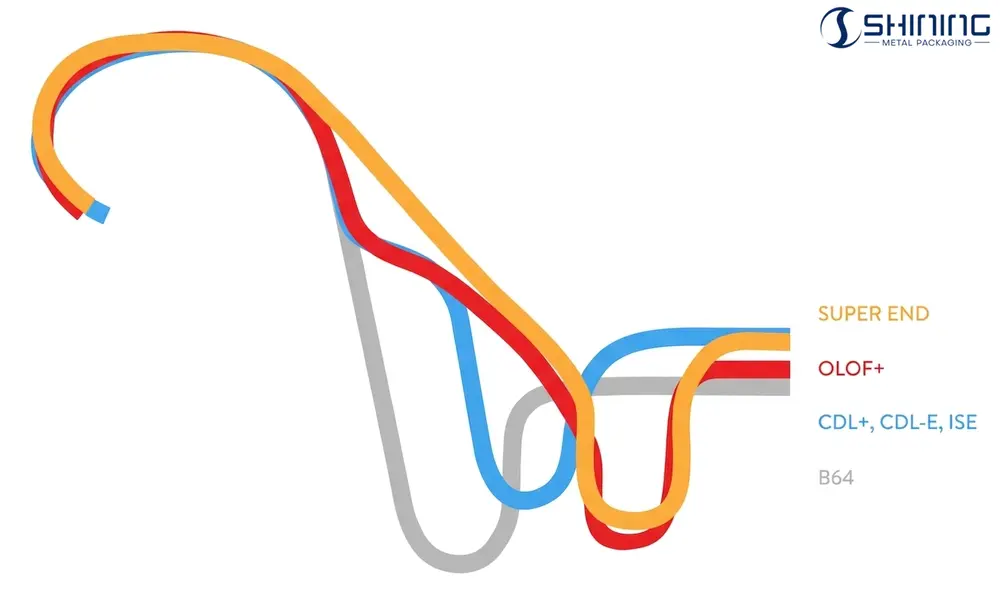
CDL can end (sometimes called “countersunk double-seam lid”) feature a specialized double-seam design that enhances sealing performance. Additionally, the CDL series includes multiple specific variants (e.g., CDL+, CDL-E, and CDL-W). In the CDL lid structure, the seam is curled inward and tightly bonds with the inner wall of the can opening, improving both seal integrity and leak resistance.
Because of the double seam, CDL ends can hold higher internal pressure and resist leaks better than a standard B64 seam. This is especially valuable for beverages that must stay fresh over a longer shelf life (for example, juices or oxygen-sensitive drinks) or for high-carbonation products. Moreover, CDL ends are manufactured from a lighter gauge aluminum. They typically use about 10–15% less metal than B64 ends. This makes them lighter and more eco-friendly, reducing material and shipping costs while still maintaining sufficient strength.
CDL ends also allow for thinner walls and premium surface quality. The alloy and process used for CDL can lids excel at forming complex shapes and yielding a smooth finish. That makes them ideal for specialty or high-end cans where print quality and reduced weight are priorities. In short, CDL lids are the modern, lightweight alternative geared toward efficiency and high seal performance.
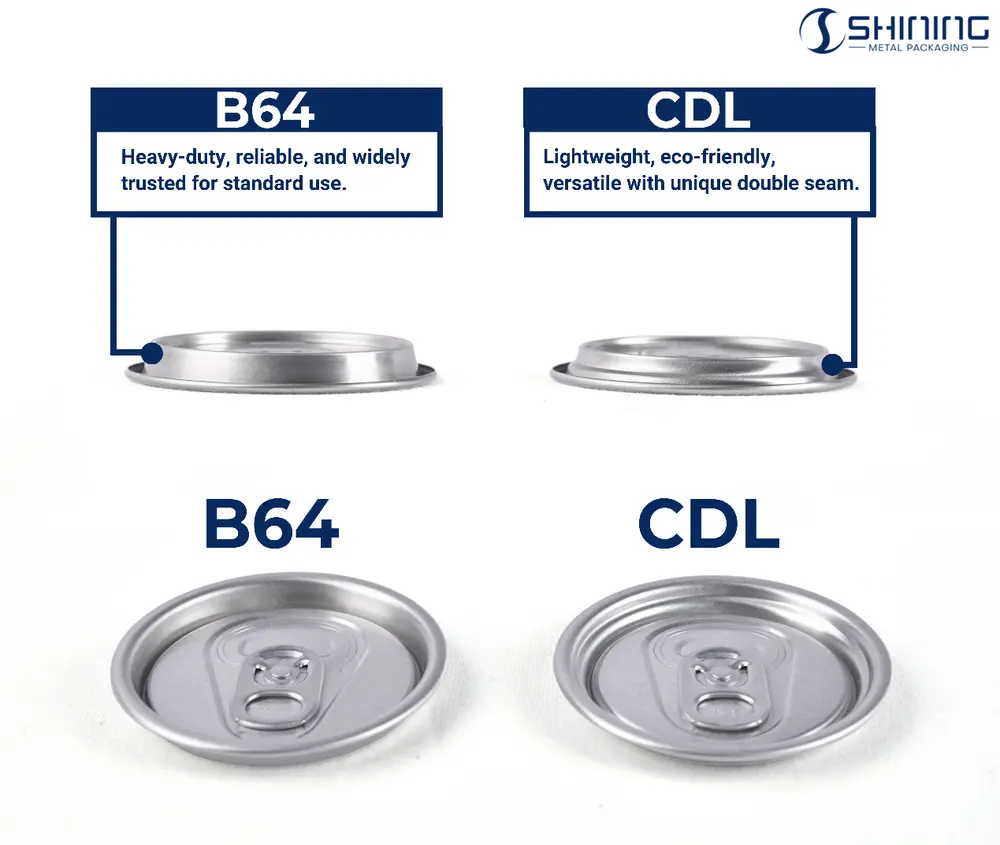
Core Differences Between CDL and B64
| Comparison Factor | B64 Can End | CDL Can End |
|---|---|---|
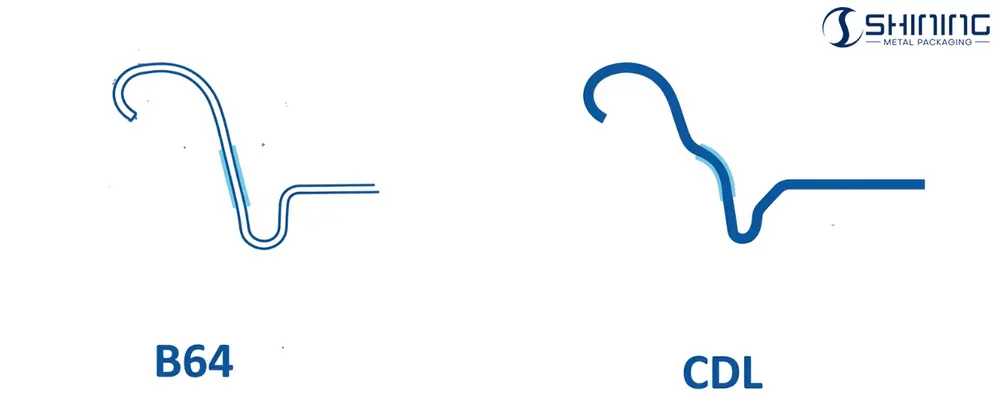
| Structural Design | Traditional standard double seam structure | Special reverse countersunk double curl structure |
| Material Usage | Uses more aluminum | Uses approximately 10–15% less aluminum |
| Typical Lid Weight | ~2.74 g per lid | ~2.49 g per lid |
| Strength Performance | High structural strength due to thicker gauge | Slightly lighter but optimized for pressure resistance |
| Sealing Performance | Reliable standard seal | Enhanced hermetic sealing due to countersink geometry |
| Internal Pressure Tolerance | Suitable for most carbonated beverages | Can support higher internal PSI with improved stability |
| Formability | Good for standard shapes | Superior formability for thinner profiles and refined geometry |
| Surface Quality | Meets standard printing requirements | Smoother surface, suitable for premium finishing |
| Environmental Impact | Higher material consumption | Lower material use, improved sustainability profile |
| Industry Adoption | Long-standing industry standard | Growing adoption, especially among high-volume producers |
| Equipment Compatibility | Widely compatible with existing seamers | Use the correct chuck and roll profile; setup adjustments may be required. For different types (e.g., CDL+, CDL-E, CDL-W), switching suppliers may require different setups and additional testing. |
Production and Seaming Compatibility
Switching between B64 and CDL involves careful machine setup. Because the CDL lid’s countersink changes the seam geometry, your can seamer must be adjusted:
- Chuck & Roller Profile: Use the exact chuck and roller set designed for the chosen lid type. Mismatching these parts to the lid can cause wrinkles, bulges, or leaks.
- Seamer Settings: Calibrate seaming pressure, height, and motion for the new end profile. CDL lids may require slightly different seaming force due to their thinner walls.
- Quality Checks: After adjustment, perform test runs and inspect each can’s double seam for integrity. Check for any leaks or weak seals and refine settings as needed.
- Operator Training: Ensure line operators understand the changes. Even small differences in timing or pressure can affect the seam quality, so training is key.
By following these steps (calibrating, testing, and inspecting), a transition from B64 to CDL – or vice versa – can be made smoothly. In practice, producers celebrate a safe switch by tasting a few test batches before full production.
How to Choose Between B64 and CDL
The decision usually hinges on existing equipment and product goals. If your filling line is already set up for B64 and you don’t need to cut weight, staying with B64 avoids any retooling hassles. B64 offers proven reliability and fits current machinery “as is”.
If your priority is reducing aluminum use, shipping costs, or achieving a sleeker, high-end image, then CDL may be worth the change. CDL lids can save material costs and support sustainability goals, as long as your production can adapt. Also consider the beverage itself: for drinks where an extra-tight seal boosts shelf life (e.g. juices, teas), the CDL’s improved hermetic performance can be an advantage.
Ultimately, weigh factors like canning volume, equipment rework costs, and brand positioning. In practice, B64 excels in durability and equipment compatibility, while CDL stands out for its weight savings and premium sealing performance. Align your choice with what matters most—whether that’s line efficiency or product freshness.
Summary
Both B64 and CDL can ends serve the same basic role but do so in different ways. B64 ends are the traditional standard – heavy-duty lids that fit nearly any standard can and sealing line. CDL ends are a modern innovation – using a unique reverse countersunk double curl structure to create a lighter lid with extra-strong sealing.
Producers typically choose B64 for broad compatibility and proven performance, and choose CDL when they need to save material or maximize seal integrity for sensitive beverages. By understanding these technical differences and testing compatibility, brewers and packagers can select the can end that best balances strength, sustainability, and seal quality for their product.
Frequently Asked Questions
A: No. The CDL countersink changes seam geometry, requiring exact chuck and roller profile matching. Using mismatched tooling risks wrinkles, bulges, or micro-leaks that fail pressure decay tests.
A: CDL lids weigh approximately 2.49 g versus 2.74 g for B64, delivering a 0.25 g per-lid reduction (10–15% less aluminum). Confirm exact values with your supplier’s gauge certificate for volume-based cost calculations.
A: CDL ends provide superior pressure tolerance thanks to the spring-like countersink double seam. B64 is adequate for standard carbonation levels but may require thicker gauge or reduced fill volume for extreme PSI applications.
A: Calibrate seamer pressure, height, and motion, then run 50–100 test cans. Perform full seam teardown inspection checking for countersink depth, hook overlap, and absence of leaks before full production acceptance.
A: Replace or re-profile the seamer chuck and first/second operation rollers to match CDL geometry. Minor adjustments to seaming force and timing are also required; full changeover usually takes 4–8 hours plus validation runs.
A: CDL’s enhanced hermetic seal reduces oxygen ingress and extends shelf life compared to B64. However, improper seamer setup can negate this benefit; always validate headspace oxygen levels and leak rates during qualification.
A: CDL’s 10–15% lower aluminum usage directly cuts per-unit material cost and reduces pallet weight/shipping fees. At scale, these savings often offset one-time seamer retooling within 3–6 months of production.
A: CDL’s superior formability and thinner-gauge process yield a smoother finish ideal for high-resolution printing and premium branding. B64 meets standard requirements but may show minor grain in high-gloss applications.