
Overview of Packaging Types
Beverage manufacturers primarily utilize aluminum cans, plastic (PET) bottles, or glass bottles as packaging containers. According to market research reports, the beverage packaging market—when segmented by material—can be categorized into plastic, glass, metal, and other materials; among these, plastic holds the largest market share, projected to reach 38.42% by 2026. Furthermore, when segmented by product type, the market can be subdivided into canned, bottled/jarred, pouched, carton-packaged, and other packaging formats; within this classification, bottled/jarred products dominate the market, expected to capture a 44.82% share by 2026. (source)
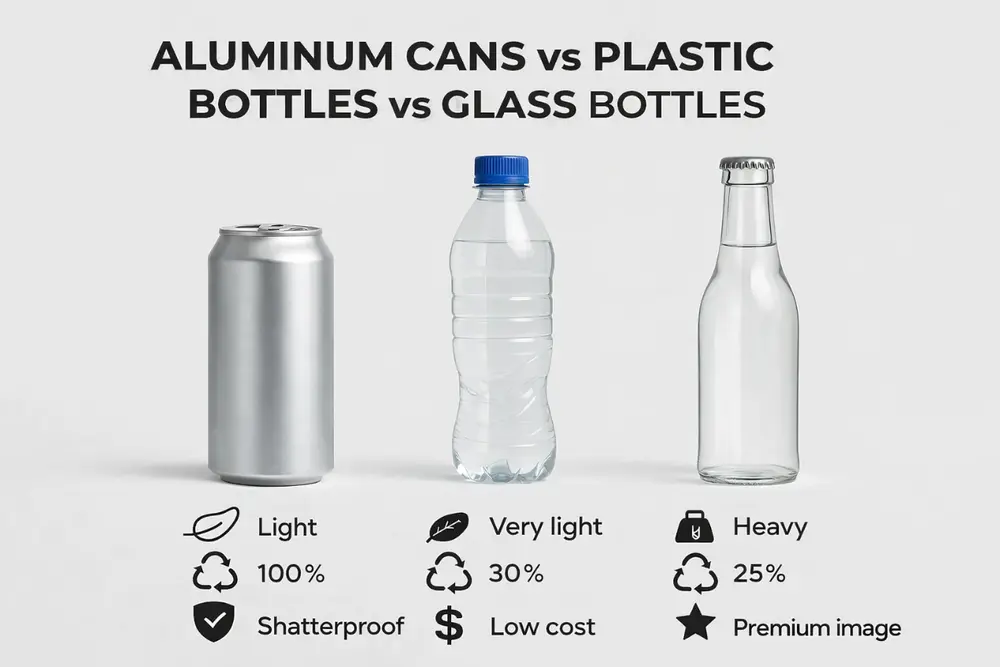
Each material possesses its own unique set of advantages and disadvantages. Glass, being relatively heavy yet chemically inert, imparts a premium, “high-end” aesthetic to products (a quality commonly associated with wines, spirits, or craft sodas). Plastic bottles, conversely, have found extremely widespread application in the water, sports drink, and fruit juice sectors due to their lightweight nature, shatter resistance, and resealable properties. Aluminum cans, meanwhile, are renowned for their ultra-light weight, robust structure, and exceptional recyclability. In practical application, the selection of packaging material is typically determined by factors such as the type of beverage, shelf-life requirements, consumer convenience, and the brand’s positioning and image.
Aluminum Cans vs Plastic Bottles
Durability and Convenience
Plastic bottles are more flexible and resistant to deformation during transport. They also offer resealability, making them ideal for multi-serving beverages and on-the-go consumption. In contrast, aluminum cans are typically single-use, though resealable can innovations are emerging.
Shelf Life and Product Protection
Aluminum cans provide a near-airtight barrier, effectively blocking oxygen and light. This helps preserve carbonation, flavor, and aroma over time. Plastic bottles, while practical, are slightly permeable, which can lead to gradual quality loss—especially for carbonated or sensitive drinks.
Cost and Production
Plastic bottles are generally cheaper and faster to produce. They also come in a wider range of sizes, from small servings to large family formats. Aluminum cans, while more expensive, offer stronger branding potential with 360-degree printing and a more premium look.
Consumer Preference and Use Cases
Plastic bottles are often preferred for convenience and versatility, while aluminum cans are associated with modern, premium beverages such as energy drinks, beer, and sparkling water.
Aluminum Cans vs Glass Bottles
Durability and Portability
Aluminum cans are lightweight, durable, and resistant to breakage, making them ideal for transport and outdoor use. Glass bottles, on the other hand, are fragile and heavier, which increases shipping costs and limits where they can be used.
Product Protection and Shelf Life
Cans offer a complete seal and block all light, helping preserve freshness—especially for beer and other light-sensitive beverages. Glass is chemically inert and does not affect taste, making it a preferred option for premium products like wine and spirits.
Brand Image and Consumer Perception
Glass bottles convey a premium, traditional feel and are often used for high-end beverages. Aluminum cans provide a sleek, modern appearance and are popular for convenience-driven products.
Recyclability and Reuse
Both materials are infinitely recyclable. Glass can also be reused in refill systems, while aluminum is often favored for its higher recycling efficiency and lower transportation impact.
Sustainability Comparison: Aluminum, Plastic, and Glass
The table below summarizes key environmental factors for single-use beverage containers.
| Factor | Aluminum Cans | Plastic Bottles (PET) | Glass Bottles |
|---|---|---|---|
| Recyclability | Infinitely recyclable; high recycling efficiency | Recyclable but degrades over time | Infinitely recyclable |
| Recycled Efficiency | Saves up to 95% energy vs new aluminum | Lower energy recycling but limited cycles | Energy-intensive due to high melting temperatures |
| Weight & Transport | Lightweight; low transport emissions | Very lightweight; lowest transport cost | Heavy; high transport emissions |
| Carbon Footprint | Generally lower than glass and plastic (when recycled) | Moderate; depends on lifecycle | Highest due to weight and production energy |
| Environmental Impact | Mining impact (bauxite extraction) | Plastic waste and microplastics risk | High energy use, but no microplastic pollution |
As shown in the chart above, according to data from the International Aluminium Institute, aluminum has the highest global recycling rate at 75%, surpassing PET (47%) and glass (42%). Data from the Aluminium Institute in the United States shows that aluminum cans have a recyclable content of 71%, also significantly exceeding glass (23%) and PET (3-10%).
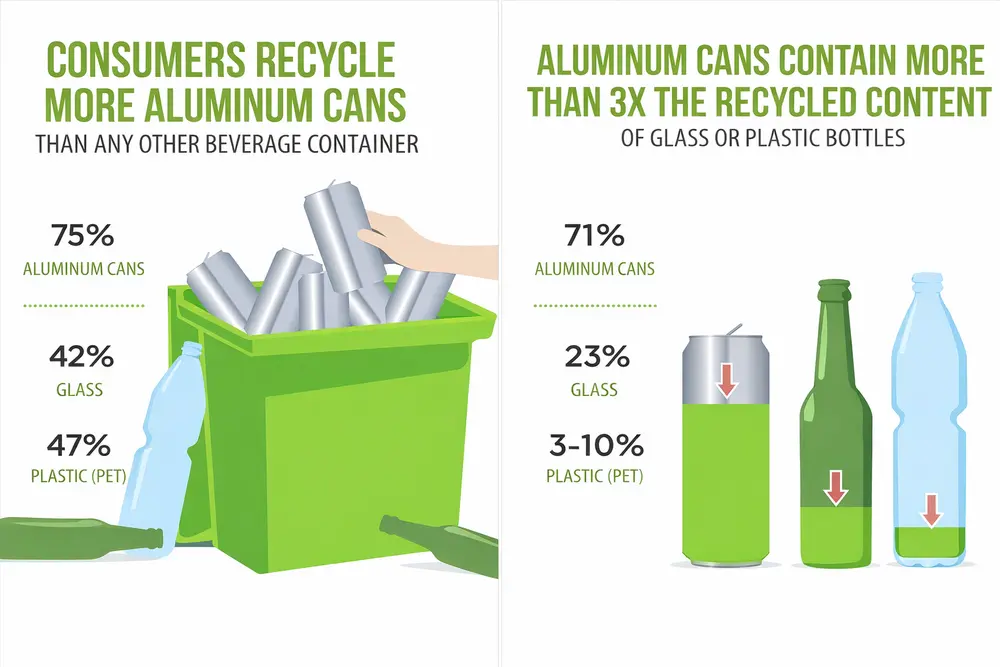
In summary, aluminum (especially recycled) generally has the lowest environmental impact among single-use beverage containers. Glass is heavy, so its transportation emissions are high. Plastic’s impact is moderate on climate but problematic as pollution. Of course, all materials are sustainable if reused many times; the best environmental choice is always reuse (e.g., refilling bottles) when possible. But given current waste systems, aluminum cans tend to be the “greenest” pick, followed by PET bottles, with glass bottles (in single-use scenarios) often having the highest footprint.
Cost and Transportation
The table below compares key cost and logistics factors for procurement and supply-chain decisions.
| Factor | Aluminum Cans | Plastic Bottles (PET) | Glass Bottles |
|---|---|---|---|
| Material Cost | Higher than plastic | Lowest cost option | Similar to aluminum (per unit) |
| Weight | Lightweight | Lightest | Heaviest (up to 40× heavier than alternatives) |
| Transport Efficiency | High (compact, stackable) | Very high (flexible, tightly packed) | Low (fragile, requires spacing) |
| Shipping Cost | Low | Lowest | Highest |
| Breakage Risk | Very low | Very low | High |
| Packaging Needs | Minimal protective packaging | Minimal | Requires extra protection (cardboard, padding) |
| Pallet Capacity | High (more units per pallet) | Very high | Low (fewer units due to weight/space) |
| Overall Cost Efficiency | Balanced | Most cost-efficient | Least cost-efficient |
When to Choose Aluminum Cans
Given all the above, when should a brand opt for aluminum cans? Generally:
- Active and On-the-Go Use: If your customers drink on the move (sports, outdoor events, travel), cans are ideal. You can take cans almost anywhere; glass is often forbidden in public venues. The lightness and durability of cans make them perfect for hiking, concerts, or picnics.
- Single-Serve Refreshments: Cans are great for single-serving beverages that don’t need resealing: beer, seltzers, craft sodas, energy drinks. These products also often benefit from cans’ superior freshness and light-proofing.
- High Recyclability Demands: If your brand emphasizes sustainability, cans carry weight with eco-conscious consumers. They boast high recycling rates and recycled content. Marketing a 100% recycled aluminum can is a strong green message.
- Logistic and Cost Efficiency: When shipping efficiency is a priority (long distances, tight fuel budgets), cans usually cut costs and emissions thanks to their low weight.
- Modern Brand Image: Cans offer vibrant 360° graphics and a trendy feel. Many craft and new-age brands prefer aluminum for its modern aesthetic and convenience factor.
Conversely – When Not to: If you need multiple-serve flexibility or consumers expect to drink part of it and save the rest, plastic bottles win. If your product is a luxury wine or spirit, the glass bottle’s elegance and perceived value may be worth its extra weight. Also, some niche beverages (for example, certain vinegars or juices) may interact with aluminum unless specially lined.
In practice, many beverage companies use a mix: aluminum for drinks targeting on-the-go or younger demographics, and bottles for products where “premium” or reuse is important. The key is matching material to use-case.
Conclusion
There’s no universal “best” packaging. Each has its place. Plastic bottles excel for lightweight, resealable convenience, especially in larger sizes. Aluminum cans excel for durability, freshness, and recyclability. Glass bottles excel for purity of taste and premium image.
A native English idiom sums it up: choose the right tool for the job. Evaluate your beverage type, target audience, and sustainability goals. If reducing weight and maximizing recyclability are top priorities, aluminum cans often edge out the competition. If resealing and clarity are key, plastic may win. If inertness and elegance matter most, glass is the choice. By understanding the trade-offs – and considering real-world factors like local recycling systems – brands can pick the packaging that aligns with their performance needs and values.
Frequently Asked Questions
A: Glass pallets hold far fewer units (often 30–50% less) due to weight and spacing requirements, directly increasing per-unit freight costs. Procurement must factor in higher fuel surcharges and reduced truckload efficiency when comparing total landed cost versus aluminum cans.
A: Require 100% visual inspection plus random sample testing for pinholes and coating thickness per ASTM standards. Acidic beverages demand special epoxy or polymer linings; failure here can cause corrosion and product recalls.
A: PET permeability allows gradual CO₂ loss (typically 10–20% over 6 months), shortening shelf life. Aluminum cans provide near-zero permeation. Engineers should reference accelerated aging data and specify barrier-enhanced PET only when resealability is mandatory.
A: For aluminum, demand minimum 70% post-consumer recycled content and verify 95% energy savings via third-party reports. Glass and PET have lower effective cycles; track closed-loop recovery rates specific to your regional waste infrastructure.
A: Glass has high shatter risk (up to 0.5–2% in handling), creating sharp hazards and venue restrictions. Aluminum cans maintain structural integrity under impact; procurement should prioritize cans for any venue with liability or glass-ban policies.
A: Conduct full migration and flavor-impact testing per FDA/EU guidelines, plus light-exposure and oxygen-barrier validation. Glass’s inertness means new lining validation is essential to prevent metallic taste or corrosion in sensitive products.