
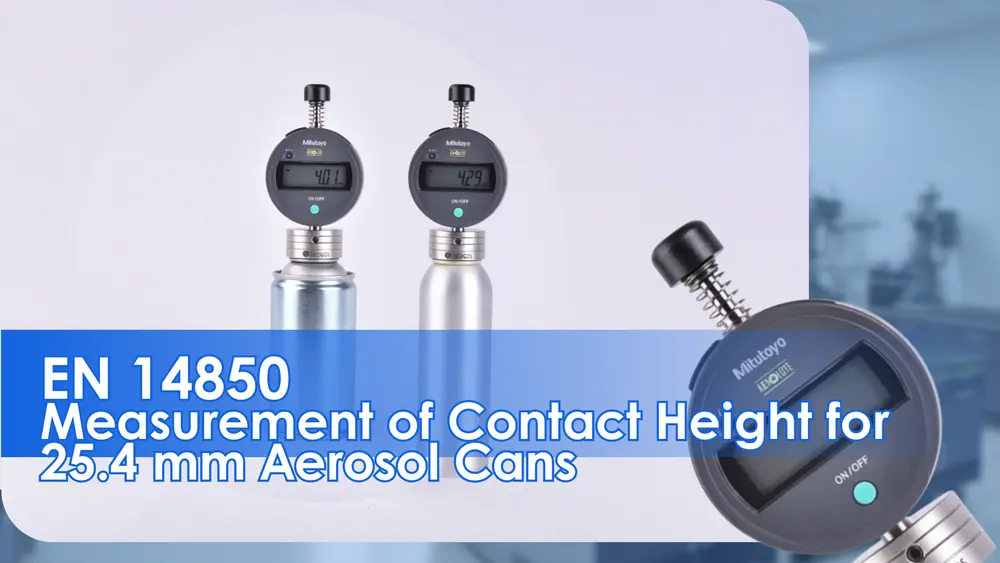
Standard Overview
EN 14850 defines the standardized measurement method for contact height on metal aerosol containers with a 25.4 mm aperture.
It does not define container geometry, but specifies how clinch-relevant geometry must be measured to ensure repeatability across filling lines and suppliers.
Scope and Applicability
- Tinplate containers according to EN 14847
- Aluminium containers according to EN 15006
- Valve cups according to EN 14848
The method applies exclusively to 25.4 mm aerosol systems.
Definition of Contact Height
Contact height (h) is defined as the distance between:
- The horizontal tangential plane of the aperture lip
- The centre of curvature of the clinching jaw extremity
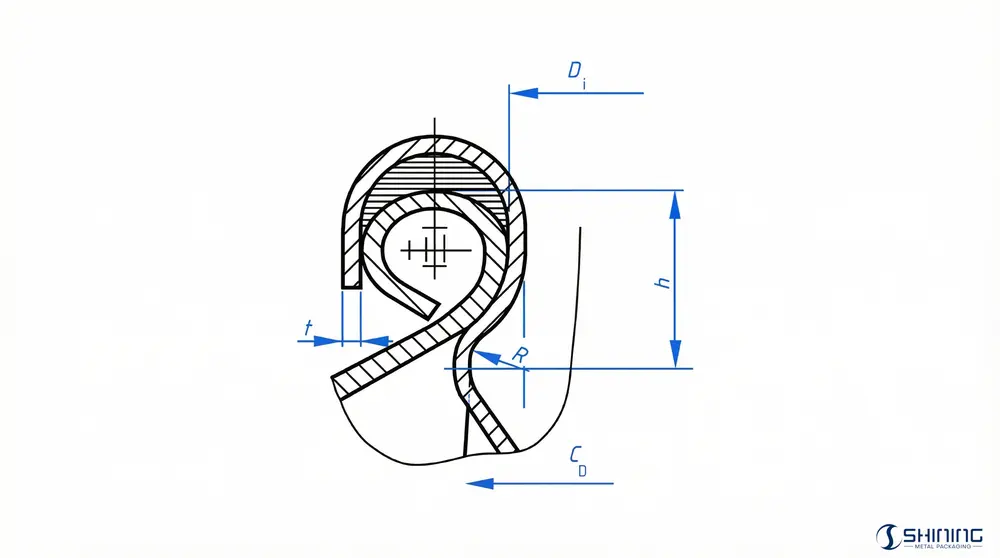
- Di – Internal diameter of aperture = 25.4 mm
- t – Wall thickness of valve cup = 0.3 mm
- R – Radius of clinching jaws = 1.2 mm
- CD – Clinch diameter of jaws = 27.1 mm
- h – Contact height
Measurement Principle
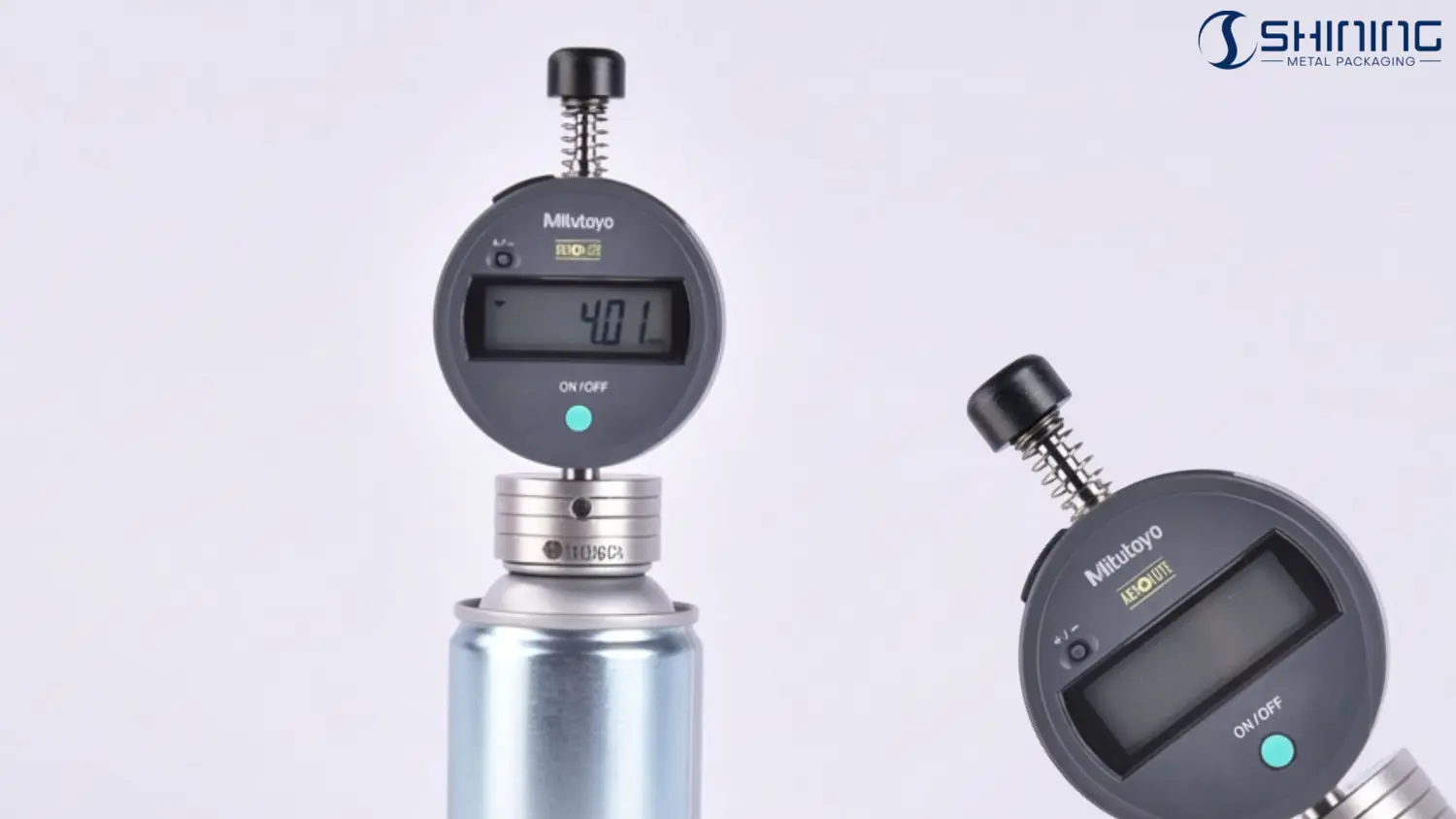
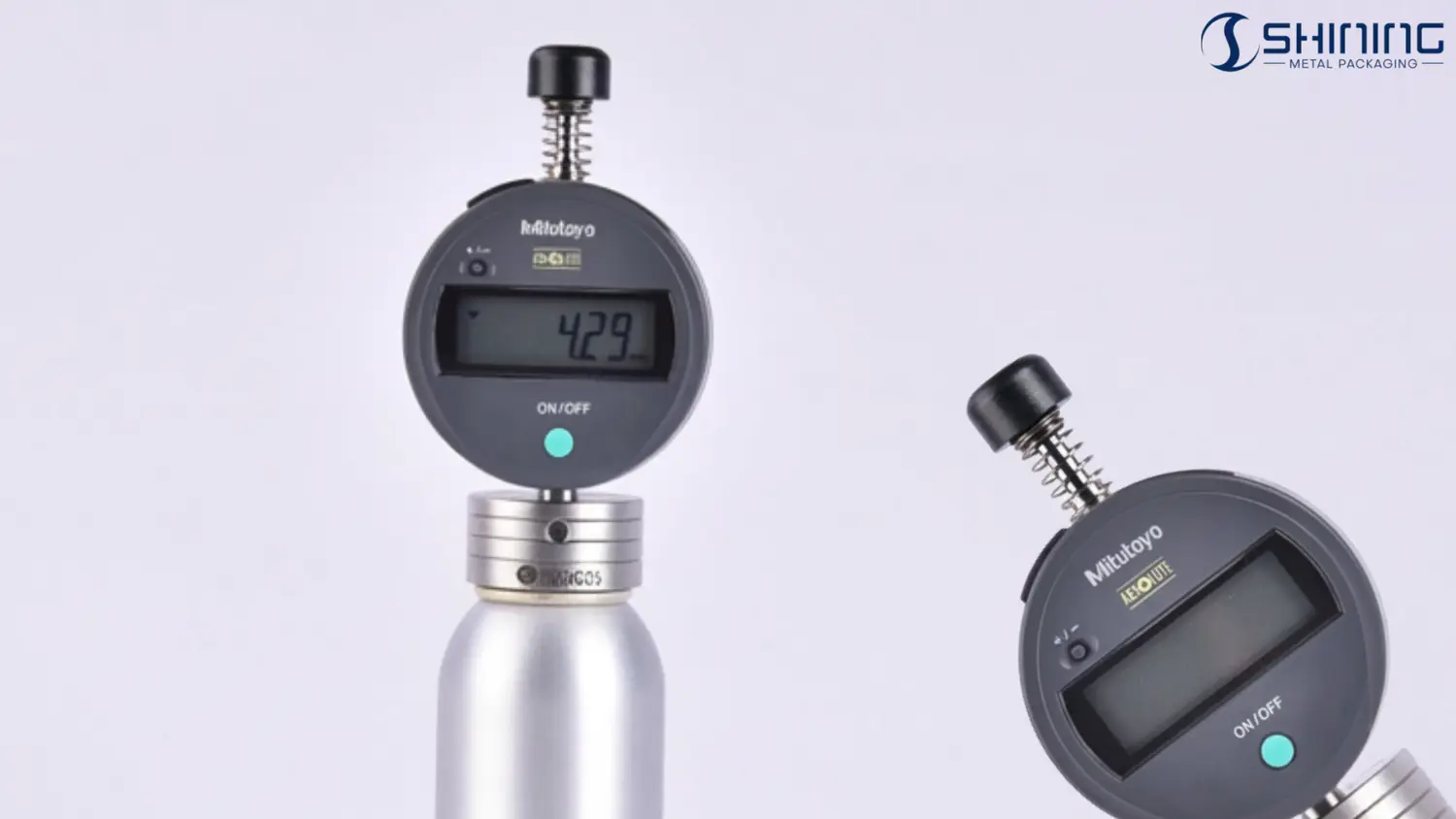
The measurement reproduces the real clinching condition by simulating the geometry of the clinching jaws acting through the valve cup wall.
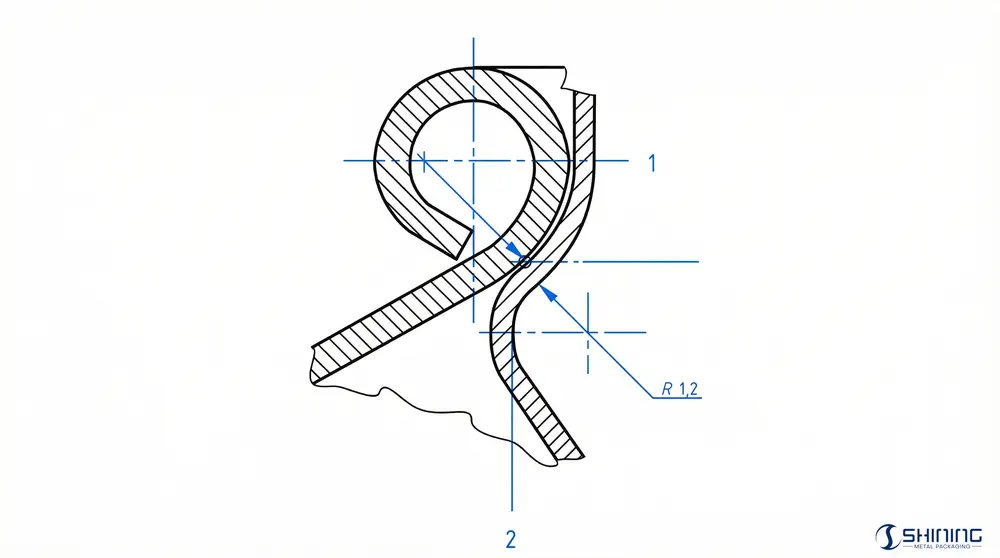
Key – Figure 2
- 1 – Point of hard contact between measuring radius and internal aperture profile
- 2 – Diameter of the clinching jaws (CD)
Instrument Geometry
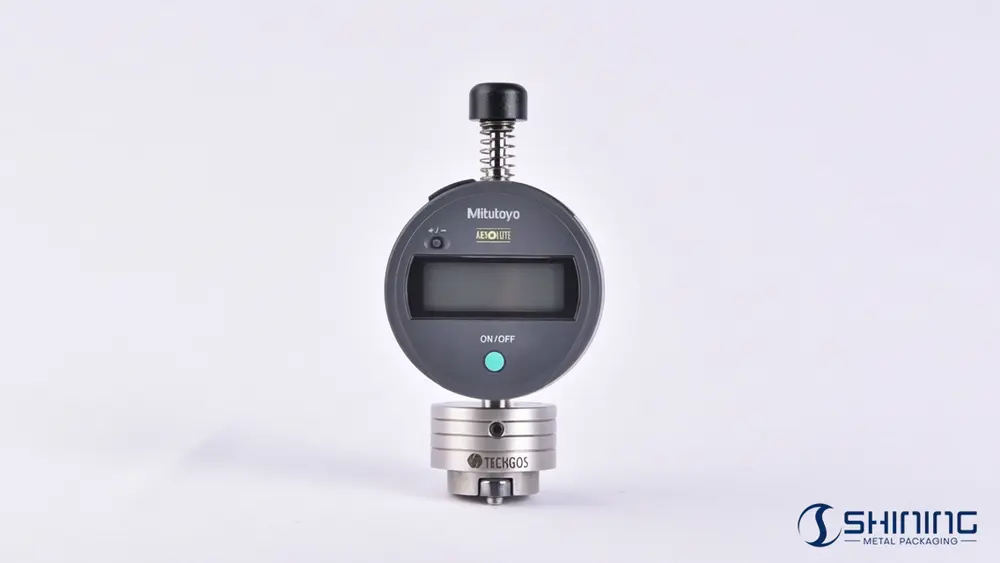
To achieve equivalence with real clinching, the clinching jaws are replaced by a dedicated measuring instrument.
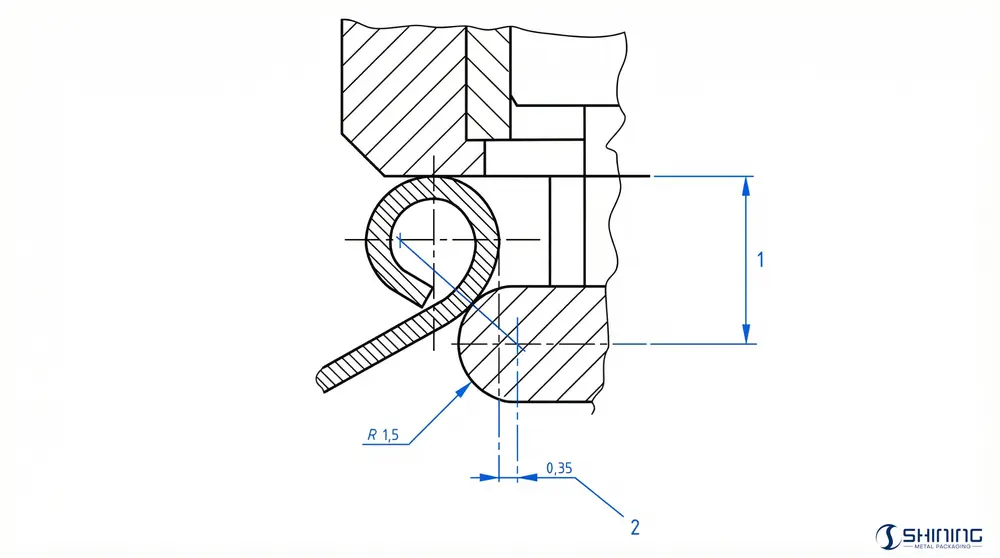
Key – Figure 3
- 1 – Contact height (h)
- 2 – Constant of the measuring instrument
Measurement Procedure
Equivalent Measuring Radius
The measuring radius r is defined as:
r = Rc + t
- Rc – Radius of curvature of clinching jaws = 1.2 mm
- t – Valve cup wall thickness = 0.3 mm
Resulting in:
r = 1.5 mm
Instrument Constant (0.35 mm)
The centre of the measuring radius is positioned at a fixed horizontal offset from the internal tangent of the aperture.
This constant is derived from:
R + t − (CD + 2t − Di) / 2 = 0.35 mm
Measurement Steps
- Zero the instrument using the reference setting piece
- Position the instrument to achieve hard contact
- Measure contact height at three equidistant positions
- Record mean, maximum, and minimum values
Why Contact Height Matters
Correct contact height supports:
- Consistent clinch geometry
- Uniform gasket compression
- Stable sealing performance
However, EN 14850 clearly states that contact height alone does not guarantee leak-tightness.
Relationship with Other Standards
- EN 14847 – Tinplate aperture dimensions
- EN 15006 – Aluminium aperture dimensions
- EN 14848 – Valve cups
- EN 15010 – Clinch-related tolerances
- FEA 216 – Clinching jaw bearing surfaces
Download the Standard PDF
This document provides EN 14850, describing the method for measuring contact height in metal aerosol containers with a 25.4 mm aperture. It defines test procedures and instrumentation requirements to support correct clinch adjustment and consistent sealing performance.
FAQ – Engineering & QA
No. It is a standardized measurement method, widely used for tooling setup and audits.
No. It is a necessary reference value but not a standalone sealing criterion.
They reveal ovality and local forming deviations that single-point checks may miss.
No. Only the EN 14850-type instrument reproduces real clinching geometry.
During setup, after tooling changes, and whenever sealing performance shifts.